




- Non-food Packaging
- Plant-Based Packaging Market
Plant-Based Packaging Market Size, Share, and Growth Forecast 2026–2033
Plant-Based Packaging Market by Material (Bioplastics, Bagasse, Paper & Paperboard), Packaging Type (Rigid, Flexible Packaging), End-use Industry (Food & Beverages, Personal Care & Cosmetics, Healthcare), and Regional Analysis, 2026–2033

Plant-Based Packaging Market Size and Trend Analysis
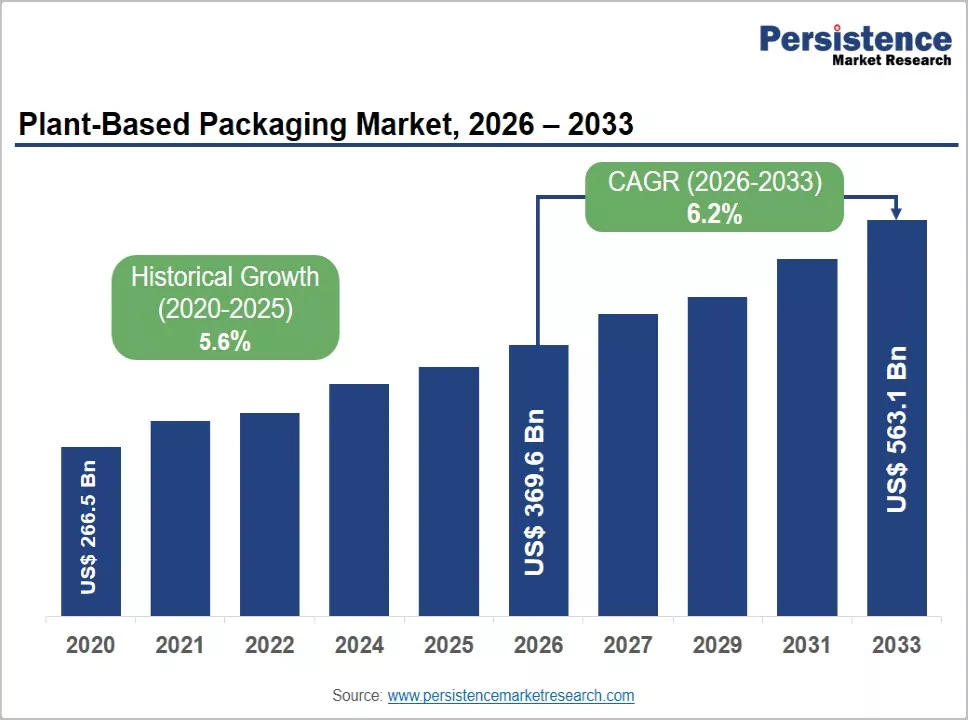
The global plant-based packaging market size is likely to be valued at US$ 369.60 billion in 2026 and is projected to reach US$ 563.10 billion by 2033, growing at a CAGR of 6.2% during the forecast period between 2026 and 2033.
Extended producer responsibility schemes, single-use plastics restrictions, and corporate commitments to reduce virgin fossil-based plastic are reshaping material choices across the packaging value chain, compelling converters and brand owners to accelerate the shift toward fiber-based, starch-based, and bio-derived alternatives.
This trajectory reflects sustained demand from food service, e-commerce, and personal care brands, alongside a regulatory tightening on per- and polyfluoroalkyl substances (PFAS) in food-contact packaging. The EU Packaging and Packaging Waste Regulation (PPWR), Regulation (EU) 2025/40, is creating a structural demand shift that favors compostable and recyclable plant-based formats, a dynamic that rewards materials suppliers with proven compliance credentials.
Key Industry Highlights
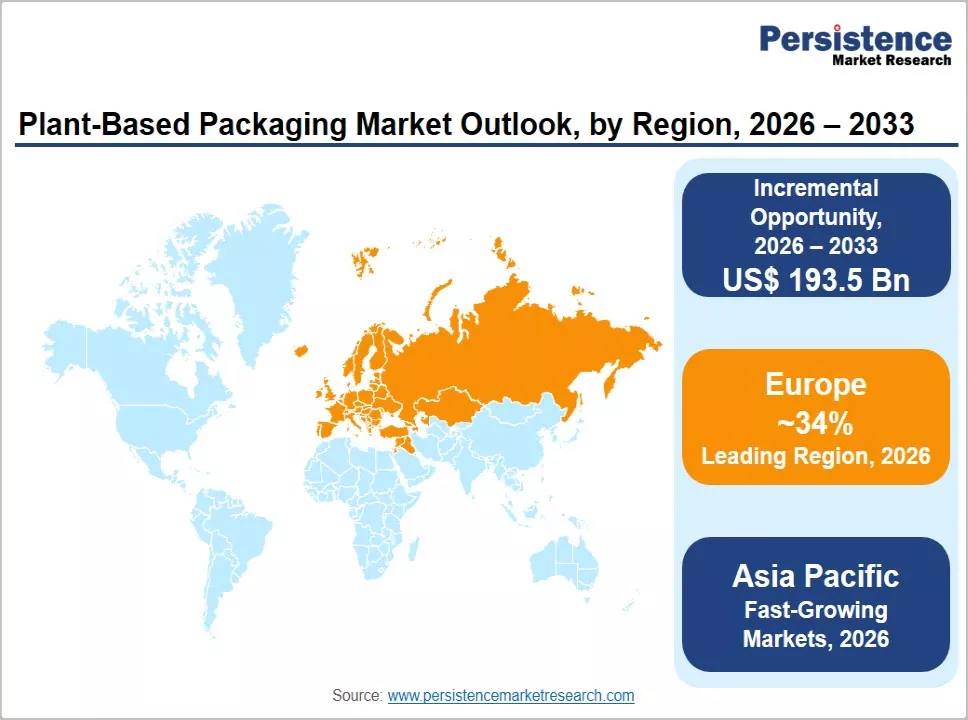
- Dominant Region: Europe is forecast to dominate the regional market, holding about 34% market share in 2026. The PPWR, the Single-Use Plastics Directive, and mature extended producer responsibility schemes are driving premium adoption of compliant fiber-based and compostable formats, a dynamic that will keep Europe’s per-unit packaging value above the global average through 2033.
- Fastest-growing Region: Growing at a CAGR of 7.5%, Asia Pacific is outpacing every other region in the plant-based packaging industry. China’s plastic restriction policies, India’s single-use plastic ban, and the rapid expansion of food delivery and e-commerce are jointly accelerating the substitution of conventional plastics by bagasse, paperboard, and starch-based alternatives.
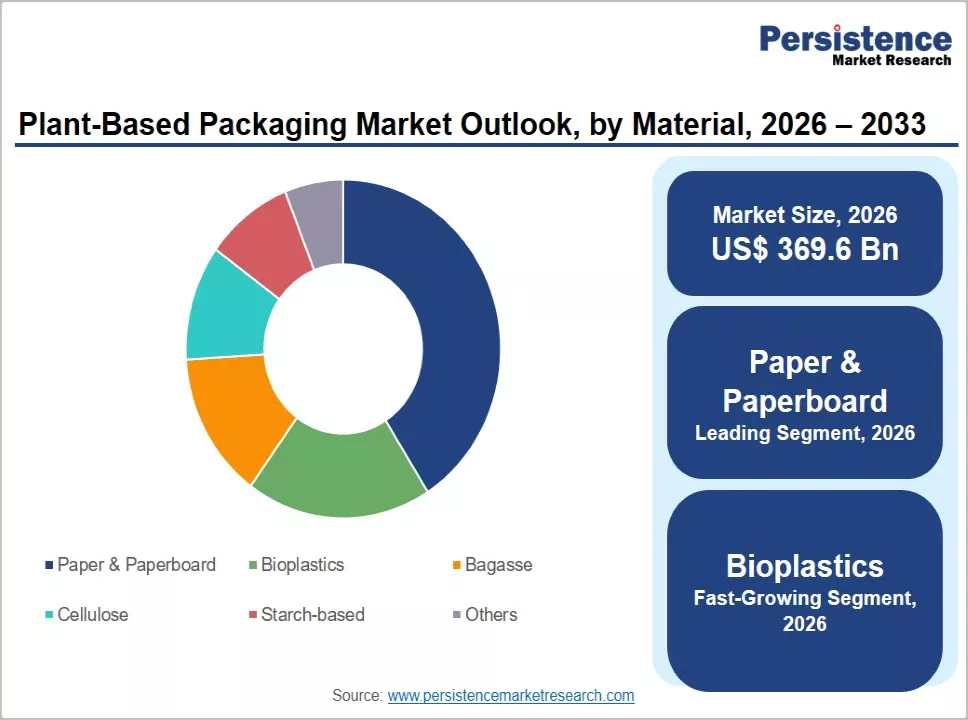
- Dominant Material: Paper & paperboard holds 41% of market share in 2026, fueled by its established recycling infrastructure, printability, and broad consumer acceptance across cartons, cups, and trays. Its leadership is structurally stable, as no alternative material yet matches its combination of cost, scale, and end-of-life infrastructure.
- Fastest-growing Material: Bioplastics are gaining share rapidly as brand owners and converters seek compostable and bio-based films that can replicate the barrier performance of conventional polymers. Product launches at Interpack 2026 from TotalEnergies Corbion and Taghleef Industries signal that industrial and home-compostable grades will capture a meaningfully larger share by 2033.
- Leading Packaging Type: Rigid packaging accounts for around 55% of market share in 2026, while flexible packaging is expected to expand fastest as compostable pouches and films move into mainstream food and personal care applications.
DRO Analysis
Driver- Tightening Plastic Regulation and Brand Owner Sustainability Commitments
Regulation is the most powerful catalyst for plant-based substitution. The EU PPWR, adopted as Regulation (EU) 2025/40, introduces recyclability requirements, recycled-content targets, and restrictions on PFAS in food-contact packaging, with its main provisions applying from 12 August 2026. Sabert Corporation Europe responded in April 2026 by launching a home-compostable, PFAS-free pulp foodservice range, illustrating how compliance deadlines are converting into product launches. Consumer goods companies are reinforcing this pull through public commitments to cut virgin plastic use, and large retailers are issuing specifications that favor renewable, certified fiber and compostable content, which together are securing multi-year volume visibility for plant-based suppliers.
Restraint- Cost Premium, Performance Gaps, and Fragmented End-of-Life Infrastructure
Plant-based materials generally carry a price premium over incumbent polyolefins and PET, and several formats still lag in moisture and oxygen barrier performance, which limits their use in shelf-stable and high-barrier applications. Compostable packaging also depends on collection and industrial composting capacity that remains uneven across geographies, and contamination of conventional recycling streams by bio-based polymers such as PLA is a recurring concern among recyclers. Feedstock competition with food crops and exposure to agricultural price swings add further uncertainty for smaller producers who lack the scale to hedge input costs.
Opportunity- Molded Fiber and Compostable Flexible Films in Foodservice and Fresh Produce
Molded fiber and compostable flexible films represent one of the most compelling growth theses in plant-based packaging. Eco-Products, a certified B Corp, launched its portfolio of reusable, recyclable, and compostable foodservice packaging in the U.K. through its sister company Vegware in February 2026, while PaperFoam secured €2 million (approx. US$2.2 million) in October 2026 to expand its starch-based, compostable packaging capacity in the Czech Republic, Malaysia, and the U.S. As retailers and grocers pursue plastic-free fresh produce programs, suppliers able to certify home compostability and PFAS-free performance are positioned to capture premium pricing.
Category-wise Analysis
Material Insights
Why Does Paper & Paperboard Dominate the Plant-Based Packaging Market?
Paper & paperboard is projected to account for nearly 41% of market share in 2026, driven by its versatility across folding cartons, corrugated shippers, cups, and food trays, and by the existence of mature collection and recycling systems that other plant-based materials cannot yet match. Mondi, Stora Enso, and Huhtamaki have expanded fiber-based barrier solutions that replace plastic liners and coatings, enabling brand owners to meet recyclability criteria without changing line speeds. Tetra Pak’s plant-based cartons, which combine paperboard with renewable polymers, reinforce the material’s visibility in beverage packaging.
Bioplastics are likely to be the fastest-growing material segment, supported by advances in polylactic acid (PLA), polyhydroxyalkanoates (PHA), and cellulose-based films. At Interpack 2026, TotalEnergies Corbion presented expandable Luminy PLA developed with Chinese machinery manufacturer Useon, while Taghleef Industries introduced home compostable grades within its Nativia range, positioning compostability and recyclability as parallel rather than competing end-of-life pathways.
Packaging Type Insights
What Keeps Rigid Packaging Ahead of Flexible Formats?
Rigid packaging is expected to lead the packaging type segment, holding around 55% of market share in 2026, as plant-based cups, clamshells, trays, bowls, and cartons are comparatively easy to produce from bagasse, molded fiber, and paperboard at industrial scale. Foodservice operators and quick-service restaurants have standardized on fiber-based rigid formats to comply with single-use plastic bans in the EU, India, and several U.S. states, sustaining consistent volume demand.
Flexible packaging is likely to be the fastest-growing type, catalyzed by innovation in compostable films, pouches, and wraps for snacks, fresh produce, and personal care sachets. Converters are investing in barrier coatings and sealants derived from plant sources, narrowing the performance gap with conventional laminates and widening the range of products that can be shipped in compostable formats.
End-use Industry Insights
Why Is Food & Beverages the Anchor End-use Industry?
Food & beverages is estimated to lead the end-use industry segment, capturing nearly 62% of market share in 2026, driven by the scale of food service, grocery, and beverage packaging and by the direct regulatory scrutiny that single-use food-contact plastics now face. Quick-service restaurants, meal-kit providers, and online grocers are among the largest buyers of fiber-based and compostable formats.
Personal care & cosmetics is likely to be the fastest-growing end-use industry, as beauty brands replace plastic tubes, jars, and secondary cartons with paper-based and bio-derived alternatives to support sustainability claims and premium positioning. Healthcare is a smaller but strategically significant segment, where sterile paper and cellulose-based barrier materials are replacing conventional plastics in non-implantable disposables.
Regional Insights
Europe Plant-Based Packaging Market Trends and Insights
Europe is forecast to dominate the regional market, capturing nearly 34% of market share in 2026, propelled by the most stringent packaging regulation globally, high consumer willingness to pay for sustainable formats, and a dense fiber-based packaging industry. The PPWR’s recyclability and reuse requirements, combined with national extended producer responsibility fees modulated by recyclability, are making plant-based and fiber-based solutions financially advantageous for brand owners. Through 2033, the region’s growth will be driven by PFAS-free food packaging and compostable formats for fresh produce and foodservice.
Germany Plant-Based Packaging Market Size
Germany is projected to account for nearly 23% of the Europe regional market in 2026. The country’s mandatory deposit and dual-system recycling infrastructure, along with strong retail pressure toward plastic-free packaging, sustains demand for paper-based and molded fiber solutions. German converters continue to invest in barrier-coated paper to replace plastic films in dry food applications through 2033.
U.K. Plant-Based Packaging Market Size
The U.K. is expected to command nearly 17% of the Europe regional market in 2026. The U.K. plastic packaging tax and the rollout of extended producer responsibility for packaging are raising the cost of virgin plastic and supporting substitution. Vegware, a Novolex brand, and a growing set of compostable foodservice suppliers are expanding retail and catering reach across the country.
North America Plant-Based Packaging Market Trends and Insights
North America is estimated to account for around 19% of market share in 2026, with state-level extended producer responsibility laws in California, Oregon, Colorado, Maine, and Minnesota and PFAS restrictions in food packaging driving the transition from plastic and fluorinated coatings. Brand owners are responding with fiber-based and compostable alternatives, creating opportunities for suppliers such as Pactiv Evergreen, Sealed Air, and Eco-Products that combine national distribution with certified compostable ranges.
U.S. Plant-Based Packaging Market Size
The U.S. is projected to hold about 88% of the North America regional market in 2026. Fresh produce programs, such as compostable organic onion and tree-free board launches announced in 2026, illustrate how growers and brand owners are adopting plant-based formats. State-level EPR mandates will continue to raise the cost of conventional plastic packaging through 2033.
Canada Plant-Based Packaging Market Size
Canada is likely to command about 12% of the North America regional market in 2026. Federal and provincial restrictions on single-use plastics, covering items such as checkout bags, cutlery, and food service ware, are encouraging foodservice operators to switch to fiber and compostable alternatives, while provincial producer responsibility programs widen the incentive.
Which Region Will Drive the Fastest Plant-Based Packaging Growth Through 2033?
Asia Pacific is likely to be the fastest-growing region during the forecast period between 2026 and 2033, expanding at a CAGR of 7.5% and accounting for the equivalent of US$ 94.25 Billion in 2026. Rising middle-class consumption, expanding food delivery platforms, and government restrictions on conventional plastics are jointly lifting demand for bagasse, paperboard, and starch-based formats. Abundant agricultural residues such as sugarcane bagasse and rice husk give regional producers a cost and supply advantage.
China Plant-Based Packaging Market Size
China is anticipated to hold around 40% of the Asia Pacific regional market in 2026. National restrictions on non-degradable plastic bags and single-use foodservice items, together with the world’s largest food delivery and e-commerce volumes, are sustaining demand for paper-based and bagasse packaging. Domestic converters are investing in molded fiber and PLA capacity to serve both local and export customers.
India Plant-Based Packaging Market Size
India is forecast to account for nearly 18% of the Asia Pacific regional market in 2026. The nationwide ban on identified single-use plastic items, in force since July 2022, and the Plastic Waste Management Rules’ extended producer responsibility framework are accelerating the shift toward paper cups, bagasse tableware, and compostable films across food service and retail.
Competitive Landscape
The global plant-based packaging market is moderately fragmented, with a tier of multinational packaging groups including Amcor, Mondi, Huhtamaki, Stora Enso, Tetra Pak International SA, Sealed Air, and Pactiv Evergreen Inc. competing on material science breadth, global converting footprints, and regulatory compliance capability.
Below this tier, specialist and regional players such as Tipa Ltd., Vegware, Ficus Pax, Pappco Greenware, Eco Packer, Pactap, and The Meyers Printing Companies, Inc. compete on compostable film innovation, foodservice specialization, and proximity to agricultural feedstock. Competitive differentiation increasingly turns on the ability to deliver certified compostable or recyclable formats with PFAS-free barrier performance at a competitive cost per unit.
Key Industry Developments
- In November 2026, Life Water launched a new 500ml paper-based water bottle developed in partnership with packaging technology company Pulpex. The bottle used molded-fiber technology to convert sustainably sourced wood fiber into a functional packaging format designed for recycling through existing paper and cardboard recycling streams. The launch expanded Life Water’s sustainable packaging portfolio and provided an alternative to conventional single-use packaging.
- In February 2025, Tetra Pak introduced carton packaging materials containing 5% ISCC PLUS-certified recycled polymers in India, becoming the first company in the food and beverage packaging industry in the country to offer such packaging. The company sourced the recycled polymers from India and manufactured the packaging material at its ISCC PLUS-certified facility in Chakan, Pune. The initiative supported compliance with the Ministry of Environment, Forest and Climate Change requirements under the Plastic Waste Management (Amendment) Rules, 2022, which mandated 5% recycled plastic content from April 1, 2025.
Companies Covered in Plant-Based Packaging Market
- Huhtamaki
- Tetra Pak International SA
- Amcor
- Sealed Air
- Pactiv Evergreen Inc.
- Ficus Pax
- Tipa Ltd.
- Pappco Greenware
- Mondi
- Eco Packer
- The Meyers Printing Companies, Inc.
- Stora Enso
- Pactap
- Vegware
Frequently Asked Questions
The global plant-based packaging market is valued at US$ 369.60 billion in 2026.
Tightening plastic regulation, including the EU Packaging and Packaging Waste Regulation, extended producer responsibility schemes, and PFAS restrictions in food-contact packaging, together with brand owner commitments to cut virgin plastic use.
Paper & paperboard holds the largest share of the plant-based packaging market at 41% in 2026. Its dominance reflects mature recycling infrastructure, strong printability, broad consumer acceptance, and its role as the base material for cartons, cups, and trays across food and beverage applications.
Europe dominates the market with a 34% share in 2026. Two structural factors underpin this leadership: the most stringent packaging regulation globally, led by the PPWR and national extended producer responsibility fees, and high consumer willingness to pay for sustainable packaging formats.
The most significant opportunities lie in molded fiber and compostable flexible films for foodservice and fresh produce, and in PFAS-free barrier coatings. Suppliers able to certify home compostability and recyclability at competitive cost are best positioned to capture premium pricing through 2033.


