




- Industrial Goods & Service
- Piston Fillers Market
Piston Fillers Market Size, Share, and Growth Forecast 2026 - 2033
Piston Fillers Market by Process Type (Manual, Semi-automatic, Automatic), Form (Powder, Liquid, Solid, Semi-solid), Product Type (Check Valve, Rotary Valve), Design (Single Head, Multi Head), by Application (Food and Beverages, Cosmetics, Pharmaceutical), and Regional Analysis, 2026 - 2033

Piston Fillers Market Size and Trend Analysis
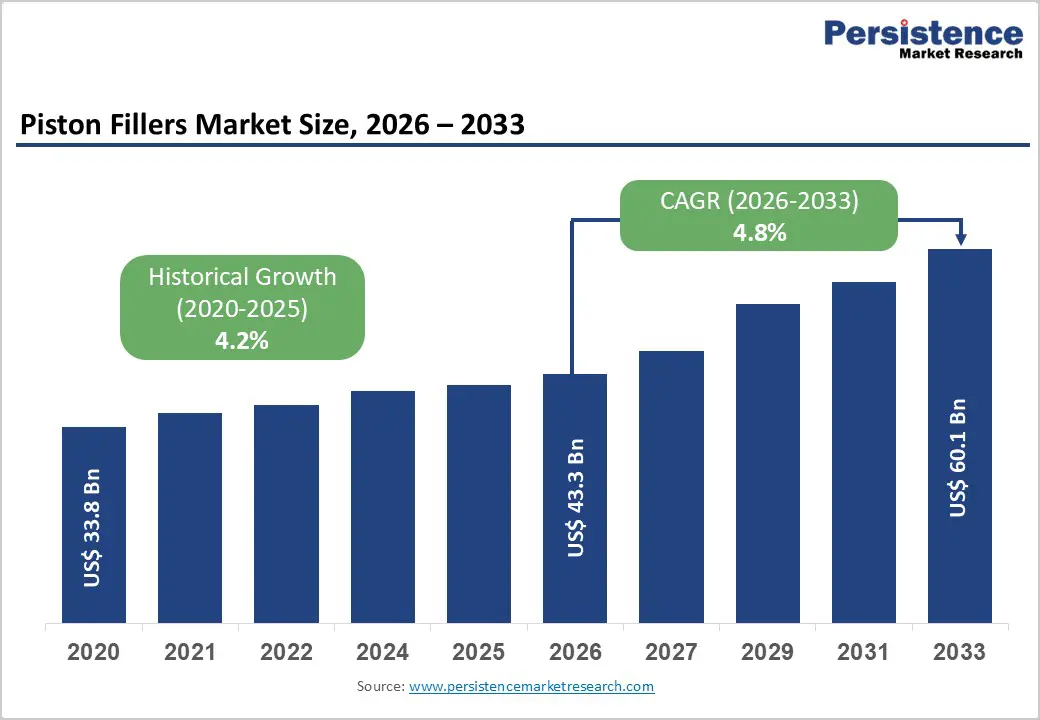
The global piston fillers market size is expected to be valued at US$ 43.3 billion in 2026 and projected to reach US$ 62.6 billion by 2033, growing at a CAGR of 4.8% between 2026 and 2033.
The growth is driven by automation in packaging lines and increasing demand for high-speed, precision filling systems. Expanding food, pharmaceutical, and cosmetics production further accelerates adoption. Additionally, stringent hygiene and safety regulations are pushing manufacturers toward advanced, easy-to-clean equipment designs. The need for consistent dosing, reduced product wastage, and improved operational efficiency continues to support steady market expansion globally.
Key Industry Highlights:
- Leading Region: Asia Pacific leads with ~38% share in 2025 due to rapid industrialization and strong manufacturing growth.
- Leading Category: Automatic piston fillers dominate with ~52% share in 2025 driven by high-speed and efficient operations.
- Fastest Growing Region: Asia Pacific is the fastest growing region due to rising automation and export-driven industries.
- Fastest Growing Category: Multi-head piston fillers are the fastest growing, driven by demand for high throughput and efficiency.
- Key Opportunity: Pharmaceutical aseptic filling offers strong growth with rising demand for sterile and GMP-compliant systems.
| Key Insights | Details |
|---|---|
|
Piston Fillers Size (2026E) |
US$ 43.3 Billion |
|
Market Value Forecast (2033F) |
US$ 62.6 Billion |
|
Projected Growth CAGR(2026-2033) |
4.8% |
|
Historical Market Growth (2020-2025) |
4.2% |
Market Dynamics
Drivers - Adoption of Automated High-Speed Filling Systems Across Industries
Rising automation in packaging lines is a key driver of the piston fillers market. Manufacturers in food, cosmetics, and pharmaceuticals are rapidly shifting toward automatic systems to improve throughput, minimize labor dependency, and enhance filling accuracy. High-end piston fillers can achieve up to 200 fills per minute, significantly improving operational efficiency and consistency.
In pharmaceutical applications, precision is critical to ensure safety and compliance, making automated piston fillers essential. The growing integration of robotics and smart manufacturing technologies further strengthens adoption, as companies increasingly invest in advanced, high-speed filling solutions to maintain productivity, reduce costs, and meet rising global demand.
Strict Hygiene Regulations and Safety Compliance Driving Equipment Demand
Stringent regulatory standards for hygiene and product safety are another major growth driver. Authorities mandate that filling equipment must support thorough cleaning, prevent contamination, and ensure consistent dosing. As a result, piston fillers built with stainless steel and compliant with sanitary and good manufacturing practices are widely preferred across industries.
The increasing production of sterile pharmaceuticals and sensitive cosmetic products further accelerates demand for hygienic filling systems. These regulations push manufacturers to upgrade existing machinery while encouraging new investments, creating sustained demand for advanced piston fillers designed for safe handling of liquids and semi-solid formulations.
Restraints - High Capital Investment Limiting Adoption Among Small Manufacturers
High initial capital investment remains a key restraint, particularly for small and medium-sized enterprises in emerging markets. Fully automatic piston fillers can cost 20–30% more than manual or semi-automatic systems due to advanced controls, sensors, and integrated software. This cost burden often represents a substantial share of annual capital budgets for smaller packaging firms.
As a result, many businesses delay automation despite increasing production needs. In price-sensitive markets, companies tend to rely on lower-cost alternatives, slowing the adoption of advanced piston filling technologies even as packaging demand continues to expand across industries.
Maintenance Complexity and Operational Costs Impacting Equipment Adoption
Maintenance complexity is another significant challenge affecting piston filler adoption. These systems depend on precision components such as valves, seals, and cylinders that require regular servicing to maintain accuracy and hygiene standards. Compliance with strict quality and safety frameworks further increases the need for frequent inspection and maintenance.
Over time, wear and tear in handling powders and semi-solids can reduce filling accuracy, leading to product losses and inefficiencies. Limited availability of skilled technicians and higher operating costs make these systems less attractive in cost-sensitive regions, restraining broader market penetration.
Opportunities - Growing Demand for High-Speed Multi-Head Filling Systems Efficiency
Advancements in multi-head piston filler designs present a significant growth opportunity for manufacturers. These systems enable simultaneous filling of multiple containers, greatly improving throughput and reducing production bottlenecks. Industries such as food & beverages and cosmetics are increasingly adopting multi-head configurations to align with high-speed packaging lines and enhance operational efficiency.
Modern servo-driven piston fillers offer accuracy levels exceeding 99.5%, while also simplifying changeovers and reducing mechanical wear. With rising global food production and increasing automation initiatives, manufacturers are investing in advanced, high-efficiency filling systems to scale operations and meet growing consumer demand.
Rising Adoption of Aseptic Filling Solutions in Pharmaceuticals
Expansion of pharmaceutical aseptic filling applications is another major opportunity in the piston fillers market. Increasing demand for sterile injectables, ointments, and semi-solid formulations is driving the need for precise and contamination-free filling technologies. This trend is supported by growing healthcare needs, aging populations, and expanding vaccine production worldwide.
Check valve piston fillers are gaining traction due to their ability to maintain sterility and prevent backflow. Integration with closed systems and advanced containment solutions enhances compliance with strict manufacturing standards, positioning pharmaceutical-focused piston fillers as a high-value and rapidly growing segment.
Category-wise Insights
Process Type Analysis
The Automatic segment leads the process type category, accounting for approximately 52% of the piston fillers market in 2025. Its dominance is driven by the increasing shift toward automation across food & beverages, pharmaceuticals, and cosmetics industries. Automatic piston fillers ensure high throughput, consistent fill accuracy, and reduced human intervention, making them ideal for high-speed production environments where precision and efficiency are critical.
The semi-automatic segment is emerging as the fastest-growing category, particularly among small and medium-sized manufacturers transitioning from manual systems. These machines offer a balance between cost and performance, allowing gradual automation without significant capital investment. Growing adoption in developing regions and flexible production setups is supporting demand for semi-automatic piston fillers.
Form Insights
The liquid segment dominates the form category, holding around 48% of the piston fillers market in 2025. This leadership is supported by the high volume of liquid products such as beverages, sauces, syrups, and pharmaceutical liquids requiring accurate and hygienic filling. Piston fillers are preferred due to their superior volumetric precision and ability to handle varying viscosities effectively.
The semi-solid segment is witnessing the fastest growth due to rising demand for creams, gels, pastes, and viscous formulations in cosmetics and pharmaceuticals. These products require precise handling to maintain consistency and avoid contamination. Increasing production of personal care and healthcare products is driving the adoption of piston fillers designed specifically for semi-solid applications.
Product Type Insights
The check valve segment leads the product type category, capturing approximately 55% of the market in 2025. Its dominance is attributed to its ability to prevent backflow, maintain hygiene, and ensure accurate dosing. Check valve piston fillers are widely used in semi-solid and pharmaceutical applications where controlled product flow and contamination prevention are essential.
The rotary valve segment is the fastest-growing category, driven by its versatility in handling a wide range of viscosities and product types. It is increasingly adopted in food and beverage applications where flexibility and quick product changeovers are required. The ability to efficiently process both liquid and particulate products enhances its appeal in dynamic production environments.
Design Insights
The multi head dominates the design category, accounting for nearly 60% of the piston fillers market in 2025. These systems enable simultaneous filling of multiple containers, significantly increasing production efficiency and throughput. They are widely used in large-scale operations where maintaining high-speed output and consistency across packaging lines is essential.
The single head segment is steadily growing particularly in niche and low-volume production settings. It is preferred by smaller manufacturers and industries requiring flexibility and frequent product changes. Lower cost, ease of operation, and suitability for customized or small-batch production are driving its adoption across emerging markets.
Application Insights
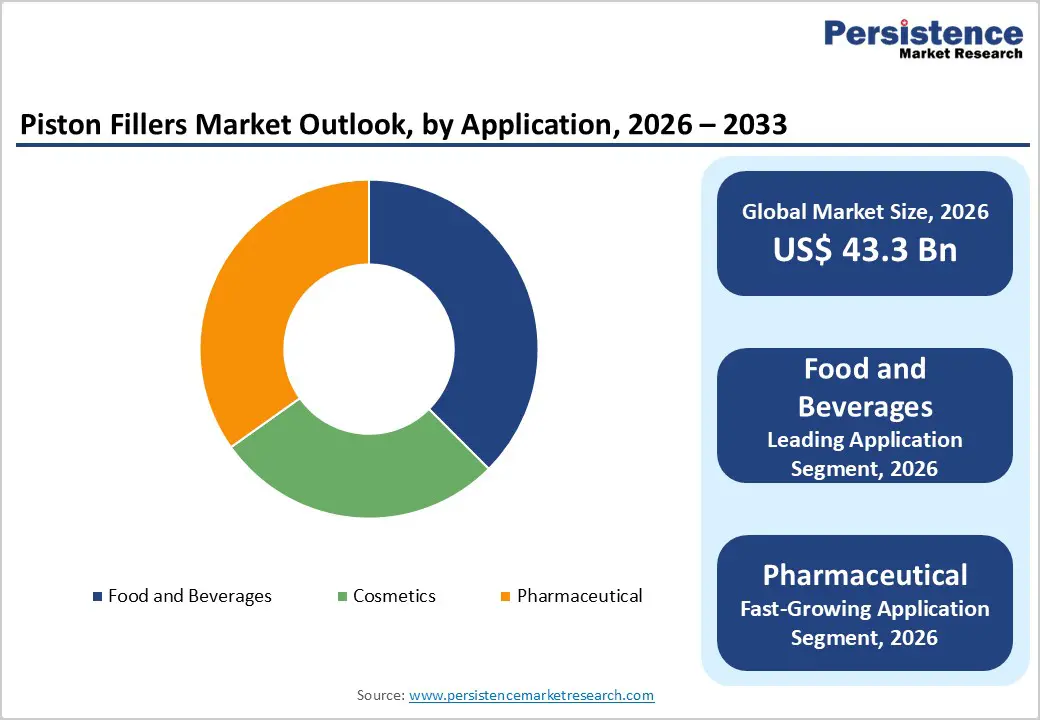
The food & beverages segment leads the application category, capturing approximately 45% of the piston fillers market in 2025. This dominance is driven by the high demand for packaged foods such as sauces, dressings, dairy products, and beverages requiring accurate and hygienic filling. Piston fillers ensure consistent portion control and compliance with strict food safety standards.
The pharmaceutical segment is the fastest-growing application, fueled by rising demand for sterile injectables, liquid medicines, and semi-solid formulations. Increasing regulatory focus on precision and contamination-free filling is encouraging the adoption of advanced piston filling systems. Expansion of global healthcare production further supports growth in this segment.
Regional Insights
North America Piston Fillers Market Trends and Insights
North America holds a significant share of the piston fillers market, accounting for approximately 35% in 2025. The region is driven by strong regulatory oversight and advanced automation across food, beverage, and pharmaceutical industries. Strict hygiene and safety standards have encouraged widespread adoption of stainless steel, GMP-compliant piston fillers with integrated cleaning systems, ensuring high precision and contamination-free operations.
The market is also witnessing steady technological advancement, particularly with the integration of IoT-enabled and sensor-driven filling systems. These innovations enhance fill accuracy, enable predictive maintenance, and support digital manufacturing initiatives. Increasing demand for precise dosing in pharmaceuticals and high-speed packaging in food industries continues to drive adoption of advanced piston filling solutions.
Europe Piston Fillers Market Trends and Insights
Europe represents a mature and regulation-driven market, supported by strong industrial automation and stringent compliance standards. Harmonized regulations for food contact materials and hygiene requirements have led manufacturers to adopt advanced piston fillers designed for durability, precision, and easy cleaning. Countries such as Germany, France, and the UK are key contributors to market stability.
The region is expected to grow at a CAGR of around 4.5%, driven by ongoing modernization and Industry 4.0 adoption. Increasing demand for high-viscosity product filling, including sauces and dairy, is further accelerating growth. Export-oriented food production and strict quality control standards continue to support the steady expansion of piston filler adoption across Europe.
Asia Pacific Piston Fillers Market Trends and Insights
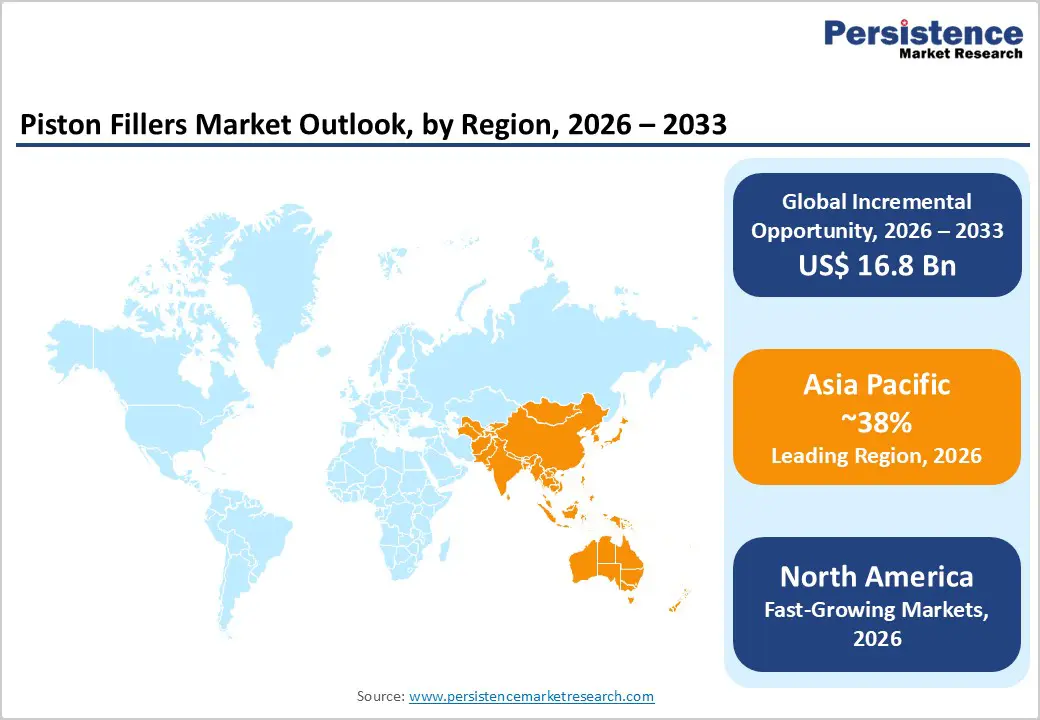
Asia Pacific leads the global piston fillers market, capturing approximately 38% share in 2025. This dominance is fueled by rapid industrialization, expanding food and beverage consumption, and strong government support for manufacturing modernization. Countries such as China, India, and Japan are key growth engines, driving large-scale adoption of automated piston filling systems.
The region is also the fastest growing, supported by increasing investments in packaging infrastructure and rising demand for cost-efficient, high-throughput solutions. Expanding pharmaceutical and cosmetics production, along with stricter hygiene regulations, is encouraging manufacturers to upgrade to advanced piston fillers. Growth in export-oriented industries across ASEAN countries further strengthens regional demand.
Competitive Landscape
The global piston fillers market is moderately consolidated, with a mix of established players and numerous regional manufacturers serving niche applications. Competition is driven by continuous investments in advanced technologies such as servo-driven systems, hygienic modular designs, and smart monitoring capabilities. Companies are focusing on expanding their geographic presence and enhancing product portfolios through partnerships and strategic collaborations.
Key competitive factors include ease of cleaning, quick changeover capabilities, and compatibility with sterile environments. Increasing emphasis on digital integration and smart manufacturing is shaping innovation. Additionally, flexible business models such as equipment-as-a-service are emerging, enabling cost efficiency and fostering long-term customer relationships.
Key Developments:
- In March 2025, Krones AG introduced a servo-driven multi-head piston filler designed for high-speed beverage and dairy applications, enhancing line speed by up to 25% while maintaining precise filling accuracy through advanced motion control and inline monitoring sensors.
- In July 2024, GEA Group launched an aseptic check valve piston filler for pharmaceutical applications, meeting FDA and EMA standards. The system supports sterile environments like isolators and RABS, reducing contamination risks in injectable and high-value liquid filling processes.
- In November 2025, Bosch Packaging expanded its manufacturing capabilities in Asia to produce automatic piston fillers, targeting growing demand in regional markets. The move aims to reduce lead times and improve localization for food, beverage, and pharmaceutical manufacturers.
Companies Covered in Piston Fillers Market
- Accutek Packaging Equipment
- APACKS
- All-Fill Inc.
- E-PAK Machinery
- Inline Filling Systems
- Filamatic
- Oden Machinery
- Pack Leader USA
- ProMach
- Krones AG
- GEA Group
- IMA Group
- Serac Group
- Cozzoli Machine Company
- Tenco Srl
Frequently Asked Questions
The global Piston Fillers Market is expected to reach US$ 43.3 billion in 2026, driven by automation and stricter quality regulations.
Key drivers include rising automation, demand for precision dosing, and stringent hygiene and safety regulations across industries.
Asia Pacific leads with approximately 38% share in 2025, supported by strong manufacturing growth and packaged food demand.
Pharmaceutical aseptic filling is a key opportunity, driven by growing demand for sterile injectables and GMP-compliant systems.
Leading players include Krones AG, GEA Group, Bosch Packaging Technology, Tetra Pak, Schubert, and IMA Group.


