




- Medical Devices
- Pediatric Interventional Cardiology Devices Market
Pediatric Interventional Cardiology Devices Market Size, Share, and Growth Forecast 2026 - 2033
Pediatric Interventional Cardiology Devices Market by Device Type (Closure Devices, Catheters, Balloons, Stents, Transcatheter Heart Valves, Guidewires, Others), Procedure (Congenital Heart Defect Closure, Angioplasty, Valvuloplasty, Transcatheter Valve Implantation, Others), End-User (Hospitals, Pediatric Cardiac Centers, Specialty Clinics, Ambulatory Surgical Centers), and Regional Analysis for 2026 - 2033

Pediatric Interventional Cardiology Devices Market Size & Trends Analysis
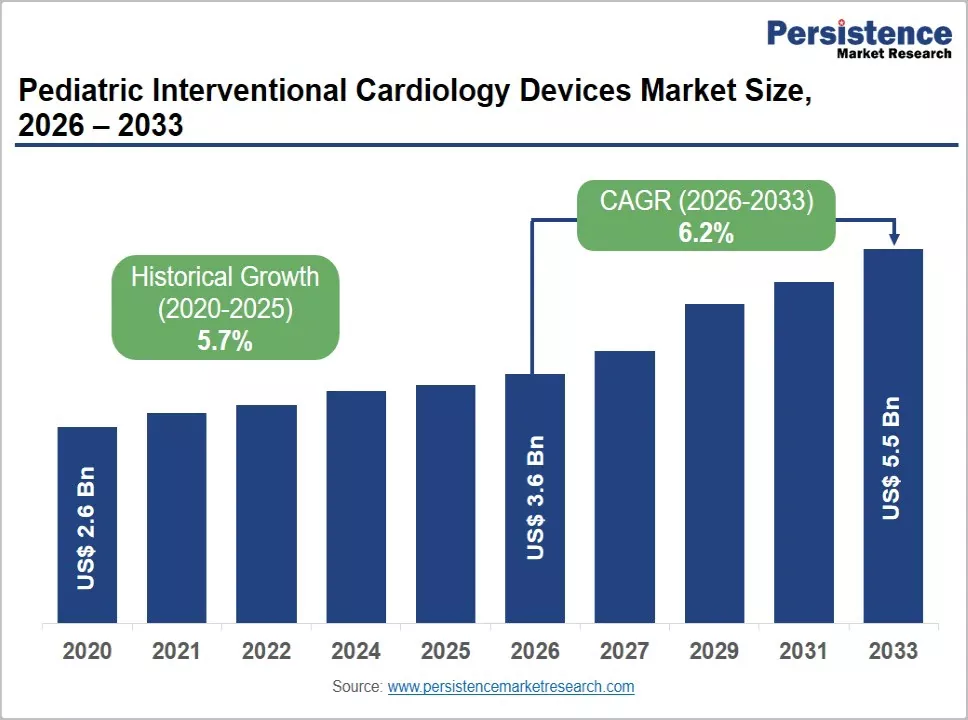
The global pediatric interventional cardiology devices market is expected to be valued at US$ 3.6 billion in 2026 and is projected to reach US$ 5.5 billion by 2033, growing at a CAGR of 6.2% between 2026 and 2033. The rapid shift from open-heart surgery to catheter-based treatment of congenital heart disease (CHD) is the main factor driving the growth of the market. CHD is the most common birth defect, affecting nearly one percent of live births, and a study published in the Journal of the American College of Cardiology estimated that about 1.35 million babies are born with CHD worldwide each year.
Minimally invasive procedures offer shorter hospital stays, faster recovery, and reduced scarring compared with open surgery, supporting their adoption for suitable congenital heart defects. Regulatory approvals of devices designed for infants, wider use of transcatheter pulmonary valves, and expansion of pediatric cardiac care programs in emerging economies are further supporting market growth.
Key Industry Highlights
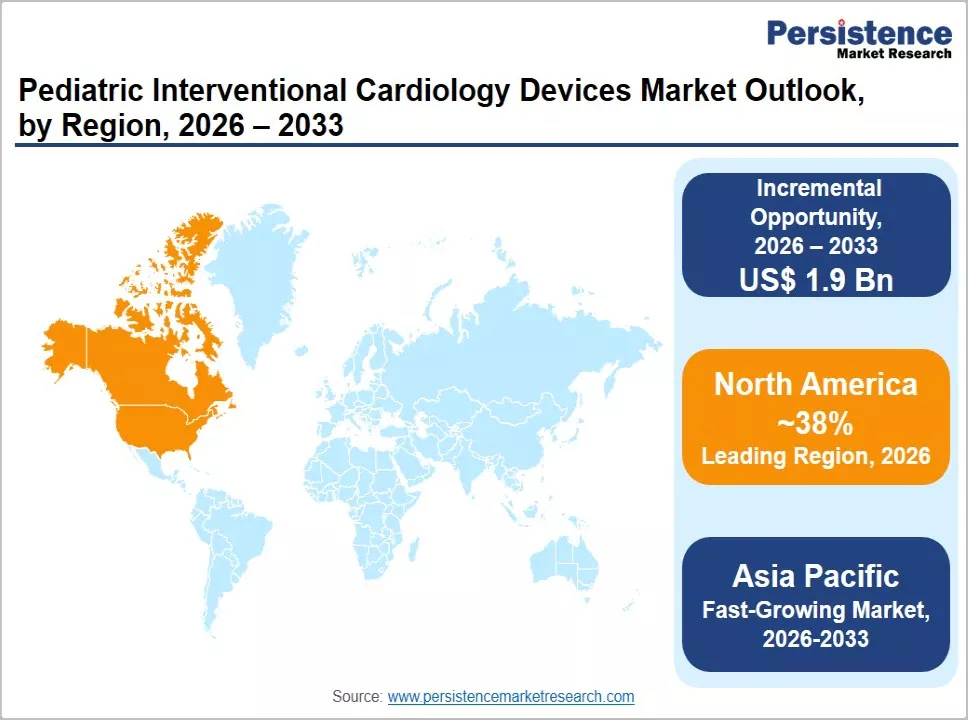
- Leading Region: North America is expected to lead the pediatric interventional cardiology devices market with around 38% share in 2026, supported by advanced children's hospitals, established reimbursement systems, and early access to FDA-approved devices.
- Fastest-growing Region: Asia Pacific is projected to be the fastest-growing market through 2033, driven by large pediatric populations, improved congenital heart disease (CHD) screening, expanding healthcare access, and the growth of domestic medical device manufacturers in China.
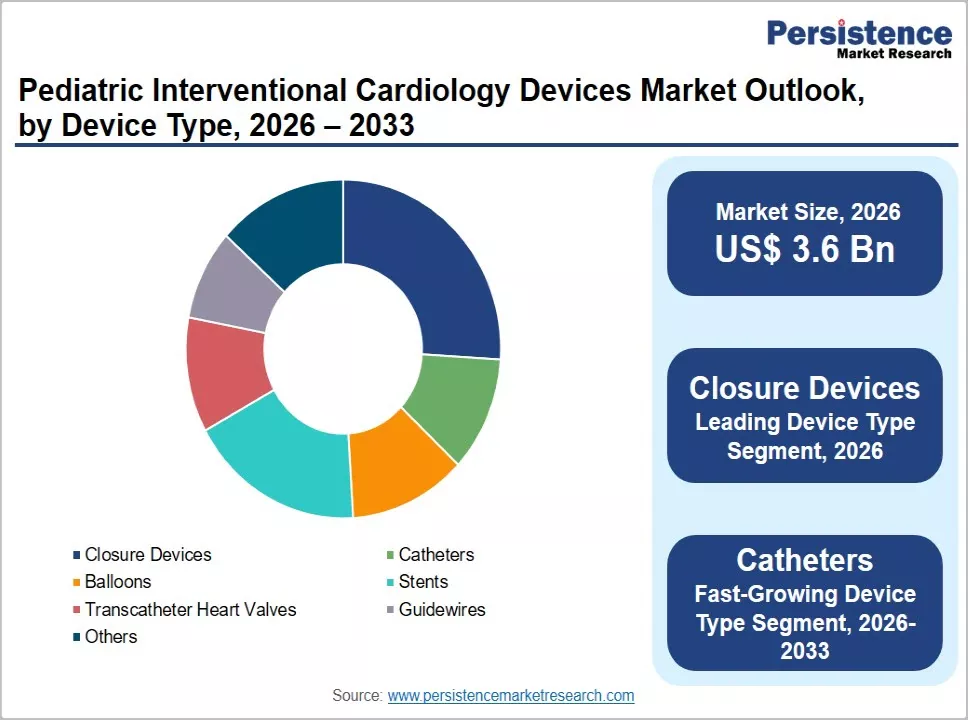
- Leading Segment: Closure devices represent the leading device type category, accounting for around 26% share in 2025, owing to the prevalence of septal defects and patent ductus arteriosus (PDA) and the established use of transcatheter closure procedures.
- Fastest-growing Segment: Catheters are projected to be the fastest-growing device type between 2026 and 2033, supported by demand for low-profile, infant-sized delivery systems and rising interventional procedure volumes among neonates and infants.
- Key Market Opportunity: Transcatheter valve therapies and expanding pediatric cardiac programs in emerging economies present key growth opportunities, driven by demand for minimally invasive treatment, advances in congenital heart disease management, and improved access to specialized cardiac care.
Market Dynamics
Drivers - High Burden of Congenital Heart Disease and Improved Survival
The large population of children and adults living with congenital heart disease (CHD) is a key driver of demand for pediatric interventional cardiology devices. According to the Centers for Disease Control and Prevention (CDC), about 40,000 babies are born with CHD in the U.S. each year, and around one in four has critical CHD requiring surgery or a catheter-based procedure during the first year of life. The Global Burden of Disease study published in The Lancet Child & Adolescent Health estimated that around 12 million people worldwide were living with CHD.
Improved diagnosis through fetal echocardiography and newborn pulse oximetry screening is also supporting earlier detection. Advances in treatment have increased survival, with the CDC estimating that about 2.4 million people in the U.S. live with CHD, including more than 1 million adults. Many patients require follow-up procedures or repeat interventions over their lifetimes, sustaining demand for closure devices, stents, balloons, and transcatheter valves.
Shift Toward Minimally Invasive Catheter-Based Procedures
The growing use of catheter-based treatment for suitable congenital heart defects is supporting adoption of interventional cardiology devices. Conditions such as atrial septal defects (ASD), patent ductus arteriosus (PDA), pulmonary valve stenosis, and coarctation of the aorta can often be treated through catheter-based procedures, depending on the patient's anatomy and clinical condition. The FDA's 2019 approval of Abbott's Amplatzer Piccolo Occluder enabled transcatheter PDA closure in selected premature infants weighing as little as 700 grams, expanding treatment options for this high-risk group.
Transcatheter pulmonary valves, including Medtronic's Melody and Harmony systems and Edwards' SAPIEN 3 valve used with the Alterra Adaptive Prestent, also provide alternatives to repeat open-heart surgery for selected patients with right ventricular outflow tract dysfunction. Shorter hospital stays and faster recovery in suitable cases are encouraging clinicians to consider minimally invasive approaches, supporting demand for specialized cardiovascular devices.
Restraints – Limited Pediatric-Specific Devices and Regulatory Hurdles
The limited availability of devices designed and approved specifically for children remains a barrier to market expansion. Pediatric patient populations are relatively small and anatomically diverse, which can limit commercial returns and complicate clinical trial recruitment. Research published in JAMA Pediatrics found that only about 24% of high-risk devices approved by the FDA through the premarket approval pathway over a multi-year study period had pediatric indications, with many indications focused on older children or adolescents.
Consequently, pediatric interventional cardiologists sometimes use devices approved for adults outside their labeled indications when clinically appropriate. In Europe, compliance with the Medical Device Regulation (MDR) has increased regulatory and certification requirements, creating additional challenges for manufacturers of niche pediatric devices. These factors can increase development costs, slow commercialization, and limit device choices for neonates and younger children.
High Procedure Costs and Limited Access in Low-Income Regions
High device and procedure costs restrict access to interventional cardiology services in many regions. Closure devices, transcatheter valves, and specialized stents require substantial investment, while procedures depend on advanced catheterization laboratories, imaging equipment, and trained clinical teams. Research cited by The Lancet and the World Heart Federation indicates that about 90% of children born with CHD live in regions where access to cardiac care is limited or unavailable.
Many low- and middle-income countries face shortages of pediatric cardiologists and specialized treatment facilities, resulting in long waiting lists and delayed treatment. Where insurance coverage is limited, out-of-pocket expenses create additional barriers for families. These affordability and infrastructure gaps constrain access to treatment and limit device adoption across underserved markets, despite substantial unmet clinical need.
Opportunities – Advanced Catheter Technologies and Infant-Sized Device Platforms
Advances in catheter technology represent a significant opportunity for manufacturers, with catheters projected to be the fastest-growing device type through 2033. Pediatric interventions require low-profile delivery systems, steerable sheaths, and specialized catheters that navigate small vessels and complex anatomy in neonates and infants. Improvements in hydrophilic coatings, braided shafts, and smaller French sizes are supporting maneuverability and procedural control.
The FDA's Pediatric Device Consortia program also supports the development and commercialization of medical devices for children, while Humanitarian Device Exemption (HDE) pathways provide a regulatory route for eligible devices intended for rare conditions. Growth-accommodating stents and bioresorbable devices are additional areas of development, although their suitability and availability vary by application. Manufacturers that develop safe, reliable, infant-sized catheter platforms are positioned to address unmet clinical needs and expand their presence in the pediatric cardiovascular devices market.
Expansion of Transcatheter Valve Therapies and Pediatric Cardiac Programs in Emerging Markets
Transcatheter valve therapies and expanding pediatric cardiac programs in Asia, Latin America, and the Middle East offer long-term growth opportunities. Patients with repaired tetralogy of Fallot and other congenital conditions can develop pulmonary valve dysfunction, sometimes requiring repeat valve interventions over their lifetimes. The FDA approved Medtronic's Harmony transcatheter pulmonary valve in 2021 for eligible patients with native or surgically repaired right ventricular outflow tracts, broadening minimally invasive treatment options for selected patients.
In emerging economies, government initiatives are also improving access to pediatric cardiac screening and treatment. India's Rashtriya Bal Swasthya Karyakram (RBSK) includes congenital heart disease among the conditions targeted for screening and early intervention, while Kerala's Hridyam program supports treatment for children with congenital heart defects. Organizations such as Children's HeartLink and Gift of Life International contribute to clinical capacity building. As healthcare infrastructure and specialist services expand, demand for appropriately priced closure devices, balloons, stents, and transcatheter valves is expected to increase.
Category-wise Analysis
Device Type Insights
Closure devices represent the leading device type segment, accounting for around 26% of the market in 2026. Their leading position is supported by demand for minimally invasive treatment of congenital heart defects, particularly secundum atrial septal defects (ASD) and patent ductus arteriosus (PDA). Transcatheter closure offers an alternative to open surgery for eligible patients, with established clinical outcomes supporting its use. Key products include Abbott's Amplatzer device family, the Amplatzer Piccolo Occluder for PDA closure in selected premature infants, and W. L. Gore's GORE CARDIOFORM ASD Occluder, which received FDA approval in 2019.
Catheters are projected to be the fastest-growing device type between 2026 and 2033, driven by their essential role in diagnostic and interventional procedures. Rising demand for low-profile delivery systems designed for neonates and infants, along with advances in catheter flexibility and maneuverability, is supporting adoption across pediatric cardiac procedures.
Procedure Insights
Congenital heart defect closure represents the leading procedure segment, accounting for around 34% of the pediatric interventional cardiology devices market in 2026. Demand is supported by the need to treat ASD and PDA, along with selected VSD cases, using minimally invasive techniques. Advances in closure devices, including the Amplatzer Piccolo Occluder for eligible premature infants with PDA, are expanding treatment options for younger patients. Transcatheter procedures can reduce the need for open surgery and support shorter hospital stays in suitable cases, reinforcing demand for closure devices and delivery systems.
Transcatheter valve implantation is projected to be the fastest-growing procedure segment through 2033, driven by advances in pulmonary valve technologies from Medtronic and Edwards Lifesciences and increasing treatment needs among patients with congenital heart disease. Patients with repaired congenital defects can develop pulmonary valve dysfunction over time, creating demand for repeat interventions. Continued improvements in valve design and delivery systems are expected to expand the number of patients eligible for transcatheter treatment and support segment growth.
End-User Insights
Hospitals are expected to account for the largest end-user share, at around 55% in 2026. Their leading position is supported by the specialized infrastructure required for pediatric interventional cardiology, including catheterization laboratories, advanced imaging equipment, pediatric anesthesia, intensive care units, and surgical backup. These resources enable hospitals to manage complex congenital heart defects, neonatal procedures, and patients requiring coordinated surgical and catheter-based care. Established referral networks and reimbursement systems in markets such as the U.S. and parts of Europe further support hospital-based procedures.
Pediatric cardiac centers are projected to be the fastest-growing end-user segment through 2033, driven by increasing investment in specialized congenital heart disease services and dedicated treatment facilities. These centers concentrate pediatric cardiologists, surgeons, and other specialists while expanding access to advanced diagnostic and interventional procedures. Government initiatives and healthcare infrastructure development in emerging markets are also expected to support the establishment and expansion of specialized pediatric cardiac care programs.
Regional Analysis
North America Pediatric Interventional Cardiology Devices Market Trends and Insights
North America is expected to lead the global pediatric interventional cardiology devices market with around 38% share in 2026. The region benefits from an established network of children's hospitals, specialized pediatric cardiologists, and broad insurance coverage for congenital heart procedures. Early access to devices approved by the FDA and Health Canada also supports the adoption of new technologies.
Key trends include growing use of transcatheter pulmonary valves, expansion of hybrid procedures combining surgical and catheter-based techniques, and greater use of 3D printing and advanced imaging for procedural planning. Clinical registries maintained by the American College of Cardiology support outcomes monitoring and evidence-based practice. The strong presence of manufacturers such as Abbott, Medtronic, Boston Scientific, Edwards Lifesciences, and W. L. Gore further reinforces regional market leadership.
U.S. Pediatric Interventional Cardiology Devices Market Size
The U.S. pediatric interventional cardiology devices market is estimated at around US$ 1.2 billion in 2026. The CDC estimates that approximately 40,000 babies are born with congenital heart disease (CHD) in the U.S. each year and that around 2.4 million people in the country live with CHD, including more than 1 million adults. This patient population, together with the need for long-term monitoring and repeat interventions, supports demand for closure devices, stents, balloons, and transcatheter valves.
The FDA's Pediatric Device Consortia program and regulatory pathways such as the Humanitarian Device Exemption (HDE) support the development of devices for pediatric and rare-disease applications. Specialized children's hospitals, Medicaid, and the Children's Health Insurance Program (CHIP) also contribute to treatment access. Growing use of transcatheter pulmonary valves among eligible adolescents and young adults is expected to support market growth through 2033.
Europe Pediatric Interventional Cardiology Devices Market Trends and Insights
Europe is expected to account for the second-largest market share, supported by established healthcare systems, specialized congenital heart centers, and clinical research networks. The European Reference Network for rare and low-prevalence complex diseases of the heart (ERN GUARD-Heart) connects expert centers across countries to support the management of complex cardiac conditions. Key trends include wider use of transcatheter valve therapies in eligible patients with repaired CHD, concentration of specialized procedures in experienced centers, and research into bioresorbable devices.
The EU Medical Device Regulation (MDR) has increased compliance requirements for manufacturers, particularly those supplying niche pediatric devices. Guidance from the Medical Device Coordination Group on orphan medical devices is intended to clarify regulatory considerations for devices addressing rare conditions. Cross-border collaboration through clinical registries and research networks also supports evidence generation and the evaluation of innovative devices across the region.
Germany Pediatric Interventional Cardiology Devices Market Size
The Germany pediatric interventional cardiology devices market is estimated at around US$ 220 million in 2026. Germany has an established congenital heart disease care network, and around 8,700 children are reported to be born with CHD in the country each year. The National Register for Congenital Heart Defects supports research into treatment outcomes and long-term patient needs. Specialized pediatric cardiac centers, statutory health insurance coverage, and participation in clinical research support demand for closure devices, stents, balloons, and transcatheter valves.
The country's established clinical infrastructure and experience with interventional technologies also support the evaluation and adoption of new devices. Continued follow-up of children and adults living with congenital heart conditions is expected to sustain demand through 2033.
U.K. Pediatric Interventional Cardiology Devices Market Size
The U.K. pediatric interventional cardiology devices market is estimated at around US$ 150 million in 2026. The British Heart Foundation (BHF) reports that around 13 babies are diagnosed with a congenital heart condition each day in the U.K. The National Congenital Heart Disease Audit, managed by the National Institute for Cardiovascular Outcomes Research (NICOR), tracks outcomes for congenital cardiac procedures and supports quality monitoring.
NHS England's congenital heart disease standards also concentrate specialized care in designated centers. The growing population of adults living with CHD and increased use of transcatheter pulmonary valves in eligible patients are expected to support demand through 2033. Investment in specialist facilities and catheterization laboratories is also supporting efforts to improve access, procedural capacity, and treatment outcomes.
France Pediatric Interventional Cardiology Devices Market Size
The France pediatric interventional cardiology devices market is estimated at around US$ 140 million in 2026. Congenital heart disease affects nearly one percent of births in France, creating ongoing demand for diagnosis, treatment, and long-term follow-up. The national rare disease network for complex congenital heart defects (M3C), supported by the French healthcare system, coordinates specialist centers involved in patient care. National health insurance provides coverage for eligible interventional procedures, while the Haute Autorité de Santé (HAS) assesses medical technologies for relevant reimbursement decisions.
French cardiac centers also participate in clinical research involving transcatheter valve technologies and other minimally invasive treatments. Improved survival and continued monitoring of adults with congenital heart disease are expected to support repeat interventions and sustain demand for stents, balloons, and valves through 2033.
Asia Pacific Pediatric Interventional Cardiology Devices Market Trends and Insights
Asia Pacific is projected to be the fastest-growing regional market between 2026 and 2033, driven by its large pediatric population, expanding healthcare infrastructure, and improving access to specialized cardiac care. China is a major contributor, with estimates indicating that around 150,000–200,000 babies are born with CHD each year. Newborn screening initiatives and improvements in pediatric cardiac services are supporting earlier diagnosis and treatment.
Regional manufacturers, including Lepu Medical, MicroPort Scientific, and Lifetech Scientific, supply lower-cost interventional devices and are developing new technologies, including biodegradable occluders. Across Asia Pacific, the expansion of catheterization laboratories, clinical training partnerships, private hospital networks, and locally manufactured devices is improving access to interventional treatment. Rising healthcare expenditure and increasing awareness of congenital heart disease are also expected to support market growth as more patients gain access to specialized pediatric cardiac services.
Competitive Landscape
The global pediatric interventional cardiology devices market is moderately consolidated, with a few multinational companies, including Abbott Laboratories, Medtronic plc, Edwards Lifesciences, W. L. Gore & Associates, and Boston Scientific, holding a large share of closure devices and transcatheter valves. Market leaders differentiate through devices specifically designed or approved for children, strong clinical evidence from registries, and close collaboration with leading children's hospitals. Companies such as Terumo, B. Braun, Merit Medical, Cook Medical, and Cordis compete in catheters, guidewires, and balloons.
Chinese manufacturers, including Lepu Medical, MicroPort, and Lifetech Scientific, are expanding globally with cost-competitive products. Key strategies include use of HDE and breakthrough pathways, investment in bioresorbable and growth-adaptive technologies, physician training programs, and partnerships with nonprofit organizations to expand access in emerging markets.
Key Industry Developments
- December 2021: Edwards Lifesciences received FDA approval for the Alterra Adaptive Prestent used with the SAPIEN 3 transcatheter heart valve, enabling non-surgical pulmonary valve replacement in pediatric and adult patients with congenital heart disease.
- March 2021: Medtronic received FDA approval for the Harmony Transcatheter Pulmonary Valve, the first non-surgical heart valve for pediatric and adult patients with a native or surgically repaired right ventricular outflow tract.
- January 2019: Abbott received FDA approval for the Amplatzer Piccolo Occluder, the first minimally invasive device to treat patent ductus arteriosus in premature babies and newborns weighing as little as 700 grams.
Companies Covered in Pediatric Interventional Cardiology Devices Market
- Abbott Laboratories
- Medtronic plc
- Boston Scientific Corporation
- Edwards Lifesciences Corporation
- Terumo Corporation
- B. Braun Melsungen AG
- Merit Medical Systems, Inc.
- Cook Medical
- Cordis
- W. L. Gore & Associates, Inc.
- LivaNova PLC
- BIOTRONIK SE & Co. KG
- MicroPort Scientific Corporation
- Lepu Medical Technology (Beijing) Co., Ltd.
Frequently Asked Questions
The global pediatric interventional cardiology devices market is expected to be valued at US$ 3.6 billion in 2026 and is projected to reach US$ 5.5 billion by 2033, growing at a CAGR of 6.2%, supported by rising use of catheter-based CHD treatment.
Demand is driven by the high burden of congenital heart disease, with about 1.35 million babies born with CHD worldwide each year, along with improved survival, earlier diagnosis, and a strong shift toward minimally invasive catheter procedures.
North America is likely to lead the market with around 38% share in 2026, owing to advanced children's hospitals, experienced pediatric interventional cardiologists, strong insurance coverage, and early access to FDA-approved pediatric devices.
Key opportunities lie in infant-sized catheter platforms, growth-adaptive and bioresorbable devices, transcatheter pulmonary valves for patients with repaired CHD, and expanding pediatric cardiac programs in Asia Pacific and other emerging regions.
Key players include Abbott Laboratories, Medtronic plc, Edwards Lifesciences, W. L. Gore & Associates, Boston Scientific, Terumo Corporation, B. Braun, Merit Medical, Cook Medical, MicroPort Scientific, and Lepu Medical.


