




- Medical Devices
- Orthopedic Screw Extraction System Market
Orthopedic Screw Extraction System Market Size, Share, and Growth Forecast 2026 - 2033
Orthopedic Screw Extraction System Market by Product Type (Screw Extractor Sets, Stripped Screw Removal Kits), Application (Trauma, Spine, Sports Medicine), End-User (Hospitals, Ambulatory Surgical Centers), and Regional Analysis, 2026 - 2033

Orthopedic Screw Extraction System Market Size and Trends Analysis
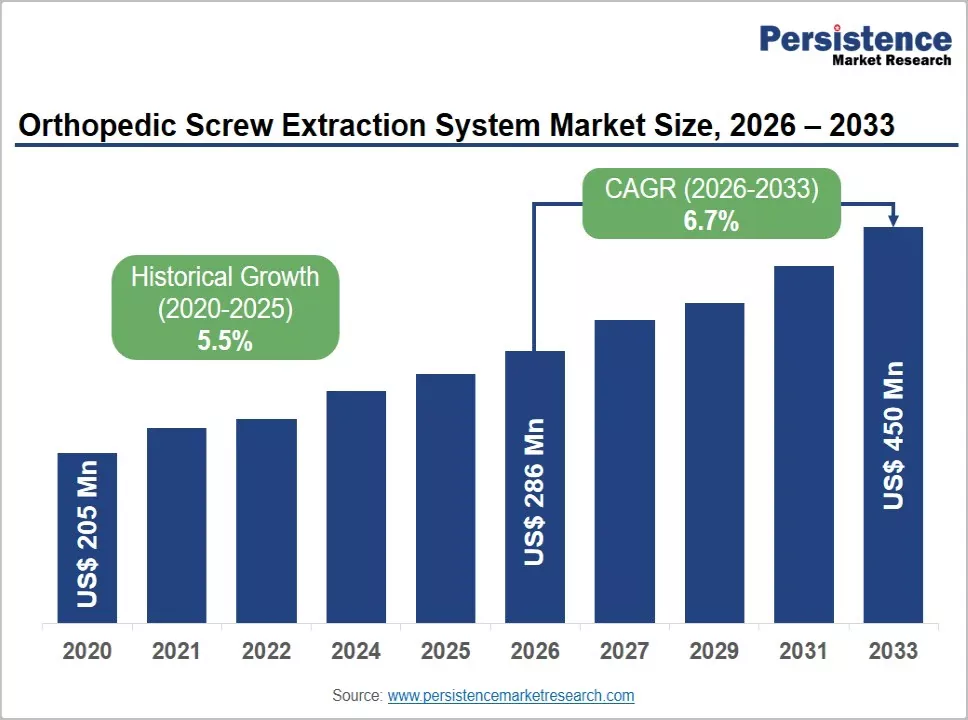
The global orthopedic screw extraction system market is expected to be valued at US$ 286 million in 2026 and is projected to reach US$ 450 million by 2033, growing at a CAGR of 6.7% during the forecast period 2026 to 2033. Market growth is driven by rising fracture fixation volumes and the need to safely remove broken, stripped, or damaged screws.
Key Industry Highlights
- Leading Product Type: Screw extractor sets are the leading product type, accounting for about 44.6% of the market share in 2026, supported by their widespread use in removing stripped and broken screws.
- Dominant Application: Trauma accounts for around 52.3% of the market share in 2026, owing to the extensive use of screws in fracture fixation procedures.
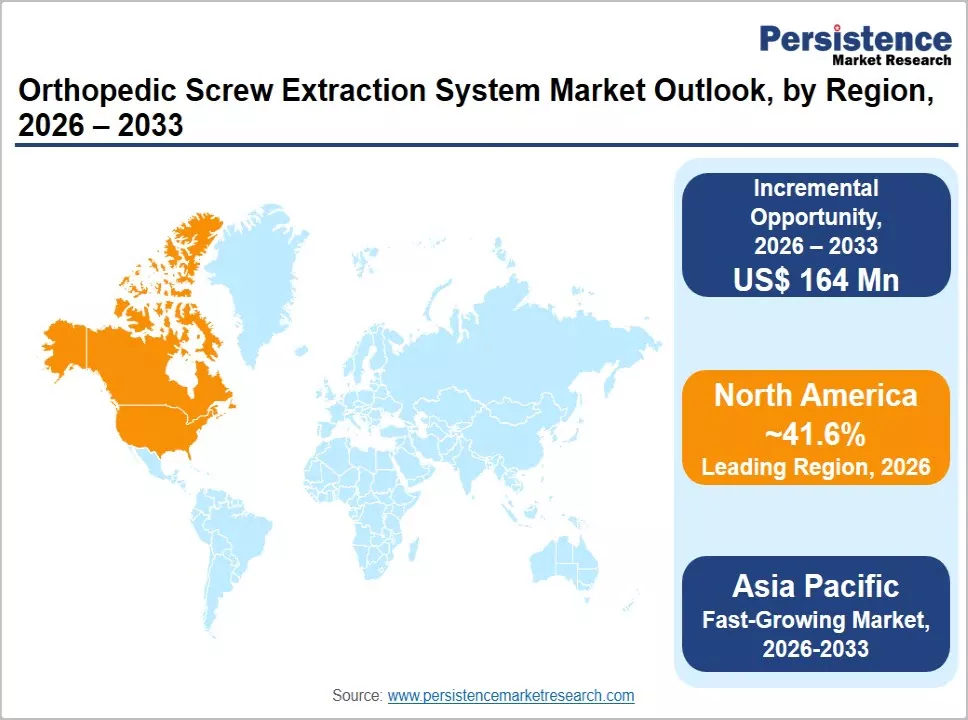
- Leading Region: North America is expected to lead the global market while holding about 41.6% share in 2026, supported by high surgical volumes and early adoption of specialized extraction tools.
- Fastest-Growing Region: Asia Pacific is expected to register the fastest growth between 2026 and 2033, driven by a rising trauma burden and expanding access to orthopedic care.
- Latest Development: In October 2025, Fusion Orthopedics promoted its FuzeFix Screw Removal System, designed to extract both headed and headless orthopedic screws. The system complements the company's FuzeFix screw portfolio, which includes titanium-alloy screws in multiple diameters and lengths for foot and ankle procedures. The system addresses a recurring challenge in revision surgery by providing a dedicated removal solution for cases involving hardware irritation, complications, or revision of a fixation construct.
Market Dynamics
Drivers – Rising Fracture Fixation Volumes to Lift Tool Demand
Orthopedic screw extraction systems remove implanted screws that are broken, stripped, or fused to bone. These systems include extractor bits, drills, and guides, with some tools designed for single-use removal of screws with damaged recesses. Revision procedures and hardware removal following fracture healing can require specialized extraction tools. Removal can be challenging when bone grows over a screw head or the screw recess becomes damaged under torque. Surgeons therefore rely on specialized bits, guides, and trephines to facilitate extraction and reduce operating time.
The fracture burden remains substantial and is expected to increase with population aging. The National Hip Fracture Database reports that more than 70,000 people in England, Wales, and Northern Ireland sustain a hip fracture each year and projects that this number could double by 2060. About one-quarter of patients experience another fragility fracture later. The audit also reports that 58% of hip fracture patients receive bone-strengthening medication.
Improved follow-up care is expected to help reduce subsequent fracture risk over time. However, the large number of fractures requiring fixation continues to support demand for orthopedic implants and associated extraction tools.
Strong Trauma Device Sales to Drive Long-Term Market Growth
Trauma device sales provide an indication of activity across the orthopedic implant market. Across the reporting companies cited, first-quarter 2026 trauma sales increased 11.2% to US$ 2,082.1 million, while extremities sales rose 6.9% to US$ 654.1 million. DePuy Synthes reported trauma sales of US$ 737.3 million, up 7.6%, while Smith+Nephew reported trauma sales of US$ 649 million for 2025.
Higher implant volumes expand the installed base of orthopedic hardware that can eventually require removal or revision. Surveys cited in a 2011 study indicate that up to 60% of surgeons routinely remove hardware after fracture healing. Zimmer Biomet reported 3.4% organic growth in its sports, extremities, and trauma business in the second quarter of 2026. A larger installed base supports potential demand for extraction tools. The same study found that only 2 of 28 complications occurred during hardware removal, providing additional context on procedural outcomes when removal is clinically indicated.
Restraint – Low Removal Rates and Limited Product Differentiation to Slow Market Growth
Many surgeons avoid hardware removal when implants do not cause symptoms, owing to surgical risks, repeat anesthesia, and additional costs. A 2011 pediatric study notes that these concerns apply to screws as well as other fixation devices, although the considerations differ by hardware type. When screws remain asymptomatic, they are often left in place, limiting the frequency of extraction procedures and associated tool use. Zimmer Biomet's second-quarter 2026 results showed 3.4% growth in its sports, extremities, and trauma business, indicating moderate growth in the cited portfolio. Such variation in implant-market performance can influence spending on supplementary surgical tools.
Low entry barriers and limited product differentiation also create pricing pressure. At least one U.S. device listing for a screw extractor tip is classified as exempt from premarket submission. This regulatory status can facilitate market entry for additional suppliers, although applicable requirements vary by device classification. Extraction tools are also frequently bundled with implant sets rather than sold separately, making product-specific sales volumes difficult to determine. Limited public data on individual tool categories further complicates market forecasting and supplier planning.
Opportunities – High Failure Risk During Removal to Support Specialty Systems
Hardware extraction can involve a risk of screw breakage or incomplete removal. A University of Kentucky review of 21 elbow cases found that hardware failed during extraction in five patients, representing 24% of the cases. Four of 14 titanium screws broke. Removal performed 12 months or later after implantation was associated with a higher incidence of broken or retained screws. These findings highlight the potential value of specialized extraction systems. Although metal type was not a significant factor in the study, later removal was associated with greater breakage, with a reported p-value of 0.046.
Improved surgical techniques also create opportunities for specialized systems. One published method uses a guidewire and a cannulated countersink under fluoroscopic guidance to access buried cannulated screws while avoiding a large incision. Earlier retrograde drilling methods often required exposure of the screw tip. Systems designed for minimally invasive removal can therefore address challenging extraction procedures. The authors described the technique as applicable to screws in different bones. Smaller incisions can reduce soft-tissue disruption and support recovery, although outcomes depend on the specific procedure and patient.
Emerging Markets to Create New Demand Pools
Emerging markets face a substantial trauma burden. India's Ministry of Road Transport and Highways reported 487,707 road accidents in 2024, an increase of 1.48%. These accidents resulted in 177,175 deaths and 471,441 injuries. Road traffic injuries contribute to demand for fracture fixation implants, while subsequent complications, revision procedures, and clinically indicated hardware removal create additional requirements for extraction tools.
Expanding orthopedic care and the wider reach of global implant manufacturers also support long-term market opportunities. Zimmer Biomet reported that China and core emerging markets weighed on its international knee sales in the second quarter of 2026. In contrast, DePuy Synthes reported a 10.6% increase in sales outside the U.S. in the first quarter of 2026.
As implant use expands, the installed base of hardware requiring revision or removal is also expected to grow. Smith+Nephew expects sales growth of about 6% in 2026. Continued expansion by global implant manufacturers can support the development of orthopedic treatment and associated extraction-tool demand in emerging markets.
Category-wise Analysis
Product Type Insights
Screw extractor sets are expected to lead the market, accounting for about 44.6% share in 2026, supported by their widespread use in removing stripped and broken screws. These sets include extractor tips, drills, and handles. One U.S. device listing describes an extractor tip designed for 6 mm screws. Sets accommodate different screw sizes, while handles and drivers are often reused after sterilization. Single-use tips are suitable for screws with damaged recesses, and kits containing multiple tip sizes reduce the need to stock several separate tools.
Cannulated removal systems are estimated to be the fastest-growing product type during the forecast period, driven by demand for less invasive extraction procedures. These systems use guidewires and countersinks to access buried screws. This growth outlook reflects our analyst view, as publicly available sales breakdowns by product type remain limited.
Application Insights
Trauma is the dominant application segment, accounting for around 52.3% of the market share in 2026, owing to the extensive use of screws in fracture fixation. Trauma was DePuy Synthes' second-largest segment in the first quarter of 2026, behind joint replacement. Its trauma sales increased by US$ 52.0 million to US$ 737.3 million. Smith+Nephew reported trauma sales of US$ 649 million in 2025. In the first quarter of 2026, trauma sales growth across the cited reporting companies outpaced growth in extremities.
Sports medicine is expected to be the fastest-growing application during the forecast period, supported by demand for surgical treatment of athletic injuries. DePuy Synthes reported that sports medicine sales increased 5.6% to US$ 173.5 million in the first quarter of 2026, while spine sales declined 2% during the same period. This growth outlook reflects our analyst view. Interference and anchor screws are commonly used in sports medicine procedures, and revision surgeries involving these implants can require specialized extraction tools.
Regional Analysis
North America Orthopedic Screw Extraction System Market Trends
North America is expected to lead the global orthopedic screw extraction system market by holding around 41.6% share in 2026, supported by high surgical volumes and early adoption of specialized extraction tools. The region also has an established orthopedic device industry. The American Joint Replacement Registry's 2024 data covered 4,969 surgeons across all 50 states and the District of Columbia. The registry also reported that robotic assistance was used in more than 6% of elective primary hip replacements in 2024, reflecting the growing use of advanced surgical technologies.
U.S. Orthopedic Screw Extraction System Market Trends
The U.S. is expected to account for nearly 88.7% of the North American market revenue in 2026, supported by its large surgical base and established orthopedic device sector. DePuy Synthes reported U.S. orthopedic sales of US$ 1,435.7 million in the first quarter of 2026, an increase of 3.7%. Robotic assistance accounted for about 16.1% of primary knee replacements in 2024. A Stryker cyberattack also disrupted revenue recognition timing for its orthopedic businesses, according to a trade report, although the company's CEO did not expect customer losses. These developments highlight the importance of established supply chains and reliable product availability in the U.S. orthopedic market.
Asia Pacific Orthopedic Screw Extraction System Market Trends
Asia Pacific is expected to be the fastest-growing regional market during the forecast period. A high trauma burden and improving access to orthopedic surgery support demand for fixation and extraction tools. However, verified public data on screw extraction system sales in the region are limited, so this assessment reflects our analyst view. Local manufacturers also supply lower-cost tools to price-sensitive healthcare providers.
China Orthopedic Screw Extraction System Market Trends
China is expected to lead the Asia Pacific market in 2026, accounting for about 38.1% of the regional market share. Its large aging population and substantial surgical base support demand for orthopedic fixation and related removal procedures. However, verified public data on screw extraction system sales in China are unavailable, so this market-share estimate reflects our analyst view. Zimmer Biomet also reported that China weighed on its international knee sales in the second quarter of 2026, highlighting variations in demand across orthopedic product categories.
India Orthopedic Screw Extraction System Market Trends
India is projected to hold about 14.6% share of the Asia Pacific market in 2026, supported by a high road-trauma burden and expanding private hospital capacity. The Ministry of Road Transport and Highways reported 471,441 people injured in road accidents in 2024. The country recorded 487,707 road accidents, an increase of 1.48%, while fatalities totaled 177,175. These injuries contribute to demand for fracture fixation and related surgical procedures. Cost-sensitive healthcare providers also favor affordable, reusable tools, creating opportunities for suppliers offering durable extraction systems at competitive prices.
Europe Orthopedic Screw Extraction System Market Trends
Europe is expected to hold nearly 25.3% share of the global orthopedic screw extraction system market in 2026, supported by an aging population and established trauma care infrastructure. More than 70,000 hip fractures occur annually in England, Wales, and Northern Ireland, reflecting the region's substantial fracture-care burden. Smith+Nephew reported 2025 revenue of US$ 6.2 billion, an increase of 6.1%, and expects 6% growth in 2026. Zimmer Biomet's international sales increased 3.1% in the second quarter of 2026. European hospitals also evaluate cost and clinical performance when procuring surgical instruments, supporting demand for reliable, cost-effective extraction tools.
Germany Orthopedic Screw Extraction System Market Trends
Germany is expected to account for about 26.4% of the European market revenue, supported by its extensive hospital network and established surgical infrastructure. Verified public data on screw extraction system sales in Germany are unavailable, so this market-share estimate reflects our analyst view. Hospital procurement and tendering processes place importance on clinical reliability, product quality, and competitive pricing, creating opportunities for suppliers offering proven extraction tool sets.
U.K. Orthopedic Screw Extraction System Market Trends
The U.K. is anticipated to hold nearly 17.2% share of the European orthopedic screw extraction system market in 2026, supported by its substantial hip fracture burden and established trauma care system. The National Hip Fracture Database reports that 58% of patients receive bone-strengthening medication. In 2024, patients waited an average of 15 hours to reach a suitable ward bed, while about 5% of operations were performed by unsupervised trainees, according to the audit. These findings highlight ongoing operational and care-quality challenges. Hospitals emphasizing procedural safety, appropriate supervision, and reliable surgical equipment can support demand for suitable extraction tools.
Competitive Landscape
The global orthopedic screw extraction system market is fragmented, with large implant makers and small tool specialists. DePuy Synthes, Smith+Nephew, Zimmer Biomet, and Stryker supply fixation systems with matching removal sets. Specialty firms such as Shukla Medical sell extractor tips. No public data show revenue by company for this segment.
Competition centers on set design, ease of use, and compatibility. Makers that cover many screw brands win more orders. Firms also compete on price and training support. Large companies bundle tools with implants to retain customers. Bundled sets lock in surgeons already trained on a brand.
Key Industry Developments
- In September 2025, Fusion Orthopedics highlighted its FuzeFix screw platform with an integrated removal strategy, emphasizing compatibility with headed and headless screws and extraction across different bone qualities. The system combines titanium-alloy fixation screws with dedicated removal instrumentation, allowing surgeons to plan for potential revision at the time of initial implantation. The approach reflects a product-design trend toward considering the entire implant lifecycle, including eventual removal, rather than focusing exclusively on initial fixation.
- In March 2025, a U.S. patent application titled Cannulated Implant Removal Tools and Method was published, describing a system for extracting cannulated orthopedic screws whose heads have fractured or become damaged. The proposed technique uses a guidewire and a specialized trephine to engage the remaining screw shaft while limiting damage to surrounding bone and preserving the existing bone-thread pathway. The invention addresses a key challenge in revision surgery, where conventional drilling and extraction techniques can remove excessive bone and complicate subsequent fixation. This is a patent publication, not evidence of a commercially launched product.
- In January 2025, Bioretec received CE marking for its RemeOs Trauma Screw portfolio, enabling commercialization in the European Union and other markets recognizing the certification. The screws are made from a bioabsorbable magnesium alloy and are designed to provide temporary fracture fixation before being absorbed by the body. Although this is not an extraction-system launch, the technology is relevant to the broader implant-removal market because bioabsorbable fixation devices may eliminate the need for a separate operation to remove certain implants.
Companies Covered in Orthopedic Screw Extraction System Market
- DePuy Synthes
- Smith+Nephew
- Zimmer Biomet
- Stryker
- Shukla Medical
- Others
Frequently Asked Questions
The global orthopedic screw extraction system market is projected to be valued at US$ 286 million in 2026.
The market is expected to reach US$ 450 million by 2033.
Key market trends include rising trauma device sales, minimally invasive removal techniques, and growing demand in emerging markets.
Screw extractor sets are expected to be the leading product type, accounting for around 44.6% of the market share in 2026, due to their wide use for stripped and broken screws.
The market is expected to grow at a CAGR of 6.7% from 2026 to 2033.
DePuy Synthes, Smith+Nephew, and Zimmer Biomet are among the key players competing in the market.


