




- Retail
- North America Gift Card Market
North America Gift Card Market Size, Share, and Growth Forecast 2026 - 2033
North America Gift Card Market by Merchant (Restaurants, Department Stores, Grocery Stores, Supermarkets/Hypermarkets, Discount Stores, Coffee Shops, Entertainment & Experiences, Salons, Spas & Wellness, Book Store, Fashion & Lifestyle, Others), Card Type (Physical Gift Cards, E-Gifting), Price Range, Sales Channel, End-User, and Country Analysis for 2026 - 2033

North America Gift Card Market Size and Trends Analysis
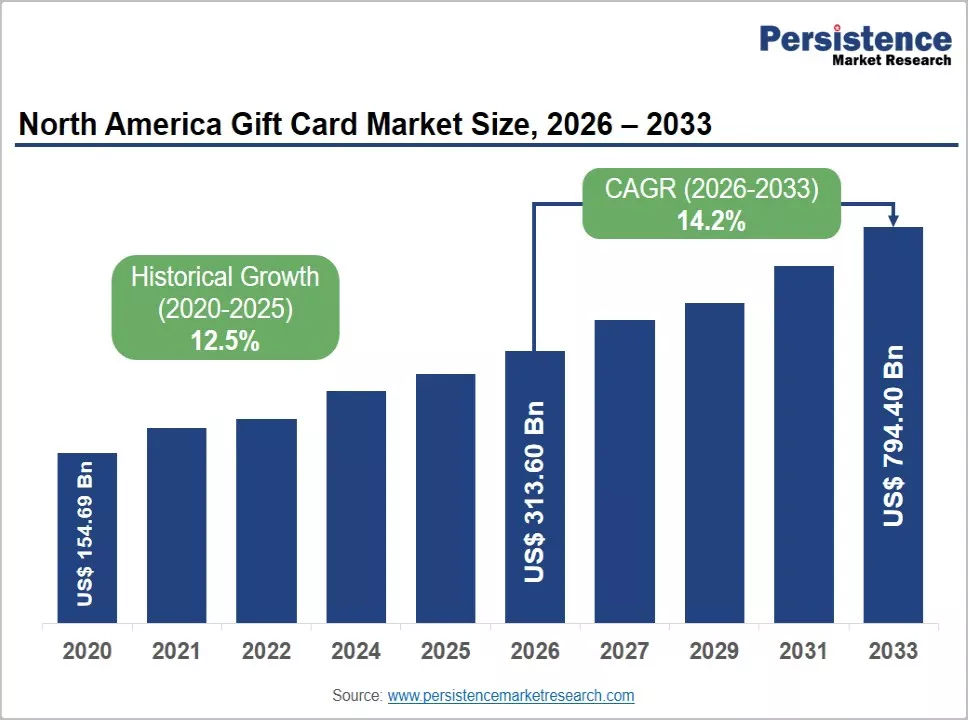
The North America gift card market is expected to be valued at US$ 313.60 billion in 2026 and is projected to reach US$ 794.40 billion by 2033, growing at a CAGR of 14.2% between 2026 and 2033.
Market growth is supported by increasing consumer adoption, expanding digital redemption infrastructure, and the integration of gift cards into corporate reward and incentive programs. According to the Retail Gift Card Association's 2025 consumer study, 73% of surveyed U.S. consumers had purchased a gift card in the preceding 12 months, while 76% reported spending more than the card's value during redemption, highlighting the potential of gift cards to generate incremental retail spending.
Corporate adoption is also strengthening, with the Incentive Research Foundation's 2025 industry outlook reporting that 55% of surveyed organizations anticipated increasing their use of gift cards in reward programs.
Key Industry Highlights
- Leading Merchant Category: Restaurants dominate the North America gift card market, with market revenue expected to reach US$ 53.31 billion in 2026, driven by their popularity across birthdays, family celebrations, corporate appreciation, and holiday gifting.
- Leading Card Type: Physical gift cards lead the market, with revenue expected to reach US$ 166.21 billion in 2026, supported by consumer preference for tangible gifting formats, attractive card presentations, and widespread availability across supermarkets, pharmacies, and retail stores.
- Fastest-Growing Card Type: E-gifting is the fastest-growing card type, driven by instant delivery, digital wallet integration, convenient redemption, and rising adoption of mobile-first gifting platforms.
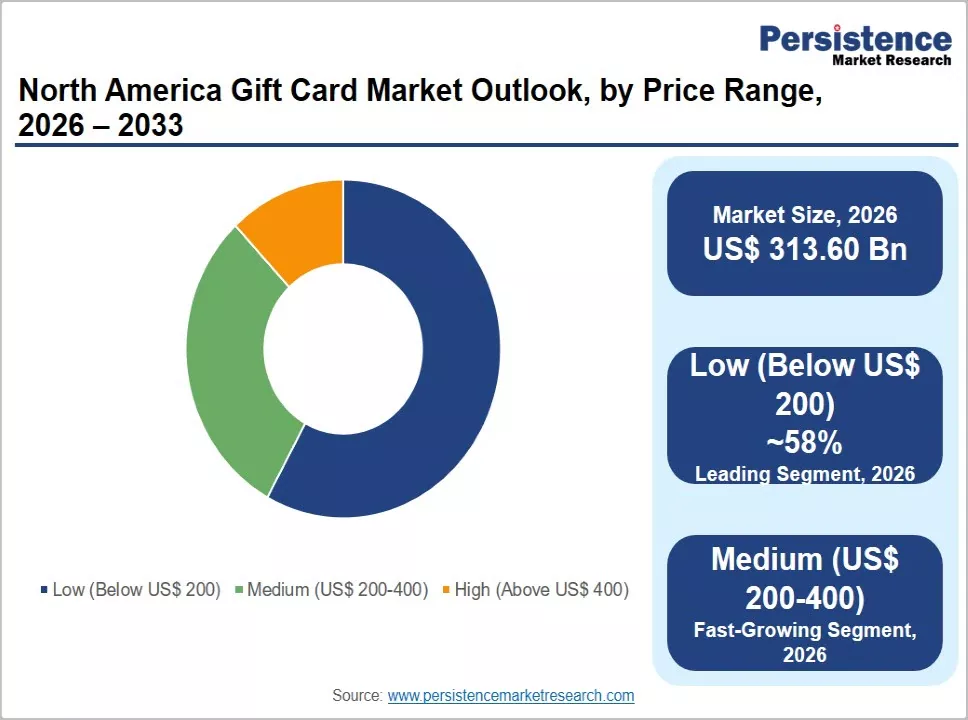
- Leading Price Range: The low (below US$ 200) segment dominates the market in 2026, driven by its affordability and suitability for personal gifting, employee appreciation, and everyday rewards.
- Fastest-Growing Price Range: The medium (US$ 200-400) segment is projected to register the fastest growth, supported by increasing corporate adoption of higher-value rewards for employee recognition, customer appreciation, and performance incentives.
- Leading Sales Channel: Offline channels lead the market, with revenue expected to reach US$ 178.75 billion in 2026, supported by extensive retail distribution through supermarkets, pharmacies, convenience stores, and big-box retailers, alongside impulse purchases at checkout counters.
- Fastest-Growing Sales Channel: Online is the fastest-growing sales channel, driven by instant digital delivery, wider merchant selection, personalized gifting options, and seamless integration with digital wallets and mobile applications.
- Leading End-User: Individual consumers dominate the North America gift card market, with revenue expected to reach US$ 188.16 billion in 2026, driven by widespread adoption across birthdays, weddings, holidays, family celebrations, and personal gifting occasions.
- Fastest-Growing End-User: Businesses represent the fastest-growing end-user segment, supported by increasing use of gift cards for employee recognition, sales incentives, customer retention, and channel partner rewards through automated digital distribution platforms.
- Leading Country: The U.S. gift card market is expected to reach US$ 247.74 billion in 2026, supported by its extensive retail and e-commerce infrastructure, established stored-value ecosystems, strong consumer gifting culture, and substantial corporate incentive spending.
Market Dynamics
Drivers - Surging Corporate Adoption of Closed-Loop and Open-Loop Incentive Programs
Corporate adoption of gift cards is strengthening demand across employee recognition, sales incentives, customer rewards, and channel partner programs. According to the Incentive Research Foundation's (IRF) Industry Outlook for 2026, nearly 70% of North American organizations anticipate increasing their use of gift cards, reflecting their flexibility and suitability for different reward budgets. Both closed-loop retail cards and open-loop prepaid products allow organizations to distribute rewards across geographically dispersed workforces without managing physical merchandise inventories. This is encouraging providers such as Blackhawk Network Holdings, Inc. and Tremendous to expand digital reward distribution and corporate gifting capabilities.
Digital Wallet Integration and the Proliferation of Mobile-First Gifting Platforms
The growing integration of gift cards with digital wallets is improving accessibility, redemption convenience, and consumer engagement across North America. According to Fiserv's Q2 2025 Gift Card Gauge, more than half of surveyed U.S. consumers use digital wallets to store gift cards, while 60% expressed interest in bundled gift card experiences accessible through these wallets. Platforms such as Apple Wallet and Google Wallet support digital pass storage, while participating merchants enable convenient redemption through compatible payment and point-of-sale systems. These developments are encouraging retailers to integrate gift cards with loyalty programs, mobile applications, and personalized promotional offers, strengthening their role in everyday digital commerce.
Restraints - Gift Card Fraud, Card Draining, and Dormancy Exploitation
Gift card fraud remains a significant challenge for retailers, issuers, and consumers, particularly as criminals exploit physical card tampering, phishing, and social engineering. Fiserv's 22nd Annual Prepaid Consumer Insights Survey (2025) found that 57% of surveyed consumers had experienced a gift card scam, while 67% of those scams resulted in financial losses. The Federal Trade Commission reported that gift card fraud accounted for US$ 212 million in reported consumer losses during 2024, with losses reaching US$ 118 million in the first half of 2025. These incidents are increasing consumer caution and compelling issuers to invest in secure activation, transaction monitoring, tamper-resistant packaging, and fraud detection technologies.
Regulatory Complexity Across State-Level Escheatment Laws
Regulatory differences across U.S. states and Canadian provinces create compliance challenges for gift card issuers and retailers operating across multiple jurisdictions. According to Alston & Bird's October 2025 regulatory review, 37 U.S. states expressly exempt qualifying gift cards from escheatment or do not require their remittance, while 14 jurisdictions, including the District of Columbia, have provisions requiring certain unclaimed balances to be transferred to state authorities. California also enacted Senate Bill 22 in October 2025, introducing changes to its gift certificate cash-redemption requirements, with the relevant provisions scheduled to become operative in April 2026.
Opportunities - Expansion of B2B Gifting Platforms and API-Driven Reward Infrastructure
The expansion of digital reward infrastructure is creating opportunities for gift card providers to serve businesses through automated, API-enabled distribution systems. According to the IRF's Industry Outlook for 2026, 62% of North American organizations expect their program technology budgets to increase, indicating growing investment in digital reward management and delivery infrastructure. Platforms such as Tremendous and Blackhawk Network enable businesses to distribute digital rewards and gift cards through integrated corporate solutions, supporting employee recognition, customer acquisition, research participation, and referral programs. API-based delivery reduces manual fulfillment requirements, improves transaction visibility, and supports personalized rewards across multiple merchants and geographical markets.
Growing Demand for Experience-Based and Subscription Gift Cards
Increasing consumer interest in experiential gifting is creating opportunities for gift cards linked to dining, entertainment, travel, events, and subscription-based services. Consumers are increasingly considering experience-oriented gift cards as flexible alternatives to conventional physical merchandise, particularly for birthdays, holidays, and corporate rewards. Platforms such as Amazon.com, Inc. and Netflix, Inc. offer prepaid gifting options that provide access to digital subscriptions and entertainment services, while restaurant chains and travel providers use gift cards to encourage advance purchases and repeat customer engagement. This shift is expanding opportunities for merchants to diversify gift card offerings beyond traditional retail categories and develop new customer acquisition and retention channels.
Category-Wise Analysis
Merchant Insights
Why Do Restaurants Lead the Market?
Restaurants lead the North America gift card market, with revenue expected to reach US$ 53.31 billion in 2026. Consumers favor restaurant cards because they offer flexible dining experiences and suit birthdays, family celebrations, corporate appreciation, and holiday gifting. According to Toast's November 2026 survey of 850 U.S. adults, 77% discovered a new restaurant through a gift card, while 90% reported occasionally spending more than its face value. This ability to attract new customers and encourage additional spending reinforces the category's commercial importance.
Entertainment and experiences represent the fastest-growing merchant segment as consumers increasingly favor experiential rewards over conventional merchandise. Concerts, sporting events, amusement parks, streaming subscriptions, and travel experiences offer flexible gifting choices. InComm Payments' 2025 Holiday Report, based on 2,517 consumers, found that 29% planned to purchase entertainment gift cards for the holiday season. This growing interest in experience-based gifting supports adoption across digital platforms and physical retail outlets.
Card Type Insights
Physical gift cards are expected to lead the market in 2026. Their continued adoption reflects consumer preference for tangible gifting, immediate availability, and attractive card presentations. Grocery stores, pharmacies, and big-box retailers make physical cards accessible during routine shopping trips. InComm Payments' 2025 Holiday Report found that consumers planned to purchase an average of eight physical gift cards compared with four digital gift cards, highlighting the continued relevance of physical formats.
E-gifting is the fastest-growing card type as consumers increasingly prioritize instant delivery, convenient purchasing, and digital redemption. Email and text-based delivery eliminate shipping delays and support last-minute gifting, workplace rewards, and personal celebrations. Fiserv's 2025 Prepaid Consumer Insights Survey, covering 1,000 U.S. adults, found that 66% preferred digital gift cards over physical alternatives. This preference encourages retailers and payment providers to expand digital purchasing, balance-checking, and redemption capabilities.
Price Range Insights
The low (below US$ 200) segment is expected to hold a substantial share of the market in 2026. Consumers favor lower denominations for birthdays, holidays, employee appreciation, and casual gifting, where affordability and flexibility influence purchasing decisions. The Incentive Research Foundation's 2025 Industry Outlook reported that US$ 50 and US$ 100 gift cards accounted for 51% of North American incentive gift card distributions in 2024. This concentration in accessible denominations reinforces the importance of lower-value cards across personal and corporate gifting.
The medium (US$ 200-400) segment is projected to grow at the fastest rate through 2033, supported by increasing adoption of higher-value gift cards for employee incentives, customer appreciation, and corporate recognition. Businesses use these denominations to provide meaningful rewards while allowing recipients flexibility in redemption. The Incentive Research Foundation's 2025 Industry Outlook reported that 62% of North American non-cash reward programs allocated between US$ 100 and US$ 500 per person in 2024.
Sales Channel Insights
Offline channels are expected to generate revenue of US$ 178.75 billion in 2026. Consumers continue purchasing gift cards through supermarkets, pharmacies, convenience stores, and big-box retailers because these outlets offer immediate availability and multiple brand choices. In-store displays also encourage unplanned purchases during routine shopping trips and seasonal gifting periods. According to 2025 consumer research by TSG and Bank of America, 71% of consumers reported being prompted to purchase gift cards in stores, including 46% at checkout counters.
Online is the fastest-growing sales channel as consumers increasingly prioritize convenient purchasing, instant delivery, and access to a wider selection of merchant-branded gift cards. Digital platforms allow buyers to compare denominations, personalize messages, and send gifts without visiting physical stores. Fiserv's 2025 Prepaid Consumer Insights Survey found that 66% of consumers preferred digital gift cards over physical alternatives. These preferences encourage retailers, payment providers, and online marketplaces to strengthen digital gift card offerings and fulfillment capabilities.
End-User Insights
Which End-User Segment Leads the North America Gift Card Market?
Individual consumers are expected to lead the market in 2026. Personal gifting remains a major purchasing occasion, covering birthdays, weddings, graduations, holidays, and family celebrations. Consumers also purchase gift cards to provide recipients with flexibility when selecting products, dining experiences, and entertainment options. According to the National Retail Federation's 2025 holiday survey, 43% of consumers planned to purchase at least one gift card during the holiday season, with total planned gift card spending reaching US$ 29 billion.
Businesses represent the fastest-growing end-user segment as organizations increasingly incorporate gift cards into employee recognition, performance incentives, customer retention, and partner reward programs. Digital distribution allows companies to issue rewards across geographically dispersed workforces while simplifying administration. The Incentive Research Foundation's 2025 Industry Outlook found that 59% of North American organizations expected their overall reward and recognition program budgets to increase in 2025.
Country Analysis
U.S. Gift Card Market Size
The U.S. gift card market is projected to be valued at US$ 247.74 billion in 2026. Its leadership is supported by an extensive retail and e-commerce network, widespread adoption of retailer-specific stored-value programs, and strong corporate demand for employee rewards and customer incentives. Digital distribution is further strengthening market accessibility, with platforms such as Amazon enabling consumers and businesses to purchase and distribute gift cards across multiple occasions. The National Retail Federation's 2025 holiday research also identifies gift cards among the leading choices for seasonal gifting, reinforcing their established role in U.S. consumer spending.
Canada Gift Card Market Size
Canada represents an established and steadily expanding market, supported by high retail participation, strong consumer gifting traditions, and widespread adoption of retailer-branded rewards programs. Major retailers such as Loblaw Companies Limited and Canadian Tire Corporation strengthen consumer engagement through their loyalty ecosystems and retail distribution networks. According to the Retail Council of Canada and Leger's 2025 Holiday Shopping Survey, 47% of Canadian consumers planned to purchase gift cards for the holiday season, increasing from 42% in 2024. This growing preference reflects demand for convenient gifting, recipient flexibility, and predictable spending.
Competitive Landscape
The North America gift card market is moderately consolidated at the network and distribution levels but remains fragmented across merchant-branded programs. A few major providers dominate in-store distribution infrastructure, while established payment networks compete through open-loop card acceptance and co-branding capabilities. Merchant-branded programs differentiate themselves through extensive redemption ecosystems, customer loyalty integration, and brand-specific offerings. Competition is increasingly driven by platform connectivity, particularly the integration of gift card issuance and redemption into enterprise HR, e-commerce, and digital payment workflows.
Key Industry Developments
- In May 2026, Zip US partnered with InComm Payments to introduce Buy Now, Pay Later (BNPL) options for gift card purchases through the Zip app. The partnership allows eligible consumers to purchase gift cards across retail, entertainment, dining, and travel categories and split payments into instalments, enhancing payment flexibility and expanding digital gift card accessibility.
- In April 2026, Blackhawk Network (BHN) launched a comprehensive stored value platform through its Digital Wallet API, enabling brands to combine gift cards, refunds, promotional credits and loyalty rewards into a single consumer balance. The solution integrates with websites, mobile apps and checkout systems, helping brands improve customer engagement, retain funds within their ecosystems and drive repeat purchases.
Companies Covered in North America Gift Card Market
- Amazon.com, Inc.
- Blackhawk Network Holdings, Inc.
- Interactive Communications International, Inc.
- Walmart Inc.
- Starbucks Corporation
- Apple Inc.
- Target Corporation
- Fiserv, Inc.
- American Express Company
- Visa Inc.
- Mastercard Incorporated
- PayPal Holdings, Inc.
- Givex Corporation
- The Home Depot, Inc.
- Others
Frequently Asked Questions
The North America gift card market is expected to be valued at US$ 313.60 Billion in 2026 and is projected to reach US$ 794.40 Billion by 2033, registering a CAGR of 14.2%.
Market growth is driven by expanding corporate incentive programs and rising integration of gift cards with mobile wallets and digital payment platforms. Simplified digital distribution, convenient redemption, and consumer protection regulations further support adoption.
The U.S. leads the North America gift card market with a 79.0% share in 2026, supported by extensive retail distribution networks and established corporate gifting programs. Strong open-loop payment infrastructure and growing digital incentive adoption further reinforce its position.
B2B incentives and employee recognition offer significant growth opportunities as enterprises increasingly adopt API-driven digital gift card distribution. Providers such as Fiserv, Inc. and Givex Corporation benefit from integrating gift card solutions into enterprise payment, loyalty, and HR platforms.
Leading companies include Amazon.com, Inc., Blackhawk Network Holdings, Inc., Visa Inc., Mastercard Incorporated, Fiserv, Inc., American Express Company, Starbucks Corporation, Target Corporation, PayPal Holdings, Inc., and Givex Corporation.


