




- Retail
- Cork Stoppers Market
Cork Stoppers Market Size, Share, and Growth Forecast, 2026 - 2033
Cork Stoppers Market by Product Type (Natural Cork Stopper, Colmated Cork Stoppers, Champagne/Sparkling Wine Cork Stoppers), Container Type (Wooden, Metal, Glass), Application (Wines, Premium Spirits, Fragrances, Oils), and Regional Analysis, for 2026 - 2033

Cork Stoppers Market Size and Trend Analysis
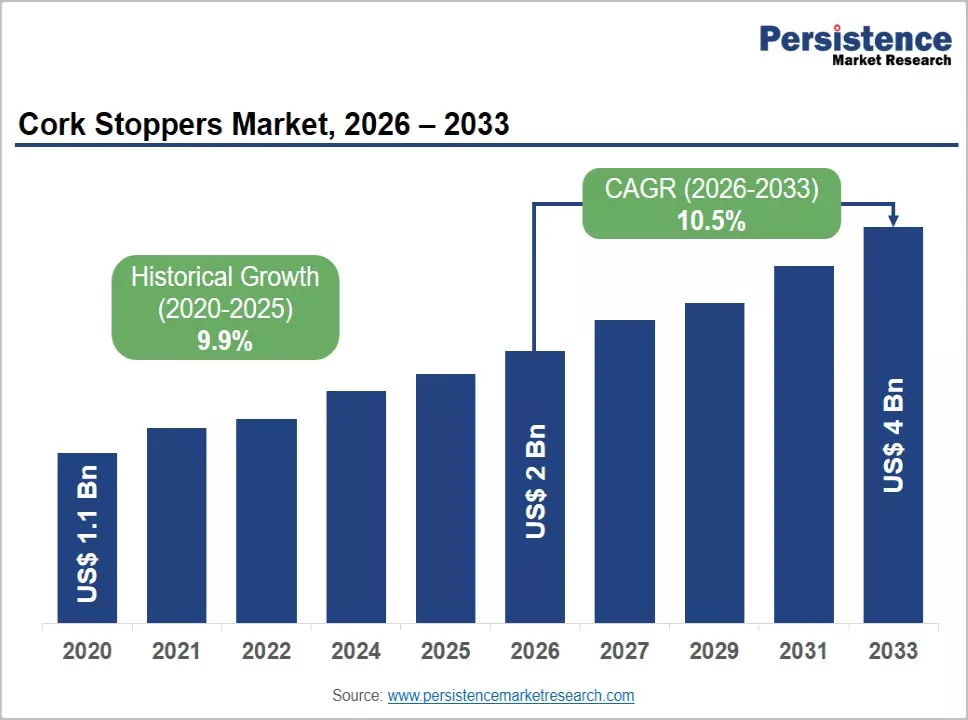
The global cork stoppers market is likely to be valued at US$ 2.0 billion in 2026 and is expected to reach US$ 4.0 billion by 2033, growing at a CAGR of 10.5% during the forecast period from 2026 to 2033.
Cork's resurgence is not nostalgic, it is structural. Wine producers, premium spirits bottlers, and artisan fragrance houses are actively rejecting synthetic closures on sustainability and sensory grounds, driving a broad revaluation of natural cork stoppers as a premium material standard.
This trajectory reflects compounding demand from premiumization across beverage categories, the European Union's biodiversity and sustainable forest management agenda under the EU Forest Strategy 2030, and accelerating wine consumption in Asia Pacific.
Key Industry Highlights:
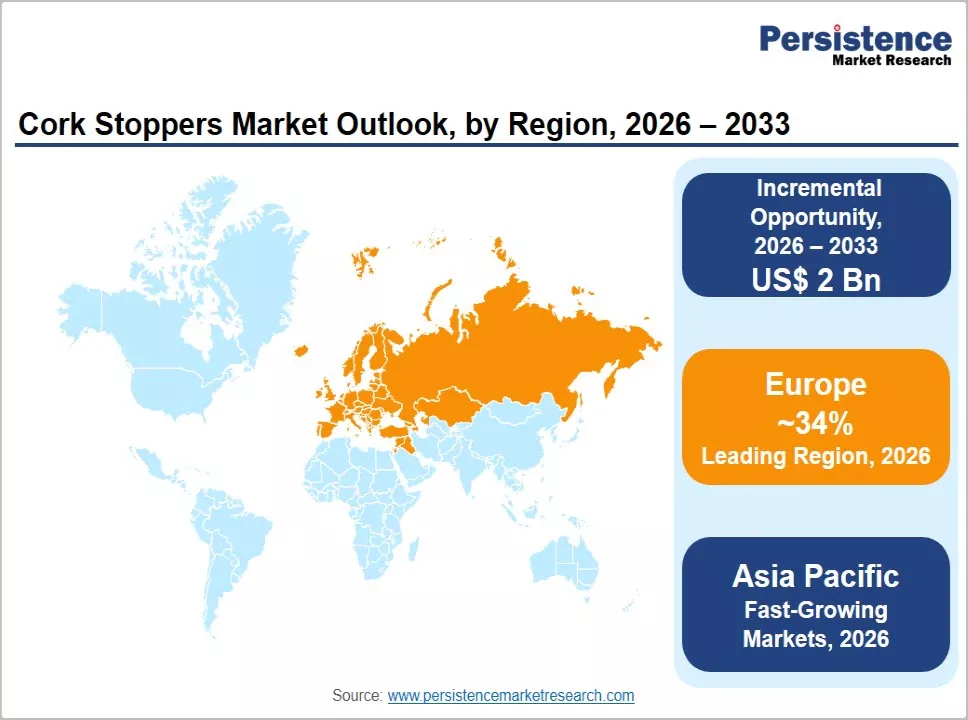
- Leading Region: Europe is anticipated to be the leading region in the cork stoppers market, supported by a market value of US$ 0.71 billion in 2026, driven by its dual role as both the primary production hub and the largest end-use market.
- Fastest-growing Region: Asia Pacific is likely to witness significant growth in the cork stoppers market at a CAGR of 12.4%, supported by a market value of US$ 0.53 billion in 2026, driven by China's wine consumption recovery and India's accelerating middle-class premiumization.
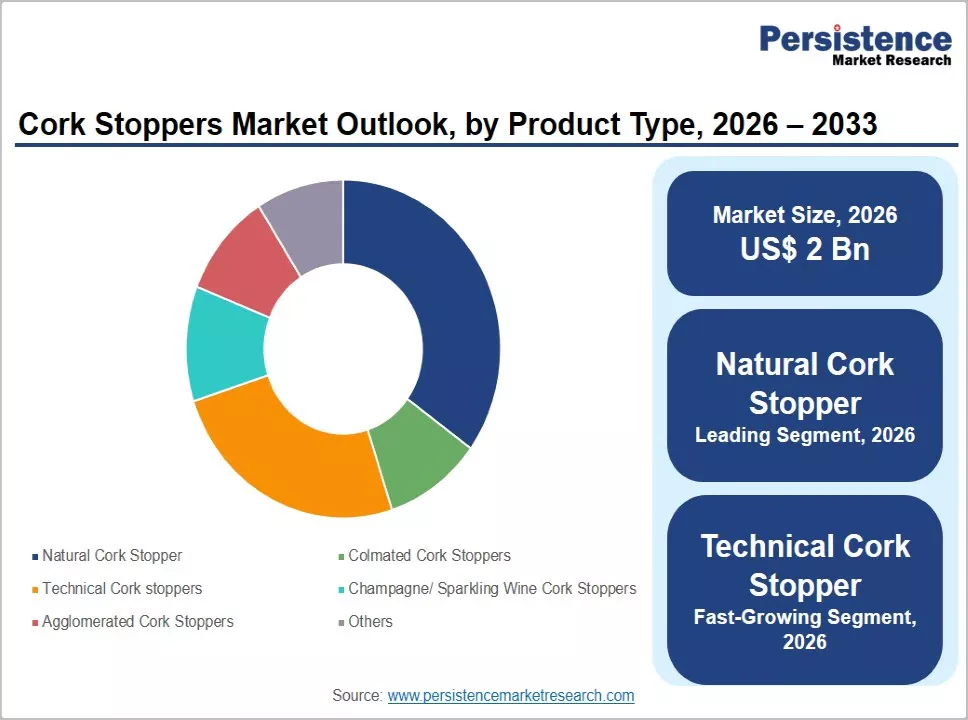
- Leading Product Type: Natural cork stopper is projected to represent the leading product type segment in 2026, accounting for 39% of the market share, anchored by its irreplaceable position in fine wine bottling and high-end spirits packaging.
- Fastest-growing Application: Premium spirits is anticipated to be the fastest-growing application segment, supported by single malt Scotch whisky exports and the mezcal boom, which signal craft authenticity through fitted natural cork closures.
- Key Opportunity: Technical cork stoppers for pharmaceutical packaging and laboratory applications create opportunities for manufacturers holding both FSC certification and validated TCA-suppression technology.
DRO Analysis
Driver - Premiumization Across Wine and Spirits Categories
Global wine and spirits producers are systematically trading up their packaging specifications, and natural cork closures sit at the center of that shift. The International Organization of Vine and Wine (OIV) reported in its 2023 State of the World Vine and Wine Sector report that wine consumption reached approximately 232 million hectoliters, with premium and super-premium SKUs outgrowing standard tiers.
Cork stoppers confer a provenance signal that aluminum screw caps and synthetic alternatives cannot replicate, particularly in direct-to-consumer and restaurant channels where the ritual of uncorking drives perceived value. Major négociants in Bordeaux and Burgundy, as well as Constellation Brands in its premium portfolio strategy, have reinforced natural cork specifications across their flagship lines, sustaining volume at higher per-unit closure prices.
Restraint - Cork Taint Risk and Quality Perception Among Cost-Sensitive Buyers
2,4,6-trichloroanisole (TCA) contamination (the compound responsible for cork taint that renders wine undrinkable) remains the most persistent reputational liability in the cork stoppers sector. While Corticeira Amorim, the world's largest cork manufacturer, launched its INNOCORK decontamination technology to suppress TCA below detectable thresholds, adoption across smaller Portuguese cooperages remains uneven.
Cost-sensitive wine producers, particularly those operating in bulk and commercial-tier categories, continue to favor screw caps and synthetic closures precisely to eliminate any taint risk and reduce per-unit closure expenditure.
Opportunity - Technical Cork Stoppers for Pharmaceutical and Specialty Industrial Applications
Beyond beverages, technical cork stoppers engineered for pharmaceutical vial sealing, laboratory flask closures, and high-precision fluid containment represent an underexploited growth vector. The European Medicines Agency (EMA) and U.S. Food and Drug Administration (FDA) permit cork-derived materials in select packaging classifications where inertness and compression recovery are operationally required.
Corticeira Amorim's industrial division and specialist manufacturers such as CP Lab Safety are already addressing laboratory and life sciences demand. As pharmaceutical packaging engineers seek alternatives to PVC and synthetic rubber under growing regulatory scrutiny of plasticizers, technical cork compounds present a credible substitution pathway.
Category-wise Analysis
Product Type Insights
Why Does Natural Cork Stopper Command the Largest Share of the Cork Stoppers Market?
Natural cork stopper accounts for 39% of the cork stoppers market in 2026, equivalent to US$ 0.82 billion, anchored by its irreplaceable position in fine wine bottling and high-end spirits packaging. The segment's dominance reflects a deeply entrenched buyer specification pattern, Appellation d'Origine Contrôlée (AOC) regulations in Bordeaux and Burgundy effectively mandate natural cork for classified growths, locking in volume regardless of price fluctuation.
Technical Cork Stoppers represent the fastest-growing product segment, propelled by their engineered performance characteristics, consistent compression recovery, low extractable content, and batch-to-batch dimensional uniformity. Vinventions, which produces the Nomacorc technical cork range, has expanded its product line to target pharmaceutical and cosmetic bottling applications since 2023, opening addressable markets well beyond the beverage sector and accelerating category growth beyond traditional wine-closure demand.
Container Type Analysis
Glass containers represent 45% of the cork stoppers market in 2026, equivalent to US$ 0.94 billion, reflecting the near-universal specification of glass bottles across premium wine, Champagne, and artisan spirits categories. Glass is the reference substrate for which natural cork stopper geometry and compression tolerances are engineered, the interaction between cork and borosilicate or soda-lime glass defines the standard seal performance parameters recognized by the International Organization of Vine and Wine.
Porcelain containers are the fastest-growing format in the cork stoppers landscape. Premium gifting applications (including limited-edition spirits decanters and artisan olive oil vessels) are driving demand for cork closures fitted to porcelain. Luxury homeware brands and boutique food producers launching porcelain-packaged editions at fine-food retail, notably at Fortnum & Mason and comparable premium grocery formats, began specifying custom cork profiles in 2023-2024 to reinforce artisan positioning.
Application Analysis
How Big Is the Wine Segment's Dominance of the Global Cork Stoppers Market in 2026?
The wines application accounts for 57% of the cork stoppers market in 2026, equivalent to US$ 1.20 billion, a share that reflects cork's functional and cultural indispensability to bottled wine.
No closure alternative replicates cork's microporosity, which permits the controlled micro-oxygenation essential to age-worthy red wines such as Cabernet Sauvignon and Nebbiolo.
Premium Spirits is the fastest-growing application in the cork stoppers industry. The expansion of single malt Scotch whisky exports (Scotch Whisky Association data shows exports exceeded £6 billion in 2022) alongside the mezcal boom driven by brands such as Del Maguey and Montelobos, has created sustained demand for fitted natural cork and agglomerated cork stoppers that signal craft authenticity.
Regional Insights
North America Cork Stoppers Market Trends
North America accounts for 17% of the cork stoppers market in 2026, representing US$ 0.57 billion, supported by the structural depth of its premium wine and craft spirits sectors. California's Napa and Sonoma appellations (which collectively export wine to over 140 countries, per Wine Institute data) maintain rigorous natural cork specifications for ultra-premium labels. Regional craft distillery growth under the Craft Beverage Modernization Act framework is widening cork demand beyond wine into spirits.
U.S. Cork Stoppers Market Trends
The U.S. cork stoppers market represents 88% of the North American regional market in 2026, equivalent to US$ 0.50 billion. American premium wine producers and the country's approximately 10,000 craft distilleries drive substantial per-unit cork procurement at premium price points. As on-trade hospitality channels recover and direct-to-consumer wine shipping regulations ease across additional states, demand for natural cork at fine-dining and collector segments will accelerate.
Canada Cork Stoppers Market Trends
The Canada cork stoppers market represents 12% of the North American regional market in 2026, equivalent to US$ 0.07 billion. The Liquor Control Board of Ontario (LCBO) (one of the world's largest single purchasers of wine and spirits) exercises significant procurement influence over closure specifications across the Canadian market. Growing British Columbia wine production under Vintners Quality Alliance (VQA) standards is expanding domestic cork closure demand.
Europe Cork Stoppers Market Trends
Europe accounts for 34% of the cork stoppers market in 2026, representing US$ 0.71 billion, driven by its dual role as both the primary production hub and the largest end-use market. Portugal alone supplies approximately 49.5% of cork raw material, per APCOR data. The EU Green Deal's emphasis on sustainable natural materials and the ongoing reform of single-use plastics regulation under the European Parliament reinforce demand for cork across intra-European bottling operations. Europe's leadership position is structurally durable through 2033.
Germany Cork Stoppers Market Trends
The Germany cork stoppers market represents 33% of the European regional market in 2026, equivalent to US$ 0.24 billion. Germany's large-scale wine bottling sector (the country is the world's third-largest wine importer by volume per German Wine Institute (Deutsches Weininstitut) data) generates consistent, high-volume cork closure procurement. Premiumization in German consumer retail, particularly in the Lebensmittelhandel grocery channel, is directing demand toward higher-grade natural and colmated stoppers.
U.K. Cork Stoppers Market Trends
The U.K. cork stoppers market represents 19% of the European regional market in 2026, equivalent to US$ 0.14 billion. The UK's well-developed direct-to-consumer wine market and its concentration of premium spirits brands (including several Distilled Spirits Council-tracked single malts) sustain consistent cork closure procurement. Post-Brexit alignment of UK packaging sustainability standards with EU norms will continue to favor cork over synthetic alternatives in premium product lines through 2033.
Asia Pacific Cork Stoppers Market Trends
Which Region Will Drive the Fastest Cork Stoppers Market Growth Through 2033?
Asia Pacific accounts for 25% of the cork stoppers market in 2026, representing US$ 0.53 billion, and is expanding at an estimated CAGR of 12.4%, the fastest of any region. China's wine consumption recovery following the removal of COVID-19 restrictions in 2023, combined with India's accelerating middle-class premiumization and the Confederation of Indian Alcoholic Beverage Companies (CIABC) reporting strong import growth in premium wines and whiskies, are compounding demand signals.
Regional bottling capacity investment will intensify cork procurement volumes through 2030.
China Cork Stoppers Market Trends
The China cork stoppers market represents 35% of the Asia Pacific regional market in 2026, equivalent to US$ 0.18 billion. China's rebound in imported Bordeaux and Burgundy wine following the resolution of Australian wine tariffs and renewed interest in domestic Ningxia and Xinjiang premium labels drives natural cork stopper procurement.
As domestic Chinese wineries upgrade to export-grade packaging, demand for FSC-certified natural corks will grow materially.
India Cork Stoppers Market Trends
The India cork stoppers market represents 19% of the Asia Pacific regional market in 2026, equivalent to US$ 0.10 billion. Rising disposable income among urban Indian consumers and the liberalization of alcohol retail in key states are sustaining import growth in premium wines and single malt whiskies. Pernod Ricard India's continued portfolio expansion and the entry of boutique importers targeting metropolitan on-trade channels signal sustained cork procurement growth through 2033.
Competitive Landscape
The cork stoppers industry operates as a moderately concentrated market, with Corticeira Amorim of Portugal holding an estimated commanding share by processing volume, followed by Cork Supply, M.A. Silva USA, and Vinventions competing on technology differentiation and service model innovation. Competition pivots on three axes: TCA suppression capability, FSC and sustainability certification credibility, and the ability to deliver custom embossing and dimensional precision at scale.
Smaller specialists, including Advance Cork International, PORTOCORK AMERICA, Stanimirov Cork Industry Lda., CorkLink Westfield Technologies Lda, and Barnacork, compete regionally through pricing flexibility and rapid turnaround for artisan and craft-volume buyers. The primary barrier to entry is raw material access in the Iberian cork oak belt, which limits new entrant scale.
Key Industry Developments:
- In July 2026, Corticeira Amorim launched ALØ, a range of natural cork stoppers developed for non-alcoholic and low-alcohol (NoLo) still and sparkling wines and spirits, with a special treatment and packaging designed to minimize contamination risk and guarantee microbial stability after bottling.
Companies Covered in Cork Stoppers Market
- Advance Cork International
- Barnacork
- Cork Supply
- CorkLink Westfield Technologies Lda
- Corticeira Amorim
- CP Lab Safety
- M.A. Silva USA
- PORTOCORK AMERICA
- Stanimirov Cork Industry Lda.
- Vinventions
Frequently Asked Questions
The global cork stoppers market is valued at US$ 2.0 billion in 2026 and is projected to reach US$ 4.0 billion by 2033, expanding at a CAGR of 10.5%.
The premiumization of wine and spirits packaging and mandatory sustainability disclosure requirements under the EU Corporate Sustainability Reporting Directive (CSRD).
Natural cork stopper holds the largest share at 39%, reinforced by appellation-level regulations in French and Italian fine wine regions.
Europe dominates with a 34% share, sustained by Portugal's position as the source of approximately 49.5% of cork raw material.
The highest-value opportunity lies in supplying technical cork stoppers to pharmaceutical packaging and laboratory applications.
Corticeira Amorim leads by processing volume, followed by Cork Supply, Vinventions, and M.A. Silva USA.


