




- Retail
- India Gift Card Market
India Gift Card Market Size, Share, and Growth Forecast 2026 - 2033
India Gift Card Market by Merchant (Restaurants, Department Stores, Grocery Stores, Supermarkets/Hypermarkets, Discount Stores, Coffee Shops, Entertainment & Experiences, Salons, Spas & Wellness, Book Store, Fashion & Lifestyle, Others), Card Type (Physical Gift Cards, E-Gifting), Price Range, Sales Channel, End-User, and Zone (North India, West India, South India, East India) Analysis for 2026 - 2033

India Gift Card Market Size and Trends Analysis
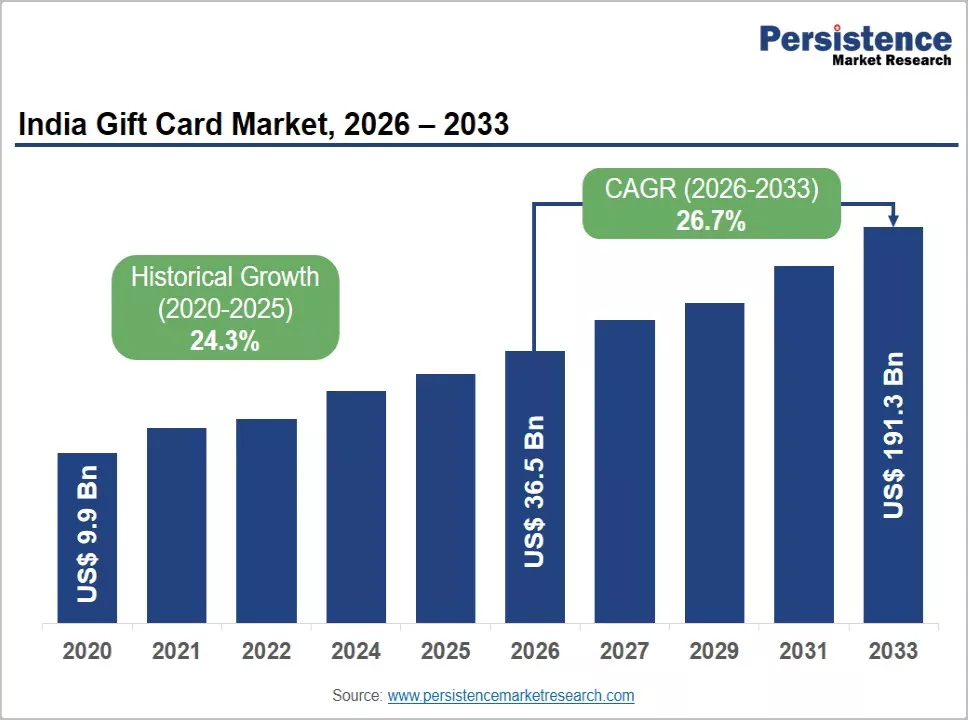
The India gift card market size is estimated at US$ 36.50 Billion in 2026 and is projected to reach US$ 191.31 Billion by 2033, registering a CAGR of 26.7% during 2026 - 2033.
The market is driven by the growing use of digital payments, increasing corporate adoption of employee rewards and incentives, and the integration of gift cards into online retail and brand loyalty programs. India's expanding digital payment infrastructure provides a favorable environment for this transition, with UPI recording 18,586.60 crore transactions worth INR 260.56 lakh crore in FY 2024-25, according to NPCI. Corporate and merchant-led distribution is also expanding, illustrated by Tata Neu's September 2024 launch of a gift card store covering more than 100 brands across 15 categories.
The RBI's PPI framework provides regulatory provisions for prepaid gift instruments, including a INR 10,000 maximum value per instrument and restrictions on reloadability and cash redemption.
Key Industry Highlights:
- Leading Merchant: Restaurants dominate the India gift card market, supported by their widespread acceptance across birthdays, festivals, family celebrations, and corporate gifting occasions, alongside growing adoption of digital food and dining vouchers.
- Fastest-growing Merchant: Entertainment & experiences represent the fastest-growing merchant category, driven by increasing consumer preference for experiential gifting, including concert tickets, sporting events, movie experiences, and adventure activities.
- Fastest-growing Card Type: E-gifting is the fastest-growing card type, supported by rising smartphone penetration, instant digital delivery, personalized gifting options, and increasing corporate adoption of digital reward and incentive solutions.
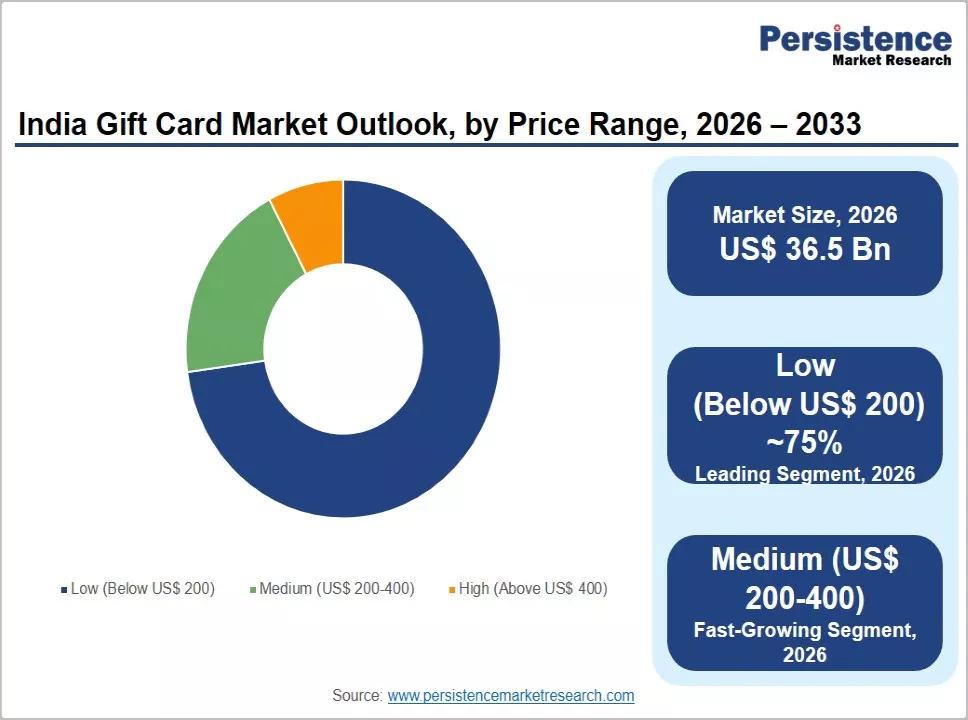
- Leading Price Range: The low (below US$ 200) segment dominates the market, reaching over US$ 27.38 billion in 2026, driven by affordability, frequent personal gifting, everyday discretionary spending, and employee appreciation programs.
- Fastest-growing Price Range: The medium (US$ 200-400) segment is witnessing the fastest growth, supported by increasing expenditure on premium gifting occasions, including weddings, anniversaries, branded merchandise, and corporate recognition programs.
- Fastest-growing Sales Channel: Online sales represent the fastest-growing distribution channel, driven by increasing digital payment adoption, instant voucher delivery, wider merchant selection, and the convenience of purchasing and sharing gift cards remotely.
- Leading End-User: Business customers dominate the India gift card market, supported by growing corporate adoption of employee rewards, festive gifting, performance incentives, and customer loyalty programs.
- Fastest-growing End-User: Individuals represent the fastest-growing end-user segment, driven by rising smartphone penetration, expanding digital purchasing access, and increasing adoption of gift cards for personal celebrations and everyday gifting.
- Leading Zone: South India leads the India gift card market, accounting for around 29% share in 2026, supported by its concentration of technology, IT services, and pharmaceutical companies across Bengaluru, Chennai, and Hyderabad, which generate substantial demand for corporate gifting and employee reward programs.
- Key Market Opportunity: The expansion of digital gifting ecosystems, integration of gift cards with UPI and online payment platforms, and growing demand for personalized corporate rewards and experiential gifting present significant opportunities for market participants. Companies investing in multi-brand gift card platforms, merchant partnerships, and seamless digital redemption solutions are well positioned to capitalize on India's rapidly expanding gift card market.
Market Dynamics
Drivers - Digital Payment Infrastructure and UPI-Enabled Redemption Ecosystems
India's expanding digital payment infrastructure is strengthening the accessibility and usability of digital gift cards across retail and corporate gifting channels. According to NPCI data, UPI processed 18,586.60 crore transactions worth INR 260.56 lakh crore in FY2024-25, representing substantial growth in everyday digital payment adoption. This ecosystem supports digital gift card purchases, wallet integration and merchant-side redemption, reducing dependence on physical vouchers. Companies such as Pine Labs Limited and PhonePe Limited are positioned to benefit from the convergence of digital payments, merchant acceptance networks and electronic gifting solutions.
Corporate Reward and Employee Incentive Programs Scaling Rapidly
Corporate gifting is becoming an increasingly structured component of employee engagement, festive rewards and performance-based incentive programs as organizations adopt digital distribution instead of traditional physical vouchers. India's expanding formal employment ecosystem provides a broader institutional customer base for bulk gift card procurement, particularly among technology companies, financial institutions and large service-sector employers. Platforms such as Pluxee India Private Limited, formerly Sodexo Benefits and Rewards India, and Edenred India facilitate corporate employee benefits and reward programs through digital solutions. The growing adoption of electronic delivery, multi-brand catalogues and centralized reward management creates opportunities for aggregators to expand their corporate gifting portfolios.
Restraints - Regulatory Ambiguity Around Expiry, Float, and Consumer Protection
India's gift card regulatory framework varies according to the instrument's structure, redemption network and issuer classification, creating compliance considerations for businesses operating across multiple formats. The RBI's Master Directions on Prepaid Payment Instruments distinguish closed-system instruments from regulated PPIs, with eligible prepaid Gift PPIs subject to a INR 10,000 maximum value per instrument and specific issuance and redemption conditions. Closed-system vouchers redeemable only with the issuing merchant are treated differently from multi-merchant prepaid instruments. These distinctions increase the compliance burden for aggregators and issuers offering diverse gift card products.
Gift Card Fraud, Counterfeiting, and Social Engineering Scams
The growing digitization of gifting and prepaid instruments exposes issuers, merchants and consumers to phishing, impersonation, unauthorized redemption and fraudulent voucher distribution. According to the Ministry of Home Affairs, India's National Cyber Crime Reporting Portal recorded around 24.03 lakh financial fraud complaints during 2025, highlighting the broader risks associated with digital financial transactions. Gift card providers must consequently invest in secure PIN generation, transaction monitoring, redemption authentication and rapid customer complaint resolution, increasing operating costs and potentially affecting consumer confidence.
Opportunities - B2B Gifting Platforms Targeting SME and Startup Employer Base
India's expanding formal business ecosystem presents a significant opportunity for corporate gift card aggregators targeting small and medium-sized enterprises and emerging startups. According to the Government of India, the country had more than 1.51 crore active GST registrations as of 30 April 2025, reflecting the substantial scale of its registered business base. Many smaller employers can be approached with flexible gifting solutions that offer bulk digital voucher issuance, multi-brand catalogues, automated distribution and consolidated invoicing.
Experiential and Lifestyle Gift Cards Capturing Premium Consumer Spending
The increasing preference for travel, leisure and experience-oriented consumption is creating opportunities for gift cards across hospitality, dining, entertainment and wellness categories. The 2025 India Holiday Report by Thomas Cook India and SOTC Travel, based on more than 2,500 respondents, found that 60% were seeking unique, experiential or bucket-list holidays, while 84% intended to increase travel spending by 20-50%. This shift creates opportunities for curated gift cards covering travel bookings, restaurant experiences, entertainment and lifestyle services rather than conventional merchandise alone.
Category-wise Analysis
Merchant Insights
Why Do Restaurants Lead the India Gift Card Market?
Restaurants are expected to remain the leading merchant category in the India gift card market, reaching around US$ 6.57 billion in revenue in 2026. Their dominance is supported by the widespread use of food and beverage vouchers for birthdays, festivals, family gatherings, and corporate celebrations.
Restaurant gift cards offer flexibility across age groups and income categories, making them suitable for both individual and business gifting. According to Swiggy's How India Swiggy'd 2025 report, around 93 million biryani orders were recorded during 2025, highlighting the strong consumer demand for food and dining experiences. These consumption patterns create favorable opportunities for restaurant chains and digital gifting platforms to expand their gift card offerings.
Entertainment & experiences represent the fastest-growing merchant category, driven by increasing consumer preference for experiential gifting over conventional material presents. Demand for movie tickets, concerts, sporting events, and adventure activities is expanding the range of gifting occasions among younger consumers and urban households. According to the FICCI-EY Media and Entertainment Report 2026, India recorded 34,086 live events in 2025, while live-event consumption increased by 17%. Platforms such as BookMyShow are benefiting from this trend through their extensive event-ticketing ecosystem and experience-based offerings, creating new opportunities for merchant partnerships and differentiated gifting solutions.
Card Type Insights
Physical gift cards are the leading card type segment, supported by continued consumer preference for tangible gifting formats during weddings, festivals, and personal celebrations. These cards preserve the traditional gifting experience while providing recipients with flexibility to select their preferred products or services. Their adoption is particularly relevant for formal gifting occasions and corporate events where physical presentation remains important. According to the WedMeGood Annual Wedding Report 2025, the average Indian wedding budget reached INR 39.5 lakh, highlighting the substantial expenditure associated with wedding-related purchases and celebrations.
E-gifting represents the fastest-growing card type, driven by increasing smartphone penetration, instant digital delivery, personalized messaging, and convenient purchasing experiences. Digital gift cards are particularly attractive for last-minute gifting, remote celebrations, and corporate reward programs involving employees across multiple locations. According to the Government of India's Economic Survey 2025-26, around 85.5% of Indian households owned at least one smartphone in 2025.
Platforms such as Amazon Pay India and Flipkart are supporting market expansion through online gift card purchasing, instant digital delivery, and personalized gifting options. The growing integration of digital gift cards with e-commerce and payment ecosystems is expected to further accelerate segment adoption.
Price Range Insights
What Is Driving Demand for Low-Value Gift Cards in India?
The low (below US$ 200) segment is expected to reach over US$ 27.38 billion in 2026, making it the dominant price category in the India gift card market. Its leadership is supported by affordability, frequent personal gifting, employee appreciation initiatives, and everyday discretionary spending. Consumers increasingly prefer smaller-denomination gift cards for birthdays, festivals, and casual celebrations, allowing them to participate in gifting without significant financial commitments. Corporate employers also utilize lower-value vouchers for employee recognition, performance incentives, and engagement programs, supporting recurring demand across business customers.
Medium (US$ 200-400) represents the fastest-growing price category, driven by rising expenditure on premium gifting occasions, including weddings, anniversaries, and corporate recognition programs. Increasing discretionary spending and demand for branded products are encouraging consumers to purchase higher-value gift cards across jewellery, electronics, fashion, and lifestyle categories. According to the WedMeGood Annual Wedding Report 2025, the average Indian wedding budget reached INR 39.5 lakh, highlighting the growing economic significance of wedding-related gifting and premium purchase occasions.
Sales Channel Insights
The offline sales channel is expected to generate over US$ 18.25 billion in 2026, supported by consumer preference for purchasing and presenting physical gift cards through established retail outlets. Supermarkets, department stores, jewelry showrooms, and bank branches provide convenient access to branded gift cards during regular shopping visits. The expansion of organized retail networks is further strengthening physical distribution opportunities. SS Retail expanded its store network from 236 outlets in March 2024 to 376 outlets by June 2025, demonstrating the increasing reach of organized retail. Retailers such as Reliance Retail and D-Mart, alongside organized electronics chains, provide potential distribution touchpoints for physical gift card products.
The online sales channel represents the fastest-growing distribution segment, driven by increasing digital payment adoption, instant voucher delivery, and convenient purchasing experiences. Online platforms enable consumers to compare merchant offerings, select preferred denominations, and send personalized gift cards without visiting physical stores. According to the Department of Financial Services Annual Report 2025-26, India's digital payment transactions reached 22,831 crore in FY 2024-25, compared with 2,071 crore in FY 2017-18. The rapid expansion of India's digital payment ecosystem is creating favorable conditions for online gift card distribution, merchant integration, and technology-enabled gifting solutions.
End-User Insights
Which End-User Segment Holds the Largest Share of India's Gift Card Market?
Business represents the leading end-user segment, holding the largest share of the market in 2026. Segment dominance is supported by corporate expenditure on employee rewards, festive gifting, performance incentives, and customer loyalty programs. Businesses increasingly prefer gift cards over conventional physical rewards because they provide recipients with greater purchasing flexibility while simplifying bulk procurement and distribution. According to Edenred India's 2025 disclosures, its global voucher network had cumulatively issued more than one billion vouchers, highlighting the scale and commercial relevance of voucher-based reward programs.
Individual consumers represent the fastest-growing end-user segment, driven by rising digital accessibility, increasing smartphone penetration, and changing personal gifting preferences. Consumers are increasingly purchasing gift cards for birthdays, festivals, weddings, and anniversaries, particularly when recipients have diverse product and brand preferences. According to the National Statistics Office's Comprehensive Modular Survey: Telecom 2025, around 85.5% of Indian households possessed at least one smartphone. Greater access to digital payment platforms and online retail ecosystems is expected to encourage individual purchases and expand gift card adoption across urban and emerging consumer markets.
Zone Analysis
North India Gift Card Market
North India's gift card market is supported by strong demand across Delhi NCR, Uttar Pradesh, and Punjab, driven by corporate headquarters, public-sector employment, and established festive gifting traditions surrounding occasions such as Diwali and Holi.
Delhi NCR's concentration of banking, financial services, insurance, and IT companies generates substantial business-to-business demand for employee rewards, corporate incentives, and customer loyalty programmes. Meanwhile, the expansion of modern retail across Tier 2 cities in Uttar Pradesh, including Lucknow, Kanpur, and Agra, is creating opportunities to strengthen physical gift card distribution. Growing digital commerce adoption and increasing consumer awareness of branded gifting platforms are expected to further support regional market development.
West India Gift Card Market
West India represents a significant commercial market, led by Maharashtra and Gujarat, supported by a strong concentration of fintech companies, large corporations, and affluent individual consumers. Mumbai's financial services ecosystem generates consistent demand for high-value corporate gifting, employee incentives, and customer engagement programs. Gujarat's expanding SME base is creating additional opportunities for gift card aggregators offering technology-enabled bulk issuance and corporate reward solutions.
Pune and Ahmedabad are emerging as important secondary growth centers, supported by expanding organized retail networks, corporate employment, and increasing awareness of digital gifting platforms. These factors are strengthening the region's position as an important market for both corporate and individual gift card consumption.
South India Gift Card Market
South India leads the India gift card market, accounting for around 29% share in 2026. Its leadership is supported by the concentration of technology, IT services, pharmaceutical, and multinational companies across Bengaluru, Chennai, Hyderabad, and Kochi.
Bengaluru's technology corridor, which hosts major employers such as Wipro Limited, HCL Technologies Limited, and global multinational corporations, generates substantial demand for bulk digital gift cards and structured employee reward programs. The region also benefits from a well-developed digital ecosystem, strong corporate procurement practices, and increasing adoption of technology-enabled employee engagement solutions. Its concentration of employers across technology, professional services, and life sciences provides a favorable foundation for sustained corporate gifting expenditure and continued market leadership.
Competitive Landscape
The India gift card market is moderately concentrated at the aggregator and corporate distribution levels, while remaining fragmented across merchant-branded issuers. Competition is primarily driven by merchant network coverage, breadth of gift card catalogues, and seamless digital and physical redemption capabilities. Banking institutions leverage established customer relationships, brand credibility, and cross-selling opportunities to strengthen their market positioning. Meanwhile, digital aggregators and corporate gifting platforms are focusing on merchant integrations, customized reward solutions, enterprise onboarding, and distribution efficiency.
Competitive differentiation increasingly depends on redemption network coverage, merchant partnerships, platform capabilities, transaction security, and scalable corporate distribution infrastructure. As digital payments and organized retail continue expanding across India, market participants with extensive merchant partnerships and technology-enabled distribution capabilities are expected to strengthen their competitive positions.
Key Industry Developments
- In July 2026, super.money, backed by the Flipkart Group, launched superGift, a multi-brand gifting solution integrating brands such as Flipkart, Myntra, Cleartrip, Zomato and District. Available in both physical and digital formats, the platform targets individual gifting, employee rewards, channel incentives and corporate customer engagement.
- In July 2026, Budgetree Technology Pvt. Ltd. launched its Gift Card API, enabling enterprises, fintech companies, and loyalty platforms to issue, deliver, and track digital gift cards from over 350 brands through a single integration. The API supports instant delivery via email, SMS, and apps, targeting corporate gifting, employee rewards, customer loyalty, and promotional campaigns.
Companies Covered in India Gift Card Market
- Pine Labs Limited
- Vouchagram India Private Limited
- Amazon Pay Private Limited
- Flipkart Internet Private Limited
- PhonePe Limited
- One 97 Communications Limited
- Pluxee India Private Limited
- Edenred Private Limited
- Nreach Online Services Private Limited
- HDFC Bank Limited
- ICICI Bank Limited
- Axis Bank Limited
- Kotak Mahindra Bank Limited
- Eroute Technologies Private Limited
- Others
Frequently Asked Questions
The India gift card market size is estimated at US$ 36.50 Billion in 2026 and is projected to reach US$ 191.31 Billion by 2033, growing at a CAGR of 26.7%.
Market growth is driven by rising corporate adoption of employee rewards and incentives, alongside the expansion of organized retail across Tier 2 and Tier 3 cities. Increasing digital payment adoption and demand for convenient gifting solutions further support market expansion.
Physical gift cards dominate the market with around 58.0% share in 2026, supported by their popularity in festive, personal, and corporate gifting. Their tangible presentation and suitability for in-person gifting sustain demand despite growing e-gifting adoption.
South India leads the market with nearly 29% share. Its strong IT and technology industry presence, corporate gifting demand, and high digital adoption across Bengaluru, Chennai, and Hyderabad support regional dominance.
SME adoption of API-integrated bulk gift card programs presents a significant growth opportunity. Increasing business formalization and demand for automated employee rewards are creating opportunities for platforms such as Vouchagram India Private Limited.
Key players include Pine Labs Limited, PhonePe Limited, Amazon Pay Private Limited, Flipkart Internet Private Limited, and Pluxee India Private Limited. Competition centers on corporate partnerships, merchant network coverage, digital integrations, and the breadth of gift card offerings.


