




- Non-food Packaging
- North America Corrugated Packaging Market
North America Corrugated Packaging Market Size, Share, and Growth Forecast, 2026 - 2033
North America Corrugated Packaging Market by Board Grade (Recycled Containerboard, Virgin Kraft Linerboard), Wall Type (Single-wall, Double-wall), Product Type, End-use Industry, and Regional Analysis for 2026 - 2033

North America Corrugated Packaging Market Size and Trends Analysis
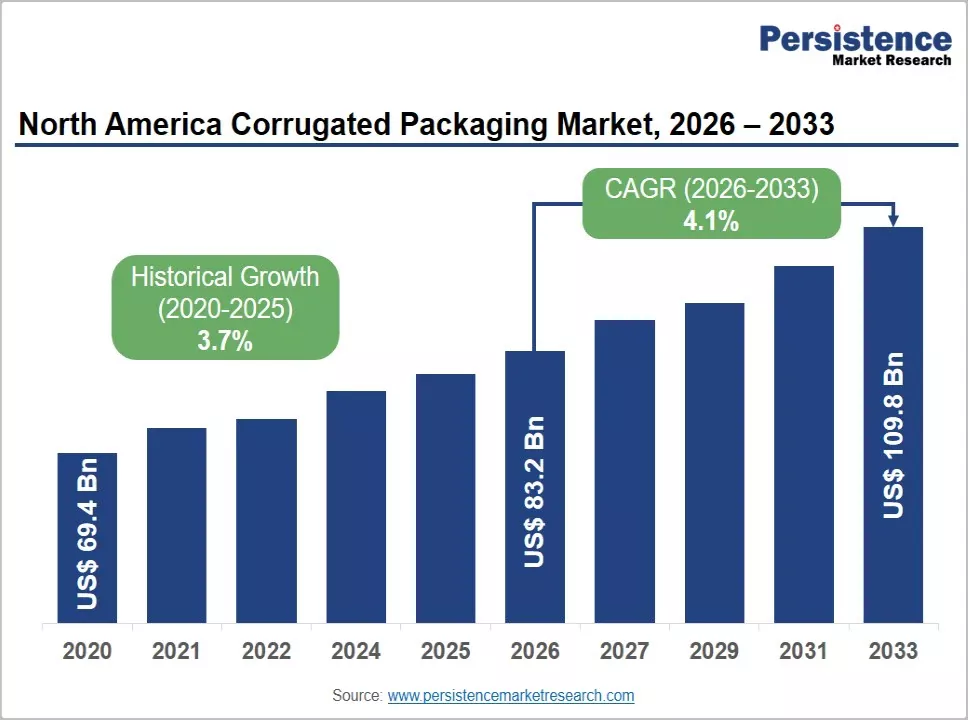
The North America corrugated packaging market size is likely to be valued at US$ 83.2 billion in 2026 and is expected to reach US$ 109.8 billion by 2033, growing at a CAGR of 4.1% between 2026 and 2033.
Market growth is being supported by rising e-commerce shipments, increasing demand for sustainable packaging materials, and the growing preference for recyclable alternatives to plastic packaging. The expansion of online retail and demand for corrugated packaging solutions for e-commerce shipping are strengthening adoption across the region, while advancements in lightweight, durable, and customized packaging are supporting demand for sustainable corrugated packaging for consumer goods.
Key Industry Highlights
- Leading Country: The U.S. dominates the North America corrugated packaging market, accounting for 80.4% of regional revenue in 2026, supported by its extensive e-commerce distribution network, food processing industry, and established corrugated manufacturing base.
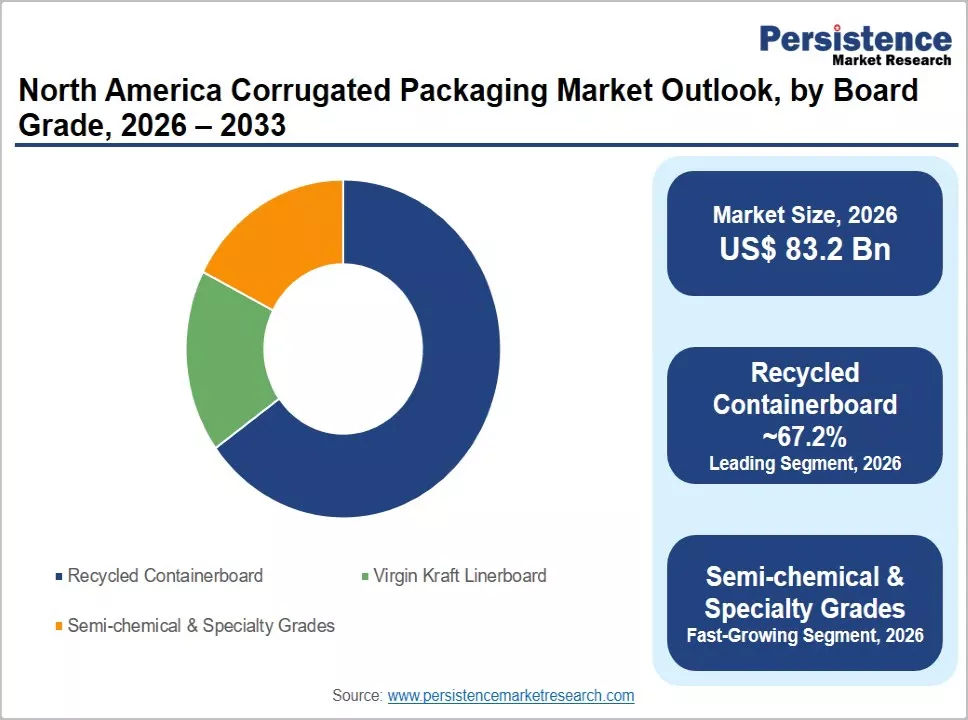
- Dominant Board Grade: Recycled containerboard leads the board grade segment with 67.2% market share in 2026, supported by established recovered-fiber collection networks and extensive use in e-commerce, grocery, and consumer goods packaging.
- Leading Wall Type: Single-wall corrugated packaging dominates the wall type segment with 58.5% market share in 2026, driven by its cost efficiency, lightweight construction, and suitability for standard shipping, retail distribution, and food packaging.
DRO Analysis
Driver - E-commerce Fulfillment and Automated Distribution Are Increasing Corrugated Packaging Demand
The expansion of direct-to-consumer sales and multi-item online orders is increasing demand for corrugated shipping boxes for e-commerce fulfillment across North America. Retailers and logistics providers increasingly require packaging that withstands automated sorting, conveyor handling, stacking, and long-distance transportation. This is supporting demand for high-strength corrugated boxes for heavy-duty shipping, particularly for electronics, appliances, and consumer goods. Shelf-ready trays and display-ready cases are also gaining traction in grocery and warehouse retail. For example, Amazon's Frustration-Free Packaging program encourages shipment-ready packaging that reduces unnecessary secondary materials and improves fulfillment efficiency.
The growing adoption of automated distribution centers is creating demand for machine-compatible corrugated packaging for automated warehouses. Consistent dimensions, structural strength, and precise box construction support automated case erecting, robotic picking, and high-speed packing operations. Manufacturers are responding with precision-converted formats that improve pallet utilization and reduce unused shipping space. Demand for custom-sized corrugated boxes for parcel delivery is also increasing as retailers seek packaging tailored to different product dimensions.
Restraint - Moisture Sensitivity and Alternative Packaging Materials Limit Corrugated Applications
Corrugated packaging is vulnerable to moisture absorption, particularly during refrigerated storage, humid warehousing, and temperature-controlled transportation. High humidity weakens paper fibers and reduces box compression strength, creating challenges for moisture-resistant corrugated packaging for cold chain logistics. These limitations are particularly relevant to fresh produce, seafood, and frozen food distribution, where condensation affects package integrity.
Corrugated materials also face limitations in applications requiring prolonged resistance to liquids, grease, and contamination. Flexible films and multilayer packaging retain advantages in products requiring strong moisture barriers and compact formats. Developing recyclable coated corrugated packaging for wet food applications remains technically challenging because protective coatings and wet-strength treatments affect fiber recovery. Maintaining barrier performance while preserving recyclability remains an important material-design consideration.
Opportunity - Functional Coatings and Digital Printing Are Expanding Corrugated Packaging Applications
Advancements in functional coatings and barrier treatments are creating opportunities for water-resistant corrugated packaging for fresh produce, seafood, and refrigerated food distribution. Manufacturers are developing treated fiberboard that improves moisture resistance while retaining compatibility with paper recycling processes. In May 2025, the American Forest & Paper Association and Fiber Box Association updated their voluntary testing standard for evaluating the repulpability and recyclability of coated and treated corrugated materials, supporting further development of recyclable moisture-barrier corrugated packaging.
Digital printing and precision converting are expanding demand for short-run digitally printed corrugated packaging among brands with frequent artwork changes, seasonal launches, and varied product portfolios. These technologies reduce dependence on preprinted inventory and support customized packaging in smaller production batches. For example, International Paper's Digital Print @ Customer offering enables on-demand printing of corrugated cases directly on customer packaging lines, supporting custom-printed corrugated boxes for retail and consumer brands.
Category-wise Market Analysis
Board Grade Insights
Recycled containerboard dominates with 67.2% market share due to its established supply chain, competitive material economics, and extensive use in high-volume packaging applications. The region has a well-developed collection and recovery network for old corrugated containers (OCC), providing paper mills with a consistent source of recovered fiber. Its suitability for manufacturing corrugated boxes used in grocery distribution, beverages, e-commerce shipments, and general consumer goods further strengthens its market position. Recycled grades also support lightweight packaging designs that reduce material consumption while maintaining the required stacking and compression strength.
Semi-chemical and specialty grades are projected to record the fastest growth as packaging applications increasingly require specific combinations of structural strength, surface quality, and functional performance. Semi-chemical fluting provides resistance to crushing and supports packaging exposed to demanding stacking and transportation conditions. Specialty grades also address requirements such as improved printability, grease resistance, moisture protection, and enhanced presentation for premium products. Demand from cosmetics, meal-kit providers, and consumer electronics brands is supporting the adoption of higher-performance corrugated substrates.
Wall Type Insights
Single-wall corrugated packaging holds 58.5% market share as it offers a practical balance of structural strength, material efficiency, and production cost across a broad range of applications. Its construction, consisting of one fluted medium sandwiched between two linerboards, provides sufficient cushioning and compression resistance for everyday shipping and storage requirements. It is extensively used in e-commerce parcels, processed food packaging, retail distribution, and light industrial shipments. Its compatibility with high-speed converting, automated packing, and standardized box designs further supports widespread adoption among manufacturers and logistics providers.
Triple-wall corrugated packaging is expected to register the fastest growth as manufacturers increasingly require heavy-duty packaging for industrial components, automotive parts, machinery, and bulk shipments. Its construction incorporates three fluted mediums and four linerboards, providing greater stacking strength, compression resistance, and impact protection than single-wall and double-wall alternatives. Growing manufacturing activity and nearshoring across the U.S. and Mexico are supporting demand for durable packaging capable of protecting heavy products during extended transportation and intermodal shipping. Triple-wall containers also offer an alternative to certain wooden crates and heavier industrial packaging formats.
Competitive Landscape
The North America corrugated packaging market is moderately consolidated, with leading integrated manufacturers competing alongside regional converters and independent packaging suppliers. Competition is primarily driven by containerboard production capacity, vertical integration, distribution networks, product customization, pricing, and recycling capabilities.
These companies compete through specialized packaging formats, sustainable material solutions, customized designs, and customer-focused converting services. The market also retains a substantial regional supplier base, with competition frequently determined by proximity to customers, delivery reliability, and the ability to meet specific packaging requirements.
Key Industry Developments
- In May 2026, International Paper broke ground on a new US$ 225 million corrugated packaging facility in Rankin County, Mississippi. The 468,000-square-foot plant is designed to expand production capacity, improve operational efficiency, and strengthen customer service across the Mid-South region.
- In May 2026, International Paper acquired Delmarva Corrugated Packaging's converting facility in Dover, Delaware, expanding its manufacturing footprint and corrugated packaging capacity in the East Coast market.
Companies Covered in North America Corrugated Packaging Market
- International Paper
- Smurfit Westrock
- Packaging Corporation of America
- Georgia-Pacific
- Pratt Industries
- Cascades Inc.
- Green Bay Packaging
- Menasha Corporation
- Hood Packaging Corporation
- Sonoco Products Company
- Atlantic Packaging Products
- Welch Packaging Group
Frequently Asked Questions
The North America corrugated packaging market is estimated to reach US$ 83.2 billion in 2026.
The market is projected to reach US$ 109.8 billion by 2033.
Key trends include increasing adoption of recycled containerboard, lightweight corrugated designs, automated packaging formats, moisture-resistant coatings, and digital printing for customized shipping boxes.
Recycled containerboard is the leading board grade segment, accounting for 67.2% of the market in 2026. Single-wall corrugated packaging leads the wall type segment with a 58.5% share.
The market is projected to expand at a 4.1% CAGR between 2026 and 2033.
The major companies include International Paper, Smurfit Westrock, Packaging Corporation of America, Georgia-Pacific, and Pratt Industries.


