




- Non-food Packaging
- Cosmetic Laminated Tube Packaging Market
Cosmetic Laminated Tube Packaging Market Size, Share, and Growth Forecast, 2026 - 2033
Cosmetic Laminated Tube Packaging Market by Tube Type (Plastic Barrier Laminate, Recyclable Laminate, Aluminum Barrier Laminate), Application (Skincare, Haircare, Facial Cleansers), Capacity, and Regional Analysis for 2026 - 2033

Cosmetic Laminated Tube Packaging Market Size and Trends Analysis
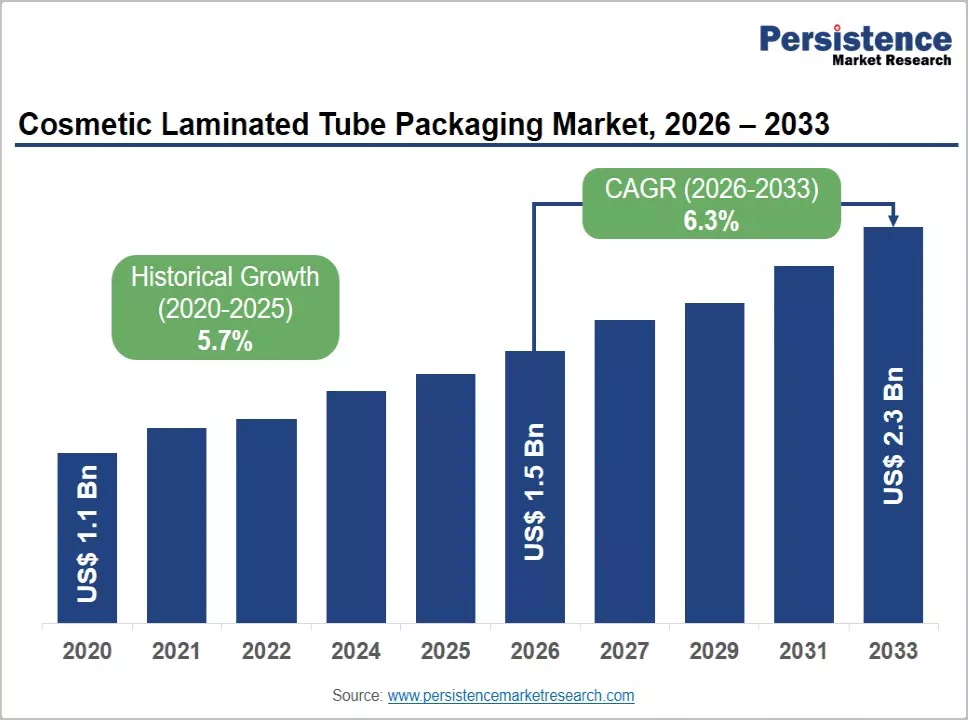
The global cosmetic laminated tube packaging market size is likely to be valued at US$ 1.5 billion in 2026 and is expected to reach US$ 2.3 billion by 2033, growing at a CAGR of 6.3% between 2026 and 2033, supported by rising demand for skincare packaging, premium personal care products, and high-barrier flexible formats. Laminated tubes combine product protection, controlled dispensing, print quality, and convenient handling. Recyclable laminate development and lightweighting are further influencing supplier investments and brand-owner packaging decisions.
Key Industry Highlights
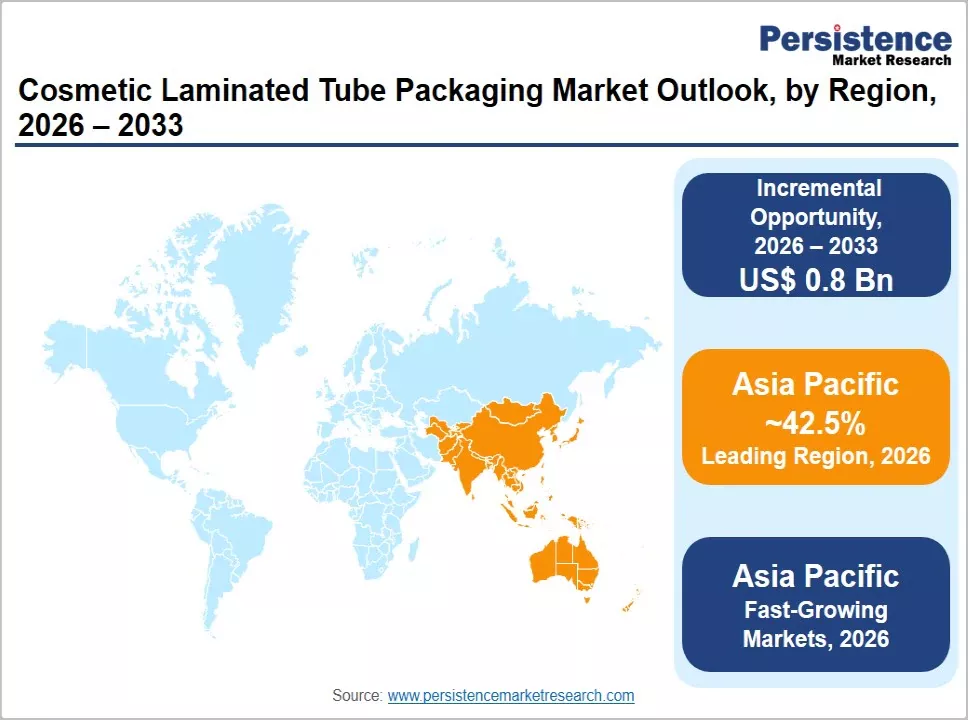
- Leading Region: Asia Pacific is anticipated to account for 42.5% of the market share, supported by a large cosmetics manufacturing base, expanding skincare consumption, and established tube-converting capacity.
- Fastest-growing Region: Asia Pacific, driven by expanding beauty and personal care demand, growth in domestic cosmetic brands, and investment in recyclable laminate structures.
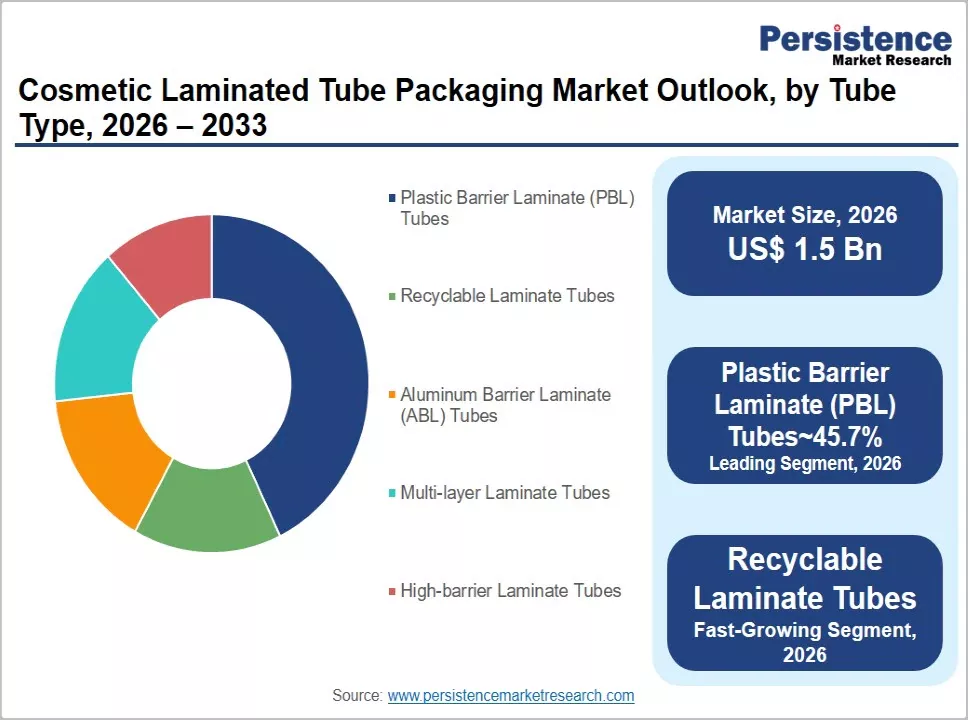
- Dominant Tube Type: Plastic Barrier Laminate (PBL) tubes, holding 45.7% of the market share in 2026, supported by barrier performance, printability, product compatibility, and broad use across skincare formulations.
- Leading Application: Skincare products, accounting for 43.4% of the market share in 2026, reflecting extensive use of tubes for creams, moisturizers, gels, lotions, and treatment products.
DRO Analysis
Drivers - Expanding Skincare Consumption Is Increasing Demand for Functional Packaging
Growing consumption of skincare products is a primary demand driver for cosmetic laminated tube packaging. Facial moisturizers, sunscreens, cleansers, anti-aging creams, and treatment gels are commonly distributed in tubes because the format supports controlled dispensing and limits direct contact between the formulation and the user. The skincare application accounted for 43.4% of the market in 2026, establishing it as the largest application category. Growth in beauty routines, product specialization, and premium skincare ranges is increasing demand for packaging that combines barrier protection with visual differentiation. Laminated tubes also support varied closures, nozzle designs, and printed finishes.
The expansion of organized beauty retail, online sales, and direct-to-consumer brands is reinforcing this demand. Product packaging remains important for shelf presentation and for maintaining product integrity during storage and distribution. Tube manufacturers are responding through customized laminate structures, improved sealing, high-definition printing, and dispensing features suited to different formulation viscosities. The resulting demand supports both large-volume production contracts and shorter customized runs for emerging cosmetic brands.
Restraint - Multilayer Construction and Recycling Infrastructure Create Cost and Processing Challenges
The use of multiple material layers creates technical and economic challenges for cosmetic laminated tube packaging. Barrier films, polymer resins, adhesives, printing inks, and specialized converting processes contribute to production costs. Changes in resin, aluminum, energy, and transportation prices also influence manufacturers’ input expenses. Multilayer structures provide product protection, but mixed-material construction complicates sorting and recycling when the layers are not compatible with established recycling streams. Recyclable alternatives require material redesign, testing, and validation to maintain sealing, barrier performance, print quality, and filling-line compatibility.
The transition to recyclable structures also involves qualification work between tube manufacturers, cosmetic brands, filling partners, and recyclers. Packaging changes require stability testing and line trials, particularly for products with sensitive formulations. Smaller brands face higher relative costs when ordering customized structures or lower production volumes. These factors create a measured transition from conventional high-barrier laminates to recyclable alternatives and influence adoption timelines across price-sensitive cosmetic categories.
Opportunities - Recyclable Laminate Structures Create New Product Development Opportunities
Recyclable laminate tubes represent a key opportunity as cosmetic brands respond to packaging circularity requirements and voluntary sustainability commitments. Manufacturers are developing all-polyethylene structures and recyclable barrier laminates that retain the dispensing and protection properties associated with conventional tubes. EPL’s Platina family and r-Platina range illustrate the development of recyclable laminate solutions for consumer packaging. In December 2025, EPL announced that its r-Platina tubes met specified future PPWR requirements and achieved the highest RecyClass rating, reinforcing the role of design-for-recycling in product development.
The European Union’s Packaging and Packaging Waste Regulation entered into force in February 2025 and applies from August 12, 2026. It establishes a framework for packaging recyclability, recycled content, and harmonized labeling, with a broader objective of making packaging recyclable by 2030. These requirements increase the importance of material selection and recyclability assessment for suppliers serving European cosmetic brands. Similar extended producer responsibility frameworks in other markets are increasing interest in recyclable and resource-efficient tube designs.
Category-wise Analysis
Tube Type Insights
Plastic Barrier Laminate (PBL) tubes are anticipated to remain the leading tube type, accounting for 45.7% of the market share in 2026. PBL tubes use polymer-based laminate structures designed to provide product protection, flexibility, and consistent dispensing. Their suitability for creams, lotions, facial cleansers, sunscreens, and other personal care formulations supports their broad adoption. The structure also provides a printable outer surface, allowing cosmetic brands to use detailed graphics, metallic effects, color variation, and product information across the tube body. Established manufacturing capabilities and compatibility with a wide range of closures further support the segment.
Recyclable laminate tubes represent the fastest-growing tube type as packaging suppliers introduce structures designed for compatibility with defined recycling streams. EPL’s Platina range includes recyclable laminate formats, while its r-Platina product development addresses evolving packaging requirements. Recyclable designs are gaining attention from brands seeking to reduce virgin plastic use and improve packaging recovery. Aluminum Barrier Laminate tubes continue to serve applications requiring strong barrier properties, while multi-layer and high-barrier formats remain relevant for formulations sensitive to oxygen, moisture, or light. Product selection depends on formulation stability, filling-line requirements, packaging appearance, and local recycling infrastructure.
Application Insights
Skincare products are anticipated to remain the leading application, accounting for 43.4% of the market share in 2026. Laminated tubes are widely used for moisturizers, face creams, sunscreens, facial treatment products, gels, and other topical formulations. The format offers controlled dispensing, portability, and a broad surface for brand communication. The growth of specialized skincare categories, including hydration, anti-aging, sun protection, and targeted treatment products, supports demand for different tube sizes and barrier specifications. Premium product positioning also increases the use of customized printing, metallic finishes, soft-touch coatings, and differentiated caps.
Haircare products represent the fastest-growing application opportunity as brands expand treatment creams, styling products, scalp-care formulations, and travel-size haircare ranges. Laminated tubes provide a convenient package for viscous products and allow controlled dispensing during use. Facial cleansers and body care products contribute to recurring demand through mass-market and premium product lines, while sunscreen products require packaging suited to frequent handling and portability. Color cosmetics form a specialized application where compact capacity, precise dispensing, and distinctive decoration are important. Demand across these applications varies according to formulation viscosity, brand positioning, and pack-size strategy.
Regional Insights
North America Cosmetic Laminated Tube Packaging Market Trends
North America represents an established market for cosmetic tube packaging, supported by a large beauty and personal care industry, developed retail infrastructure, and demand for premium skincare products. The U.S. is the principal market, while Canada represents an important secondary market. Demand is supported by skincare launches, specialized formulations, e-commerce distribution, and packaging redesign programs focused on lightweighting and recycled content. Regulatory requirements for cosmetic labeling and packaging information also influence tube design, printing, and product documentation.
U.S. Cosmetic Laminated Tube Packaging Market Trends
The U.S. remains the leading North American market due to its extensive cosmetics brand base, contract manufacturing network, and established packaging supply chain. Skincare, sun care, facial cleansers, and premium personal care products support demand for laminate tubes with barrier properties and high-quality decoration. The U.S. Food and Drug Administration’s cosmetic labeling requirements address product identity, net quantity, ingredient declarations, and applicable warnings. These requirements influence the design and printed information carried on cosmetic packaging.
In June 2025, Amcor announced a lightweighting project for Bulldog skincare tubes. The company reduced the wall thickness of selected 100 ml and 150 ml tube sleeves by 16.67%, with expected annual plastic savings of approximately 8.5 metric tonnes. The complete tube also incorporated more than 62% post-consumer recycled plastic. This development reflects investment in material reduction and recycled content for established skincare products.
Europe Cosmetic Laminated Tube Packaging Market Trends
Europe is an important market for cosmetic laminated tube packaging, supported by established beauty brands, advanced packaging converters, and strong demand for sustainable packaging design. Germany and France are key country markets, with France also serving as a major center for cosmetics brand ownership and product development. The regulatory environment is increasingly focused on recyclability, packaging waste prevention, recycled material, and consistent labeling.
Germany Cosmetic Laminated Tube Packaging Market Trends
Germany represents a significant European market because of its established cosmetics, personal care, and packaging manufacturing base. Demand includes skincare creams, facial cleansers, sun care, and professional personal care products. German converters and brand owners place importance on barrier performance, material efficiency, product safety, and consistent quality. The Packaging and Packaging Waste Regulation is increasing the relevance of recyclability assessment and material design for packaging suppliers serving German and wider EU customers.
In October 2025, Neopac and PackSys Global presented the UltraLite tube at K 2025. The design integrates a flip-top closure into the tube body and incorporates tamper evidence, with the company reporting plastic reduction of up to 78% compared with standard tubes. The development targets beauty, over-the-counter, and oral care applications and demonstrates the use of integrated closures and material reduction in tube design.
Asia Pacific Cosmetic Laminated Tube Packaging Market Trends
Asia Pacific is anticipated to account for 42.5% of the global cosmetic laminated tube packaging market and remain the fastest-growing regional market. The region benefits from large cosmetics manufacturing clusters, expanding middle-income consumer groups, rising skincare consumption, and established production capacity for flexible and laminate packaging. China and India are major demand centers, while regional suppliers also serve brands across Southeast Asia and international export markets. Growth is supported by domestic beauty brands, contract manufacturing, organized retail, and online beauty sales.
India Cosmetic Laminated Tube Packaging Market Trends
India is an important market for cosmetic laminated tubes because of its growing personal care industry, expanding skincare consumption, and established tube manufacturing base. Local and international brands use laminated tubes for face washes, moisturizers, sunscreens, hair removal creams, and treatment products. Domestic manufacturers supply both local brands and export customers, supporting demand for high-volume production, customized printing, and recyclable packaging. The Plastic Waste Management Rules and associated extended producer responsibility framework cover multiple plastic packaging categories, including multilayer packaging structures.
In its FY 2024–25 annual report, EPL reported that recyclable tubes accounted for 33% of its global portfolio and that it expanded its Platina recyclable range. The company also reported nine patents across tube structures, decoration technologies, and sustainable materials during the year. These developments highlight India's role in laminate tube innovation and the growing importance of recyclable packaging in domestic and export-oriented production.
China Cosmetic Laminated Tube Packaging Market Trends
China is a major cosmetics production and consumption market, supported by a large domestic beauty industry, extensive contract manufacturing capabilities, and a broad supplier base for packaging materials. Demand for cosmetic laminated tubes is supported by skincare, facial cleansing, sun care, and premium personal care products. Local brands increasingly compete through product differentiation, packaging design, and online retail distribution. Tube manufacturers serve both domestic brands and export programs, with demand for customized printing, barrier properties, and flexible production volumes.
China's packaging supply chain benefits from integrated access to polymer materials, printing, converting, closures, and filling services. This manufacturing base supports cost-competitive production and shorter supply links for regional cosmetic brands. Packaging sustainability and recycling requirements are also influencing material development, with suppliers evaluating thinner structures, recycled content, and recyclable polymer-based laminates.
Competitive Landscape
The global cosmetic laminated tube packaging market includes multinational packaging suppliers, specialist tube manufacturers, and regional converters. Competition is based on laminate engineering, barrier performance, print quality, production scale, customer qualification, cost efficiency, and sustainability credentials. Albéa, EPL Limited, Hoffmann Neopac, Huhtamaki, Montebello Packaging, and other suppliers offer tube and laminate solutions for cosmetics and personal care applications. The market remains competitive because suppliers serve overlapping end-use categories and brand owners qualify multiple packaging sources.
Manufacturers are investing in recyclable laminate structures, material lightweighting, advanced printing, integrated closures, and customized dispensing systems. Partnerships with cosmetic brands and filling-line operators support product validation and long-term supply relationships. Regional manufacturing capacity and proximity to major beauty production clusters also influence sourcing decisions. Competitive differentiation increasingly depends on balancing formulation protection, attractive appearance, manufacturing reliability, and packaging circularity.
Key Industry Developments
- In January 2026, EPL Limited introduced r-Platina, a recyclable laminate tube solution with up to 60% post-consumer recycled (PCR) content. Certified with the highest RecyClass A rating, the product is designed for compatibility with existing HDPE recycling streams and supports cosmetic brands transitioning toward recyclable packaging formats.
Companies Covered in Cosmetic Laminated Tube Packaging Market
- Albéa Group
- EPL Limited
- Hoffmann Neopac
- Amcor
- Huhtamaki
- Montebello Packaging
- Berry Global
- CTL Packaging
- Linhardt
- Alltub Group
- Scandolara
- IntraPac International
- Viva Group
- Antilla Propack
- Perfektüp
Frequently Asked Questions
The global cosmetic laminated tube packaging market is projected to be valued at US$ 1.5 billion in 2026.
The market is expected to reach US$ 2.3 billion by 2033.
The market is projected to expand at a CAGR of 6.3% between 2026 and 2033.
Plastic Barrier Laminate (PBL) tubes are the leading tube type, accounting for 46.8% of the market share in 2026.
Major companies include Albéa Group, EPL Limited, Hoffmann Neopac, Amcor, Huhtamaki, Montebello Packaging, Berry Global, and CTL Packaging.


