




- Semiconductor Electronics
- NOR Flash Memory Market
NOR Flash Memory Market Size, Share, and Growth Forecast, 2026 - 2033
NOR Flash Memory Market by Interface Type (Serial NOR Flash (SPI NOR), Octal/xSPI NOR, Others), Density (32 Mb (16–64 Mb range), >256 Mb, Others), Application, and Regional Analysis for 2026 - 2033

NOR Flash Memory Market Size and Trends Analysis
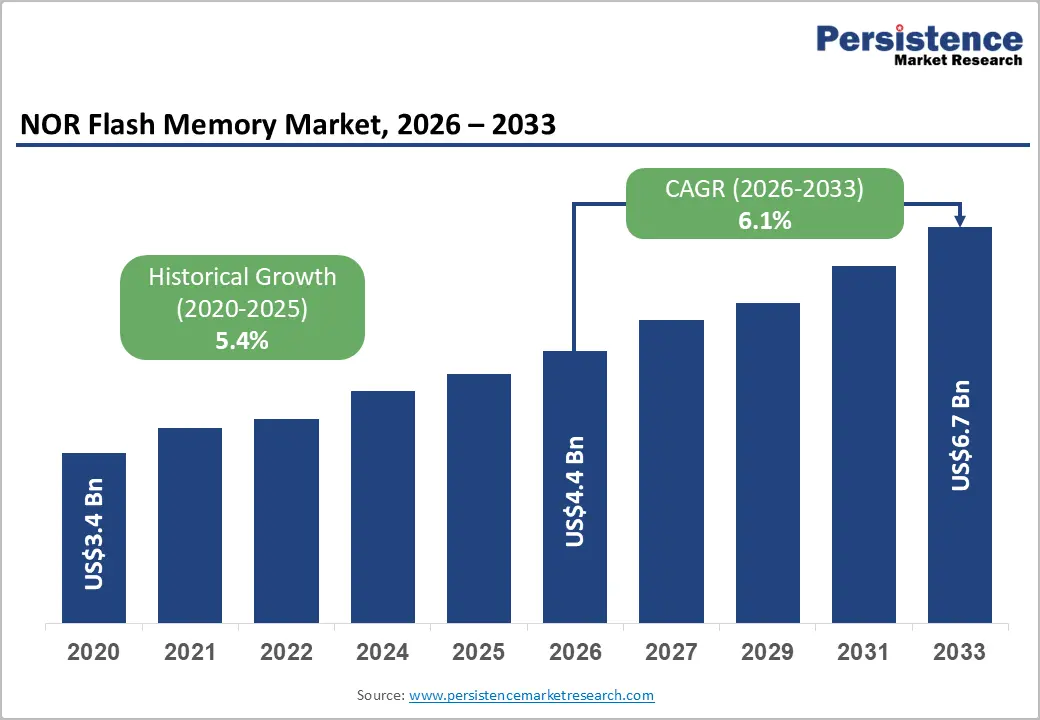
The global NOR flash memory market size is likely to be valued at US$4.4 billion in 2026 and is expected to reach US$6.7 billion by 2033, growing at a CAGR of 6.1% between 2026 and 2033, driven by rising demand for reliable code storage, fast boot functionality, and execute-in-place (XiP) capabilities across automotive, industrial, and connected device applications. Growth is increasingly supported by software-defined vehicles, industrial automation systems, and expanding Internet of Things (IoT) deployments. NOR flash memory remains a critical component in embedded systems where deterministic performance, high reliability, and secure firmware storage are essential. These technologies provide higher data throughput, improved energy efficiency, and enhanced security capabilities, supporting next-generation applications in advanced driver assistance systems (ADAS), edge artificial intelligence (AI), telecommunications infrastructure, and industrial control systems.
Key Industry Highlights:
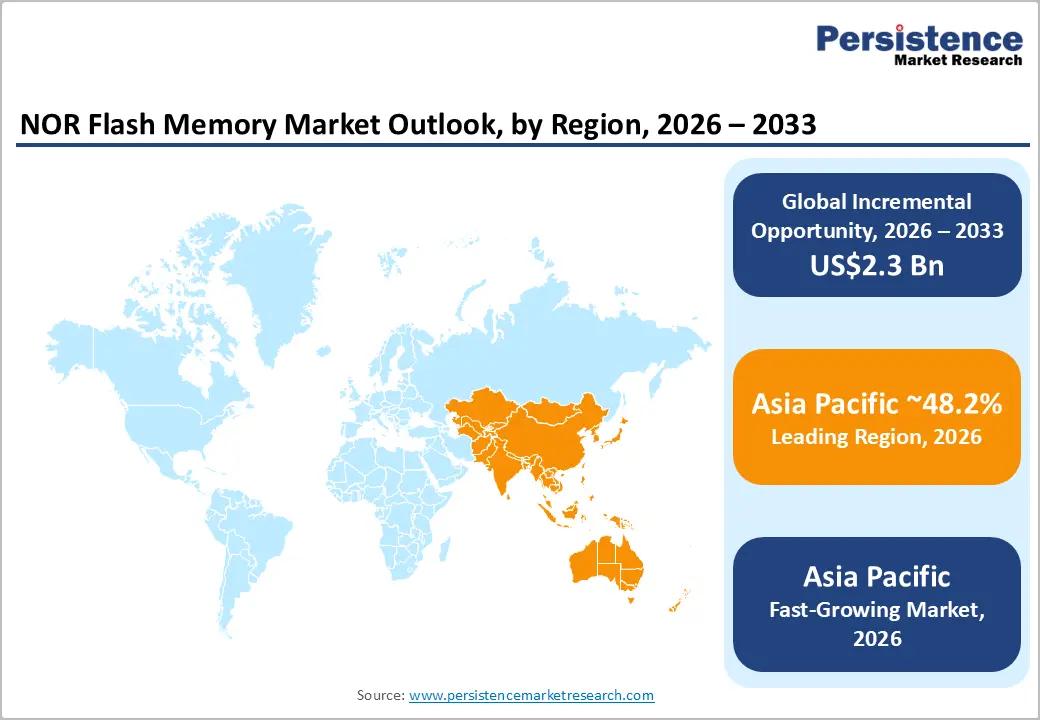
- Leading Region: Asia Pacific is anticipated to account for approximately 48.2% of the market share in 2026, driven by strong semiconductor manufacturing capabilities, expanding electric vehicle production, and robust demand from the consumer electronics and telecommunications sectors.
- Fastest-growing Region: Asia Pacific is projected to register the highest growth rate through 2033, supported by increasing adoption of software-defined vehicles, industrial automation, AI-enabled edge devices, and continued investments in semiconductor manufacturing across China, India, South Korea, Taiwan, and ASEAN countries.
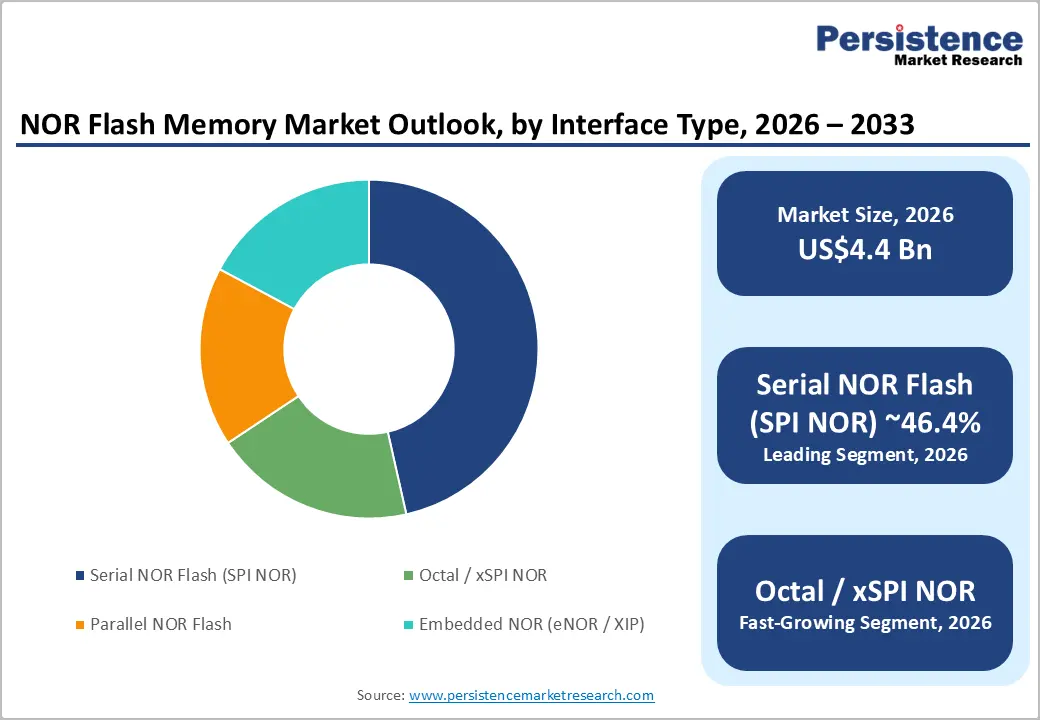
- Dominant Interface Type: Serial NOR Flash (SPI NOR) is anticipated to hold approximately 46.4% market share in 2026, owing to its low pin count, compact design, broad MCU compatibility, and extensive use in automotive electronics, industrial systems, networking equipment, and IoT devices.
- Leading Density: 32 Mb (16–64 Mb Range) is anticipated to account for approximately 27.6% market share in 2026, supported by its optimal balance of cost, storage capacity, and performance for body control modules, industrial controllers, networking equipment, and connected consumer devices.
DRO Analysis
Driver - Growing Software Content in Automotive Electronics
The automotive industry has emerged as the most important growth driver for NOR flash memory. Modern vehicles contain hundreds of electronic control units (ECUs), advanced infotainment systems, digital instrument clusters, battery management systems, and ADAS platforms that require dependable boot memory and firmware storage. The rapid expansion of electric vehicle production is further increasing semiconductor content per vehicle.
Software-defined vehicle architectures require secure storage for operating systems, over-the-air (OTA) updates, cybersecurity protocols, and safety-critical firmware. Regulatory requirements related to automotive cybersecurity and software update management are encouraging vehicle manufacturers to adopt higher-performance NOR flash solutions. As firmware complexity increases, automotive OEMs are integrating larger-density NOR flash devices, creating sustained demand across both mature and emerging vehicle platforms.
Expansion of IoT, Industrial Automation, and 5G Infrastructure
The accelerating deployment of industrial IoT systems, smart factories, connected infrastructure, and 5G communications networks is creating substantial demand for reliable code storage memory. Industrial gateways, smart meters, edge computing nodes, networking equipment, and telecommunications hardware require fast boot times, low power consumption, and long operational lifecycles.
NOR flash memory remains the preferred technology for firmware storage in these applications due to its execute-in-place capability and high read performance. The migration toward Industry 4.0 environments is increasing the number of connected devices deployed globally, while the rollout of 5G networks is expanding demand for communications equipment that relies on secure and high-speed firmware storage. These trends are supporting long-term market expansion across industrial and telecommunications sectors.
Restraint - Competition from Alternative Memory Technologies
Despite its technical advantages, NOR flash faces increasing competition from NAND flash and hybrid memory architectures in applications requiring larger storage capacity. As firmware sizes continue to increase, many system designers are evaluating alternatives that provide lower cost per bit and greater density.
NAND-based solutions offer significant cost advantages for data-intensive applications, limiting NOR flash adoption in certain consumer electronics segments. Price pressure is particularly evident in lower-density memory categories, where commoditization reduces profit margins. While NOR flash remains indispensable for secure boot and code execution functions, manufacturers must continually improve performance and integration capabilities to maintain competitiveness against emerging memory alternatives.
Opportunity - Adoption of High-Speed Octal and xSPI NOR Architectures
The transition from traditional SPI NOR to Octal and xSPI interfaces represents one of the most significant opportunities within the market. High-speed interfaces deliver substantially higher data transfer rates, enabling faster system boot times and improved application responsiveness.
Applications such as autonomous driving platforms, AI-enabled edge devices, advanced networking equipment, and industrial automation systems increasingly require higher firmware bandwidth. Manufacturers introducing high-performance NOR products with integrated security functions, error correction capabilities, and automotive-grade reliability are well positioned to capture premium market segments and improve average selling prices.
Growing Demand from Aerospace, Defense, and Medical Electronics
Mission-critical applications in the aerospace, defense, and medical sectors present attractive opportunities for NOR flash suppliers. These industries prioritize reliability, long product lifecycles, deterministic operation, and resistance to harsh environmental conditions.
Satellite systems, avionics equipment, military electronics, diagnostic devices, and life-support systems require memory solutions capable of maintaining data integrity over extended periods. As governments increase investments in defense modernization and space exploration programs, demand for high-reliability NOR flash devices is expected to expand steadily. These applications typically support higher margins and longer product qualification cycles than mainstream commercial markets.
Category-wise Analysis
Interface Type Insights
Serial NOR Flash (SPI NOR) is anticipated to account for approximately 46.4% of the market share in 2026, making it the dominant interface category. Its leadership is driven by low pin count requirements, compact design, simplified PCB layouts, and broad compatibility with microcontrollers and processors. These advantages make SPI NOR a cost-effective and reliable choice for embedded systems.
SPI NOR is widely deployed across automotive electronics, industrial automation equipment, consumer devices, networking hardware, and IoT modules. For example, automotive body control modules, smart meters, Wi-Fi routers, and wearable devices commonly use SPI NOR for firmware storage and secure boot functionality. Its mature ecosystem and extensive controller support continue to reinforce its market dominance.
Octal/xSPI NOR is anticipated to be the fastest-growing interface segment. Growth is supported by the rising demand for higher bandwidth, faster boot times, and larger firmware storage in advanced embedded applications. ADAS systems, edge AI processors, 5G base stations, and industrial gateways increasingly require memory solutions capable of supporting rapid firmware execution.
For example, autonomous driving platforms and next-generation telecom equipment utilize Octal NOR to accelerate startup performance while maintaining the reliability advantages associated with NOR flash technology. The growing adoption of software-defined systems is expected to further drive demand for xSPI-based architectures.
Density Insights
The 32 Mb density segment is anticipated to hold approximately 27.6% of the market share in 2026, making it the leading density category. This density range offers an effective balance between storage capacity, performance, and cost, making it suitable for a wide range of embedded applications.
Applications such as automotive body control units, industrial controllers, smart home hubs, and networking devices frequently utilize 32 Mb NOR flash because it provides sufficient capacity for firmware, boot loaders, and security functions without significantly increasing system costs. Its versatility continues to support strong adoption across multiple end-use industries.
The greater than 256 Mb segment is anticipated to be the fastest-growing density category. Increasing software complexity and larger firmware requirements are driving demand for higher-density NOR flash solutions. Advanced applications such as ADAS platforms, electric vehicle control systems, industrial edge servers, aerospace electronics, and 5G infrastructure require larger memory capacities to support over-the-air updates, cybersecurity features, and multi-image firmware architectures.
For example, autonomous driving domain controllers and satellite communication systems increasingly deploy high-density NOR flash to manage expanding software workloads while maintaining high reliability and data integrity.
Regional Insights
North America NOR Flash Memory Market Trends
North America remains a strategically important NOR flash memory market, supported by its advanced semiconductor ecosystem, strong automotive electronics sector, extensive industrial automation infrastructure, and significant aerospace and defense investments. The region benefits from increasing demand for secure embedded memory solutions used in connected vehicles, industrial IoT platforms, networking equipment, and mission-critical defense applications.
U.S. NOR Flash Memory Market Trends
The U.S. is anticipated to account for the largest share of the North American NOR flash memory market. The country leads regional demand through its concentration of semiconductor innovation, automotive technology development, aerospace programs, and defense electronics manufacturing. Demand is particularly strong from ADAS systems, autonomous vehicle development, industrial automation platforms, and secure networking infrastructure. The presence of major semiconductor manufacturers and extensive R&D investments continues to support technological advancements in high-performance and secure NOR flash solutions.
Canada NOR Flash Memory Market Trends
Canada represents a smaller but steadily growing market, driven by industrial automation projects, telecommunications infrastructure upgrades, and increasing adoption of connected technologies. Growth is supported by smart manufacturing initiatives, energy infrastructure modernization, and expanding deployment of IoT-enabled systems. NOR flash memory is increasingly utilized in industrial control systems, networking equipment, and smart utility applications.
The regional regulatory environment places increasing emphasis on cybersecurity, supply chain security, and system reliability, encouraging adoption of secure NOR flash solutions with advanced firmware protection and trusted boot capabilities.
Europe NOR Flash Memory Market Trends
Europe represents a high-value NOR flash memory market characterized by stringent regulatory standards, advanced automotive manufacturing capabilities, and a strong industrial automation base. The region benefits from increasing deployment of software-defined vehicles, Industry 4.0 technologies, and connected infrastructure projects. Demand is particularly strong for automotive-grade and safety-certified NOR flash products capable of supporting secure firmware storage and software update management.
Germany NOR Flash Memory Market Trends
Germany is anticipated to hold the largest share of the European NOR flash memory market in 2026. The country serves as the region's automotive manufacturing hub, with strong demand for vehicle electronics, ADAS platforms, industrial automation equipment, and smart factory applications. German manufacturers increasingly require secure and reliable memory solutions to support software-intensive vehicle architectures and industrial digitalization initiatives.
U.K. NOR Flash Memory Market Trends
The U.K. is witnessing growing demand for NOR flash memory through investments in telecommunications infrastructure, connected transportation systems, and industrial automation. The expansion of 5G networks and adoption of IoT-enabled industrial equipment continue to create opportunities for high-performance firmware storage solutions.
Spain NOR Flash Memory Market Trends
Spain is experiencing increased demand from smart manufacturing projects, renewable energy systems, and telecommunications infrastructure development. Continued investments in industrial modernization and connected technologies are supporting the gradual adoption of advanced NOR flash products.
Regulatory frameworks focused on cybersecurity, functional safety, and software update management continue to strengthen demand for automotive-qualified and security-enhanced NOR flash solutions across the region.
Asia Pacific NOR Flash Memory Market Trends
Asia Pacific is anticipated to account for approximately 48.2% of the market share in 2026, making it the largest and fastest-growing regional market. The region benefits from its position as the world's leading electronics manufacturing hub, extensive semiconductor production capabilities, and rapidly expanding automotive and telecommunications industries. Strong demand from consumer electronics, electric vehicles, industrial automation, and AI-enabled edge devices continues to drive market expansion.
China NOR Flash Memory Market Trends
China is anticipated to account for approximately 38% of the Asia Pacific NOR flash memory market in 2026, making it the region's dominant contributor. The country benefits from large-scale electronics manufacturing, rapid electric vehicle adoption, expanding telecommunications infrastructure, and government support for semiconductor development. Demand is particularly strong from automotive electronics, industrial IoT platforms, consumer devices, and 5G equipment.
Japan NOR Flash Memory Market Trends
Japan is expected to contribute approximately 22% of regional market revenue in 2026. The country's leadership in automotive manufacturing, factory automation, robotics, and industrial electronics continues to support demand for high-reliability NOR flash solutions. Japanese manufacturers increasingly adopt higher-density and automotive-qualified memory products to support advanced vehicle platforms and industrial systems.
South Korea NOR Flash Memory Market Trends
South Korea is projected to account for approximately 16% of Asia Pacific demand in 2026. The country's strong semiconductor ecosystem, consumer electronics industry, and expanding automotive technology sector support sustained market growth. Demand is driven by advanced networking equipment, AI-enabled devices, smart appliances, and connected automotive systems.
Competitive Landscape
The global NOR flash memory market is moderately fragmented, with several global semiconductor manufacturers competing across automotive, industrial, consumer electronics, and networking applications. Competition is driven primarily by product performance, reliability, interface innovation, automotive qualifications, security capabilities, and long-term supply commitments.
Leading companies are focusing on high-performance interface development, automotive-grade reliability, integrated security features, and global market expansion. Product differentiation increasingly centers on functional safety certifications, secure boot technologies, error correction capabilities, and long-term supply assurance. Strategic partnerships and regional manufacturing investments remain important tools for strengthening market presence.
Key Industry Developments:
- In May 2025, Infineon Technologies AG announced that its SEMPER NOR Flash family received ASIL-D functional safety certification, the highest automotive functional safety level.
- In March 2025, GigaDevice Semiconductor Inc. introduced a dual-power-supply SPI NOR flash designed for 1.2V SoCs, combining 1.8V core voltage with 1.2V I/O.
Companies Covered in NOR Flash Memory Market
- Infineon Technologies AG
- Micron Technology, Inc.
- Macronix International Co., Ltd.
- Winbond Electronics Corporation
- GigaDevice Semiconductor Inc.
- Cypress Semiconductor Corporation (now part of Infineon Technologies)
- Microchip Technology Inc.
- Renesas Electronics Corporation
- STMicroelectronics N.V.
- Toshiba Electronic Devices & Storage Corporation
- Integrated Silicon Solution, Inc. (ISSI)
- EON Silicon Solution Inc. (EON)
- Elite Semiconductor Microelectronics Technology Inc. (ESMT)
- XTX Technology Limited
- Wuhan Xinxin Semiconductor Manufacturing Co., Ltd. (XMC)
- Puya Semiconductor (Shanghai) Co., Ltd. (PUYA)
Frequently Asked Questions
The global NOR flash memory market is anticipated to be valued at US$4.4 billion in 2026.
The global NOR flash memory market is projected to reach US$6.7 billion by 2033.
Key trends include the growing adoption of Octal/xSPI NOR interfaces, increasing deployment of automotive-grade memory solutions, rising demand for secure boot and over-the-air (OTA) update capabilities, expansion of Industrial IoT and edge AI applications, and the shift toward higher-density NOR flash devices exceeding 256 Mb.
Serial NOR Flash (SPI NOR) is the leading interface type segment, anticipated to account for approximately 46.4% of the market share, due to its low pin count, compact footprint, and widespread use in automotive, industrial, networking, and IoT applications.
The NOR Flash Memory market is projected to grow at a CAGR of 6.1% between 2026 and 2033.
Some of the major companies include Infineon Technologies AG, Micron Technology, Inc., GigaDevice Semiconductor Inc., Winbond Electronics Corporation, and Macronix International Co., Ltd.


