




- Specialty & Fine Chemicals
- Natural Surfactants Market
Natural Surfactants Market Size, Share, and Growth Forecast, 2026 - 2033
Natural Surfactants Market by Product Type (Anionic, Nonionic, Other), Source (Glycolipids, Lipopeptides & Lipoproteins, Others), Application, and Regional Analysis for 2026 - 2033

Natural Surfactants Market Size and Trends Analysis
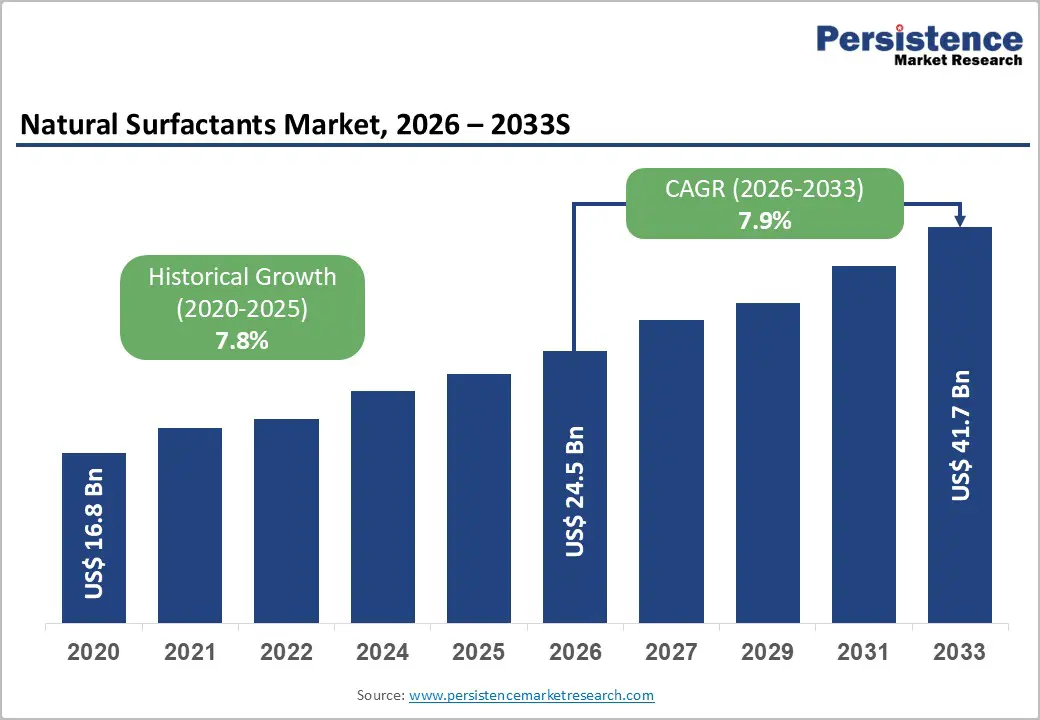
The global natural surfactants market size is likely to be valued at US$24.5 billion in 2026 and is expected to reach US$41.7 billion by 2033, growing at a CAGR of 7.9% between 2026 and 2033, driven by increasing regulatory emphasis on biodegradability, rising consumer preference for bio-based ingredients in personal care and cleaning products, and the commercialization of fermentation-derived biosurfactants. Strong policy support in Europe and procurement-driven adoption in North America are reinforcing the transition away from petrochemical-based surfactants.
Key Industry Highlights:
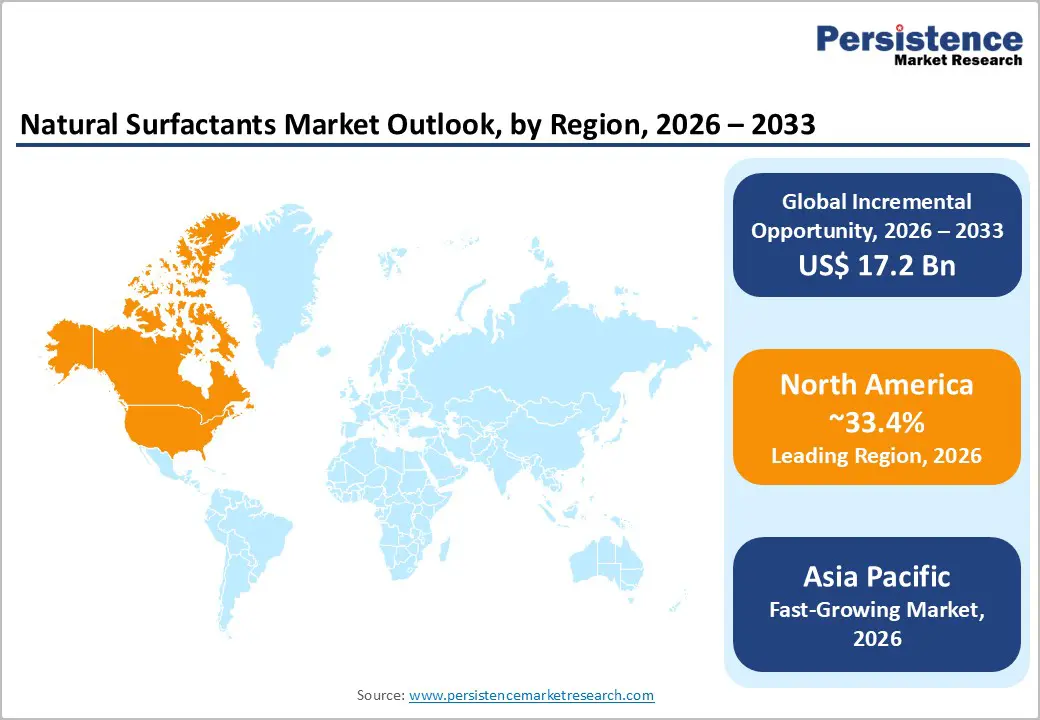
- Leading Region: North America is projected to account for approximately 33.4% of the market share, supported by strong regulatory frameworks, advanced manufacturing capabilities, and high demand for bio-based products.
- Fastest-growing Region: Asia Pacific is the fastest-growing region, driven by increasing industrialization, rising consumer demand, and expanding production capacity across countries such as China, India, and Japan.
- Investment Plans: Leading companies are actively investing in bio-based surfactant production and fermentation technologies, with capacity expansions and regional manufacturing developments focused on Asia Pacific and North America to strengthen supply chains and meet growing demand.
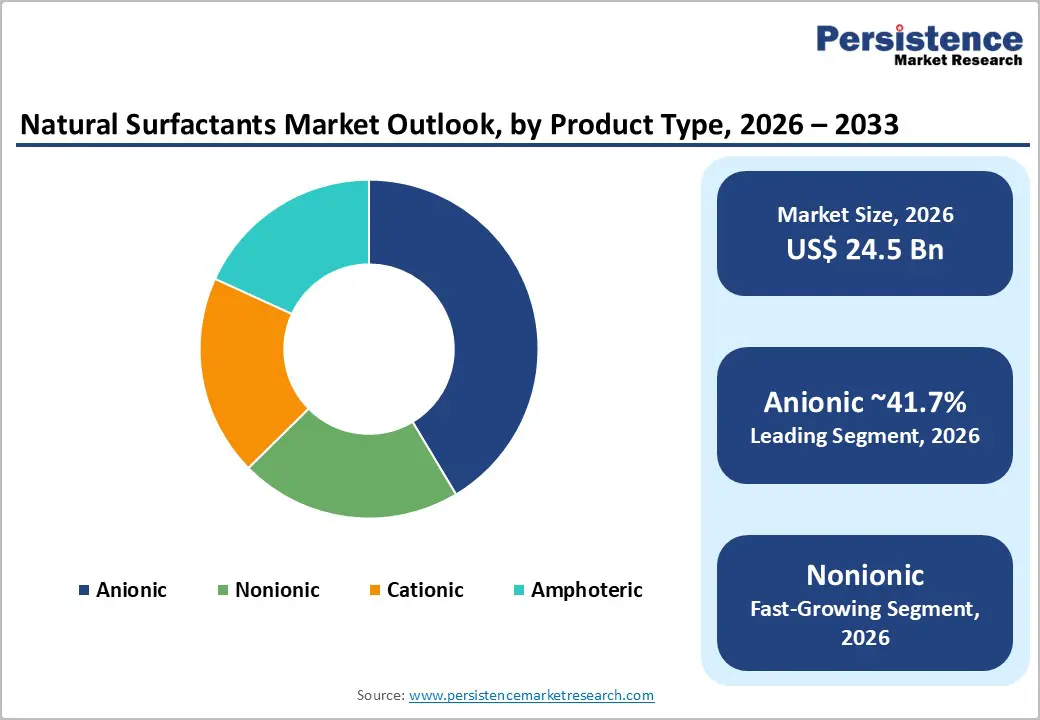
- Dominant Product Type: Anionic surfactants dominate, holding an anticipated market share of approximately 41.7%, due to their widespread use in detergents, personal care products, and household cleaning applications.
- Leading Source: Glycolipids lead, accounting for an anticipated 37.6% market share, supported by their strong performance characteristics, biodegradability, and increasing adoption in personal care and cleaning formulations.
| Key Insights | Details |
|---|---|
| Natural Surfactants Market Size (2026E) | US$24.5 Bn |
| Market Value Forecast (2033F) | US$41.7 Bn |
| Projected Growth (CAGR 2026 to 2033) | 7.9% |
| Historical Market Growth (CAGR 2020 to 2025) | 7.8% |
Market Factors - Driver, Restraint, and Opportunity Analysis
Driver Analysis - Stringent Environmental Regulations Are Accelerating the Shift Toward Biodegradable Surfactants
Global regulatory frameworks are increasingly mandating the use of environmentally safe and biodegradable chemicals, particularly in detergents and personal care formulations. In Europe, surfactants must meet strict biodegradability criteria, while eco-labeling systems further reinforce compliance requirements. In the United States, government-backed programs promoting bio-based products have created structured procurement pathways, encouraging institutional buyers to adopt renewable alternatives. These regulatory pressures are significantly reducing reliance on synthetic surfactants and expanding the market scope for natural alternatives, especially in regulated end-use industries such as home care and cosmetics.
Shift toward Performance-Driven Sustainable Formulations among Consumer Brands
Major consumer goods and specialty chemical companies are transitioning from basic “natural” claims to performance-driven sustainable chemistry. Companies such as BASF SE, Clariant AG, Croda International Plc, Evonik Industries AG, and Kao Corporation are expanding portfolios that combine bio-based content with high-performance characteristics such as mildness, emulsification efficiency, and formulation stability. This shift reflects a broader industry trend where sustainability is no longer a differentiator but a baseline requirement, integrated into product design and innovation strategies.
Advancements in Industrial-Scale Fermentation and Feedstock Innovation
Technological progress in fermentation and bio-processing is enhancing the commercial viability of natural surfactants. The transition from pilot-scale production to industrial-scale facilities is improving supply reliability and cost efficiency. Companies are investing in biosurfactants such as rhamnolipids and exploring alternative feedstocks, including agricultural residues and non-edible biomass. These developments are enabling regional production hubs, reducing supply chain dependencies, and facilitating broader adoption across high-volume applications such as household cleaning and industrial formulations.
Restraint Analysis - High Production Costs and Capital-Intensive Manufacturing Processes
Natural surfactants often require advanced fermentation technologies, specialized processing infrastructure, and segregated supply chains, resulting in higher production costs compared to conventional surfactants. Significant capital investments in production facilities further increase financial barriers for new entrants. In price-sensitive applications such as household detergents and industrial cleaning, these cost differentials limit widespread substitution unless supported by regulatory mandates or premium product positioning.
Supply Chain Complexity and Feedstock Sustainability Concerns
The reliance on agricultural feedstocks such as palm oil derivatives, coconut-based inputs, and other renewable oils introduces supply chain risks. Issues related to deforestation, land use, and competition with food production have intensified scrutiny on sourcing practices. Companies must ensure traceability and compliance with sustainability certifications, which can increase operational complexity and costs. Failure to address these concerns may lead to reputational risks and regulatory challenges, constraining market growth.
Opportunity Analysis - Rapid Expansion Potential in Asia Pacific Markets
Asia Pacific presents significant growth opportunities due to its strong manufacturing base, expanding consumer markets, and availability of renewable raw materials. Regional investments in production capacity and localized supply chains are enhancing market accessibility and reducing dependency on imports. Companies such as BASF SE have expanded bio-based surfactant production in Thailand to cater to regional demand, while Kao Corporation continues to innovate with plant- and biomass-derived surfactants in Japan and Southeast Asia. Countries such as China, India, and ASEAN nations are witnessing rising demand for sustainable personal care and cleaning products, supported by increasing disposable incomes and urbanization. Localization strategies not only reduce logistics costs but also enable faster response to market demand fluctuations, improving supply chain resilience and strengthening regional competitiveness.
Growth in Home Care and Industrial Cleaning Applications
The increasing demand for eco-friendly cleaning solutions is driving the adoption of natural surfactants in home care and industrial applications. These products offer advantages such as biodegradability, low toxicity, and compatibility with low-temperature and concentrated formulations, making them ideal for modern cleaning systems. Companies like Stepan Company and Pilot Chemical Company are actively developing bio-based surfactants tailored for detergents, surface cleaners, and institutional cleaning products. As regulatory requirements tighten and consumer awareness grows, manufacturers are reformulating products to incorporate sustainable ingredients without compromising performance. The shift toward concentrated and water-efficient cleaning solutions is further amplifying demand, positioning home care and industrial cleaning as key growth drivers within the natural surfactants market.
Category-wise Analysis
Product Type Insights
Anionic surfactants dominate the market with an anticipated share of approximately 41.7%, due to their widespread use in detergents, personal cleansing products, and household cleaning formulations. Their strong cleaning efficiency, high foaming capacity, and compatibility with various formulation systems make them essential in both consumer and industrial applications. Common natural-based examples include fatty alcohol sulfates (derived from coconut or palm kernel oil) and soap-based surfactants produced from vegetable oils. These variants are increasingly adopted as they deliver comparable performance to synthetic counterparts while complying with biodegradability standards. Their cost-effectiveness and scalability further reinforce their position as the backbone of high-volume cleaning applications, particularly in laundry detergents and dishwashing liquids.
Nonionic surfactants are experiencing rapid growth due to their versatility, mildness, and lower sensitivity to water hardness, making them suitable for a broad range of applications. Bio-based variants such as alkyl polyglucosides (APGs), derived from glucose and fatty alcohols, are widely used in personal care, home care, and industrial cleaning products due to their excellent biodegradability and low toxicity. These surfactants are particularly favored in premium skincare and baby care formulations where mildness is critical. Amphoteric surfactants, including betaines derived from coconut oil, are also gaining traction in gentle cleansing products such as shampoos and facial cleansers. Meanwhile, cationic surfactants continue to serve specialized roles in fabric softeners, hair conditioners, and antistatic applications, maintaining steady but niche demand.
Source Insights
Glycolipids lead the market with an anticipated share of approximately 37.6%, driven by their strong performance characteristics and increasing commercial adoption across multiple industries. Biosurfactants such as rhamnolipids and sophorolipids are widely used in personal care and cleaning products due to their superior emulsification, wetting, and detergency properties. These compounds are produced through microbial fermentation using renewable feedstocks such as sugars and vegetable oils, making them environmentally sustainable alternatives to petrochemical surfactants. Their low toxicity and high biodegradability also make them suitable for sensitive applications, including cosmetics and healthcare products. The scalability of fermentation technologies is further supporting their growing market penetration.
Lipopeptides and lipoproteins are emerging as the fastest-growing category due to advancements in microbial fermentation, synthetic biology, and precision fermentation technologies. These surfactants exhibit enhanced functional properties, including antimicrobial activity, high stability under extreme conditions, and superior surface activity, making them suitable for specialized applications such as pharmaceuticals, oilfield chemicals, and high-performance cleaning solutions. Examples include surfactin and other Bacillus-derived lipopeptides, which are gaining attention for their multifunctional capabilities. Increasing investment in strain engineering and bioprocess optimization is expected to improve production efficiency and reduce costs, accelerating their commercial adoption. Meanwhile, plant-based sources continue to dominate in terms of volume due to established supply chains, while marine and algal-derived surfactants remain niche but promising for future diversification.
Regional Insights
North America Natural Surfactants Market Trends-Strong Regulatory Support and Industrial-Scale Innovation
North America leads the global market, accounting for approximately 33.4% of the market share. The region benefits from a well-established regulatory framework, strong institutional procurement programs, and advanced manufacturing capabilities. The United States dominates regional demand due to its mature consumer base, strong preference for sustainable products, and the presence of leading specialty chemical manufacturers such as Stepan Company and Pilot Chemical Company. These companies have been actively expanding their portfolios of bio-based and biodegradable surfactants to cater to evolving regulatory and consumer requirements.
Key growth drivers include increasing consumer awareness of environmentally friendly products, government-backed sustainability initiatives, and continuous investments in production capacity. For instance, Evonik Industries AG has strengthened its biosurfactant commercialization strategy through distribution expansion in the U.S., improving product accessibility across cleaning and personal care segments. Similarly, BASF SE is investing in localized production of alkyl polyglucosides (APGs), enhancing supply reliability and reducing dependency on imports. These developments are accelerating the adoption of natural surfactants in high-volume applications such as home care and industrial cleaning. The region’s strong innovation ecosystem, supported by biotechnology firms and contract manufacturers, continues to drive advancements in fermentation-based surfactants, positioning North America as both a consumption and innovation hub.
Europe Natural Surfactants Market Trends-Compliance-Driven Growth and Premium Bio-Based Development
Europe remains a highly influential market due to its stringent environmental regulations and strong focus on sustainability. Countries such as Germany, the United Kingdom, France, and Spain are key contributors to regional growth, supported by harmonized regulatory standards across the European Union. These regulations mandate high levels of biodegradability and environmental safety, compelling manufacturers to transition toward natural surfactants in both consumer and industrial applications.
The region is characterized by high-value product development, particularly in personal care and premium cleaning applications. Major players such as Clariant AG and Croda International Plc are focusing on developing fully bio-based surfactant ranges tailored to eco-certified formulations. Evonik Industries AG has also established industrial-scale biosurfactant production in Europe, marking a significant shift toward the commercialization of fermentation-derived surfactants. These investments are enabling regional suppliers to meet strict compliance requirements while offering high-performance alternatives to conventional surfactants.
Sustainability certifications and eco-labeling schemes play a critical role in shaping purchasing decisions across Europe. As a result, companies are increasingly investing in traceable sourcing of raw materials, particularly for palm and coconut derivatives, to ensure compliance with environmental and ethical standards. This focus on responsible sourcing, combined with advanced R&D capabilities, positions Europe as a leader in premium and innovation-driven segments of the natural surfactants market.
Asia Pacific Natural Surfactants Market Trends-Rapid Expansion Fueled by Cost Efficiency and Raw Material Access
Asia Pacific is the fastest-growing regional market, driven by rapid industrialization, expanding consumer markets, and cost-effective manufacturing capabilities. Countries such as China, Japan, India, and ASEAN members are key growth engines, supported by rising disposable incomes and increasing demand for sustainable personal care and cleaning products. The region’s access to renewable raw materials, including palm oil and coconut derivatives, provides a strong foundation for natural surfactant production. Significant investments in production infrastructure are strengthening the region’s role as a global manufacturing hub. BASF SE has expanded its APG production capacity in Thailand to meet growing regional demand, improving supply chain efficiency and reducing lead times. Kao Corporation continues to advance its bio-based surfactant technologies in Japan, including innovations derived from non-edible biomass, which support sustainability goals while reducing reliance on food-based feedstocks. In India, Galaxy Surfactants Ltd is expanding its presence in personal care ingredients, catering to both domestic and export markets.
Localization of manufacturing and supply chains is a key trend in the Asia Pacific, enabling companies to reduce costs and respond quickly to regional demand fluctuations. Additionally, the growing presence of multinational consumer brands and increasing regulatory awareness are encouraging the adoption of eco-friendly formulations. These developments, combined with favorable economic conditions and abundant raw material availability, position Asia Pacific as the primary growth engine for the natural surfactants market over the forecast period.
Competitive Landscape
The global natural surfactants market is moderately fragmented, with a mix of global chemical companies and regional players. Large multinational corporations hold significant influence due to their extensive product portfolios, technological capabilities, and global distribution networks. However, smaller and specialized companies are gaining traction through innovation in biosurfactants and niche applications.
Leading companies are focusing on innovation, sustainability certification, and geographic expansion. Key strategies include developing high-performance bio-based products, investing in fermentation technologies, and strengthening regional manufacturing capabilities. Companies are also leveraging partnerships and distribution agreements to enhance market penetration and customer reach.
Key Industry Developments
- In November 2025, BASF SE announced the expansion of its alkyl polyglucosides (APG) production capacity in Bangpakong, Thailand, aimed at strengthening regional supply capabilities and meeting growing demand for sustainable surfactants across personal care, home care, and industrial applications.
Companies Covered in Natural Surfactants Market
- BASF SE
- Evonik Industries AG
- Clariant AG
- Croda International Plc
- Kao Corporation
- Solvay SA
- Stepan Company
- Galaxy Surfactants Ltd
- Innospec Inc.
- Pilot Chemical Company
- Jeneil Biotech Inc.
- Locus Fermentation Solutions
- Dow Inc.
- Huntsman Corporation
- Akzo Nobel N.V.
- Arkema S.A.
Frequently Asked Questions
The global natural surfactants market is estimated to be valued at US$24.5 billion in 2026.
The natural surfactants market is projected to reach US$41.7 billion by 2033.
Key trends include the increasing shift toward biodegradable and bio-based ingredients, growing adoption of fermentation-derived biosurfactants, rising demand in personal care and home care applications, and regional capacity expansions to strengthen supply chains.
The anionic surfactants segment leads the market, accounting for approximately 41.7% of the total share, driven by its extensive use in detergents and cleaning applications.
The natural surfactants market is expected to grow at a CAGR of 7.9% from 2026 to 2033.
Leading companies include BASF SE, Evonik Industries AG, Clariant AG, Croda International Plc, and Kao Corporation.


