




- Electrical Equipment & Services
- Motor Monitoring Market
Motor Monitoring Market Size, Share, and Growth Forecast, 2026 - 2033
Motor Monitoring Market by Offering (Hardware, Services, Others), Deployment (Cloud, On-Premise), End-use Industry, and Regional Analysis for 2026 - 2033

Motor Monitoring Market Size and Trends Analysis
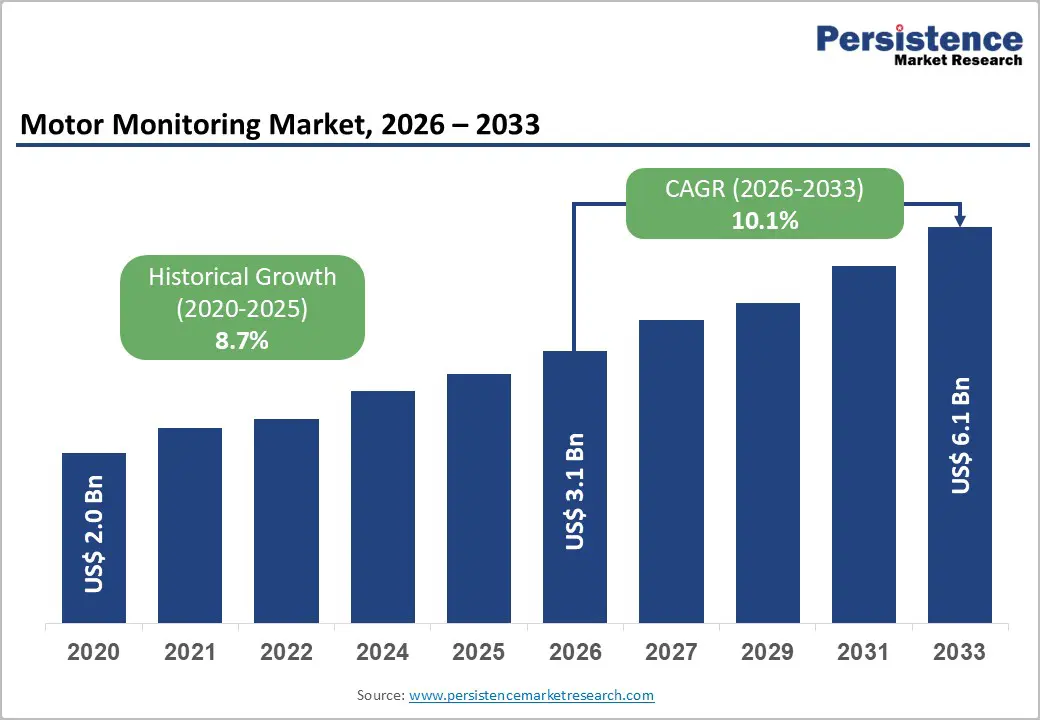
The global motor monitoring market size is likely to be valued at US$ 3.1 billion in 2026 and is expected to reach US$ 6.1 billion by 2033, growing at a CAGR of 10.1% between 2026 and 2033, driven by increasing industrial automation, rising adoption of predictive maintenance technologies, and growing demand for energy-efficient motor systems across manufacturing, oil & gas, and power generation industries.
Industrial operators are increasingly deploying motor monitoring systems to reduce unplanned downtime, improve operational reliability, and optimize energy consumption. The integration of IoT sensors, AI-driven analytics, cloud-based diagnostics, and remote asset monitoring platforms is also strengthening long-term market growth prospects.
Key Industry Highlights:
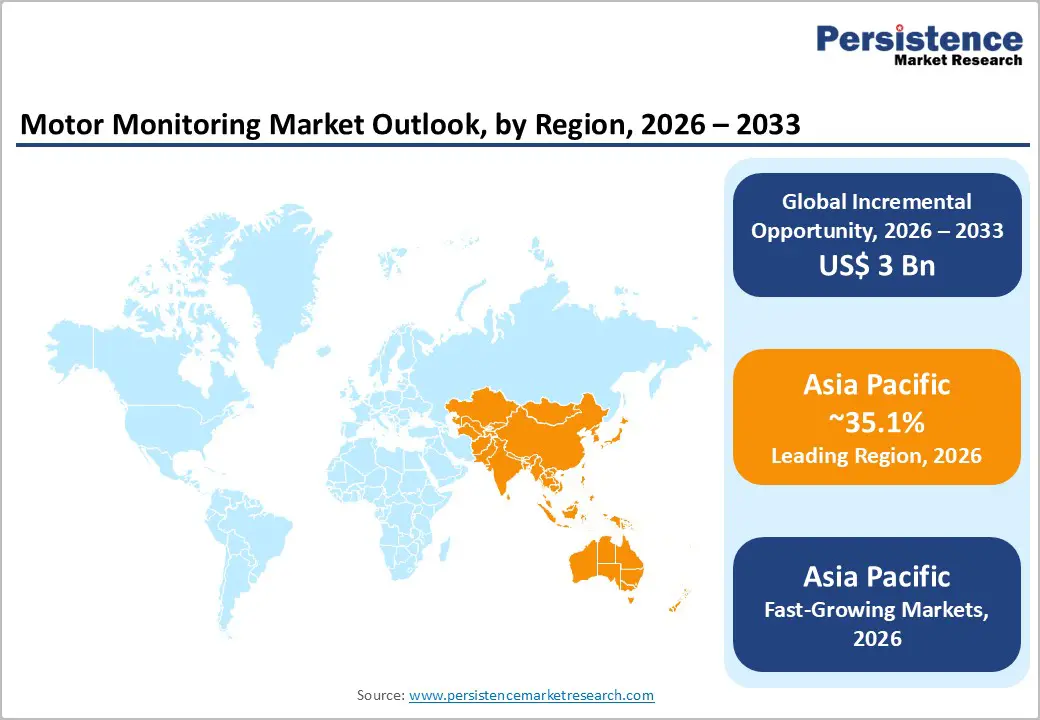
- Leading Region: Asia Pacific is projected to account for approximately 35.1% of market revenue in 2028, supported by rapid industrialization, expanding manufacturing infrastructure, and increasing Industry 4.0 adoption across China, India, Japan, and ASEAN countries.
- Fastest-growing Region: Asia Pacific is projected to remain the fastest-growing regional market during the forecast period, driven by rising investments in smart manufacturing, predictive maintenance, and industrial automation technologies.
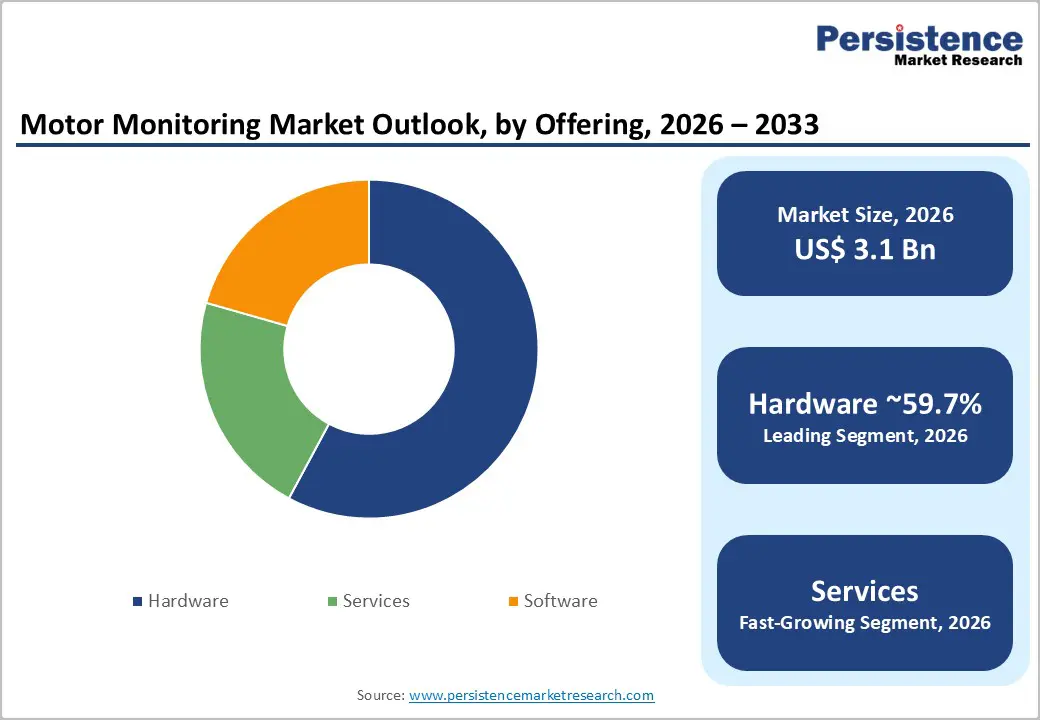
- Dominant Offering: Hardware is expected to dominate, with 59.7% market share in 2026, driven by strong demand for vibration sensors, analyzers, thermal monitoring devices, and industrial communication modules.
- Leading End-use Industry: The oil & gas segment is estimated to dominate with approximately 29.2% of market share in 2026, driven by rising deployment of predictive maintenance systems across compressors, pumps and conveyors
DRO Analysis
Driver - Rising Energy-Efficiency Regulations and Industrial Sustainability Targets
Governments and industrial regulatory agencies worldwide are strengthening energy-efficiency mandates for industrial motors and rotating equipment. Electric motors account for a substantial portion of industrial electricity consumption, particularly in sectors such as manufacturing, chemicals, mining, oil & gas, and utilities. Regulatory frameworks promoting high-efficiency motor systems are encouraging companies to adopt continuous monitoring technologies that improve operational performance and reduce power losses.
Motor monitoring systems help industrial facilities track vibration, temperature, voltage fluctuations, and operational load in real time, enabling early detection of inefficiencies and equipment degradation. Industries are increasingly prioritizing energy optimization initiatives to reduce operating costs and meet sustainability objectives. In Europe, stricter efficiency standards for industrial motors and variable speed drives are accelerating the adoption of predictive monitoring solutions. Similar trends are emerging across Asia Pacific and North America, where manufacturers are investing in digital maintenance infrastructure to support long-term energy management strategies and carbon-reduction targets.
Growing Adoption of Predictive Maintenance and AI-Enabled Diagnostics
The increasing shift from reactive maintenance to predictive maintenance is a major growth driver for the motor monitoring market. Industrial companies are under continuous pressure to minimize downtime, improve equipment reliability, and extend the lifecycle of high-value assets. Modern motor monitoring systems utilize AI algorithms, IoT-enabled sensors, cloud connectivity, and machine learning analytics to identify anomalies before equipment failure occurs.
Predictive maintenance solutions provide real-time insights into motor health conditions, helping maintenance teams prioritize repairs based on operational risk rather than fixed maintenance schedules. This reduces unexpected shutdowns and lowers maintenance expenditures across industrial operations. Industries such as oil & gas, power generation, automotive manufacturing, and mining are adopting advanced monitoring technologies to improve production continuity and reduce operational disruptions.
The growing integration of industrial IoT platforms with cloud-based analytics is also supporting remote diagnostics, centralized monitoring, and enterprise-wide asset visibility, creating additional demand for intelligent motor monitoring systems.
Restraint - High Initial Deployment Costs and Integration Complexity
Despite strong long-term benefits, the adoption of motor monitoring systems is often constrained by high upfront investment requirements and integration challenges. Comprehensive monitoring solutions require deployment of sensors, communication gateways, analytics software, and cybersecurity infrastructure, which can significantly increase implementation costs for industrial facilities with large motor fleets.
Brownfield manufacturing plants frequently operate with legacy systems that require extensive customization and integration with existing operational technology infrastructure. This increases deployment timelines and creates additional engineering complexity. In industries such as utilities, oil & gas, and critical infrastructure, cybersecurity concerns surrounding cloud connectivity and remote monitoring also slow implementation decisions. Many organizations continue to prioritize monitoring only for mission-critical assets while postponing broader deployment across secondary equipment categories. These cost and integration barriers may limit adoption among small and medium-sized industrial operators during the early stages of digital transformation initiatives.
Opportunity - Rapid Industrial Expansion across the Asia Pacific
Asia Pacific represents the largest and fastest-growing opportunity for the motor monitoring market due to rapid industrialization, infrastructure expansion, and accelerating automation investments. China, India, Japan, and ASEAN countries are expanding manufacturing capacity across automotive, electronics, chemicals, power generation, and heavy industrial sectors. These industries require reliable motor systems capable of operating efficiently under demanding production conditions.
Governments across the region are promoting smart manufacturing initiatives and industrial digitalization programs to strengthen productivity and energy efficiency. Industrial operators are increasingly adopting predictive maintenance solutions to reduce downtime, improve equipment utilization, and support large-scale production operations. The region’s cost-sensitive industrial environment is also creating demand for scalable wireless sensors, cloud-based monitoring platforms, and retrofit solutions that can be deployed across existing facilities without major infrastructure replacement.
Expansion of Cloud-Based Monitoring and Recurring Service Models
The growing adoption of cloud computing and industrial analytics platforms is creating significant opportunities for software-driven motor monitoring solutions. Industrial companies are increasingly shifting from hardware-centric purchasing models toward subscription-based monitoring services that provide continuous diagnostics, remote support, and predictive maintenance recommendations.
Cloud-based platforms enable centralized monitoring of multiple facilities, allowing operators to improve asset visibility across geographically distributed operations. AI-enabled analytics systems can process large volumes of operational data to identify performance trends, optimize maintenance schedules, and reduce operational risks. Vendors are increasingly bundling monitoring hardware with software subscriptions, consulting services, and lifecycle maintenance support to create recurring revenue streams. This transition toward service-oriented business models is expected to strengthen long-term profitability for technology providers while offering customers greater operational flexibility and lower maintenance risk.
Category-wise Analysis
Offering Insights
Hardware is anticipated to account for nearly 59.7% of the market share during the forecast period, maintaining its position as the leading segment. The category includes vibration sensors, thermal monitoring devices, analyzers, communication modules, and industrial gateways used for real-time motor condition assessment. These components serve as the operational backbone of monitoring systems, collecting critical data on vibration, temperature, voltage, current, and rotational speed.
Companies such as ABB, Siemens, and SKF continue to expand their industrial sensor portfolios to support predictive maintenance applications across the manufacturing and energy sectors. Demand for monitoring hardware remains particularly strong in oil & gas, mining, power generation, and heavy manufacturing environments where equipment failure can lead to major operational disruptions.
Services are anticipated to witness the fastest growth throughout the forecast period due to rising demand for predictive maintenance, remote diagnostics, and AI-based asset management. Industrial operators increasingly require installation support, calibration, maintenance consulting, and cloud-based analytics alongside hardware deployment. This trend is accelerating the adoption of integrated monitoring service models.
End-use Industry Insights
Oil & gas is anticipated to account for approximately 29.2% of the market share during the forecast period, making it the leading end-use industry. The sector relies heavily on pumps, compressors, conveyors, and rotating equipment operating under continuous and high-risk conditions. Equipment failure can result in production losses, environmental incidents, and costly shutdowns.
Motor monitoring systems are widely deployed across offshore platforms, refineries, LNG terminals, and pipeline infrastructure to improve operational reliability and reduce maintenance-related downtime. For example, upstream operators increasingly utilize vibration and temperature monitoring systems on compressors and pumping stations to detect abnormalities before critical failure occurs.
Power generation is anticipated to witness the fastest CAGR through 2033, due to increasing investments in grid modernization, renewable energy integration, and energy infrastructure expansion. Thermal plants, renewable energy facilities, substations, and energy storage systems require reliable motor performance to maintain uninterrupted electricity generation and transmission.
Motor monitoring solutions help utilities identify insulation degradation, overheating, and mechanical wear before operational failures occur. For example, wind farms and hydroelectric facilities increasingly deploy AI-enabled monitoring systems to optimize turbine motor performance and reduce maintenance interruptions. Rising investment in renewable energy projects, smart grids, and decentralized power infrastructure is expected to further accelerate adoption of advanced monitoring technologies across the global power generation sector.
Regional Insights
North America Motor Monitoring Market Trends
North America remains one of the most technologically advanced motor-monitoring markets, supported by strong industrial automation infrastructure, high adoption of predictive maintenance, and increasing investment in AI-enabled monitoring technologies. The region benefits from extensive deployment of industrial IoT platforms, cloud-based diagnostics, and energy-efficiency initiatives across manufacturing, oil & gas, utilities, chemicals, and transportation industries.
U.S. Motor Monitoring Market Trends
The U.S. is expected to account for the largest share of the North America motor monitoring market due to its extensive industrial base and high adoption of advanced automation technologies. Major demand originates from oil & gas, shale production, refining, manufacturing, chemicals, and power generation industries, where equipment reliability is critical for continuous operations. Industrial companies across the country are increasingly deploying AI-driven analytics, wireless sensors, and remote monitoring systems to improve asset visibility and reduce maintenance costs.
The U.S. is also witnessing rising adoption of predictive maintenance platforms integrated with industrial IoT ecosystems. Government initiatives promoting energy-efficient industrial systems and modernization of manufacturing infrastructure are further supporting market growth. Strong presence of industrial automation companies and software developers continues to strengthen technological innovation within the regional market.
Canada Motor Monitoring Market Trends
Canada is experiencing steady demand growth for motor monitoring systems, particularly across mining, oil sands, utilities, and heavy industrial sectors. Industrial operators are increasingly investing in condition monitoring technologies to improve equipment reliability under harsh operating environments. Mining companies and energy producers are deploying vibration monitoring, thermal analytics, and predictive maintenance platforms to minimize unexpected shutdowns and optimize operational efficiency.
The country’s focus on industrial sustainability and modernization of energy infrastructure is also encouraging adoption of advanced monitoring solutions. Increased deployment of remote monitoring systems in geographically isolated industrial operations is further contributing to market expansion across Canada.
Europe Motor Monitoring Market Trends
Europe represents a mature but steadily expanding motor monitoring market supported by strict energy-efficiency regulations, sustainability initiatives, and industrial digitalization strategies. Regional industries are increasingly investing in predictive maintenance technologies to optimize motor performance, reduce electricity consumption, and support long-term carbon-reduction targets.
The growing adoption of Industry 4.0 technologies, AI-driven diagnostics, and cloud-based monitoring platforms is further strengthening demand across manufacturing, utilities, chemicals, automotive, mining, and water treatment industries.
Germany Motor Monitoring Market Trends
Germany remains the largest market within Europe due to its advanced manufacturing ecosystem and strong industrial automation capabilities. The country’s automotive, machinery, chemicals, and industrial engineering sectors are major adopters of motor monitoring systems. German manufacturers are increasingly integrating AI-driven analytics, predictive maintenance software, and industrial IoT solutions into smart factory environments to improve productivity and reduce operational disruptions.
Government support for energy-efficient manufacturing and Industry 4.0 adoption continues to strengthen investment in intelligent monitoring infrastructure. Demand for precision monitoring technologies is particularly high across automotive production facilities and advanced industrial machinery applications.
U.K. Motor Monitoring Market Trends
The U.K. is witnessing growing adoption of motor monitoring systems across utilities, transportation, water treatment, and industrial manufacturing sectors. Companies are increasingly deploying cloud-based monitoring platforms and AI-enabled diagnostics to improve operational efficiency and reduce maintenance-related costs.
The country’s focus on industrial modernization and digital transformation initiatives is supporting investment in predictive maintenance technologies. Utilities and infrastructure operators are also increasing adoption of condition monitoring systems to improve the reliability of critical assets and support long-term sustainability objectives.
France Motor Monitoring Market Trends
France continues to generate stable demand for motor monitoring technologies across energy, chemicals, transportation, and industrial manufacturing sectors. Industrial companies are increasingly implementing predictive maintenance systems to reduce downtime, improve energy efficiency, and extend equipment lifespan.
Growing investments in smart manufacturing initiatives and industrial automation projects are supporting wider deployment of AI-based monitoring platforms. Utilities and renewable energy operators are also adopting advanced motor monitoring systems to strengthen operational reliability across power infrastructure networks.
Asia Pacific Motor Monitoring Market Trends
Asia Pacific is expected to account for approximately 35.1% of global revenue in 2026 and remains the fastest-growing regional market for motor monitoring systems. Rapid industrialization, expanding manufacturing capacity, infrastructure development, and increasing automation investments are major factors supporting market growth.
China Motor Monitoring Market Trends
China represents the largest country-level market in Asia Pacific due to its massive industrial manufacturing capacity and rapid adoption of industrial automation technologies. The country’s electronics, automotive, heavy machinery, chemicals, and industrial processing industries are major users of motor monitoring systems.
Chinese manufacturers are increasingly investing in predictive maintenance technologies and smart factory infrastructure to improve production efficiency and reduce operational disruptions. Government initiatives supporting industrial modernization and advanced manufacturing are further accelerating the deployment of AI-driven monitoring systems across industrial facilities.
India Motor Monitoring Market Trends
India is emerging as one of the fastest-growing motor monitoring markets due to rising manufacturing activity, infrastructure expansion, and industrial modernization initiatives. Investments across energy, transportation, chemicals, mining, and heavy manufacturing sectors are creating strong demand for reliable motor monitoring systems capable of reducing operational downtime and improving asset performance.
Government programs supporting manufacturing expansion and digital industrial transformation are also encouraging adoption of predictive maintenance technologies. Industrial operators are increasingly deploying cloud-based monitoring systems and wireless sensor networks to optimize operational efficiency across large production facilities.
Competitive Landscape
The global motor monitoring market is moderately fragmented, with competition distributed among multinational industrial automation providers, sensor manufacturers, software developers, and specialized predictive maintenance companies. Leading companies compete through product innovation, integrated digital platforms, predictive analytics capabilities, and extensive industrial service networks.
Leading companies are focusing on AI-enabled predictive maintenance, cloud-based analytics, lifecycle service expansion, and regional manufacturing localization to strengthen market position. Vendors are increasingly adopting subscription-based business models that combine monitoring hardware, software platforms, and consulting services to generate recurring revenue while improving long-term customer retention.
Key Industry Developments:
- In March 2026, Siemens introduced Drivetrain Analyzer Onsite, a new on-premise analytics solution for industrial drive systems featuring integrated Industrial AI capabilities.
- In April 2026, Schneider Electric launched TeSys Tera, a next-generation intelligent motor management system designed for predictive diagnostics, energy monitoring, and industrial motor protection.
Companies Covered in Motor Monitoring Market
- ABB
- Siemens
- Emerson Electric Co.
- Schneider Electric
- Honeywell International Inc.
- Rockwell Automation
- Baker Hughes (Bently Nevada)
- SKF Group
- Mitsubishi Electric Corporation
- Eaton Corporation
- Yokogawa Electric Corporation
- Fluke Corporation
- Banner Engineering Corp.
- KCF Technologies
- Parker Hannifin Corporation
- General Electric (GE Vernova)
Frequently Asked Questions
The global motor monitoring market is estimated to be valued at US$ 3.1 billion in 2026.
The motor monitoring market is projected to reach approximately US$ 6.1 billion by 2033.
Key trends include increasing adoption of predictive maintenance, integration of AI-driven analytics, rising deployment of industrial IoT platforms, growing use of wireless monitoring sensors, and stronger focus on energy-efficient industrial operations.
The hardware segment is the leading offering category, accounting for nearly 59.7% of the market share, driven by strong demand for sensors, analyzers, communication modules, and industrial gateways.
The motor monitoring market is projected to grow at a CAGR of 10.1% from 2026 to 2033.
Major companies include ABB, Siemens, Emerson Electric Co., Schneider Electric, and Honeywell International Inc.


