




- Medical Devices
- Mitral Valve Repair Market
Mitral Valve Repair Market Size, Share, and Growth Forecast, 2026 - 2033
Mitral Valve Repair Market by Procedure Type (Transcatheter Mitral Valve Repair, Surgical Mitral Valve Repair, Others), Product (Edge-to-Edge Repair/Clip-Based Devices, Annuloplasty Devices/Rings, Others), Indication, End-user, and Regional Analysis for 2026 - 2033

Mitral Valve Repair Market Size and Trends Analysis
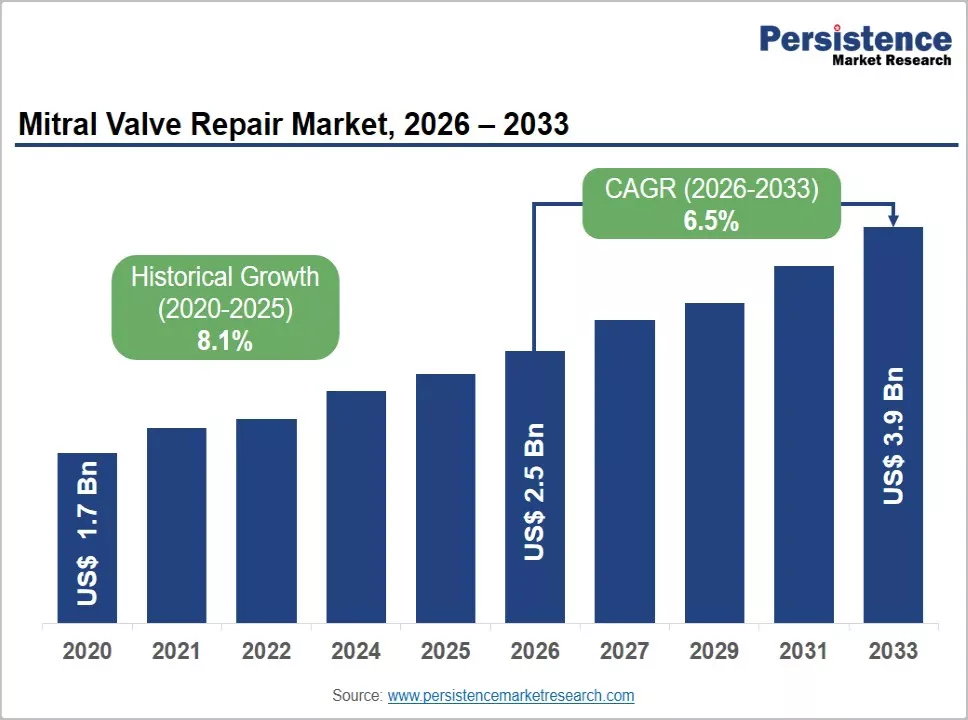
The global mitral valve repair market size is likely to be valued at US$2.5 billion in 2026 and is expected to reach US$3.9 billion by 2033, growing at a CAGR of 6.5% during the forecast period from 2026 to 2033, driven by the increasing prevalence of clinically significant mitral regurgitation, population aging, broader adoption of transcatheter mitral valve repair, and improvements in cardiovascular diagnostics.
Updated clinical guidelines are also expanding treatment pathways for appropriately selected patients with primary and secondary mitral regurgitation. High procedure costs, specialized infrastructure requirements, and the need for experienced heart teams will continue to influence adoption.
Key Industry Highlights:
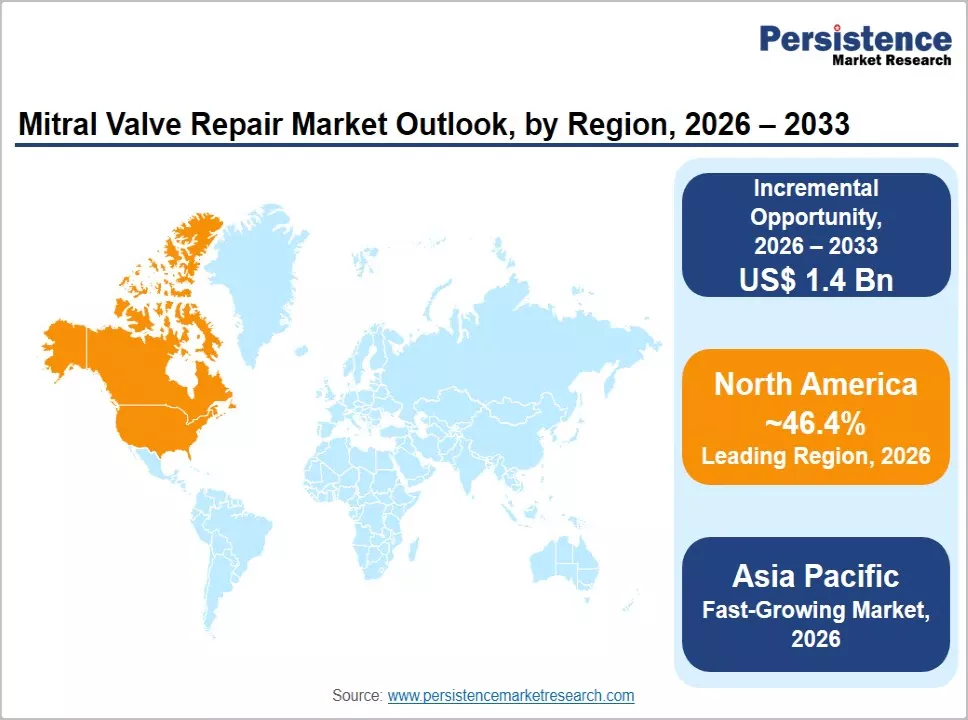
- Leading Region: North America, anticipated to account for 46.4% of the market share, supported by established structural-heart centers, advanced cardiac imaging, reimbursement pathways, and strong adoption of TEER.
- Fastest-growing Region: Asia Pacific, driven by population aging, expanding tertiary-care infrastructure, increasing specialist expertise, and growing domestic development of structural-heart devices.
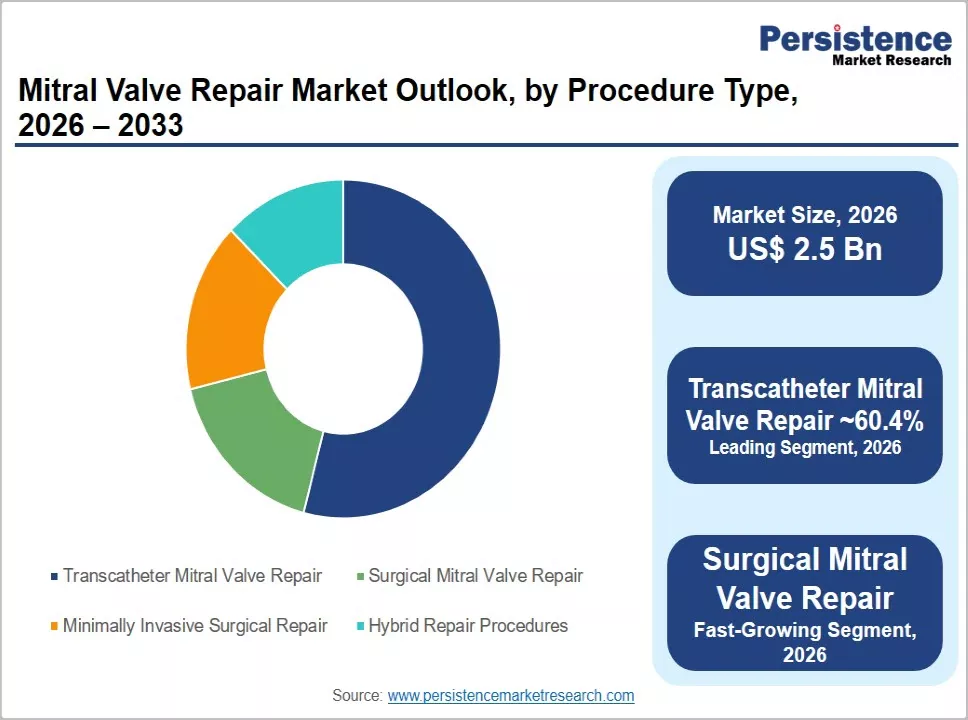
- Dominant Procedure Type: Transcatheter mitral valve repair, anticipated to account for 60.4% of the market share, supported by increasing adoption among elderly and high-surgical-risk patients.
- Leading Product: Edge-to-Edge Repair and Clip-Based Devices, anticipated to account for 49.8% of the market share, supported by established platforms such as Abbott's MitraClip and Edwards Lifesciences' PASCAL.
DRO Analysis
Drivers - Population Aging Is Expanding the Patient Base for Mitral Valve Repair
Population aging is a fundamental demand driver for the mitral valve repair market because mitral regurgitation becomes increasingly prevalent with age. A 2025 systematic review found that moderate-to-severe mitral regurgitation rises substantially among older populations, with prevalence increasing from less than 1% in middle-aged adults to several percentage points among people in their 70s and reaching its highest levels among very elderly populations. This creates a growing pool of patients requiring regular cardiovascular monitoring and, where clinically appropriate, corrective intervention.
The demographic shift is particularly important for structural-heart care because older patients often have multiple comorbidities that can increase the risks associated with conventional open-heart surgery. The United Nations expects the global population aged 65 years and older to expand significantly over the coming decades. As this population grows, healthcare systems are likely to see greater demand for less invasive treatment options that can reduce recovery time and limit the physiological burden of major surgery.
Guideline Expansion and Clinical Evidence Are Strengthening TEER Adoption
The clinical role of transcatheter edge-to-edge repair (TEER) is expanding as evidence continues to clarify which patients benefit most from the procedure. Recent European treatment guidelines have strengthened recommendations for mitral valve intervention, including early surgical repair for suitable patients with severe primary mitral regurgitation and TEER for selected patients who face high surgical risk. TEER also has an increasingly established role in appropriately selected patients with severe secondary mitral regurgitation who remain symptomatic despite optimized medical treatment.
In the U.S., established Medicare coverage pathways for mitral TEER have also helped create greater clarity around reimbursement and patient eligibility. At the same time, large clinical registries are providing physicians with more information on patient selection, procedural outcomes, complications, and longer-term treatment patterns.
Restraint - High Procedural Complexity and Specialized Infrastructure Requirements
Mitral valve repair requires specialized imaging, experienced physicians, multidisciplinary decision-making, and advanced cardiac-care infrastructure. Transcatheter procedures depend on high-quality echocardiographic imaging, catheterization or hybrid operating facilities, and teams trained in structural-heart interventions. Surgical repair similarly requires established cardiac-surgery capabilities, anesthesia support, intensive-care resources, and postoperative monitoring.
These requirements can make mitral repair difficult to establish in smaller hospitals and healthcare systems where procedural volumes are limited. U.S. registry data covering more than 50,000 MTEER procedures across hundreds of hospitals have also highlighted differences in procedural experience and outcomes between centers. Geographic variation in procedure utilization further indicates that access remains uneven across healthcare systems.
Opportunities - Secondary Mitral Regurgitation Is Creating an Expanding Treatment Opportunity
Secondary mitral regurgitation represents an important growth opportunity because it is closely associated with heart failure, left-ventricular dysfunction, and cardiac remodeling. Treatment has traditionally focused on managing the underlying cardiac condition, but growing clinical evidence has established a clearer role for TEER in selected patients whose severe symptoms persist despite optimized medical therapy.
Recent European guidelines have further strengthened the position of TEER for appropriately selected patients with severe secondary MR and impaired ventricular function. This is expanding the addressable population for transcatheter technologies while encouraging heart centers to develop more structured pathways for evaluating and treating secondary MR.
Asia Pacific Provides Significant Expansion Potential
Asia Pacific offers substantial expansion potential because of its large and aging population, rising cardiovascular disease burden, improving healthcare infrastructure, and growing availability of specialist cardiac services. China and India provide particularly large patient populations, while Japan represents a mature structural-heart market supported by advanced healthcare infrastructure and a rapidly aging demographic.
Access to sophisticated cardiovascular interventions is also improving as tertiary-care hospitals expand their structural-heart capabilities. At the same time, manufacturers in China, India, and other Asian markets are developing locally produced technologies that can potentially address regional cost and accessibility requirements. Increasing clinical expertise and physician training are further supporting the development of structural-heart programs.
Category-wise Analysis
Procedure Type Insights
Transcatheter mitral valve repair is anticipated to account for 60.4% of the market share in 2026. Its position reflects growing preference for less invasive treatment among elderly and high-surgical-risk patients. Transcatheter edge-to-edge repair (TEER) enables physicians to approximate the mitral leaflets using a catheter-based device, avoiding conventional open-heart access. The expansion of TEER has increased treatment options for patients who may be unsuitable for surgery. U.S. Medicare data show strong adoption following its introduction, with annual MTEER procedures rising from 2,322 in 2015 to 9,021 in 2019. Abbott's MitraClip and Edwards Lifesciences' PASCAL are prominent examples, while newer generations have focused on improved steering, leaflet grasping, visualization, and device positioning.
Surgical mitral valve repair is anticipated to be the fastest-growing procedure segment in selected emerging markets, supported by expanding cardiac-surgery infrastructure, greater surgeon expertise, improved diagnostics, and increasing use of minimally invasive techniques. Clinical evidence also indicates that procedural experience has a strong influence on repair utilization, reinforcing the importance of specialized cardiac centers. Minimally invasive and hybrid procedures are also gaining attention.
Examples include robotic-assisted mitral valve repair and thoracoscopic repair, which can provide the durability associated with surgical intervention while reducing procedural trauma. The market is therefore moving toward a more individualized approach based on patient risk, valve anatomy, and clinical suitability rather than a simple shift from surgery to catheter-based treatment.
Product Insights
Edge-to-edge repair and clip-based devices are anticipated to account for 49.8% of the market share in 2026. Their position is supported by extensive clinical experience, established regulatory pathways, physician familiarity, and suitability for appropriately selected high-risk patients. MitraClip remains a leading TEER platform, while PASCAL provides a competing system with differentiated leaflet-capture and device-control features. U.S. Transcatheter Valve Therapy Registry data demonstrate the rapid expansion of TEER, with procedure volumes increasing substantially during the 2010s.
Annuloplasty devices and rings are anticipated to be the fastest-growing product category. These devices remain important in surgical mitral repair because reshaping and stabilizing the mitral annulus can improve leaflet coaptation and support repair durability. Examples include Medtronic's CG Future, SimuForm, Profile 3D, and SimuPlus annuloplasty systems, along with Edwards Lifesciences' MITRIS surgical platform. Chordal repair devices, transcatheter annuloplasty systems, and combined repair technologies are also advancing, particularly for patients whose anatomy cannot be adequately treated using conventional TEER alone.
Regional Insights
North America Mitral Valve Repair Market Trends
North America is anticipated to maintain its leadership in the market share, accounting for 46.4% of the market share in 2026. The U.S. represents the dominant regional market, supported by an aging population, established structural-heart programs, advanced imaging capabilities, specialist physician networks, and favorable reimbursement pathways. The scale of U.S. activity is reflected in registry data covering more than 51,000 MTEER patients across 493 hospitals between 2020 and 2023.
U.S. Mitral Valve Repair Market Trends
The U.S. market benefits from strong adoption of transcatheter technologies and an established ecosystem linking hospitals, device manufacturers, clinical researchers, and specialist physicians. Abbott's MitraClip remains a major TEER platform, while Edwards Lifesciences' PASCAL provides another established option for appropriately selected patients. In 2025, Abbott introduced the MitraClip G5, incorporating design and delivery improvements intended to simplify positioning and deployment. Such product development is supporting continued investment in structural-heart programs and encouraging centers to expand their capacity for minimally invasive mitral intervention.
Canada Mitral Valve Repair Market Trends
Canada represents a smaller but well-developed market supported by specialized cardiac centers and publicly funded healthcare. Adoption is concentrated in high-volume institutions capable of providing advanced imaging and multidisciplinary structural-heart assessment. The presence of companies such as Abbott and Edwards within the broader Canadian cardiovascular-device market provides access to established TEER technologies, while clinical specialization supports continued adoption of less invasive treatment for appropriately selected high-risk patients.
Europe Mitral Valve Repair Market Trends
Europe is a mature market supported by an aging population, established cardiac-surgery infrastructure, specialist heart centers, and increasing use of transcatheter interventions. The EU's elderly population represents a substantial patient base, while Germany, France, the U.K., and Spain remain important national markets. The 2025 ESC/EACTS guidelines have also strengthened the clinical position of mitral repair by supporting early surgical intervention in suitable primary MR patients and TEER for selected high-risk and secondary MR populations.
Germany Mitral Valve Repair Market Trends
Germany benefits from extensive cardiovascular infrastructure and a large elderly population. Its established hospital network supports both surgical repair and transcatheter intervention, allowing treatment decisions to be tailored to patient risk and valve anatomy. Medtronic's surgical mitral portfolio, including annuloplasty systems, complements the country's established cardiac-surgery segment, while transcatheter platforms from Abbott and Edwards support the expansion of catheter-based treatment. The European Medical Device Regulation has also increased requirements for clinical evidence and post-market surveillance, favoring manufacturers with established regulatory capabilities.
United Kingdom Mitral Valve Repair Market Trends
The U.K. remains an important market for advanced mitral intervention, supported by specialist cardiac centers and the National Health Service. The increasing use of multidisciplinary heart teams is encouraging more structured assessment of patients who may benefit from TEER rather than conventional surgery. At the European level, Edwards Lifesciences' SAPIEN M3 received CE Mark approval in April 2025 for transcatheter mitral valve replacement. Although replacement rather than repair, the technology demonstrates continued investment in transcatheter mitral therapies and intensifies competition across the broader structural-heart market.
Asia Pacific Mitral Valve Repair Market Trends
Asia Pacific is anticipated to remain the fastest-growing regional market, supported by population aging, expanding cardiac infrastructure, increasing healthcare investment, and the emergence of domestic medical-device manufacturers. China, Japan, and India represent the region's most significant opportunities, although adoption remains concentrated in major tertiary-care centers.
China Mitral Valve Repair Market Trends
China offers the region's largest population opportunity and is becoming an increasingly important center for indigenous structural-heart innovation. Lepu Medical has been developing mitral technologies including MemoClip-A, MemoChord, and MemoClip-F, expanding the range of locally developed repair options. Peijia Medical has likewise advanced its transcatheter mitral portfolio, including the GeminiOne system. These developments can support greater domestic competition, local clinical expertise, and potentially more cost-efficient access to structural-heart treatment.
India Mitral Valve Repair Market Trends
India represents a high-potential market because of its large population, expanding tertiary-care hospital network, and increasing availability of advanced cardiac procedures. Companies such as Meril Life Sciences are strengthening India's domestic cardiovascular-device ecosystem, while international manufacturers continue to provide advanced structural-heart technologies. Greater physician training, broader access to specialized imaging, and expansion of cardiac centers beyond major metropolitan areas are likely to support wider adoption of mitral repair. Together, these developments position Asia Pacific for continued expansion as treatment becomes more accessible and locally supported.
Competitive Landscape
The global mitral valve repair market is relatively concentrated in transcatheter edge-to-edge repair but more fragmented across surgical repair, annuloplasty, chordal repair, and emerging transcatheter technologies. Abbott and Edwards Lifesciences have strong positions in commercial TEER, while Medtronic, Artivion, Corcym, and other companies maintain important surgical repair portfolios.
Market leaders are emphasizing product innovation, clinical evidence, indication expansion, physician training, and geographic expansion. Established companies use broad portfolios and installed clinical networks, while emerging manufacturers increasingly focus on anatomy-specific technologies, localized manufacturing, cost efficiency, and access to rapidly developing Asian markets.
Key Industry Developments:
- In April 2026, Prolacta Bioscience announced results from the JASMINE randomized clinical trial conducted across 11 Japanese NICUs, reporting faster growth and earlier achievement of full feeds among very-low-birth-weight infants receiving its exclusive human milk diet.
Companies Covered in Mitral Valve Repair Market
- Abbott Laboratories
- Edwards Lifesciences
- Medtronic
- Boston Scientific
- Artivion
- Corcym
- Peijia Medical
- Lepu Medical Technology
- Meril Life Sciences
- NeoChord
- CardioMech
- Micro Interventional Devices
- HighLife SAS
- Valcare Medical
- Cardiac Dimensions
- Ancora Heart
Frequently Asked Questions
The global mitral valve repair market is expected to be valued at US$2.5 billion in 2026.
The mitral valve repair market is expected to reach US$3.9 billion by 2033.
Key trends include increasing adoption of transcatheter edge-to-edge repair (TEER), growing demand for minimally invasive procedures, expanding treatment of secondary mitral regurgitation, advancements in clip-based and annuloplasty technologies, and increasing development of locally manufactured structural-heart devices in Asia Pacific.
By procedure type, transcatheter mitral valve repair is the leading segment, anticipated to account for approximately 60.4% of the market.
The mitral valve repair market is projected to grow at a 6.5% CAGR from 2026 to 2033.
Major players include Abbott Laboratories, Edwards Lifesciences, Medtronic, Artivion, and Peijia Medical.


