




- Medical Devices
- Advanced Wound Management Technologies Market
Advanced Wound Management Technologies Market Size, Share, and Growth Forecast 2026 - 2033
Advanced Wound Management Technologies Market by Product Type (Advanced Non-Biological Wound Dressings), Application (Chronic Wound Management), and End User (Hospitals, Other), and Regional Analysis, 2026 - 2033

Advanced Wound Management Technologies Market Size and Trend Analysis
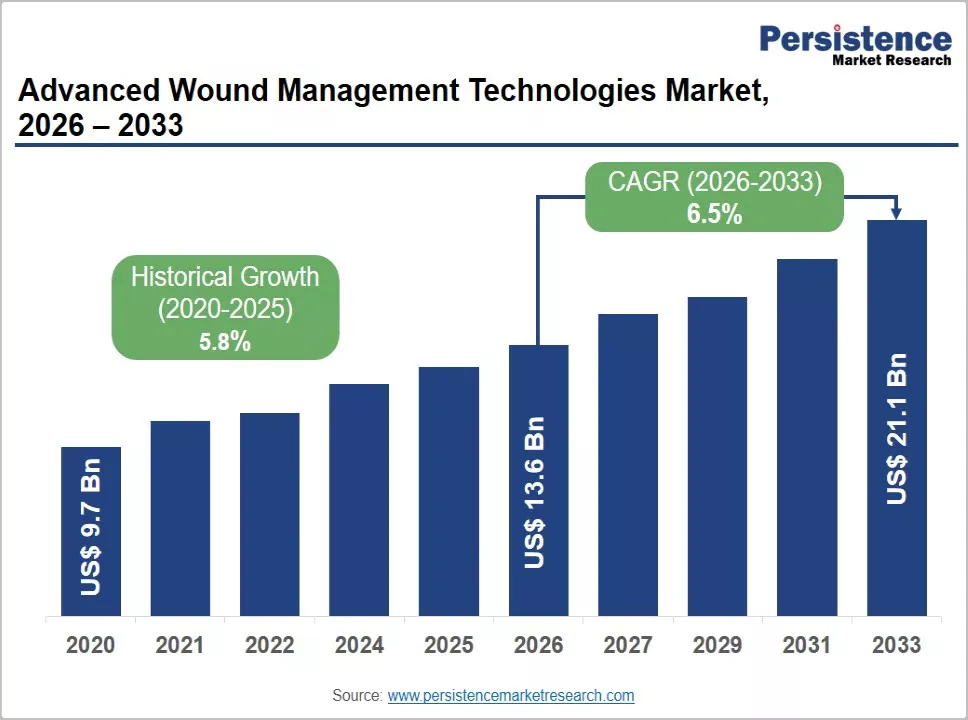
The global advanced wound management technologies market size is likely to be valued at US$ 13.60 billion in 2026 and is projected to reach US$ 21.13 billion by 2033, growing at a CAGR of 6.5% during forecast period between 2026 and 2033.
The World Health Organization (WHO) estimates that more than 500 million people globally live with diabetes a primary driver of chronic, treatment-resistant wounds including diabetic foot ulcers. This epidemiological pressure, combined with accelerating adoption of negative pressure wound therapy, cellular and tissue-based products, and smart wound monitoring systems, sustains a growth trajectory that institutional investors and strategic acquirers should treat as structurally durable rather than cyclical.
Key Industry Highlights
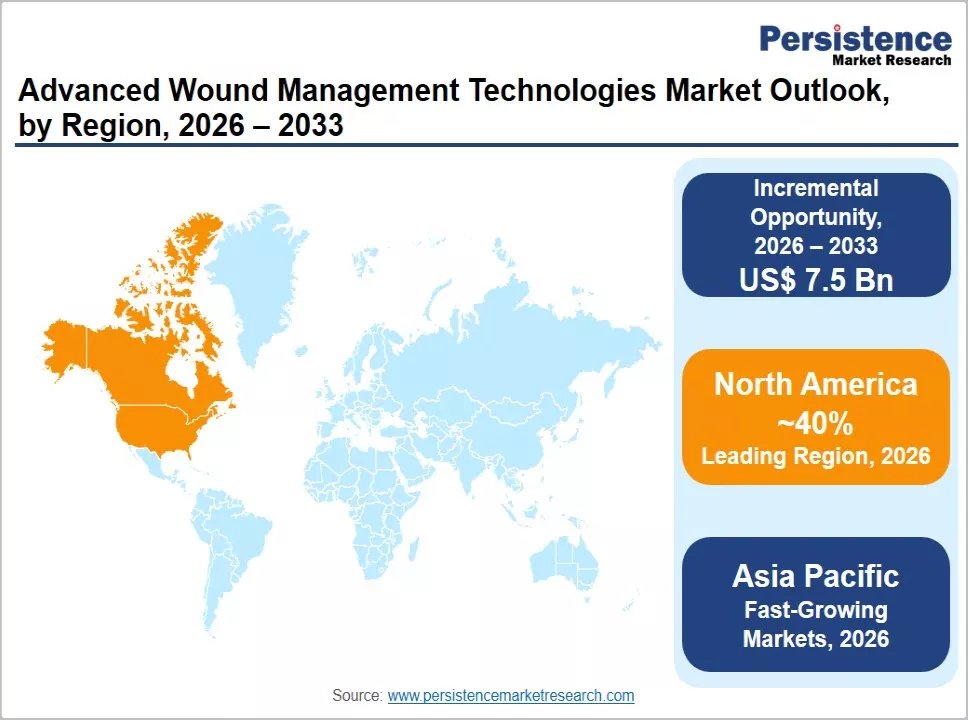
- Dominant Region: North America command 40% of market revenue in 2026, propelled by Medicare and Medicaid reimbursement structures that reward outcomes-based wound care and by the highest per-capita chronic wound burden among mature economies. The region's structural advantages in payer policy and clinical infrastructure make its leadership position durable through 2033.
- Fastest growing Region: Growing at an estimated CAGR of 8.2%, Asia Pacific is outpacing every other region in the advanced wound management technologies industry. The International Diabetes Federation's projection that Asia will house the majority of the world's diabetic population by 2045 means this regional acceleration is structural, not cyclical positioning early-movers in China and India for compounding market share gains.
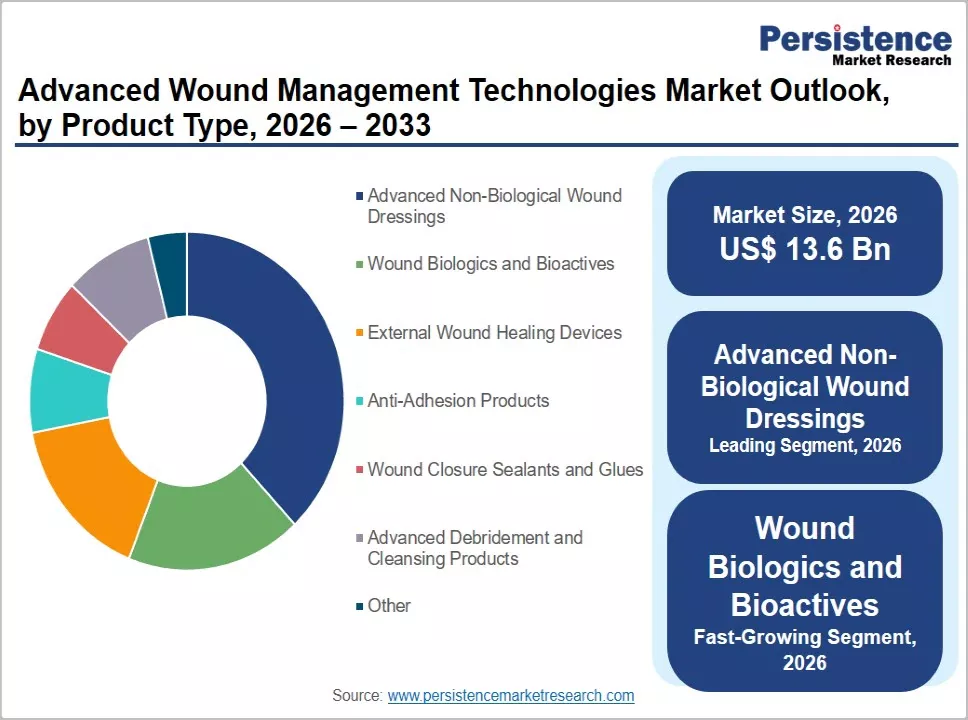
- Leading Product Type: Advanced non-biological wound dressings hold 38% of the global product market at US$ 5.17 billion in 2026, sustained by universal clinical applicability across wound types, established distributor networks, and deep integration into hospital formularies. Their position as the workhorse of multi-product wound care protocols insulates this segment from displacement by higher-cost biologics in cost-sensitive settings.
- Fastest-growing Product Type: Wound biologics and bioactives are the standout growth segment within the advanced wound management technologies space, driven by expanding FDA clearance activity and NHS and CMS reimbursement recognition for amnion-derived wound matrices. Manufacturers investing in clinical outcomes data to support coding applications are best positioned to capture disproportionate share as biologics move from adjunctive to first-line status in chronic wound guidelines.
DRO Analysis
Driver - Rising Prevalence of Chronic Wounds Linked to Non-Communicable Disease Burden
Chronic wounds principally diabetic foot ulcers, venous leg ulcers, and pressure injuries impose an escalating clinical and economic burden on healthcare systems worldwide. The Centers for Disease Control and Prevention (CDC) reports that diabetic foot complications account for approximately 1.6 million hospitalizations annually in the U.S. alone, each requiring multi-week advanced wound care protocols that consume premium product categories including biofilm-disrupting wound cleansers and silver-impregnated antimicrobial dressings.
Hospital procurement teams and wound care coordinators now specify evidence-based advanced dressings over traditional gauze because reimbursement frameworks, particularly Medicare's wound care bundled payment models, reward demonstrable healing outcomes. This clinical-economic alignment creates a durable pull-through demand structure across the advanced wound management technologies landscape.
Restraint - High Product Cost and Reimbursement Complexity Limiting Uptake in Cost-Sensitive Settings
Advanced wound care technologies particularly cellular and tissue-based products (CTPs) and bioactive wound matrices carry substantially higher per-unit costs than conventional wound care materials. The Centers for Medicare and Medicaid Services (CMS) periodically reassesses reimbursement coding for skin substitutes and CTPs, introducing uncertainty that slows formulary adoption by long-term care facilities and home healthcare providers operating on fixed reimbursement rates. Procurement decision cycles lengthen when value evidence is contested, constraining product uptake even where clinical efficacy is well-documented.
Opportunity - Digital Wound Assessment and Remote Monitoring as a Growth Frontier
Artificial intelligence-enabled wound imaging platforms and connected wound monitoring sensors represent the most nascent and potentially most disruptive growth vector within the advanced wound management technologies industry. Tissue Analytics and WoundMatrix have deployed AI-powered smartphone-based wound measurement tools that integrate into electronic health record systems, enabling remote wound progression tracking for home healthcare and long-term care populations.
The U.S. Department of Veterans Affairs (VA) piloted telehealth wound care programs across multiple facilities between 2023 and 2025, demonstrating that remote monitoring protocols can reduce unnecessary outpatient visits while maintaining healing outcomes. Technology vendors, medtech incumbents, and digital health platforms are all competing to own this emerging care coordination layer.
Category-wise Analysis
Product Type Insights
Why Do Advanced Non-Biological Wound Dressings Command the Largest Market Share?
Advanced non-biological wound dressings are forecast to dominate the segment account nearly 38% of market share in 2026, driven by they offer an unmatched combination of clinical versatility, manufacturing scalability, and established reimbursement coding. Hospital wound care nurses and community tissue viability specialists rely on foam dressings, hydrocolloids, hydrogels, and silver-containing antimicrobial dressings as the foundational layer of multi-product wound care protocols applied at every clinical encounter from initial debridement through final healing. Essity Aktiebolag's Leukoplast and Cutimed product families, distributed across European acute care systems, exemplify the category's breadth.
Wound biologics and bioactives are likely to be the fastest-growing product segment, propelled by expanded clinical evidence supporting growth factor concentrates, platelet-rich plasma matrices, and amniotic tissue allografts in hard-to-heal wounds. MiMedx launched its EpiFix dehydrated human amnion/chorion membrane across a broader set of wound care clinic networks in 2024, accelerating adoption among specialist podiatrists and vascular surgeons managing treatment-refractory diabetic ulcers.
Application Insights
Chronic Wound Management accounts for 36% of the global advanced wound management technologies market in 2026, equivalent to US$ 4.90 Billion. The application's dominance reflects the longitudinal nature of treatment: a single diabetic foot ulcer patient managed through a specialty wound care clinic will consume advanced dressings, debridement products, offloading devices, and potentially biological wound matrices across a care episode spanning three to twelve months. This volume intensity per patient creates a recurring revenue dynamic that sustains procurement at scale across hospitals and wound care clinics alike.
Chronic wound management is likely to be the fastest-growing application, catalyzed by CMS expanding reimbursement access for cellular and tissue-based products under the Outpatient Prospective Payment System (OPPS) in its 2024 final rule. This reimbursement expansion enables hospital outpatient wound care centers to deploy higher-tier biological therapies cost-effectively, widening the clinical toolkit available to wound care specialists treating patients who have failed conventional advanced dressing protocols.
End User Insights
Hospitals are estimated to command about 38% of market share in 2026, propelled by their role as the primary site of management for complex acute wounds, surgical site complications, and high-acuity chronic wounds requiring procedural intervention. Hospital wound care committees centralize formulary decision-making, meaning that a single procurement contract with a major integrated delivery network can deliver sustained, high-volume product uptake across dozens of facilities. Cardinal Health supplies advanced wound care product portfolios directly to hospital systems through its medical distribution network, reinforcing the channel's institutional purchasing leverage.
Specialty wound care clinics are likely to be the fastest-growing end-user segment. The Healogics network operating more than 600 wound care centers embedded within U.S. hospital campuses has expanded its use of hyperbaric oxygen therapy alongside advanced wound dressings and CTPs since 2023, creating a multi-modal treatment environment that drives higher per-visit product consumption than general outpatient settings.
Regional Insights
North America Advanced Wound Management Technologies Market Trends and Insights
North America is forecast to dominate the regional market capture around 40% of the advanced wound management technologies market share in 2026, fueled by the highest per-capita chronic wound prevalence among developed economies, a mature reimbursement infrastructure, and deep hospital system adoption of premium wound care technologies. CMS reimbursement policy functions as a de facto technology adoption accelerator across the region. North America will retain regional leadership through 2033, sustained by continued investment in home healthcare wound management programs.
U.S. Advanced Wound Management Technologies Market Size
The U.S. is projected to capture about 87% of the North America regional market in 2026. The primary demand driver is the disproportionate burden of diabetic foot disease among the U.S. adult population, with an estimated 34.2 million Americans living with diabetes per CDC data. Continued growth in outpatient wound care center networks will sustain premium product adoption through the forecast period.
Canada Advanced Wound Management Technologies Market Size
Canada is expected to hold around 13% of the North America regional market in 2026. Health Canada's accelerated review pathway for innovative wound care devices and the provincial health system's expanding home care wound management programs are the primary structural demand drivers. Increasing integration of telehealth wound assessment into provincial home care services positions Canada for above-regional-average growth through 2030.
Europe Advanced Wound Management Technologies Market Trends and Insights
Europe is estimated to command about 17% of market share in 2026. The region's growth trajectory is shaped by the dual pressure of EU MDR 2017/745 compliance costs which are elevating barriers for smaller product manufacturers and an ageing population driving chronic wound prevalence across Western European healthcare systems. The European Wound Management Association (EWMA) continues to publish clinical practice guidelines that accelerate formulary adoption of evidence-supported advanced wound care technologies.
Germany Advanced Wound Management Technologies Market Size
Germany is projected to account for 23% of the Europe regional market share in 2026. Germany's hospital-centric care model and the Gemeinsamer Bundesausschuss (G-BA) benefit assessment framework drive high uptake of clinically validated wound care technologies within statutory health insurance reimbursement. B. Braun SE's domestic manufacturing and clinical education infrastructure sustain Germany's position as Europe's largest national wound care market through 2033.
U.K. Advanced Wound Management Technologies Market Size
The U.K. is expected to command about 19% of the Europe regional market in 2026. The National Institute for Health and Care Excellence (NICE) wound care technology appraisal program channels NHS procurement toward cost-effective advanced wound management solutions, with recent guidance supporting expanded use of NPWT in community nursing. NHS integrated care systems' focus on reducing wound-related unplanned hospital admissions will drive further advanced technology uptake through 2033.
Which Region Will Drive the Fastest Advanced Wound Management Technologies Market Growth Through 2033?
Asia Pacific is likely to be the fastest growing during the forecast period between 2026 to 2033. The region's acceleration is driven by rapidly expanding diabetic populations in China and India, increasing government investment in wound care infrastructure, and rising private hospital adoption of international-standard advanced wound care protocols. The International Diabetes Federation (IDF) projects Asia will account for more than 60% of global diabetes cases by 2045, making the region the most consequential long-term growth market in the advanced wound management technologies industry.
China Advanced Wound Management Technologies Market Size
China is estimated to command about 36% of the Asia Pacific regional market in 2026. The National Medical Products Administration (NMPA) has streamlined approval pathways for innovative wound care devices under its 2023 medical device regulatory reform agenda, accelerating domestic market entry for multinational manufacturers. China's expanding network of tertiary hospitals with dedicated wound care departments will sustain above-average regional growth through 2033.
Japan Advanced Wound Management Technologies Market Size
Japan is anticipated to command about 21% of the Asia Pacific regional market in 2026. Japan's universal health insurance system, administered by the Ministry of Health, Labor and Welfare (MHLW), funds advanced wound dressings and bioactive therapies for defined chronic wound indications, supporting structured clinical uptake. Japan's established medical device manufacturing base and ageing population profile position it as a stable, high-value market for premium advanced wound management technologies through the forecast period.
Competitive Landscape
The global advanced wound management technologies market is moderately consolidated at the top, with 3M, Coloplast Group, Mölnlycke AB, ConvaTec Group PLC, and Smith+Nephew collectively commanding substantial global share through diversified wound care portfolios, hospital group purchasing organization contracts, and proprietary clinical education programs.
Competition turns on three axes: clinical evidence supporting reimbursement coding, breadth of portfolio enabling single-source hospital supply agreements, and manufacturing scale sustaining cost-competitive pricing under group purchasing frameworks. Mid-tier players including Integra LifeSciences Corp., MiMedx, and Organogenesis Holdings Inc. compete primarily in the higher-margin biologics and CTPs segment, where proprietary tissue processing technology and FDA clearance status function as durable differentiation factors. Smaller specialists face margin compression as integrated delivery networks consolidate supplier lists.
Key Industry Developments
- In November 2026, Spartan Medical launched three advanced wound care solutions on Veterans Day to expand treatment options for veterans suffering from chronic, non-healing wounds. The newly introduced solutions included ViaCLYR, Microlyte PainGuard with Lidocaine and Omeza Complete Matrix, which addressed different wound management requirements, including antimicrobial protection, pain management and wound healing. ViaCLYR featured an FDA 510(k)-cleared wound management lavage based on Copper-Iodine Complex Solution (CICS).
- In May 2026, Smith+Nephew announced the launch of ALLEVYN COMPLETE CARE Foam Dressing and RENASYS EDGE Negative Pressure Wound Therapy (NPWT) System to advance chronic wound management and improve patient outcomes. The company introduced both innovations at the European Wound Management Association (EWMA) Conference, held in Bremen, Germany, from May 6-8, 2026. The launches aimed to simplify wound management, support clinicians and reduce the clinical burden associated with chronic wounds.
Companies Covered in Advanced Wound Management Technologies Market
- 3M
- Abbvie Inc.
- Advanced Medical Solutions Group Plc
- Biotissue Inc.
- B. Braun Se
- Cardinal Health
- Coloplast Group
- Convatec Group Plc
- Dermarite Industries LLC
- Essity Aktiebolag
- Integra Lifesciences Corp.
- Medline Industries Inc.
- Mimedx
- Misonix Inc.
- Mölnlycke Ab
- Organogenesis Holdings Inc.
Frequently Asked Questions
The global advanced wound management technologies market is valued at US$ 13.60 billion in 2026.
Escalating chronic wound incidence linked to diabetes and population ageing, and the expansion of reimbursement frameworks including updated CMS Outpatient Prospective Payment System coding for cellular and tissue-based products that incentivize adoption of premium wound care technologies across hospital outpatient and specialty clinic settings.
Advanced non-biological wound dressings are projected to hold about 38% of market share in 2026. Their dominance reflects universal clinical applicability across wound types, deep integration into hospital group purchasing organization formularies, and established reimbursement coding factors that collectively insulate the segment from near-term displacement risk.
North America is forecast to hold around 40% of market revenue in 2026. The Medicare and Medicaid reimbursement system that actively incentivizes evidence-based advanced wound care adoption, and the highest concentration of specialty wound care clinic networks globally. North America's leadership is expected to persist through 2033.
The largest opportunity within the advanced wound management technologies industry lies in the accelerating adoption of cellular and tissue-based products for treatment-refractory chronic wounds, particularly as CMS and international payers expand reimbursement access for biological wound matrices.
Some leading players include Mölnlycke AB, ConvaTec Group PLC, Coloplast Group, Solventum Corporation (formerly 3M Healthcare), and Integra LifeSciences Corp.


