




- Specialty & Fine Chemicals
- Methyl Mercaptan Market
Methyl Mercaptan Market Size, Share, and Growth Forecast, 2026 - 2033
Methyl Mercaptan Market by Product Type (Hydrogen Sulfide–Methanol Vapor-Phase Synthesis, Thiourea–Dimethyl Sulfate Synthesis, Others), Application (Methionine/Animal Nutrition, Others), End‑use Industry, and Regional Analysis for 2026 - 2033

Methyl Mercaptan Market Size and Trends Analysis
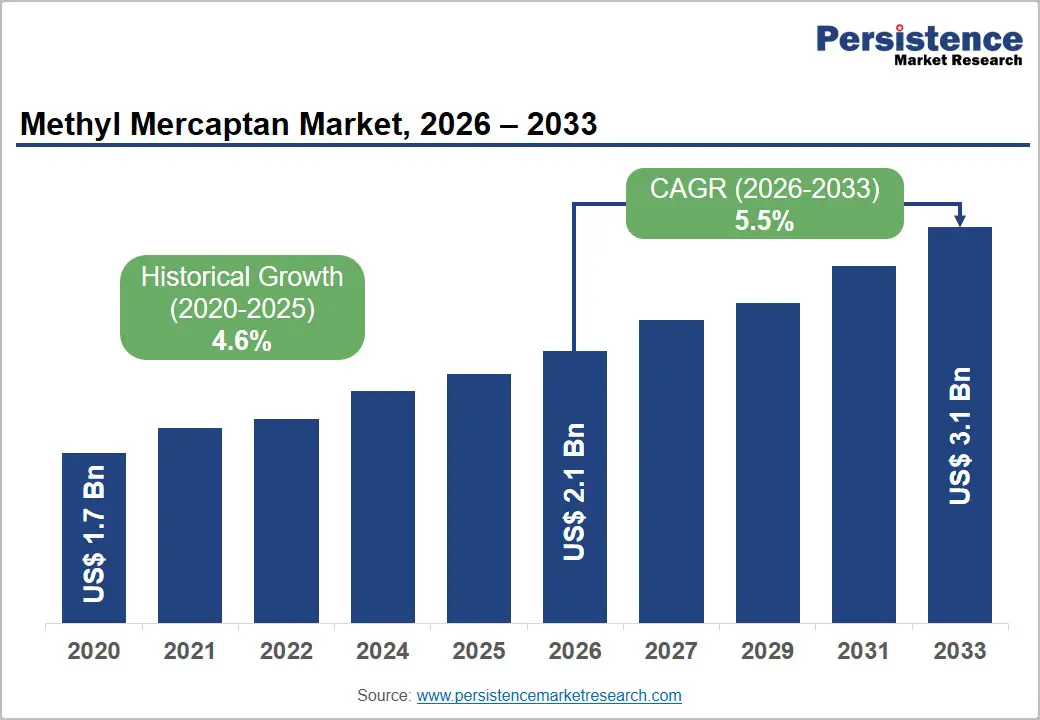
The global methyl mercaptan market size is likely to be valued at US$2.1 billion in 2026 and is expected to reach US$3.1 billion by 2033, growing at a CAGR of 5.5% between 2026 and 2033, driven by the increasing demand for methionine in animal nutrition, rising investments in sulfur-based chemical manufacturing, and expanding applications across petrochemicals, natural gas odorization, and specialty chemicals. Continuous improvements in production technologies and growing downstream demand for sulfur-containing intermediates are strengthening the industry's long-term outlook. Regulatory emphasis on process safety and sustainable manufacturing is also encouraging producers to modernize facilities and adopt integrated production models that improve efficiency and supply chain resilience.
Key Industry Highlights:
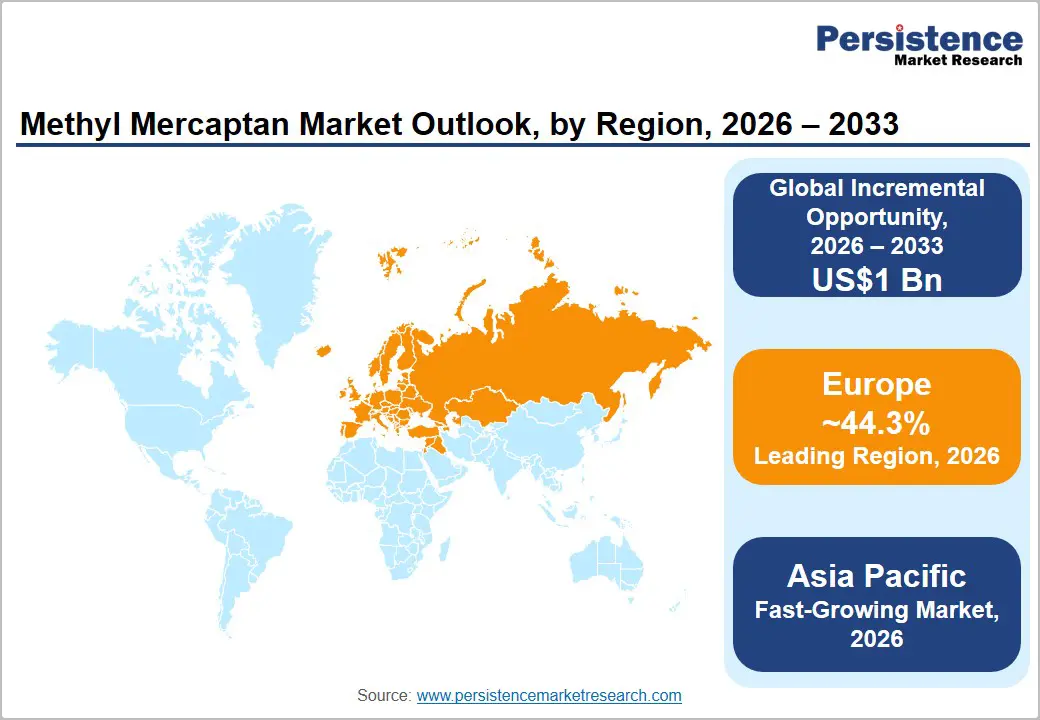
- Leading Region: Europe is anticipated to account for approximately 44.3% of the market share in 2026, supported by its well-established specialty chemicals industry, integrated production infrastructure, and stringent environmental standards.
- Fastest-growing Region: Asia Pacific is projected to register the fastest growth through 2033, driven by expanding methionine production, increasing livestock farming, rapid industrialization, and rising investments in chemical manufacturing across China, India, and ASEAN countries.
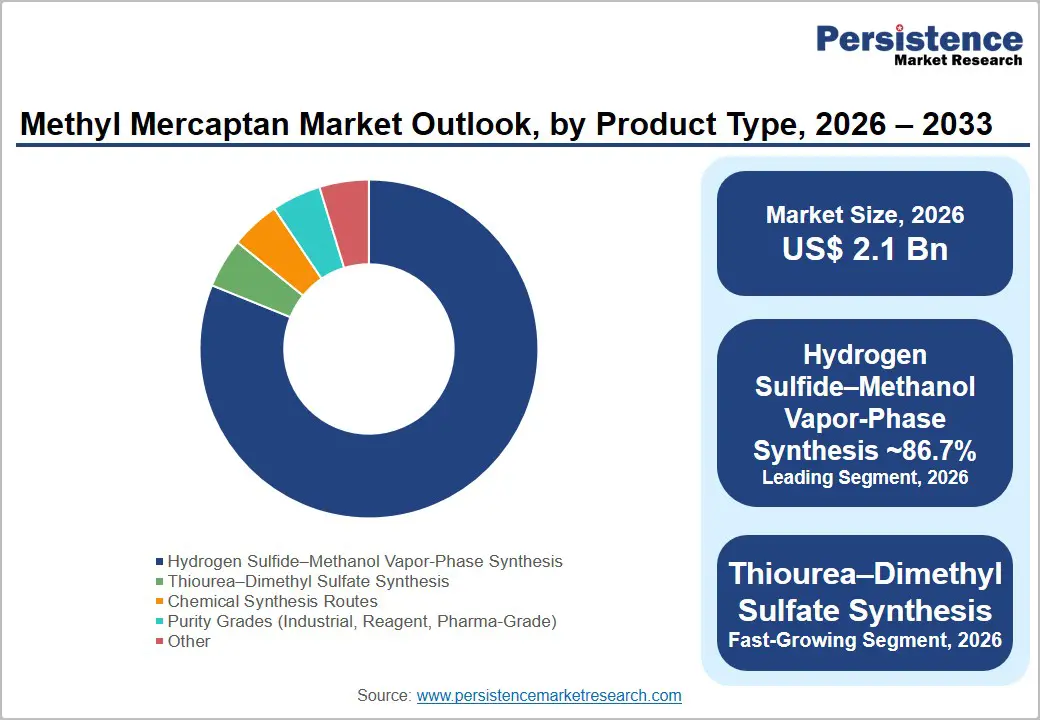
- Dominant Product Type: Hydrogen Sulfide–Methanol Vapor-Phase Synthesis is anticipated to account for 86.7% of the market share in 2026, owing to its high production efficiency, continuous processing capability, and widespread use in large-scale methionine manufacturing.
- Leading Application: Methionine/Animal Nutrition is expected to hold 46.1% of the market share in 2026, supported by sustained demand from the poultry, swine, aquaculture, and livestock feed industries.
DRO Analysis
Drivers - Growing Demand for Methionine from the Animal Nutrition Industry
The largest growth driver for the methyl mercaptan market remains its extensive use in methionine production, which serves as an essential amino acid in livestock and poultry feed. Rising global consumption of poultry, pork, and aquaculture products continues to increase demand for balanced animal nutrition, encouraging feed manufacturers to expand methionine production capacity. Since methyl mercaptan serves as a key raw material in synthetic methionine manufacturing, demand for the chemical grows alongside global livestock production. Increasing focus on feed efficiency, improved animal health, and sustainable livestock farming further supports long-term consumption. Expanding protein consumption across developing economies, particularly in Asia, Latin America, and parts of Africa, is expected to sustain stable demand throughout the forecast period.
Increasing Vertical Integration across Sulfur Chemical Production
Chemical manufacturers are increasingly adopting backward integration strategies to secure reliable methyl mercaptan supplies while minimizing raw material price volatility and transportation risks. Integrated production facilities improve operational efficiency, reduce logistics costs, and enhance overall supply chain stability. Companies continue investing in dedicated methyl mercaptan production facilities that directly support methionine manufacturing operations, lowering dependence on third-party suppliers. Simultaneously, producers are modernizing manufacturing infrastructure to improve energy efficiency and reduce emissions. These investments strengthen production reliability while helping companies comply with increasingly stringent environmental regulations. As production integration expands globally, methyl mercaptan manufacturers benefit from improved profitability, enhanced operational control, and greater resilience against supply disruptions.
Restraint - Strict Safety Regulations and High Production Costs
Methyl mercaptan is classified as a highly flammable and hazardous chemical requiring specialized storage, transportation, and handling procedures throughout its lifecycle. Compliance with occupational safety, environmental protection, hazardous material transportation, and emissions regulations significantly increases production and operating expenses. Manufacturers must invest heavily in monitoring systems, leak detection technologies, explosion prevention equipment, and employee safety training programs. Regulatory approval processes for plant expansion or new production facilities can also extend project timelines and increase capital investment requirements. These structural challenges particularly affect smaller manufacturers, limiting new market entry while increasing operating costs across the global supply chain.
Opportunities - Expanding Livestock Production across Asia Pacific
Rapid population growth, rising disposable incomes, and changing dietary preferences continue to accelerate meat consumption throughout Asia Pacific. Increasing poultry, swine, aquaculture, and dairy production creates sustained demand for methionine-based feed additives, directly supporting methyl mercaptan consumption. Governments across several Asian countries continue investing in livestock productivity, food security, and commercial farming modernization, creating favorable conditions for feed additive manufacturers. Regional chemical producers are also expanding production capacity closer to major feed manufacturing hubs, reducing logistics costs and strengthening supply security. These developments position Asia Pacific as one of the most attractive investment destinations for methyl mercaptan manufacturers during the forecast period.
Expansion of High-Value Specialty Chemical Applications
Beyond animal nutrition, methyl mercaptan continues to gain importance as an intermediate in specialty chemicals, agrochemicals, pharmaceuticals, petrochemicals, and sulfur-containing compounds. Growing investments in advanced materials, specialty polymers, and fine chemical production are expanding downstream consumption opportunities. Increasing demand for ultra-high purity grades supports premium pricing, particularly within pharmaceutical and specialty manufacturing applications where product consistency and purity remain critical. Manufacturers capable of producing high-purity methyl mercaptan while maintaining strict environmental compliance are expected to benefit from stronger profit margins and broader customer diversification as downstream industries continue expanding globally.
Category-wise Analysis
Product Type Insights
Hydrogen sulfide–methanol vapor-phase synthesis is anticipated to account for 86.7% of the market share in 2026. The process remains the preferred commercial production route due to its high efficiency, continuous manufacturing capability, and cost-effectiveness for large-scale methionine production. Its widespread adoption by integrated chemical manufacturers ensures consistent product quality and reliable supply. For example, leading global producers use this technology to support large methionine production facilities serving the animal nutrition industry.
Thiourea–dimethyl sulfate synthesis is expected to witness the fastest growth as manufacturers diversify production technologies to improve process flexibility and meet evolving environmental standards. Advances in catalytic processes and waste reduction are enhancing commercial viability, while demand for 99.9%+ purity grades continues to increase across pharmaceutical and specialty chemical applications. Emerging electrochemical production methods are also attracting research investments for future commercialization.
Application Insights
Methionine production is anticipated to account for 46.1% of the market share in 2026. The segment maintains its leadership due to sustained demand from poultry, swine, aquaculture, and livestock feed manufacturers. Rising global protein consumption continues to drive methionine production, making methyl mercaptan an indispensable feedstock. For instance, expanding poultry production in China, Brazil, and India continues to support strong consumption of feed-grade methionine.
The petrochemicals and refining segment is projected to be the fastest-growing application segment, supported by increasing investments in integrated refining and specialty chemical production. Methyl mercaptan is widely used as an intermediate in sulfur-containing chemicals and refinery operations. For example, expanding refining and petrochemical complexes across China, India, and the Middle East are creating new opportunities for sulfur-based intermediates, supporting above-average growth for this application during the forecast period.
Regional Insights
North America Methyl Mercaptan Market Trends
North America remains a technologically advanced market, supported by an established chemical manufacturing base, strong methionine production capacity, and stringent environmental and safety regulations. Continued investments in production modernization, supply chain integration, and sustainable manufacturing practices are strengthening regional competitiveness. Stable demand from animal nutrition, petrochemicals, and specialty chemicals is expected to support consistent market growth.
U.S. Methyl Mercaptan Market Trends
The U.S. dominates the North America market owing to its integrated petrochemical infrastructure, advanced sulfur chemical production, and large livestock industry. Strong investments in methionine production, refinery modernization, and process safety continue to support methyl mercaptan demand. Growing adoption of low-emission manufacturing technologies is further enhancing the country's competitive position.
Canada Methyl Mercaptan Market Trends
Canada contributes to regional growth through its expanding petrochemical sector and natural gas infrastructure. Increasing demand for sulfur-based intermediates, along with investments in environmentally compliant chemical production, supports steady market development. The country's focus on sustainable industrial practices also creates opportunities for specialty chemical manufacturers.
Europe Methyl Mercaptan Market Trends
Europe is anticipated to account for approximately 44.3% of the global market share in 2026, making it the leading regional market. Growth is supported by a highly developed specialty chemicals industry, integrated production facilities, and strict environmental regulations that encourage technological innovation. Investments in energy-efficient manufacturing and circular economy initiatives continue to strengthen the region's competitive advantage.
Germany Methyl Mercaptan Market Trends
Germany leads the Europe market with its strong chemical manufacturing industry and extensive production of sulfur-containing intermediates. Continuous investments in sustainable production technologies and specialty chemicals support long-term market growth.
France Methyl Mercaptan Market Trends
France remains a significant producer due to its well-established sulfur chemicals sector and integrated manufacturing infrastructure. Increasing emphasis on environmentally responsible production and process efficiency continues to drive investment.
U.K. Methyl Mercaptan Market Trends
The U.K. market is supported by demand from specialty chemicals, pharmaceuticals, and industrial manufacturing. Companies continue to invest in high-value chemical production while complying with evolving environmental standards.
Belgium Methyl Mercaptan Market Trends
Belgium plays an important role through its integrated chemical production clusters and strategic export capabilities. The country's advanced logistics infrastructure strengthens the regional supply chain for sulfur-based chemicals.
Asia Pacific Methyl Mercaptan Market Trends
Asia Pacific is projected to be the fastest-growing regional market throughout the forecast period. Rapid industrialization, expanding livestock production, increasing protein consumption, and growing investments in chemical manufacturing continue driving demand. The region also benefits from competitive manufacturing costs, expanding export capabilities, and increasing downstream chemical production.
China Methyl Mercaptan Market Trends
China is the largest producer and consumer in the region, supported by its extensive chemical manufacturing base and rapidly expanding animal nutrition industry. Growing investments in integrated petrochemical complexes and specialty chemicals continue to fuel methyl mercaptan demand.
India Methyl Mercaptan Market Trends
India is expected to witness significant growth due to increasing commercial livestock farming, expanding feed production, and rising investments in specialty chemical manufacturing. Government support for domestic chemical production further strengthens market prospects.
Competitive Landscape
The global methyl mercaptan market is moderately consolidated, with a limited number of integrated producers controlling a significant portion of global production capacity. Competition is primarily based on manufacturing efficiency, production integration, product purity, regulatory compliance, and long-term customer relationships. Companies with integrated sulfur chemical operations and captive methionine production enjoy stronger competitive positioning due to improved cost efficiency and supply chain stability. Regional manufacturers continue expanding production capacity while investing in cleaner technologies and higher-value specialty applications to strengthen market competitiveness.
Leading manufacturers continue focusing on backward integration, production efficiency improvements, sustainability initiatives, geographic expansion, and specialty product development. Investments in low-carbon manufacturing technologies, high-purity product grades, and integrated supply chains remain key competitive strategies supporting long-term market growth and profitability.
Key Industry Developments:
- In March 2025, Evonik Industries AG announced that construction of its methyl mercaptan plant in Mobile, Alabama, was progressing as planned and remained on track for completion in 2025.
- In March 2025, Evonik Industries AG announced the installation of a photovoltaic system at its Singapore methionine production site as part of its sustainability strategy.
Companies Covered in Methyl Mercaptan Market
- Arkema S.A.
- Evonik Industries AG
- Chevron Phillips Chemical Company LLC
- Toray Fine Chemicals Co., Ltd.
- BASF SE
- Sumitomo Chemical Co., Ltd.
- China National Bluestar (Group) Co., Ltd.
- Hebei Yanuo Bioscience Co., Ltd.
- Haihang Industry Co., Ltd.
- Merck KGaA
- Tokyo Chemical Industry Co., Ltd. (TCI)
- Thermo Fisher Scientific Inc.
- Santa Cruz Biotechnology, Inc.
- Alfa Aesar (Thermo Fisher Scientific)
- MilliporeSigma
- LGC Standards GmbH
Frequently Asked Questions
The global methyl mercaptan market is anticipated to be valued at US$2.1 billion in 2026.
The methyl mercaptan market is projected to reach US$3.1 billion by 2033.
Key market trends include increasing methionine production for animal feed, growing investments in integrated sulfur chemical manufacturing, expansion of high-purity specialty chemical applications, and adoption of low-carbon, energy-efficient production technologies.
Hydrogen sulfide–methanol vapor-phase synthesis is the leading product type, accounting for an anticipated 86.7% market share, while methionine/animal nutrition is the leading application segment with an anticipated 46.1% market share.
The methyl mercaptan market is projected to expand at a CAGR of 5.5% between 2026 and 2033.
Some of the major companies include Arkema S.A., Evonik Industries AG, Chevron Phillips Chemical Company LLC, BASF SE, and Sumitomo Chemical Co., Ltd.


