




- Automation & Robotics
- Machine Automation Controller Market
Machine Automation Controller Market Size, Share, and Growth Forecast, 2026 - 2033
Machine Automation Controller Market by Controller Type (Distributed Control System (DCS), PC-Based/Industrial PC (IPC) Controllers), Control Function, End-Use Industry, Architecture & Form Factor, and Regional Analysis for 2026 - 2033

Machine Automation Controller Market Size and Trends Analysis
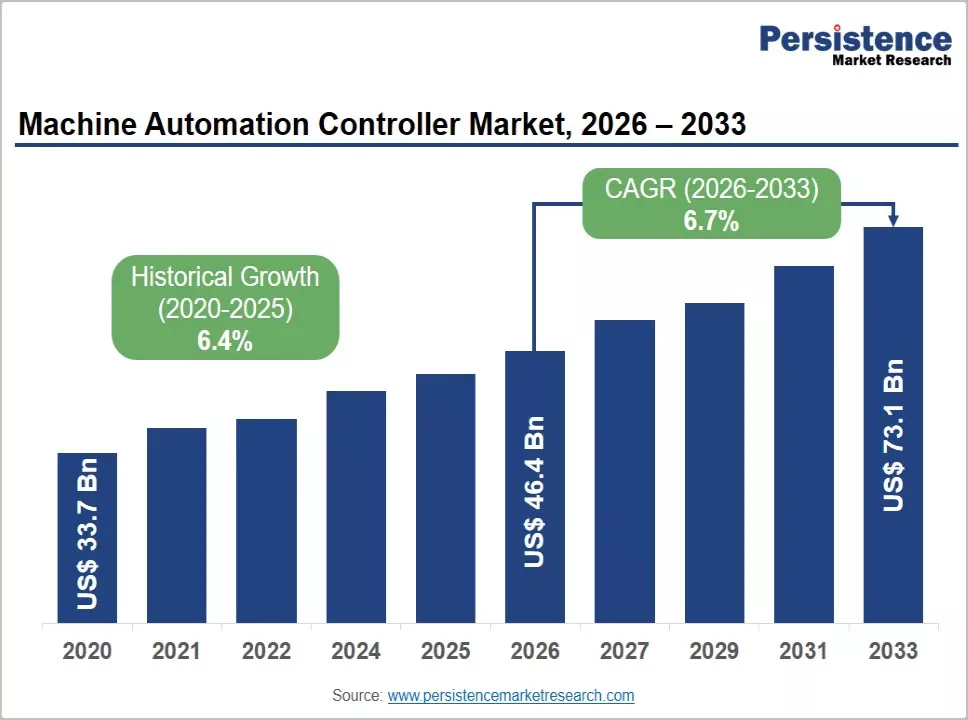
The global machine automation controller market size is likely to be valued at US$ 46.4 billion in 2026 and is expected to reach US$ 73.1 billion by 2033, growing at a CAGR of 6.7% between 2026 and 2033, driven by increasing industrial automation, expanding adoption of industrial robotics, and rising demand for integrated machine control systems.
Manufacturers are deploying advanced controllers to coordinate production equipment, improve operational accuracy, and connect manufacturing processes with industrial networks. Growing investment in smart factories and connected manufacturing is further supporting demand for programmable, distributed, and PC-based control architectures.
Key Industry Highlights
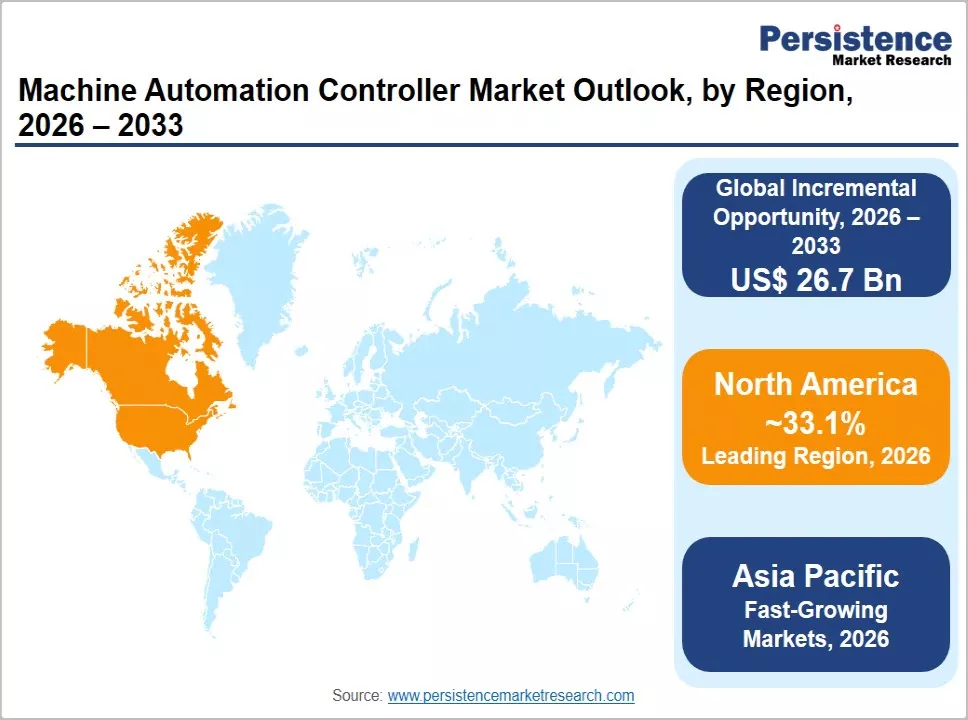
- Leading Region: North America, anticipated to account for 33.1% of the global market share, supported by advanced manufacturing infrastructure and established industrial automation capabilities.
- Fastest-growing Region: Asia Pacific, driven by expanding manufacturing capacity, industrial robotics adoption, semiconductor investments, and increasing factory automation.
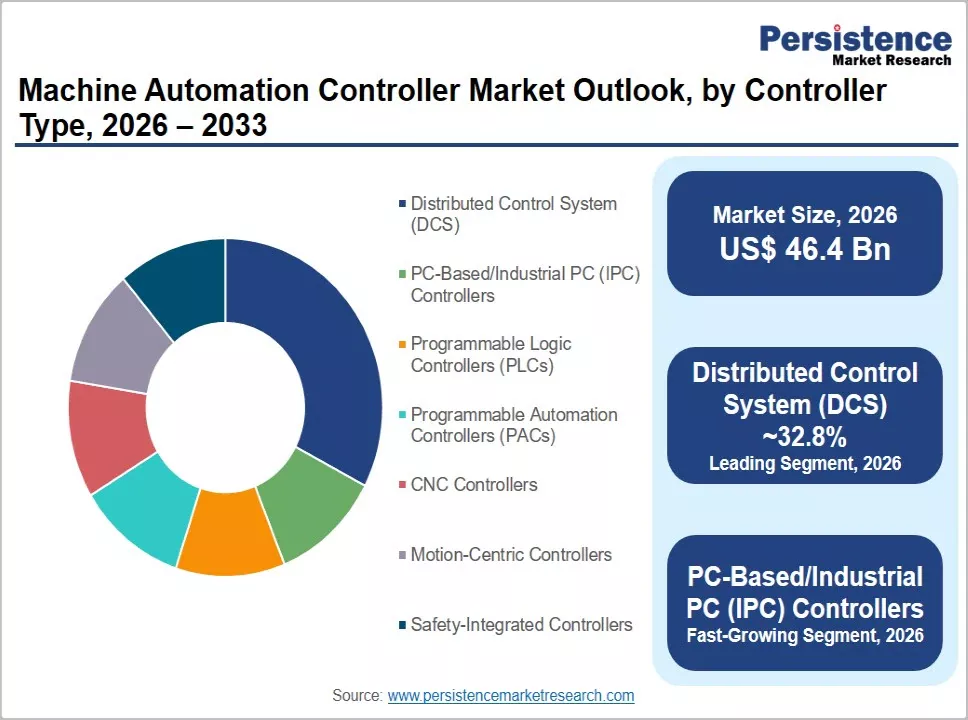
- Dominant Controller Type: Distributed Control Systems (DCS), anticipated to account for 32.8% of the market share, supported by their application in complex manufacturing and continuous process operations.
- Leading Control Function: Logic / Sequence Control, accounting for 31.9% of the market share, driven by its role in coordinating machine operations and automated production sequences.
DRO Analysis
Drivers - Growing Industrial Automation and Robotics Adoption Is Increasing Demand for Advanced Controllers
Increasing industrial automation is a major driver of the Machine Automation Controller Market. Manufacturers are investing in automated production systems to improve operational efficiency, maintain consistent product quality, and manage production costs. Machine automation controllers coordinate industrial equipment, sensors, actuators, robotic systems, and production machinery through centralized or distributed control architectures.
Approximately 542,000 industrial robots were installed globally in 2024, representing more than double the installations recorded a decade earlier. Asia accounted for 74% of new installations, while Europe represented 16% and the Americas 9%. Growing industrial robot deployment is increasing demand for controllers that support precise motion coordination, machine synchronization, and automated production processes.
Smart Manufacturing and Industry 4.0 Are Expanding Controller Applications
The growing adoption of smart manufacturing is increasing demand for advanced machine automation controllers. Manufacturers are integrating industrial control systems with sensors, industrial networks, manufacturing execution systems, and data analytics platforms to improve production visibility and operational coordination.
Modern controllers combine machine logic, motion control, communication, and data processing within integrated platforms. These capabilities support equipment monitoring, predictive maintenance, production scheduling, and automated quality management. The expansion of connected manufacturing is also increasing demand for PC-based and edge-enabled controllers that process machine data closer to production equipment.
Restraint - High Implementation Costs and Integration Complexity Increase Adoption Challenges
High implementation costs remain a significant challenge for the Machine Automation Controller Market. Advanced control systems require investments in controllers, industrial networking equipment, sensors, software licenses, engineering services, and system integration. Modernizing existing production facilities also involves compatibility requirements between new controllers and legacy machinery, particularly in manufacturing environments operating equipment from multiple suppliers.
Cybersecurity and functional safety requirements further increase implementation complexity. Controllers connected to enterprise networks and remote monitoring platforms introduce additional security considerations. Manufacturing facilities require effective authentication, access management, system integrity, and network protection. These requirements increase engineering and maintenance costs, particularly for small and medium-sized manufacturers.
Opportunities - Integration of Industrial AI and Edge Computing Creates New Growth Opportunities
The integration of industrial artificial intelligence, edge computing, and advanced analytics is creating opportunities for machine automation controller manufacturers. Industrial facilities require controllers that combine machine control with data acquisition, equipment monitoring, and real-time processing. Edge-enabled controllers support local processing of production information and improve communication between machinery and industrial data platforms.
Manufacturers are introducing platforms that connect existing production equipment with industrial networks without requiring complete infrastructure replacement. In September 2025, OMRON introduced its Sysmac-Edge DX1 Data Flow Controller to collect, analyze, and visualize manufacturing equipment data. The platform supports connectivity with PLCs from multiple manufacturers, strengthening opportunities in industrial data management and retrofit automation.
Category-wise Analysis
Controller Type Insights
Distributed Control Systems (DCS) are anticipated to account for 32.8% of the market share. DCS platforms are widely used in process-oriented industrial environments that require continuous monitoring and coordinated control. Chemicals, oil and gas, power generation, pharmaceuticals, and energy facilities rely on distributed architectures to manage interconnected processes. DCS solutions integrate controllers, operator stations, industrial networks, and process instrumentation, supporting coordinated operations across large industrial facilities. ABB, Siemens, Emerson, Honeywell, and Yokogawa offer DCS platforms for complex industrial applications.
PC-Based/Industrial PC (IPC) Controllers are anticipated to be the fastest-growing controller type. The segment benefits from advanced computing capabilities, flexible software environments, and integration between machine control and industrial data processing. IPC controllers support machine vision, robotics, motion coordination, and high-speed data exchange. Their adoption is increasing across electronics manufacturing, semiconductor equipment, automotive production, and advanced machinery. Growing demand for open automation architectures is further supporting segment expansion.
Control Function Insights
Logic/Sequence Control is anticipated to account for 31.9% of the market share, supported by its central role in coordinating automated machine operations. Logic controllers execute predefined instructions based on sensor inputs, machine conditions, and production sequences. PLCs are widely deployed across assembly lines, packaging equipment, material handling systems, and industrial machinery. These controllers coordinate motors, valves, actuators, conveyors, and safety interlocks to maintain consistent production operations. Their established industrial applications and compatibility with different manufacturing equipment support the segment's leading position.
Motion Control is anticipated to be the fastest-growing control function, driven by increasing adoption of industrial robotics, precision manufacturing, semiconductor equipment, and automated packaging systems. Motion controllers coordinate the speed, position, acceleration, and synchronization of motors and mechanical components. Their applications include multi-axis machinery, CNC equipment, robotic arms, automated inspection systems, and high-speed manufacturing lines. Increasing requirements for accurate positioning and shorter production cycles are strengthening demand for advanced motion-control platforms.
Regional Insights
North America Machine Automation Controller Market Trends
North America is anticipated to account for 33.1% of the global machine automation controller market, supported by advanced manufacturing infrastructure, established automation providers, and increasing investment in robotics and smart manufacturing. The region has a strong presence of automotive, aerospace, semiconductor, food processing, pharmaceutical, and industrial machinery manufacturers. Demand is supported by the integration of programmable control systems, industrial PCs, motion controllers, and distributed control platforms.
The U.S. represents the dominant market in North America, while Canada represents an important secondary market. Both countries are witnessing increasing integration of industrial control technologies with connected manufacturing systems.
U.S. Machine Automation Controller Market Trends
The U.S. remains the dominant market in North America due to its established industrial automation industry and advanced manufacturing infrastructure. Automotive manufacturing, semiconductor production, aerospace, pharmaceuticals, and industrial machinery are important application areas. Manufacturers are adopting integrated control platforms to improve machine coordination, production visibility, and equipment performance.
In October 2025, Rockwell Automation introduced its ControlLogix 5590 controller, designed to support multidiscipline control and integration across its Logix automation ecosystem. The introduction reflects growing demand for controllers that combine machine control, software integration, safety, and industrial connectivity.
The expansion of domestic semiconductor and advanced manufacturing capacity is further supporting demand for precision motion controllers, industrial PCs, and programmable automation systems. Increasing industrial robotics deployment across automotive and electronics facilities is also strengthening demand for advanced control technologies.
Canada Machine Automation Controller Market Trends
Canada represents an important market for machine automation controllers, supported by manufacturing modernization and investments across automotive, mining, energy, food processing, and industrial equipment manufacturing. The country's automotive industry is increasing demand for controllers used in automated assembly, robotic welding, material handling, and vehicle component production.
Mining and energy industries also contribute through equipment monitoring, process automation, and machinery coordination. Distributed control systems are particularly relevant to energy and process facilities, while PLCs and industrial PCs support discrete manufacturing.
Growing adoption of connected industrial technologies is increasing demand for controllers with advanced communication, equipment diagnostics, and remote monitoring capabilities. Integration with existing industrial infrastructure remains an important consideration among Canadian manufacturers.
Europe Machine Automation Controller Market Trends
Europe represents a mature market supported by its established industrial manufacturing ecosystem, advanced engineering capabilities, and strong adoption of factory automation. Germany and the U.K. are important markets, with demand across automotive, industrial machinery, chemicals, pharmaceuticals, aerospace, and food processing.
The European regulatory environment is influencing controller development and purchasing decisions. Machinery safety, cybersecurity, energy efficiency, and industrial product compliance are important considerations. Regulation (EU) 2023/1230, which replaces the earlier Machinery Directive framework, applies from January 20, 2027, establishing updated machinery safety requirements.
The adoption of industrial robotics and digital manufacturing technologies is supporting demand for integrated controllers, motion-control systems, and industrial PCs. Manufacturers are also focusing on interoperability between existing machinery and newer automation platforms.
Germany Machine Automation Controller Market Trends
Germany represents a major European market due to its strong automotive, industrial machinery, electrical equipment, and chemical manufacturing industries. Machine automation controllers are extensively used across automotive assembly, machine tools, packaging machinery, industrial robotics, and precision manufacturing.
Germany's Industry 4.0 initiatives are supporting the integration of industrial equipment with digital manufacturing systems. Manufacturers are adopting controllers that combine logic, motion, communication, and data-processing capabilities. Siemens and other automation suppliers maintain a strong presence in the country's industrial ecosystem.
The increasing focus on machinery cybersecurity and regulatory compliance is also influencing controller selection. Demand for industrial control platforms with secure communication, system monitoring, and long-term product support is gaining importance.
U.K. Machine Automation Controller Market Trends
The U.K. represents an important market supported by investments in advanced manufacturing, automotive production, aerospace, pharmaceuticals, and food processing. Manufacturers are deploying programmable controllers and industrial PCs to improve equipment productivity and automate repetitive production activities.
The country's focus on advanced manufacturing and industrial digitalization is supporting demand for integrated control systems and connected automation platforms. Machine builders are incorporating motion control, machine monitoring, and industrial networking functions into their equipment.
Cybersecurity and machinery safety requirements are also shaping technology adoption. Growing integration of manufacturing equipment with industrial networks is increasing demand for controllers with secure communication and improved monitoring capabilities.
Asia Pacific Machine Automation Controller Market Trends
Asia Pacific is anticipated to be the fastest-growing regional market, supported by expanding manufacturing capacity, industrial robotics adoption, electronics production, and semiconductor investments. China and India are important markets because of their manufacturing ecosystems and growing adoption of automated production technologies.
Asia accounted for 74% of global industrial robot installations in 2024, reflecting its extensive manufacturing base. The growing electronics and semiconductor industries are increasing demand for precision controllers, motion-control systems, and industrial PCs. Automotive manufacturers are also investing in automated production lines, particularly for electric vehicles, battery manufacturing, and component assembly.
Government-supported manufacturing initiatives and industrial infrastructure investments are further strengthening regional demand.
China Machine Automation Controller Market Trends
China represents the largest industrial automation opportunity in Asia Pacific due to its extensive manufacturing base and large-scale deployment of industrial robots. The country has significant demand across automotive, electronics, semiconductor equipment, industrial machinery, and consumer electronics manufacturing.
China recorded approximately 295,000 industrial robot installations in 2024, representing a 7% increase from the previous year. Its operational industrial robot stock exceeded 2 million units, accounting for 43% of the global total. These installations support demand for programmable controllers, motion-control systems, industrial PCs, and integrated automation platforms.
Chinese manufacturers are adopting automation technologies to improve production consistency and manufacturing capacity. Semiconductor equipment manufacturing, electric vehicle production, and automated electronics assembly are further supporting demand.
India Machine Automation Controller Market Trends
India is emerging as an important growth market due to expanding manufacturing capacity and increasing investment in industrial modernization. Automotive, electronics, pharmaceuticals, food processing, and industrial machinery represent important application areas. Manufacturing initiatives and investments in domestic electronics production are increasing the adoption of automated machinery and programmable control systems.
Indian manufacturers are deploying PLCs, motion controllers, industrial PCs, and compact integrated controllers to improve production efficiency. Automotive component manufacturing and electronics assembly are important sources of demand as manufacturers expand automated production lines.
The growing presence of industrial automation suppliers and system integrators is also supporting adoption. Investments in industrial robotics, smart manufacturing, and connected production infrastructure are creating opportunities for controllers that combine machine-level automation with data communication and equipment monitoring.
Competitive Landscape
The global machine automation controller market is characterized by competition among established industrial automation companies, programmable controller manufacturers, process automation suppliers, and specialized motion-control providers. Major companies compete based on controller performance, software compatibility, industrial networking capabilities, functional safety, product reliability, and integration with broader automation platforms.
Leading companies are focusing on product innovation, integrated controller architectures, industrial connectivity, and software-supported automation platforms. Product development emphasizes multi-function control, edge computing, cybersecurity, and interoperability. Companies are also expanding their automation portfolios through technology partnerships, regional expansion, and industry-specific solutions.
Key Industry Developments
- In February 2026, ABB launched System 800xA 7.0, its latest distributed control system platform, supporting digital capabilities, analytics, and modernization of existing process-control operations.
- In March 2026, Siemens introduced LOGO! 9, a new generation of its intelligent logic controller featuring expanded function blocks, increased input and output capacity, and updated engineering software.
- In July 2026, Mitsubishi Electric introduced its MX Controller in the U.S. industrial automation market, integrating sequence, motion, and network control within a single system.
Companies Covered in Machine Automation Controller Market
- Siemens AG
- Rockwell Automation
- ABB Ltd.
- Schneider Electric
- Mitsubishi Electric
- Emerson Electric
- Honeywell International
- OMRON Corporation
- Yokogawa Electric
- Bosch Rexroth
- Beckhoff Automation
- B&R Industrial Automation
- Delta Electronics
- FANUC
- Advantech
Frequently Asked Questions
The global machine automation controller market is projected to be valued at US$ 46.4 billion in 2026.
The market is expected to reach US$ 73.1 billion by 2033.
Key trends include the growing adoption of industrial robotics, integrated machine controllers, PC-based automation, edge computing, industrial IoT, advanced motion control, and connected manufacturing systems.
Distributed Control Systems (DCS) represent the leading controller type, accounting for 32.8% of the global market share.
Major companies include Siemens AG, Rockwell Automation, ABB, Schneider Electric, Mitsubishi Electric, Emerson Electric, and OMRON Corporation.


