




- Automation & Robotics
- GMC-Based Motion Controller Market
GMC-Based Motion Controller Market Size, Share, and Growth Forecast, 2026 - 2033
GMC-Based Motion Controller Market by Product Type (PLC-based Controllers, Standalone Embedded Controllers, PC-based Controllers, Modular Rack-mount Controllers), Axis Count, Network Communication Protocol, Application, and Regional Analysis for 2026 - 2033

GMC-Based Motion Controller Market Size and Trends Analysis
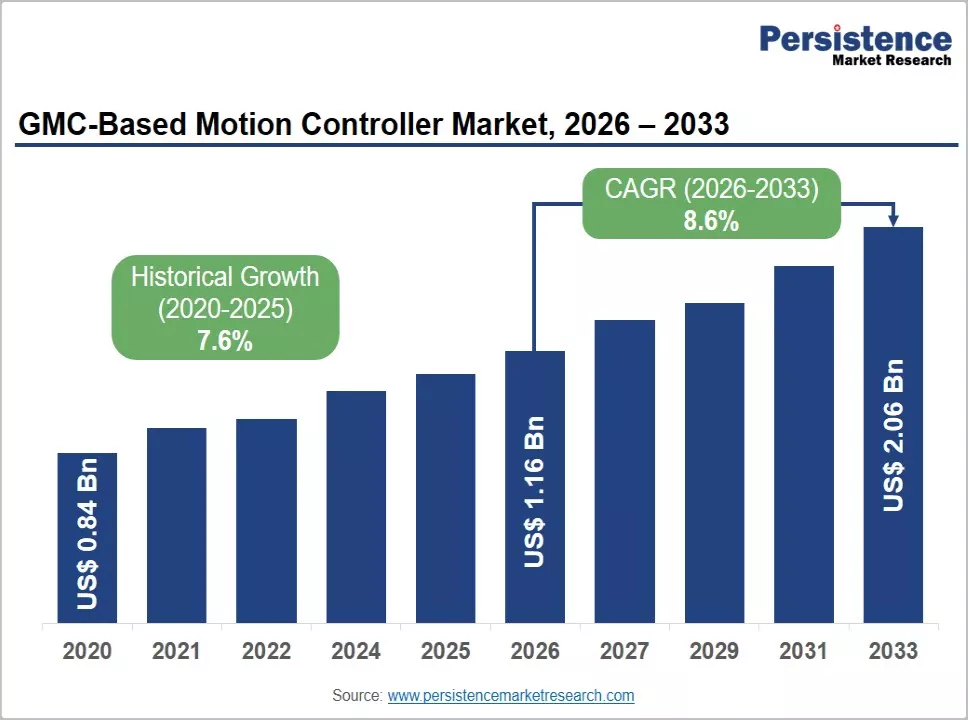
The global GMC-based motion controller market size is likely to be valued at US$ 1.16 billion in 2026 and is expected to reach US$ 2.06 billion by 2033, growing at a CAGR of 8.6% between 2026 and 2033. Market expansion is supported by increasing industrial automation, rising demand for precision positioning, and growing adoption of multi-axis control systems.
Electronics manufacturing, semiconductor production, packaging, and robotics are major application areas. The integration of industrial Ethernet protocols and advanced servo technologies is further supporting demand for networked motion control platforms.
Key Industry Highlights
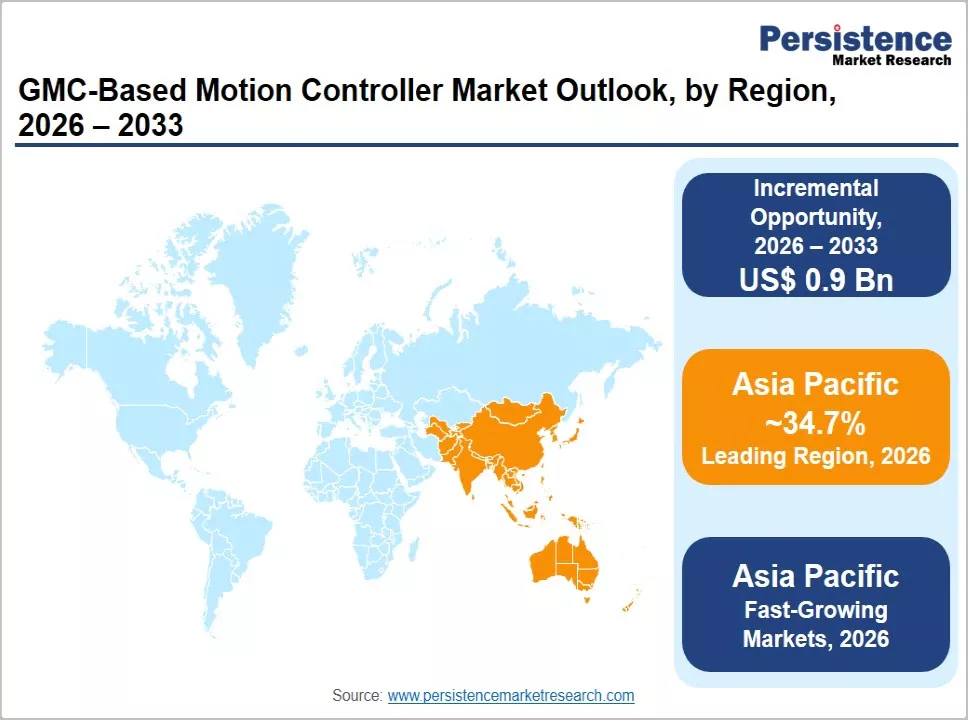
- Leading Region: Asia Pacific, accounting for about 34.7% of market share, supported by its extensive electronics manufacturing base, industrial automation investment, and expanding semiconductor production.
- Fastest-growing Region: Asia Pacific, driven by manufacturing capacity expansion, industrial robotics adoption, and increasing investment in automated production systems.
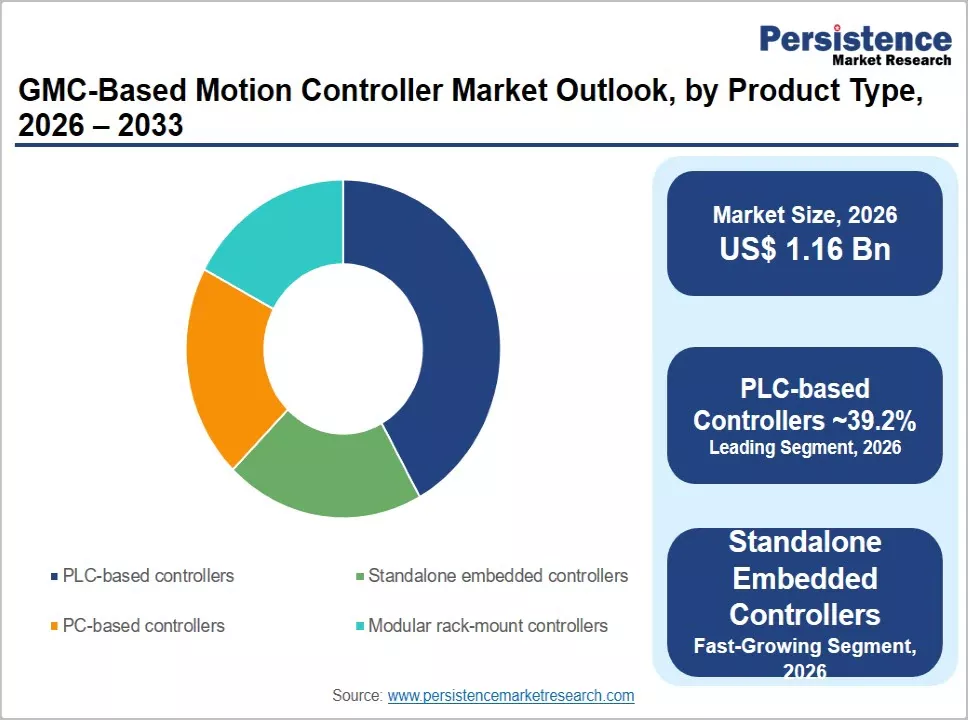
- Dominant Product Type: PLC-based controllers, anticipated to account for approximately 39.2% of the market share in 2026, supported by their integration with programmable logic and industrial automation systems.
- Leading Axis Count: 3–5 axis controllers, anticipated to account for approximately 37.4% of the market share in 2026, reflecting their widespread use in coordinated machinery and assembly applications.
DRO Analysis
Drivers - Expansion of Industrial Automation Is Increasing Demand for Precision Motion Control
Increasing industrial automation is strengthening demand for GMC-based motion controllers across manufacturing industries. Motion controllers coordinate servo motors, drives, encoders, and machine axes to perform positioning, speed regulation, interpolation, and synchronized movement. These functions are particularly important in electronics assembly, packaging, machine tools, robotics, and semiconductor equipment, where movement accuracy and repeatability directly influence production quality.
According to the International Federation of Robotics, approximately 542,000 industrial robots were installed worldwide in 2024. Asia accounted for 74% of new installations, reflecting the concentration of automated manufacturing activity in the region. The expansion of robotic production systems is supporting demand for motion controllers with higher processing capabilities, multi-axis synchronization, and compatibility with industrial communication networks.
Digital Manufacturing and Semiconductor Investment Are Supporting Market Growth
The expansion of semiconductor manufacturing and advanced electronics production is increasing demand for precision motion control technologies. Wafer handling, inspection, die bonding, component placement, and automated assembly require accurate positioning and coordinated movement across multiple machine axes. Motion controllers support these processes through programmable motion profiles, servo coordination, and real-time communication between machine components.
The International Federation of Robotics reported 128,899 industrial robot installations in the electrical and electronics industry in 2024. This reflects the importance of automation in electronics production and supports demand for advanced machine control systems. Investment in semiconductor fabrication, advanced packaging, and automated inspection equipment is further increasing the requirement for high-performance motion controllers. The adoption of EtherCAT, PROFINET, and EtherNet/IP also supports communication between controllers, servo drives, sensors, and distributed input/output systems.
Restraint - System Integration and Engineering Complexity Increase Deployment Costs
System integration remains a significant challenge for the GMC-based motion controller market. Motion controllers operate alongside servo drives, motors, encoders, sensors, safety devices, PLCs, and industrial communication networks. Differences in hardware compatibility, programming environments, and communication protocols increase engineering and commissioning requirements.
Retrofitting existing machinery also involves electrical modifications, software migration, equipment downtime, and operator training. These requirements increase implementation costs, particularly for small and mid-sized manufacturers. High-performance multi-axis systems also require specialized engineering expertise and detailed motion tuning. Cybersecurity and functional safety requirements add further responsibilities as controllers become connected to plant networks and industrial data systems. These factors influence purchasing decisions and extend deployment timelines for complex automation projects.
Opportunities - Standalone Embedded Controllers Are Expanding in Compact and Specialized Machinery
Standalone embedded controllers represent an important growth opportunity as machine builders increasingly adopt compact and application-specific motion control platforms. These controllers combine dedicated motion processing, communication interfaces, and programmable functions within a smaller hardware configuration. Their applications include packaging equipment, laboratory automation, medical devices, precision stages, and specialized assembly machinery.
The standalone embedded controller segment is projected to expand at a CAGR of 9.23% through 2030. Growth is supported by modular machine design, demand for space-efficient control systems, and increasing adoption of specialized automation equipment. Embedded platforms also provide machine builders with greater flexibility in developing dedicated motion architectures. Their application across compact robotics, automated inspection, and precision handling equipment is further expanding the segment's commercial relevance.
Semiconductor and Advanced Electronics Equipment Create New Market Opportunities
Semiconductor manufacturing represents a significant opportunity for motion controller suppliers because advanced production equipment requires precision positioning, synchronized stages, robotic handling, and high-speed inspection. Wafer handling, die bonding, lithography-related equipment, and advanced packaging processes depend on repeatable movement and coordinated machine operations.
The semiconductor manufacturing application is projected to grow at a CAGR of 8.9%. Investment in semiconductor fabrication facilities and electronics production capacity is supporting demand for multi-axis controllers and deterministic industrial communication. High-axis controllers are particularly relevant for complex machinery that coordinates multiple stages, actuators, and robotic mechanisms. Suppliers offering flexible axis configurations, real-time communication, and compatibility with different servo technologies are positioned to address these equipment requirements.
Category-wise Analysis
Product Type Insights
PLC-based controllers dominate the GMC-based motion controller market, accounting for approximately 39.2% of the market share in 2026. Their leading position reflects their integration with established industrial automation systems and their ability to coordinate motion functions across manufacturing equipment. These controllers are widely used in packaging machinery, assembly lines, material handling systems, and machine tools. Their compatibility with programmable logic controllers and industrial communication networks supports their adoption among manufacturers seeking integrated machine control.
Standalone embedded controllers represent the fastest-growing product type. Their growth is associated with demand for compact, application-specific control systems that combine motion processing and machine-level functionality. These controllers support equipment designs requiring dedicated control architecture, reduced system complexity, and efficient coordination of motion functions. Their use across robotics, precision machinery, and specialized manufacturing equipment supports segment expansion.
Axis Count Insights
The 3–5 axis controllers segment leads the market, accounting for approximately 37.4% of the market share. These controllers are widely used in industrial machinery requiring coordinated movement across multiple axes without the complexity of higher-axis configurations. Applications include automated assembly, packaging equipment, machine tools, and material handling systems. Their balance of motion control capability and system complexity supports adoption across manufacturing environments.
Controllers supporting above 10 axes represent the fastest-growing axis-count segment, with a projected CAGR of 9.2%. Growth is driven by rising requirements for synchronized multi-axis operations in advanced manufacturing equipment, industrial robotics, and semiconductor production systems. These controllers coordinate several motors and motion components within a single machine architecture, supporting complex positioning, synchronized movement, and high-precision operations.
Regional Insights
North America GMC-Based Motion Controller Market Trends
North America represents an established market for motion controllers, supported by advanced manufacturing, industrial automation investment, aerospace production, automotive manufacturing, food processing, and medical equipment production. The U.S. represents the primary regional demand center, while Canada contributes through automotive manufacturing, industrial machinery, packaging, and food processing. Regional adoption is influenced by factory modernization, labor productivity requirements, semiconductor investment, and the expansion of automated production facilities.
U.S. GMC-Based Motion Controller Market Trends
The U.S. remains the dominant market in North America due to its large industrial automation base and established presence of automation technology suppliers. Motion controllers are widely used in automotive production, aerospace manufacturing, electronics assembly, robotics, and packaging equipment. Manufacturers are increasingly integrating programmable controllers, servo drives, and industrial communication networks to improve machine synchronization and production efficiency.
In October 2025, Rockwell Automation launched its ControlLogix 5590 controller, designed to support multidiscipline control and software integration across manufacturing operations. The development reflects growing demand for integrated industrial control platforms that connect machine-level operations with enterprise manufacturing systems. U.S. investment in semiconductor manufacturing and automated production facilities is further supporting demand for high-performance motion control technologies.
Canada GMC-Based Motion Controller Market Trends
Canada represents an important secondary market, supported by automotive manufacturing, food processing, packaging, mining equipment, and industrial machinery production. Motion controllers are used in robotic welding, automated material handling, machine tools, and production line synchronization. The expansion of advanced manufacturing and investment in automotive supply chains are supporting demand for programmable motion systems.
Canadian manufacturers are increasingly adopting connected automation equipment to improve production consistency and operational efficiency. Demand is also supported by the presence of North American automation distributors and engineering integrators that provide PLC-based controllers, servo systems, and industrial networking solutions. The modernization of existing production facilities remains an important source of demand for motion control equipment.
Europe GMC-Based Motion Controller Market Trends
Europe represents a significant market for GMC-based motion controllers, supported by its established automotive, industrial machinery, electronics, packaging, and precision engineering industries. Germany, the U.K., France, Italy, and other manufacturing economies maintain demand for programmable and multi-axis motion platforms. European manufacturers place strong emphasis on equipment reliability, machine safety, energy efficiency, and interoperability.
Regulatory harmonization is an important factor influencing industrial equipment development. Regulation (EU) 2023/1230 establishes a common machinery safety framework across the European Union and applies from January 20, 2027. The regulatory framework influences machine design, conformity assessment, and the integration of safety-related control functions.
Germany GMC-Based Motion Controller Market Trends
Germany represents a major European market because of its automotive, machine tool, robotics, and industrial equipment manufacturing base. Motion controllers support precision machining, automated assembly, packaging, material handling, and production line synchronization. According to the International Federation of Robotics, Germany recorded 26,982 industrial robot installations in 2024, maintaining its position as Europe's largest industrial robot market.
German machine builders emphasize reliable control platforms, deterministic communication, and integration with established automation systems. The country's advanced manufacturing ecosystem supports demand for PLC-based controllers, PC-based motion systems, and high-axis configurations. Investment in factory digitalization and industrial robotics is further supporting adoption of networked motion control platforms.
U.K. GMC-Based Motion Controller Market Trends
The U.K. maintains demand for motion control technologies across automotive, aerospace, pharmaceuticals, food processing, and specialized machinery manufacturing. Motion controllers are used in automated production lines, robotic handling, packaging equipment, and precision manufacturing systems. The adoption of programmable automation platforms is supported by productivity improvement initiatives and modernization of manufacturing facilities.
The U.K. also has an established industrial automation supplier and system integration ecosystem. Machine builders increasingly use networked controllers and servo systems to support flexible manufacturing, automated inspection, and coordinated machine operations. Demand for compact and modular motion control solutions is particularly relevant to specialized equipment manufacturers and smaller production facilities.
Asia Pacific GMC-Based Motion Controller Market Trends
Asia Pacific is both the leading and fastest-growing regional market for GMC-based motion controllers, accounting for about 34.7% of global market share. The region benefits from large-scale electronics manufacturing, semiconductor production, automotive manufacturing, industrial machinery output, and an extensive industrial robotics base. China, Japan, South Korea, Taiwan, India, and ASEAN economies contribute to demand through factory automation and equipment investment.
According to the International Federation of Robotics, Asia accounted for 74% of new industrial robot installations in 2024. China alone recorded 295,000 installations, representing 54% of global installations. This concentration of industrial automation activity supports demand for PLC-based controllers, embedded motion platforms, and high-axis control systems.
China GMC-Based Motion Controller Market Trends
China is the largest industrial robotics market and a major demand center for GMC-based motion controllers. The country installed approximately 295,000 industrial robots in 2024, reflecting its extensive manufacturing automation base. Motion controllers are used in electronics assembly, automotive production, semiconductor equipment, packaging machinery, machine tools, and industrial robotics.
The country's large electronics manufacturing ecosystem is increasing demand for precise positioning, synchronized movement, and high-speed machine operations. Domestic automation suppliers are expanding their product portfolios, while international vendors continue to serve applications requiring established control platforms and advanced motion capabilities. Manufacturing modernization, localization of automation components, and investment in advanced electronics production are supporting demand for multi-axis motion controllers.
Japan GMC-Based Motion Controller Market Trends
Japan remains an important market because of its established industrial automation suppliers, robotics manufacturers, precision machinery producers, and electronics companies. The country installed 44,453 industrial robots in 2024, reflecting its strong position in industrial robotics and automated manufacturing. Japanese manufacturers have established expertise in servo systems, programmable controllers, precision machinery, and multi-axis motion technologies.
In October 2026, Panasonic Industry launched its GM5 Series motion controller, supporting synchronized control of up to 128 axes across two EtherCAT networks. The controller is designed for high-speed and high-precision industrial machinery, including applications involving positioning, machining, and synchronized production processes. This launch reflects continued product development in high-axis motion control and real-time industrial communication.
Competitive Landscape
The global GMC-based motion controller market includes diversified industrial automation companies and specialized motion control suppliers. Competition is based on controller performance, supported axis count, programming environment, communication protocol compatibility, integration with servo drives, engineering support, and installed customer base. Large automation vendors compete through integrated portfolios covering PLCs, drives, safety, industrial networks, and software. Specialized suppliers focus on high-speed multi-axis control, compact embedded platforms, precision positioning, and application-specific motion solutions.
Leading companies are emphasizing product innovation, integrated automation portfolios, open industrial communication, and scalable controller architectures. Strategic priorities include higher axis capacity, faster control cycles, compact embedded designs, functional safety, and simplified engineering. Vendors are also strengthening relationships with machine builders and system integrators while expanding application support for semiconductor equipment, electronics assembly, packaging, and robotics.
Key Industry Developments
- In October 2026, Panasonic Industry launched its GM5 Series motion controller, supporting synchronized control of up to 128 axes through two EtherCAT networks. The product addresses high-speed and high-precision machinery applications.
Companies Covered in GMC-Based Motion Controller Market
- Siemens
- Mitsubishi Electric
- Rockwell Automation
- ABB
- Schneider Electric
- Bosch Rexroth
- OMRON
- Yaskawa
- Panasonic Industry
- Delta Electronics
- Beckhoff Automation
- B&R
- Elmo Motion Control
- Trio Motion Technology
- ACS Motion Control
Frequently Asked Questions
The global GMC-based motion controller market is likely to be valued at US$ 1.16 billion in 2026.
The market is expected to reach US$ 2.06 billion by 2033, growing at a CAGR of 8.6% between 2026 and 2033.
Key trends include increasing adoption of PLC-integrated motion control, standalone embedded controllers, multi-axis synchronization, industrial Ethernet communication, precision positioning, and automated manufacturing systems.
The market is projected to expand at a CAGR of 8.6% between 2026 and 2033.
Semiconductor manufacturing is the fastest-growing application, registering a projected CAGR of 8.9%, supported by increasing automation in wafer handling, precision positioning, inspection, and advanced packaging equipment.
Major companies include Siemens, Mitsubishi Electric, Rockwell Automation, ABB, Schneider Electric, Bosch Rexroth, and OMRON, Yaskawa.


