




- Electrical Equipment & Services
- Low Voltage Electric Drives Market
Low Voltage Electric Drives Market Size, Share, and Growth Forecast, 2026 - 2033
Low Voltage Electric Drives Market by Drive Type (AC Drives, Servo Drives, Others), Power Rating (7.5 kW - 22 kW, Above 200 kW, Others), End-user Industry, and Regional Analysis for 2026 - 2033

Low Voltage Electric Drives Market Size and Trends Analysis
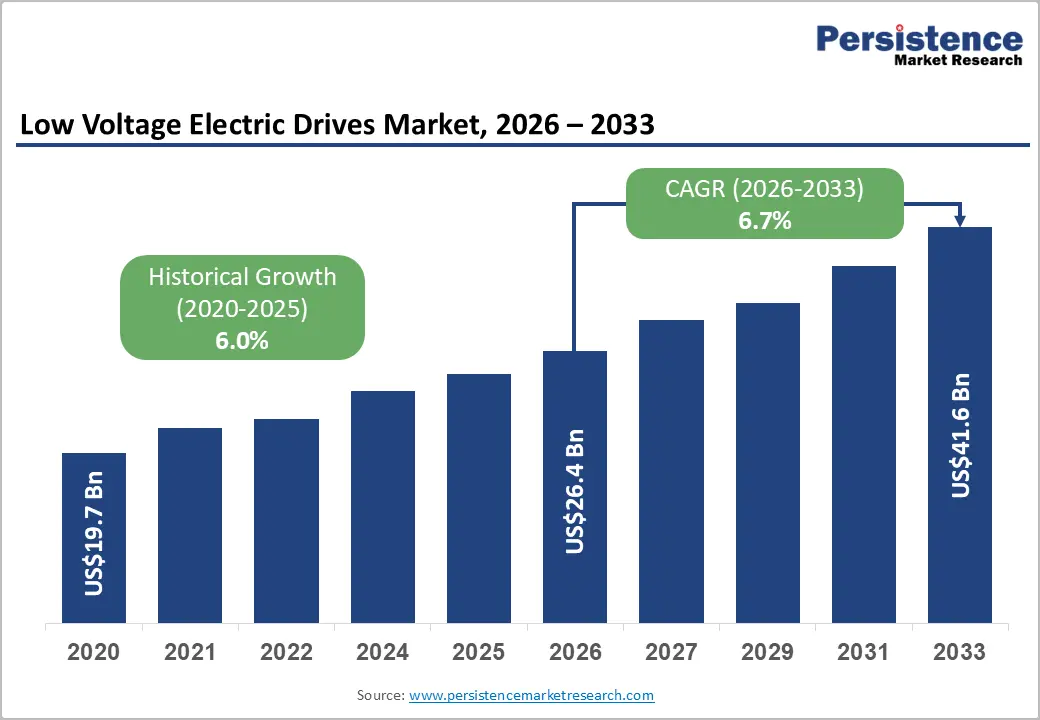
The global low-voltage electric drives market size is likely to be valued at US$26.4 billion in 2026 and is expected to reach US$41.6 billion by 2033, growing at a CAGR of 6.7% between 2026 and 2033, driven by rising industrial automation, stricter energy-efficiency regulations, and increasing deployment of variable-speed motor control systems across manufacturing and commercial infrastructure.
Low-voltage electric drives are becoming essential for optimizing energy consumption in pumps, compressors, conveyors, HVAC systems, and process equipment. Growing investments in smart manufacturing, electrification of industrial operations, and modernization of water and wastewater infrastructure are further strengthening long-term market demand.
Key Industry Highlights:
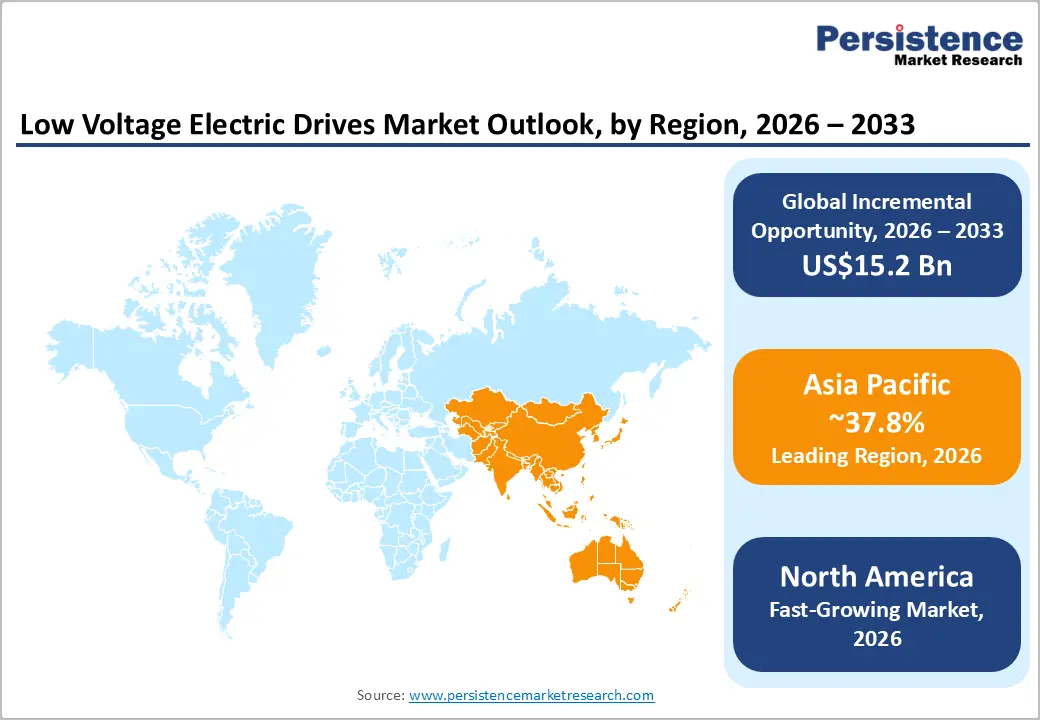
- Leading Region: Asia Pacific is projected to lead with 37.8% of market share in 2026, supported by strong manufacturing activity, industrial automation expansion, and rapid infrastructure development across China, Japan, India, and ASEAN countries.
- Fastest-growing Region: North America is projected to be the fastest-growing regional market through 2033, driven by rising investments in industrial automation, smart buildings, HVAC modernization, data center expansion, and energy-efficiency upgrades across the U.S. and Canada.
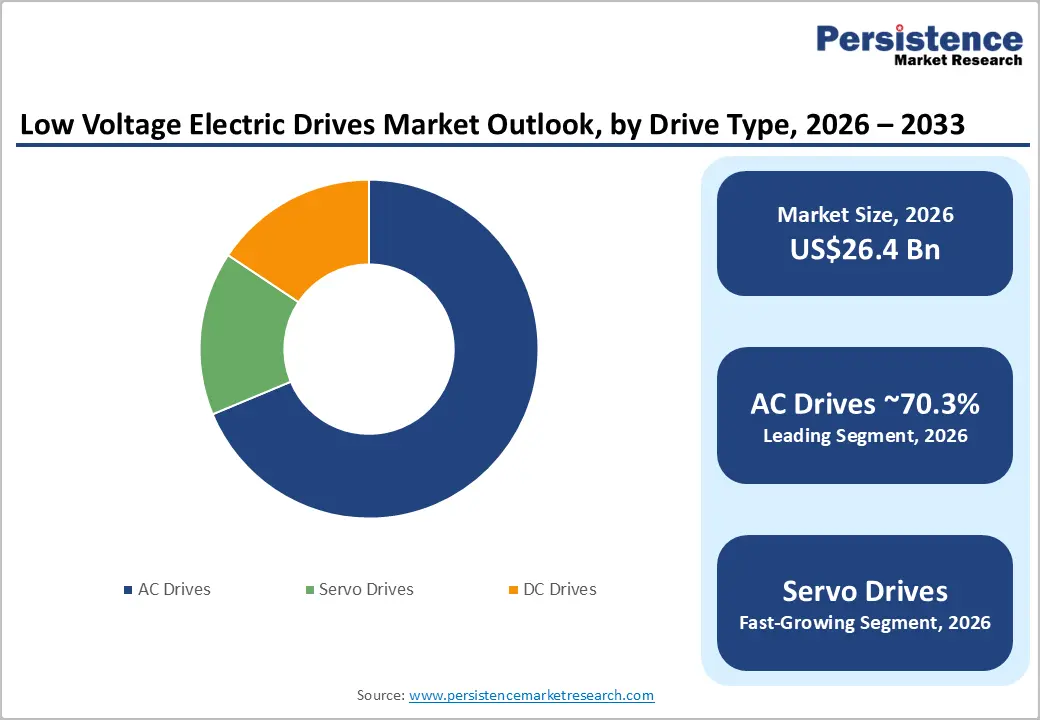
- Dominant Drive Type: AC Drives is estimated to account for 70.3% of market share, due to widespread deployment across HVAC systems, pumps, compressors, conveyors, and industrial processing applications.
- Leading End-user Industry: HVAC and building services are anticipated to lead with 23.9% market share in 2026, supported by growing investments in commercial infrastructure modernization, smart building technologies, and energy-efficient HVAC systems.
DRO Analysis
Driver - Energy-Efficiency Regulations and Rising Lifecycle Cost Optimization
Energy-efficiency mandates remain one of the strongest structural growth drivers for the low voltage electric drives market. Industrial facilities, commercial buildings, and utility operators are increasingly adopting variable frequency drives (VFDs) to reduce electricity consumption and improve operational efficiency. Electric motor systems account for a substantial share of global industrial electricity use, particularly in pumps, compressors, fans, and conveyor systems. Low-voltage drives help regulate motor speed according to load requirements, reducing unnecessary energy consumption and lowering operational expenditure.
Organizations are increasingly prioritizing lifecycle cost analysis over upfront procurement costs. The adoption of low-voltage drives helps reduce maintenance frequency, improve equipment reliability, and extend motor lifespan. Regulatory initiatives focused on carbon reduction and industrial efficiency standards are also supporting deployment across manufacturing facilities, commercial buildings, and municipal infrastructure projects. As energy prices remain volatile across several regions, businesses are accelerating investments in motor-control technologies that provide measurable energy savings and operational stability.
Industrial Automation and Electrification of Manufacturing Systems
Industrial automation is becoming a major catalyst for the adoption of low-voltage electric drives across the automotive, electronics, packaging, food processing, and heavy manufacturing industries. Modern production facilities increasingly require precise motor control, synchronized motion systems, and intelligent monitoring capabilities. Low-voltage drives are being integrated into broader digital manufacturing ecosystems that support predictive maintenance, remote diagnostics, and process optimization.
The transition toward electrified manufacturing operations is particularly significant in electric-vehicle and battery manufacturing plants. These facilities require high-performance motion control systems capable of maintaining precision, repeatability, and operational efficiency under continuous production cycles. Manufacturers are also integrating drive systems with industrial IoT platforms to improve machine utilization and reduce downtime. This trend is shifting the competitive landscape from standalone hardware supply toward software-enabled automation solutions that combine motor control, analytics, and lifecycle service support.
Restraint - High Initial Capital Costs and Retrofit Integration Challenges
Despite strong long-term energy-saving benefits, the adoption of low-voltage electric drives is still constrained by high initial implementation costs and retrofit complexity. Industrial operators often incur additional expenses for engineering design, installation, system integration, harmonic mitigation, and compatibility testing with existing motors and control infrastructure. These factors can delay investment decisions, particularly in cost-sensitive industries and small- to medium-sized manufacturing facilities.
Brownfield installations pose additional challenges, as legacy systems often require modifications to electrical panels, cabling configurations, and motor protection systems before new drives can be deployed effectively. Harmonics management also remains an important technical issue in facilities with dense electrical loads or sensitive equipment. While manufacturers continue introducing compact and low-harmonic drive technologies, procurement teams often prioritize short-term capital budgeting over long-term efficiency gains.
Opportunity - Water, Wastewater, and HVAC Infrastructure Modernization
Water treatment facilities, wastewater systems, and HVAC infrastructure represent one of the most attractive growth opportunities for low-voltage electric drives. These applications rely heavily on pumps, fans, blowers, and compressors that operate under variable-load conditions, making them ideal for energy-efficient motor speed-control technologies. Municipal authorities and commercial infrastructure operators are increasingly investing in energy-efficient modernization programs to reduce electricity consumption and operational costs.
Low-voltage drives improve flow regulation, reduce mechanical stress on equipment, and enhance process reliability in utility infrastructure. Rapid urbanization and growing demand for sustainable building management systems are further supporting deployment in commercial real estate, hospitals, airports, educational institutions, and smart city projects. The opportunity is especially strong in emerging economies where aging infrastructure and rising electricity demand are driving investments in efficient utility systems and building automation technologies.
Growth of EV Manufacturing and Advanced Industrial Automation
The rapid expansion of electric vehicle manufacturing and advanced industrial automation is creating substantial growth opportunities for servo drives and intelligent low-voltage drive systems. EV production facilities require high-speed motion synchronization, precision motor control, and digitally connected manufacturing equipment capable of operating under high-throughput production environments.
Battery manufacturing plants, robotics systems, semiconductor production facilities, and automated packaging lines are increasingly deploying advanced drive technologies integrated with industrial automation software. Manufacturers are also investing in digital twin technologies and AI-enabled production monitoring systems, further increasing demand for intelligent motion-control infrastructure. Companies capable of delivering integrated automation ecosystems that combine drives, software platforms, analytics, and predictive maintenance services are expected to gain a competitive advantage as industrial digitization accelerates globally.
Category-wise Analysis
Drive Type Insights
AC Drives are anticipated to account for over 70.3% of the market share in 2026, making them the dominant drive-type segment. Their leadership is supported by widespread deployment across pumps, compressors, HVAC systems, conveyors, mixers, and industrial processing equipment in sectors such as manufacturing, food processing, water treatment, and commercial infrastructure. For example, AC drives are extensively used in HVAC systems within airports, hospitals, and large office buildings to regulate fan and chiller motor speeds while reducing electricity consumption.
The segment also benefits from strong retrofit demand as AC drives significantly improve energy efficiency and reduce maintenance requirements in existing motor-driven systems. Industrial operators continue prioritizing AC drive installations due to their scalability, operational reliability, and compatibility with automated production systems.
Servo drives are anticipated to witness the fastest growth. Growth is primarily driven by rising automation intensity across robotics, electronics manufacturing, semiconductor fabrication, packaging machinery, and EV production facilities. Servo drives provide precise positioning, rapid response capability, and synchronized motion control, making them essential in high-precision manufacturing environments. For instance, EV battery assembly lines and robotic welding systems increasingly rely on servo-drive technology for accurate and continuous motion control. Investments in Industry 4.0 technologies, AI-enabled manufacturing, and advanced robotics are further accelerating adoption.
End-user Industry Insights
HVAC and building services are anticipated to account for over 23.9% of market share in 2026, making them the leading end-user segment. The segment benefits from extensive deployment of pumps, chillers, compressors, air-handling units, and ventilation systems across commercial buildings, hospitals, airports, shopping complexes, hotels, and institutional infrastructure. For example, large commercial facilities increasingly use low-voltage drives in HVAC systems to optimize airflow and reduce electricity consumption during non-peak operating hours.
The automotive and EV manufacturing segment is anticipated to record the fastest growth. The rapid expansion of EV assembly plants, battery manufacturing facilities, and automated production lines is driving demand for advanced motor-control systems and high-performance servo drives. For example, robotic painting systems, automated conveyor lines, and battery cell production equipment in EV factories require highly synchronized drive systems for precision manufacturing. The broader shift toward electrified transportation and smart manufacturing is creating strong opportunities for automation suppliers across battery assembly, power electronics production, and robotic machining operations.
Regional Insights
North America Low Voltage Electric Drives Market Trends
North America is anticipated to emerge as the fastest-growing regional market for low voltage electric drives due to its strong industrial automation ecosystem, large installed base of aging motor systems, and increasing investments in energy-efficiency modernization. The region benefits from the rapid adoption of industrial IoT platforms, predictive maintenance technologies, and digitally connected manufacturing systems. Demand is also supported by the expansion of data centers, smart buildings, and water infrastructure modernization projects.
U.S. Low Voltage Electric Drives Market Trends
The U.S. remains the dominant contributor to regional demand, supported by large-scale investments in manufacturing automation, HVAC modernization, logistics infrastructure, and industrial electrification. Industries across automotive, food processing, chemicals, and warehousing are increasingly deploying low voltage drives to improve energy efficiency and operational reliability. For example, automated distribution centers and large commercial buildings are integrating variable-frequency drives into conveyor systems, chillers, and ventilation equipment to optimize energy use and reduce downtime.
Growing regulatory focus on industrial energy efficiency and sustainability targets is accelerating the adoption of premium drive systems equipped with remote monitoring, harmonics mitigation, and predictive maintenance capabilities. Expansion of AI-driven data centers is also creating demand for medium- and high-power drive applications in cooling and power-management systems.
Canada Low Voltage Electric Drives Market Trends
Canada is witnessing a steady market growth due to investments in water treatment infrastructure, mining operations, and commercial building modernization. Industrial facilities are increasingly adopting drive technologies to improve operational efficiency and reduce electricity consumption in pumping and ventilation systems. Growth in renewable energy integration and smart infrastructure projects is also supporting regional demand for energy-efficient motor-control systems.
Europe Low Voltage Electric Drives Market Trends
Europe remains a strategically important market due to strong regulatory alignment with industrial efficiency, sustainability, and carbon-reduction objectives. The region benefits from advanced industrial infrastructure, widespread adoption of automation technologies, and increasing investments in smart manufacturing and energy-efficient building systems.
Germany Low Voltage Electric Drives Market Trends
Germany leads the Europe market due to its strong industrial manufacturing base, advanced machinery sector, and leadership in factory automation technologies. Automotive production facilities, industrial processing plants, and smart factories are major adopters of low voltage electric drives. German manufacturers continue investing in digitally integrated production systems that require intelligent motor-control technologies and advanced automation capabilities.
U.K. Low Voltage Electric Drives Market Trends
The U.K. is experiencing growing demand for low-voltage drives through commercial building modernization, smart infrastructure development, and industrial energy-efficiency upgrades. HVAC retrofits in hospitals, airports, office complexes, and public infrastructure projects are contributing significantly to market growth. Increasing adoption of building management systems is also strengthening demand for connected drive technologies.
Asia Pacific Low Voltage Electric Drives Market Trends
Asia Pacific is projected to account for 37.8% of the market share in 2026, making it the leading regional market for low-voltage electric drives. The region benefits from rapid industrialization, strong manufacturing concentration, urban infrastructure expansion, and rising investments in automation technologies. Asia Pacific also maintains a major competitive advantage due to localized manufacturing capabilities, lower production costs, and extensive industrial supply chains.
China Low Voltage Electric Drives Market Trends
China remains the largest regional market due to its vast manufacturing ecosystem and extensive deployment of industrial motor systems across electronics, automotive, steel, chemicals, and consumer goods production. The country continues investing heavily in factory automation, robotics, and industrial electrification initiatives. Expansion of EV manufacturing facilities and smart industrial parks is further accelerating demand for advanced servo drives and automation systems.
India Low Voltage Electric Drives Market Trends
India is emerging as one of the fastest-growing markets within the Asia Pacific due to rapid industrial expansion, infrastructure development, and increasing investments in smart manufacturing initiatives. Growth in commercial real estate, metro rail projects, water-treatment infrastructure, and manufacturing automation is supporting rising demand for low voltage electric drives. Government-led industrial development programs and expansion of HVAC infrastructure are also strengthening market potential.
Increasing deployment of smart factories, industrial electrification projects, HVAC systems, and water infrastructure modernization initiatives will continue supporting long-term market expansion across the Asia Pacific region.
Competitive Landscape
The global low voltage electric drives market remains moderately consolidated among leading multinational automation and electrification companies, while a large number of regional and specialized suppliers continue operating across local markets. Major participants compete based on product performance, digital integration capabilities, lifecycle service support, energy-efficiency technologies, and industrial automation expertise.
Leading companies are prioritizing innovation, digital integration, localized manufacturing, and lifecycle service expansion to strengthen market positioning. Vendors increasingly focus on software-enabled automation platforms, predictive maintenance tools, and application-specific engineering solutions tailored for industrial automation, HVAC systems, water infrastructure, and EV manufacturing facilities. The market is gradually shifting toward integrated control ecosystems that combine hardware, analytics, connectivity, and long-term service support.
Key Industry Developments
- In October 2025, Siemens launched the SINAMICS S220 drive system as part of its Siemens Xcelerator portfolio, introducing advanced cybersecurity, digital connectivity, and high-performance motion-control capabilities for industrial automation applications.
- In November 2025, Mitsubishi Electric introduced the FR-D800 series inverters featuring compact design, simplified installation, and improved energy-efficiency performance for industrial machinery and process-control applications.
Companies Covered in Low Voltage Electric Drives Market
- ABB
- Siemens
- Schneider Electric
- Danfoss
- Rockwell Automation
- Mitsubishi Electric
- Yaskawa Electric Corporation
- Eaton
- Fuji Electric Co., Ltd.
- WEG S.A.
- Delta Electronics, Inc.
- Nidec Corporation
- SEW-EURODRIVE GmbH & Co KG
- Inovance Technology Co., Ltd.
- Toshiba Mitsubishi-Electric Industrial Systems Corporation (TMEIC)
- Regal Rexnord Corporation
Frequently Asked Questions
The global low voltage electric drives market is anticipated to be valued at US$26.4 billion in 2026.
The low voltage electric drives market is projected to reach approximately US$41.6 billion by 2033.
Major trends include growing adoption of Industry 4.0 technologies, increasing deployment of smart HVAC systems, rising demand for predictive maintenance solutions, expansion of EV manufacturing facilities, and integration of AI-enabled monitoring capabilities into drive systems. Industrial automation and energy optimization remain key market growth drivers.
AC Drives represent the leading segment, accounting for over 71% of global market share, due to their extensive use in pumps, compressors, conveyors, HVAC systems, and industrial processing equipment.
The low voltage electric drives market is projected to expand at a CAGR of 6.7% between 2026 and 2033.
Major companies include ABB, Siemens, Schneider Electric, Danfoss, and Rockwell Automation.


