




- Technology
- Livestock Monitoring Robot Market
Livestock Monitoring Robot Market Size, Share, and Growth Forecast, 2026 - 2033
Livestock Monitoring Robot Market by Component (Hardware, Software, Services), Robot Type (Autonomous Mobile Robots, Fixed‑Position Robots, Drone‑Based Robots, Others), Livestock Type (Cattle, Poultry, Swine, Sheep & Goats, Aquaculture / Fish Farms, Others), Application, and Regional Analysis for 2026 - 2033

Livestock Monitoring Robot Market Size and Trends
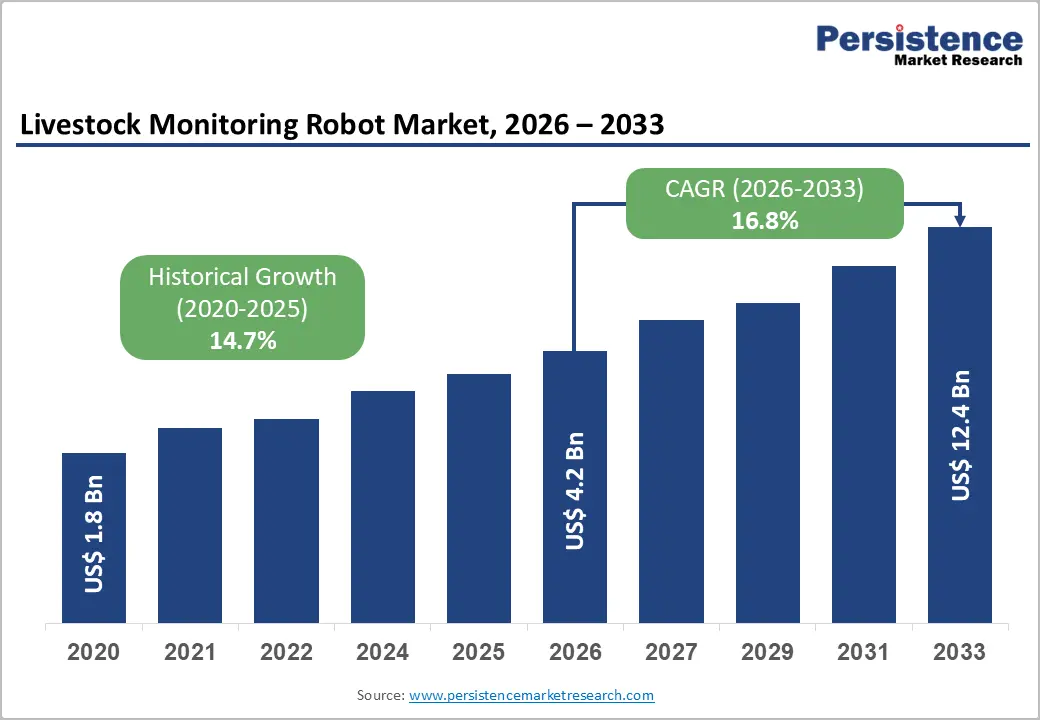
The global livestock monitoring robot market size is projected to rise from US$4.2 billion in 2026 to US$12.4 billion by 2033. It is anticipated that the market will grow at a CAGR of 16.8% from 2026 to 2033, driven by increasing demand for precision livestock farming and labor automation, particularly in developed agricultural economies.
Rising concerns around animal health monitoring, disease outbreaks, and farm productivity are driving adoption. Advancements in robotics, IoT integration, and AI-enabled analytics are enabling farmers to optimize operations and improve yield efficiency, thereby strengthening long-term market expansion.
Key Industry Highlights:
- Leading Component: Hardware dominates with over 58% market share in 2026, valued at more than US$ 2.4 Bn, driven by the need for durable robots, sensors, cameras, and mobility systems capable of operating in harsh farm environments. Software is the fastest-growing due to rising AI, IoT, and predictive analytics adoption.
- Leading Robot Type: Fixed-position robots hold over 37% market share in 2026, valued at more than US$ 1.6 Bn, primarily used in structured farm setups like dairy barns for milking, feeding, and cleaning. Drone-based robots are the fastest-growing, supporting large-area surveillance and real-time livestock tracking.
- Leading Livestock Type: Cattle accounts for the largest share at over 40% in 2026, valued at more than US$ 1.7 Bn, due to high economic value and intensive management needs. Poultry is the fastest-growing segment, with a 19.3% CAGR, driven by large-scale operations and disease control requirements.
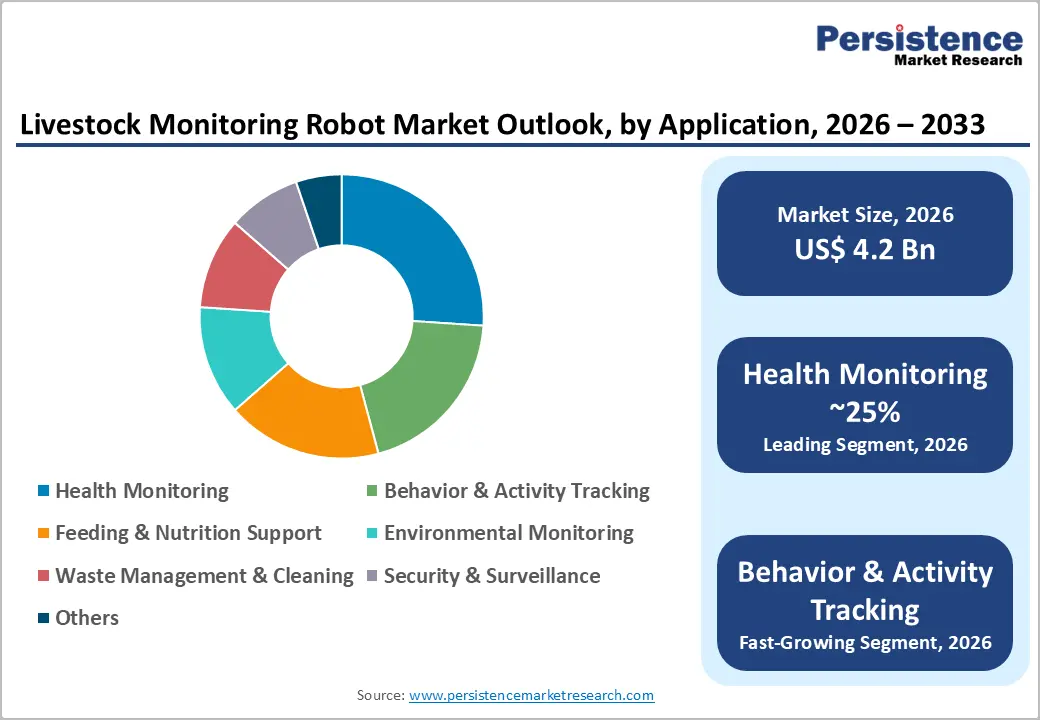
- Leading Application: Health monitoring dominates with over 25% market share in 2026, valued at more than US$ 1.0 Bn, by enabling early disease detection and preventive care. Behavior and activity tracking is the fastest-growing application, supporting welfare compliance, productivity optimization, and reproductive management.
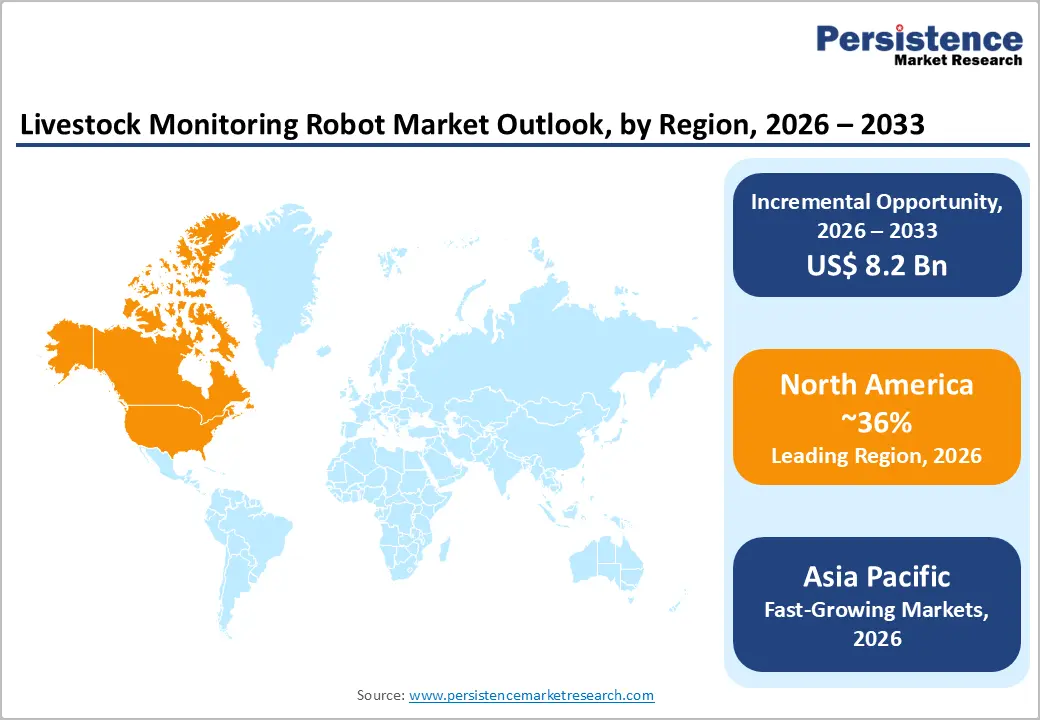
- Leading Region: North America leads with over 36% share in 2026, valued at US$ 1.5 Bn, supported by advanced agricultural infrastructure, large-scale farms, and strong R&D in AI-driven livestock solutions. Asia Pacific is the fastest-growing region, with a 22.1% CAGR, driven by government support, large livestock populations, and digital technology adoption.
| Key Insights | Details |
|---|---|
| Livestock Monitoring Robot Market Size (2026E) | US$4.2 Bn |
| Market Value Forecast (2033F) | US$12.4 Bn |
| Projected Growth (CAGR 2026 to 2033) | 16.8% |
| Historical Market Growth (CAGR 2020 to 2025) | 14.7% |
Market Dynamics
Driver - Rising Labor Shortages and the Push for Farm Automation
Labor shortages in agriculture, particularly in developed regions such as North America and Europe, are significantly boosting demand for robotic solutions. Farm employment in the United States declined by approximately 35% between 1969 and 2021, and it has continued into the current decade.
In early 2025, the average gross wage for livestock workers reached US$ 18.15 per hour, putting immense pressure on farm operators to reduce their reliance on manual labor. Study found that large-scale farms using automated milking systems reported labor cost reductions of over 20%. Livestock monitoring robots, by automating health surveillance, feeding schedules, and behavioral tracking, directly address this shortage while simultaneously improving herd productivity and farmer profitability.
Rising Adoption of Precision Livestock Farming Technologies
The growing emphasis on precision livestock farming is a primary factor for the livestock monitoring robot. According to FAO, global meat demand is expected to increase by over 14% by 2030, necessitating efficient and scalable livestock management solutions. Robotics integrated with sensors and AI allows real-time monitoring of animal health, feeding patterns, and environmental conditions, reducing mortality rates and improving productivity.
Farms adopting automated monitoring solutions have reported improvements of 20-25% in operational efficiency. This aligns closely with developments in the precision agriculture equipment market, where data-driven farming practices are becoming standard across advanced agricultural ecosystems.
Restraint - High Initial Capital Investment and Complex Infrastructure Requirements
Despite their long-term cost-saving potential, livestock monitoring robots carry prohibitive upfront costs that restrict adoption among small and medium-scale farm operators. A standard two-robot dairy installation for approximately 100 cows costs between US$ 430,000 and US$ 740,000 all-in, inclusive of barn modifications, electrical upgrades, plumbing, and ventilation. Banks in most markets still lack standardized underwriting models for agri-tech assets, making financing difficult.
Nationwide in the United States, only approximately 5% of dairy operations currently use robotic milking systems, reflecting the steep financial barrier. This capital burden is even more acute in emerging economies across the Asia Pacific and Latin America, where farm fragmentation and limited access to credit constrain widespread technology adoption.
Interoperability Challenges and Data Fragmentation Across Platforms
Major players operate proprietary closed ecosystems that produce incompatible data formats. Farm operators seeking whole-farm intelligence across multiple species and system types face costly and technically complex integration challenges. This vendor lock-in reduces the flexibility of farm management and deters multi-system deployments. The absence of unified industry data standards, despite efforts by agricultural standards bodies, remains a known structural limitation that constrains the scalability and interoperability of precision livestock management systems globally.
Opportunity - Drone-Based and Autonomous Mobile Robots for Extensive and Open-Range Livestock Operations
The rapid commercial maturation of drone-based monitoring and autonomous mobile robots (AMRs) presents a significant growth opportunity, particularly for extensive and open-range livestock operations that cannot be served by fixed robotic infrastructure. Drone platforms equipped with thermal imaging, multispectral sensors, and AI-powered animal identification algorithms monitor herd health, detect injuries, and track animal locations across vast grazing areas at a fraction of the cost of physical infrastructure.
In June 2025, Globalstar strengthened its partnership with CERES TAG to support satellite-enabled livestock monitoring for remote ranching regions. This growing nexus of drone-as-a-service models and satellite IoT connectivity is expected to unlock demand from millions of small and medium farms worldwide.
Integration of AI, IoT, and Predictive Analytics
The integration of artificial intelligence and IoT technologies presents a major growth opportunity in the livestock monitoring robot market. AI-driven predictive analytics detect early signs of disease, optimize feeding schedules, and enhance breeding outcomes. For instance, smart monitoring systems reduce disease-related losses by up to 30%. This evolution aligns with the smart farming market, where interconnected devices and analytics platforms are transforming agricultural productivity. Companies investing in AI-powered robotics are likely to gain a competitive advantage by offering advanced decision-support tools.
Category-wise Analysis
Component Insights
Hardware is dominant capturing more than 58% share in 2026 with a value exceeding US$ 2.4 Bn, due to the essential need for physical automation and real-time data capture on farms. Farmers require durable robots, sensors, cameras, and mobility systems to operate in harsh outdoor and barn environments. The increasing demand for precision livestock farming and continuous monitoring drives investment in hardware. High upfront costs of robotic systems further increase the share of hardware. Integration of AI-enabled sensors and vision systems enhances disease detection and productivity, making hardware indispensable.
Software is expected to grow rapidly due to the rising need for data-driven decision-making and predictive analytics in livestock management. It enables farmers to interpret large volumes of animal health and behavioral data in real time. Cloud-based dashboards, AI models, and mobile apps support remote farm management and automation. Increasing adoption of IoT ecosystems and subscription-based SaaS models is accelerating software demand. As farms become more digitized, software becomes increasingly critical for optimizing feed efficiency, preventing disease, and planning operations.
Robot Type Insights
Fixed-Position Robots hold over 37% market share in 2026, with a value exceeding US$ 1.6 Bn, due to their suitability for structured farm environments such as dairy barns and feeding stations. These robots are widely used for tasks like milking, feeding, and cleaning, where repetitive operations are required. Farmers prefer them for their reliability, lower operational complexity, and continuous performance. They also integrate easily with existing farm infrastructure, reducing transition costs. Their proven efficiency in improving milk yield and labor savings strengthens their dominance.
Drone-based robots are expected to grow rapidly due to the need for large-area monitoring and real-time surveillance of livestock in open grazing systems. Drones enable farmers to track herd movement, detect anomalies, and monitor remote or inaccessible areas efficiently. They reduce manual labor and improve response time to potential threats such as disease or predation. Advances in AI-powered imaging and GPS tracking further enhance their capabilities. Growing adoption in extensive livestock farming regions is fueling their rapid growth.
Livestock Type Insights
Cattle command the largest market share at over 40% in 2026, with a value exceeding US$ 1.7 Bn, due to their high economic value and intensive management requirements, especially in dairy farming. Monitoring cattle health, milk production, and reproduction cycles is critical for farm profitability. Robots help detect early signs of illness, optimize feeding, and automate milking processes. The scale of cattle farming operations increases the need for automation. Rising global demand for dairy products is driving investment in cattle-focused monitoring technologies.
Poultry is expected to grow at a CAGR of 19.3% due to the need for high-density farm monitoring and disease control in large-scale operations. Poultry farms require continuous tracking of environmental conditions, bird health, and movement patterns to prevent outbreaks. Robots and automated systems help maintain hygiene, monitor feed consumption, and detect abnormalities early. Increasing global demand for affordable protein sources like chicken and eggs is driving poultry farm expansion. This creates strong demand for scalable and efficient monitoring solutions.
Application Insights
Health Monitoring dominates the market, capturing more than 25% market share in 2026, with a value exceeding US$ 1.0 Bn, driven by the critical need for early disease detection and preventive care in livestock farming. Continuous monitoring of vital parameters such as temperature, movement, and feeding behavior helps reduce mortality and treatment costs. Farmers increasingly rely on robotics to minimize economic losses from disease outbreaks. Integration with AI enables predictive alerts and timely interventions. Health monitoring directly impacts productivity, making it the most prioritized application.
Behavior & activity tracking is expected to grow rapidly as focus on animal welfare, productivity optimization, and reproductive management intensifies. Tracking movement, grazing patterns, and social interactions helps farmers identify stress, estrus cycles, and health issues early. Advanced analytics provide insights into improving feed efficiency and overall herd performance. Regulatory pressure and consumer demand for ethical farming practices further drive adoption. As farms move toward precision agriculture, behavior tracking becomes a key growth area.
Regional Insights
North America Livestock Monitoring Robot Market Trends
North America holds over 36% share in 2026, reaching US$ 1.5 Bn value, due to advanced agricultural infrastructure and high adoption of automation technologies. The United States, supported by initiatives from the USDA, is at the forefront of implementing smart farming solutions. Large-scale dairy farms and increasing labor costs are key drivers encouraging robotic adoption. Strong R&D investments and the presence of leading technology providers enhance innovation in livestock monitoring systems. The region also benefits from a robust innovation ecosystem, with startups and established players focusing on AI-driven livestock solutions. Integration of robotics with farm management platforms is gaining traction, improving operational efficiency.
Asia Pacific Livestock Monitoring Robot Market Trends
Asia Pacific is expected to grow at a significant rate with a CAGR of 22.1%, underpinned by large livestock populations and increasing government support for agricultural modernization. Countries such as China, India, and Japan are investing in smart farming technologies to improve productivity. According to FAO, Asia accounts for over 44% of the global livestock population, creating significant demand for monitoring solutions. The region also benefits from cost-effective manufacturing and rapid adoption of digital technologies. Government initiatives promoting mechanization and subsidies for agricultural equipment are encouraging farmers to adopt robotic solutions.
Europe Livestock Monitoring Robot Market Trends
Europe is expected to hold more than 28% of the market share by 2026, led by strong regulatory frameworks and widespread adoption of sustainable farming practices. Countries such as Germany, the U.K., France, and Spain are actively promoting automation to enhance farm productivity and animal welfare. The European Commission has introduced policies to support digital agriculture and precision livestock farming, encouraging investment in robotic technologies. The region’s focus on environmental sustainability and traceability in food production further drives demand for monitoring robots. European farms are increasingly integrating robotics with data analytics platforms, improving decision-making processes.
Competitive Landscape
The global Livestock Monitoring Robot market exhibits a moderately consolidated structure, with a small group of established European and North American players commanding the largest share. These incumbents compete based on robotics engineering excellence, integrated software ecosystems, and extensive service networks.
Companies are focusing on strategic acquisitions and continuous product innovation. Mid-tier players are differentiating through niche specialization, sensor partnerships, and regional distribution alliances. Emerging business models, including Robot-as-a-Service (RaaS) and outcome-based leasing, are gaining traction as vendors seek to lower adoption barriers for small farms.
Key Developments:
- In March 2026, Nuwa Agricultural Technology unveiled its flagship Cleaning + AI Monitoring livestock robot in Silicon Valley, combining autonomous barn cleaning with AI-driven behavioral and environmental monitoring. The system turns routine farm tasks into real-time data insights, enabling healthier, more efficient, and data-driven livestock operations.
- In June 2025, Lely launched three innovative solutions for modern dairy farming: Astronaut A5 Next, enhancing milking precision and animal welfare with a new operating system and automated features; Astronaut Max, designed for large-scale farms to centralize milking and cleaning processes; and Lely Hub, a device ensuring on-farm digital resilience and data security, all supporting the vision of the Farm of the Future.
Companies Covered in Livestock Monitoring Robot Market
- Lely Industries
- GEA Group
- DeLaval
- BouMatic
- Fullwood JOZ
- Dairymaster
- AMS Galaxy USA
- Milkomax
- Waikato Milking Systems
- System Happel GmbH
- HETWIN Automation Systems
- Fancom BV
- Allflex Livestock Intelligence
- CowManager
- Smartbow
- Others
Frequently Asked Questions
The global livestock monitoring market is projected to be valued at US$4.2 Bn in 2026.
The need to enhance farm efficiency, reduce labor dependency, and ensure real-time health and welfare monitoring of animals on large-scale and technologically advanced farms are key driver of the market.
The market is expected to witness a CAGR of 16.8% from 2026 to 2033.
Rising adoption of AI-driven monitoring systems, integration of IoT, and wearable sensors is creating strong growth opportunities.
Lely Industries, GEA Group, DeLaval, BouMatic, Fullwood JOZ, Dairymaster, AMS Galaxy USA, Milkomax are among the leading key players.


