




- Automotive
- Light Trucks Market
Light Trucks Market Size, Share, and Growth Forecast 2026 – 2033
Light Trucks Market by Vehicle Type (Vans, Pickup Trucks, Mini Trucks), Class (Class 1, Class 2), Component (Engine and Powertrain, Chassis and Suspension, Body and Bed), Application (Delivery Services), and Regional Analysis, 2026 – 2033

Light Trucks Market Size and Trends Analysis
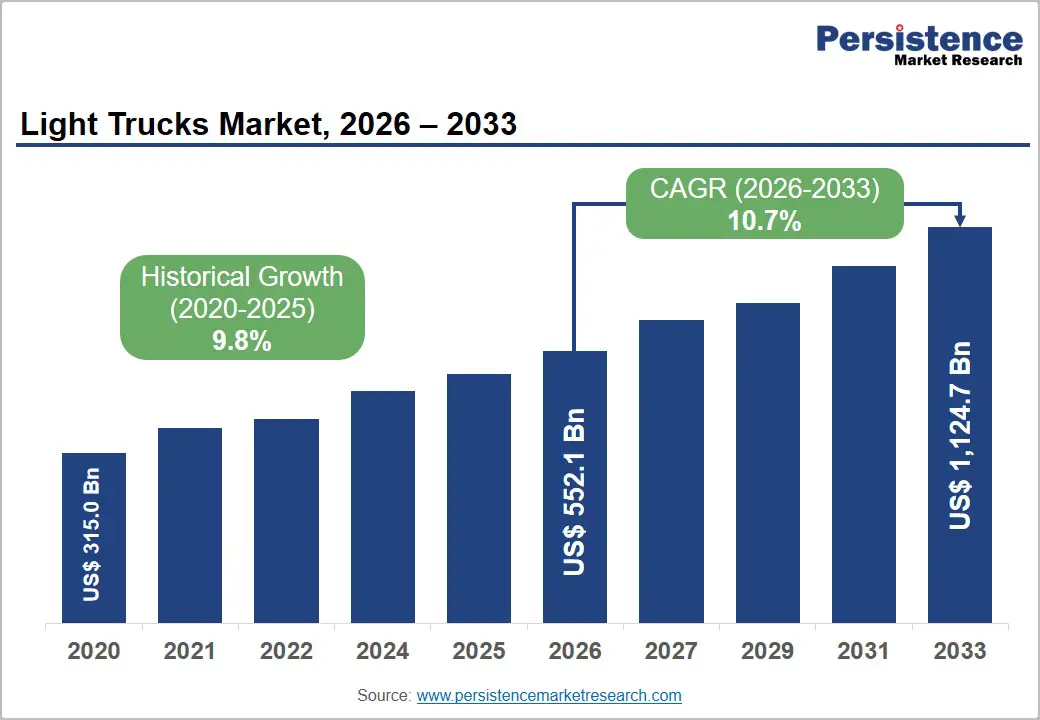
The global light trucks market size is likely to be valued at US$552.1 billion in 2026 and is estimated to reach US$1,124.7 billion by 2033, growing at a CAGR of 10.7% during the forecast period from 2026 to 2033, driven by the ongoing expansion of e-commerce and last-mile delivery services and rising investments in infrastructure and construction projects. The surging adoption of electric and connected light trucks to meet strict emission regulations and improve fleet efficiency is also propelling the market.
Key Industry Highlights:
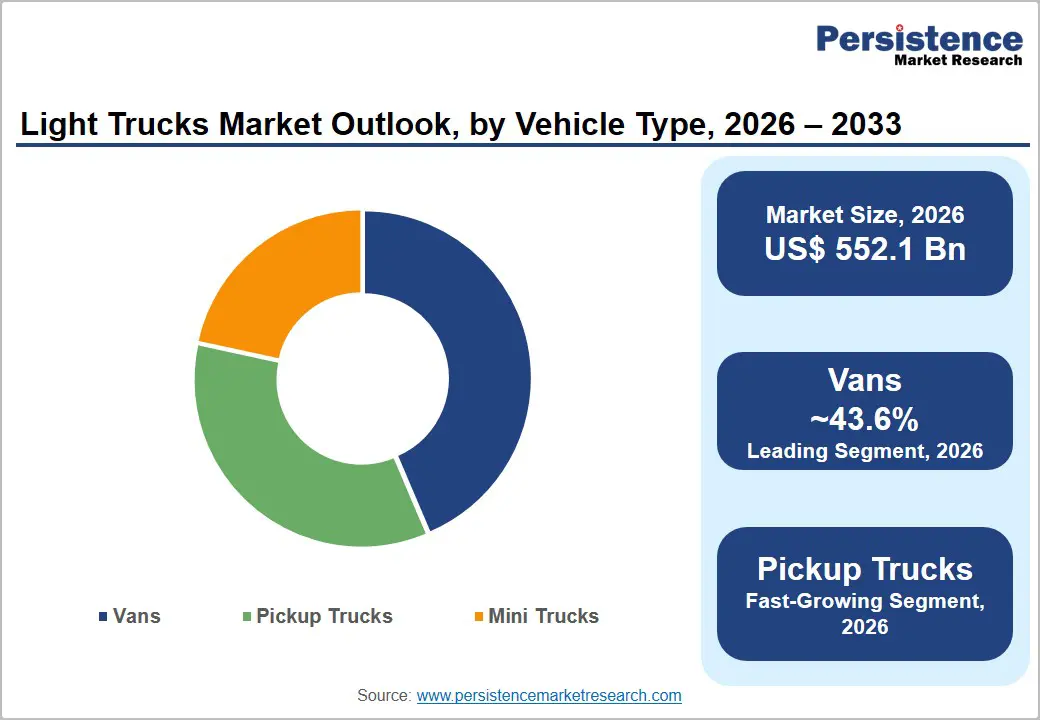
- Leading Vehicle Type: Vans, approximately 43.6% share in 2026, because they deliver high cargo space, easy loading access, and low operating costs for commercial fleet operators.
- Dominant Component: Engine and powertrain, around 40.5% share in 2026, as it influences vehicle performance, fuel efficiency, payload capacity, emissions, and operating costs.
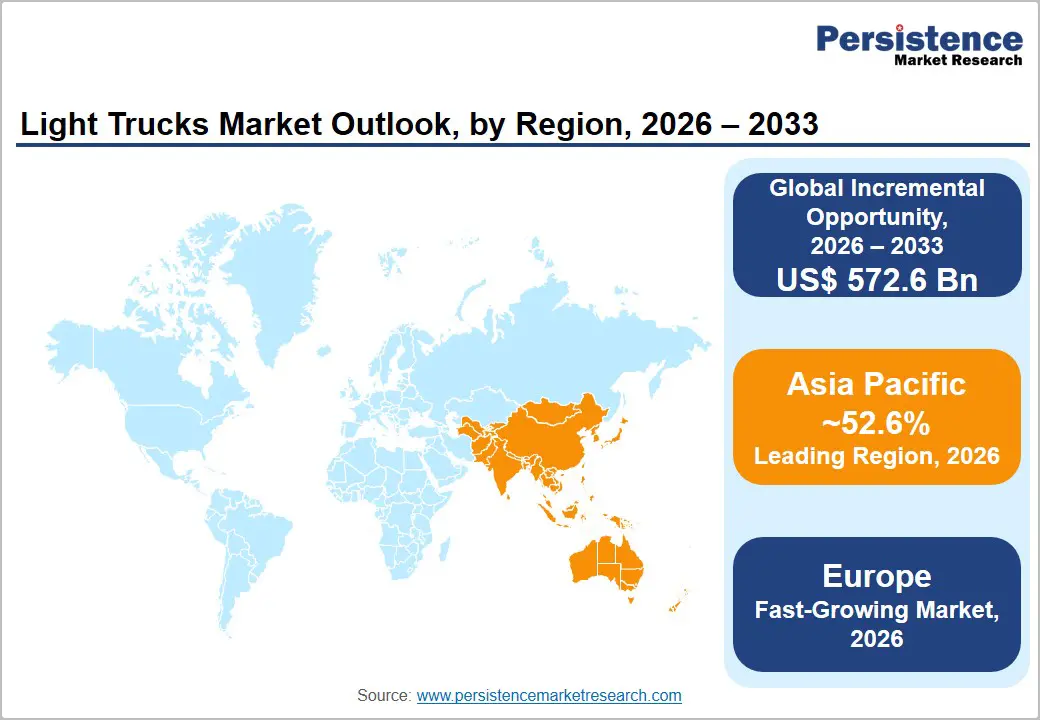
- Leading Region: Asia Pacific, with about a 52.6% share in 2026, backed by its large automotive manufacturing base and expanding logistics sector.
- Fast-growing Region: Europe, as fleet operators rapidly adopt electric light trucks to comply with stringent emission regulations.
- Latest Agreement: In March 2025, Stellantis Pro One and Iveco Group signed a 10-year supply agreement to develop and commercialize two fully electric light commercial vehicles for Europe’s market. Under the agreement, Stellantis will manufacture the vans at its facilities in Italy, Poland, and France, while Iveco will market them under its own brand, with commercial sales scheduled to begin by mid-2026.
DRO Analysis
Driver - Boom of E-commerce and Last-Mile Logistics
Light trucks and cargo vans have become the operational backbone of urban last-mile delivery, the final leg of a shipment from a distribution hub to the recipient. The vehicles' ability to navigate narrow urban streets, comply with low-emission zone restrictions, and operate efficiently on short delivery routes makes them structurally irreplaceable in city logistics. The scale is expanding rapidly.
In July 2025, DHL Group announced in an official press release that by the end of 2025, 2,400 new e-vans from Ford Pro, comprising the E-Transit and E-Transit Custom, would be added to the DHL delivery fleet in Germany. It would bring the total number of Ford Pro e-vans in the Post & Parcel Germany business unit to 4,900 vehicles and the total electric delivery fleet to approximately 35,000 units.
Pickup Trucks to Become the Primary Consumer Vehicle across North America
The pickup truck has moved well beyond its working-vehicle origins to become the dominant personal and family vehicle across much of North America. This is because consumers increasingly prefer multifunctional trucks that serve daily drivability and lifestyle utility purposes, specifically seeking passenger comfort, technology, safety, and infotainment, all with strong towing and off-roading specifications. This cultural shift is reflected in purchasing data.
According to a Cornell Law School Journal of Law and Public Policy analysis published in November 2024, a third of pickup owners rarely or never use their trucks for hauling, and two-thirds rarely or never use them for towing. Instead, they use them for daily commuting, errands, and leisure activities. As manufacturers release premium trims with luxury interiors and performance enhancements, the pickup is capturing an expanding consumer base that previously purchased sedans or Sports Utility Vehicles (SUVs).
Restraint - Higher Per-Kilometer Operating Costs Compared to Smaller Vehicle Classes
Light trucks carry a structurally higher operating cost burden than passenger cars and standard cargo vans, and those costs have been rising. According to the American Transportation Research Institute's (ATRI) 2025 Analysis of the Operational Costs of Trucking, the total cost of operating a truck averaged US$2.260 per mile in 2024. While fuel costs fell 7 cents per mile, non-fuel operating costs rose 3.6%, reaching the highest non-fuel expense level ever recorded by ATRI, with driver-based costs as the primary driver.
Maintenance costs worsen the scenario. According to Fleetio's 2025 fleet benchmarking data published in Automotive Fleet magazine, average maintenance and repair costs increased 4.9% in Q1 2025 compared to full-year 2024, and 2024 itself had already recorded an 11.3% increase over 2023. For fleet operators managing large numbers of light trucks, these cumulative cost increases compress profitability, particularly for small-scale logistics carriers operating on thin margins.
Opportunity - Battery Electric Light Trucks to Replace Diesel Vans
The transition from Internal Combustion Engine (ICE) delivery vans to Battery Electric Vehicles (BEVs) is fueling under both economic and regulatory pressure. Electric delivery vans now deliver comparable cargo volumes to their diesel equivalents, with meaningfully lower per-kilometer fuel and maintenance costs in urban duty cycles. The DHL Group's official press release confirmed that the Ford E-Transit provides a cargo space volume of 18 cubic meters, approximately 200 parcels per load, with a 68 kWh battery capacity, making it Europe's best-selling electric van in the two-ton segment.
Amazon's commitment to acquire 100,000 electric delivery vans from Rivian by 2030 represents the largest single electric commercial vehicle order globally. According to the International Energy Agency (IEA), sales of electric Light Commercial Vehicles (LCVs) increased by more than 40% in 2024. This confirms that fleet electrification is no longer experimental but a mainstream procurement decision.
Safety Mandates to Compel Active Driver Assistance Integration
The U.S. federal regulation is now propelling the installation of Advanced Driver Assistance Systems (ADAS) across every new light truck sold. In May 2024, the National Highway Traffic Safety Administration (NHTSA) published a final rule, Federal Motor Vehicle Safety Standard (FMVSS) No. 127. It mandates Automatic Emergency Braking (AEB) and Pedestrian Automatic Emergency Braking (PAEB) systems in all new passenger cars and light trucks up to 10,000 lbs Gross Vehicle Weight Rating (GVWR).
According to the official NHTSA press release, this standard is expected to save at least 360 lives a year and prevent at least 24,000 injuries annually, with full compliance required by September 2029. The rule also mandates Forward Collision Warning (FCW), lane departure warnings, and lane-keeping assist under the Bipartisan Infrastructure Law, collectively establishing a baseline ADAS suite that every new light truck must include. As manufacturers integrate these systems to comply, the sensor, camera, and radar content per vehicle rises significantly, increasing the technical complexity and value of each unit produced.
Category-wise Analysis
Vehicle Type Insights
Vans are predicted to lead with a share of approximately 43.6% in 2026, as they deliver a combination of high cargo capacity, easy loading, and low operating costs. Their enclosed cargo area protects goods from weather and theft, making them suitable for parcel delivery, cold chain logistics, pharmaceuticals, food distribution, and service businesses. Compared to larger trucks, vans can easily move through narrow city roads and congested urban areas. This helps companies complete more deliveries in less time, especially as same-day and next-day delivery services become common.
Pickup trucks are estimated to be the fastest-growing segment over the forecast period, as they serve both commercial and personal users. Businesses use them for transporting tools, construction materials, agricultural products, and equipment, while individual buyers prefer them for towing, recreation, and off-road driving. This dual-purpose nature allows manufacturers to target a broader customer base than traditional cargo vehicles. Improvements in ride comfort, cabin technology, fuel efficiency, and safety have further increased their appeal.
Component Insights
Engine and powertrain are anticipated to dominate with a share of nearly 40.5% in 2026, as they determine vehicle performance, fuel consumption, payload capability, towing capacity, emissions, and overall reliability. Fleet operators often evaluate a light truck based on its total cost of ownership, and the powertrain has the greatest influence on maintenance costs and fuel efficiency over the vehicle's lifetime. As emission standards become more stringent worldwide, manufacturers continue investing heavily in clean diesel engines, turbocharged gasoline engines, hybrid systems, and electric drivetrains.
Electrical and cooling systems are expected to remain in the second position in 2026, as modern light trucks contain far more electronic components than previous generations. Features such as Advanced Driver Assistance Systems (ADAS), telematics, digital dashboards, connected fleet management, electric steering, battery management systems, and over-the-air software updates all depend on more powerful electrical architectures. Hence, demand for high-capacity wiring harnesses, sensors, controllers, batteries, alternators, and electronic control units continues to rise.
Regional Insights
Asia Pacific Light Trucks Market Trends
Asia Pacific is anticipated to lead in 2026 with a share of nearly 52.6%, as it combines the world's largest manufacturing base with growing domestic demand for freight movement. China, India, Japan, and South Korea have well-established automotive production hubs, extensive supplier networks, and low manufacturing costs. The region also benefits from surging e-commerce, industrial production, and urbanization, which increase the demand for light trucks used in last-mile delivery and intra-city logistics. Governments are supporting commercial vehicle adoption through infrastructure spending and policies that encourage cleaner transport.
China Light Trucks Market Trends
China will likely lead in Asia Pacific in 2026 with a share of around 44.3%, owing to its booming logistics sector, expanding electric vehicle industry, and government support for low-emission commercial transport. The country has one of the world's largest parcel delivery networks. According to China's State Post Bureau, express delivery companies handled more than 170 billion parcels in 2024, creating sustained demand for light vans and pickup trucks used in urban distribution. The country is also leading the transition to electric light trucks. Domestic manufacturers such as BYD, SAIC Maxus, Foton, Geely Farizon, and JAC continue to launch battery-electric commercial vehicles for city logistics.
India Light Trucks Market Trends
In 2026, India is projected to account for a share of approximately 20.8% in 2026, as road freight remains the country's primary mode of goods transportation. The expansion of e-commerce, organized retail, construction, agriculture, and manufacturing has increased the demand for small and medium commercial vehicles. Government investments under programs such as the PM Gati Shakti National Master Plan are improving highway connectivity and logistics efficiency, creating favorable conditions for light truck demand.
Europe Light Trucks Market Trends
Europe will likely be the fastest-growing market over the forecast period with a share of nearly 21.7% in 2026, as the region is rapidly replacing conventional diesel light trucks with electric and low-emission alternatives. Strict carbon emission regulations, expanding low-emission zones, and corporate sustainability targets are encouraging logistics companies to modernize their fleets. Governments across Europe also continue to support electric commercial vehicles through incentives, charging infrastructure, and public procurement programs.
Germany Light Trucks Market Trends
Germany will likely register a substantial share of approximately 34.6% in 2026, due to its advanced manufacturing sector, export-driven economy, and well-developed logistics network. Demand comes from parcel delivery companies, industrial suppliers, construction firms, and municipal fleets. Local manufacturers are also leading innovation in electric commercial vehicles, connected fleet technologies, and vehicle safety systems.
France Light Trucks Market Trends
A share of around 18.4% is predicted to be held by France in 2026, as businesses accelerate the adoption of electric light commercial vehicles. National policies supporting decarbonization, together with strict urban emission rules, are encouraging fleet operators to replace aging diesel vans and light trucks. Growth is particularly rising in parcel delivery, food distribution, municipal services, and utility fleets operating in cities. Local manufacturers are actively expanding electric vehicle production. Renault, for example, continues strengthening its electric commercial vehicle portfolio through models such as the Master E-Tech and Trafic E-Tech.
North America Light Trucks Market Trends
North America is predicted to witness decent growth in 2026 with a share of approximately 18.9%, supported by increasing construction activity, agriculture, energy, logistics, and small business operations. Pickup trucks continue to dominate commercial and personal transportation because they deliver high towing capacity, durability, and versatility. Fleet operators are also investing in connected vehicle technologies that improve maintenance planning and fuel efficiency.
U.S. Light Trucks Market Trends
A share of nearly 62.3% is expected to be held by the U.S. in 2026, as light trucks remain essential across construction, agriculture, utilities, oil and gas, and last-mile delivery. The country also has one of the world's strongest pickup truck cultures, with several vehicles serving both commercial and personal purposes. Continued investments in infrastructure and warehousing are supporting replacement demand for commercial fleets.
Competitive Landscape
The global light trucks market is moderately consolidated, with a small group of multinational manufacturers accounting for a significant share of sales. Regional manufacturers compete in specific geographies through specialized product portfolios, localized manufacturing, and alternative-fuel offerings. Leading manufacturers such as Ford, General Motors, Toyota, Isuzu, Stellantis, Volkswagen, Renault, Tata Motors, Daimler Truck, and Volvo Group continue to strengthen their positions through frequent product launches and platform upgrades rather than relying solely on capacity expansion.
The industry has witnessed an accelerated shift toward electric and hybrid light trucks, prompting established players to expand battery-electric lineups while defending their conventional diesel and gasoline portfolios. Chinese manufacturers, including BYD, Foton, JAC, Geely Farizon, and Changan, are also becoming increasingly competitive by offering lower-cost electric light trucks and expanding into export markets. Strategic partnerships have become a defining competitive strategy as manufacturers seek to reduce development costs and accelerate electrification.
Key Industry Developments:
- In May 2026, Stellantis unveiled a €60 billion (US$68.4 billion) business strategy that includes the launch of 11 new commercial vehicle models by 2030 through its Stellantis Pro One division. The roadmap covers new battery-electric, hybrid, and internal combustion light commercial vehicles, alongside refreshed pickup truck platforms and expanded software-enabled fleet solutions.
- In January 2026, PlusAI and Iveco expanded their strategic partnership by launching Southern Europe's first autonomous heavy-duty truck testing program. The initiative will deploy Iveco trucks equipped with PlusAI's Level 4 autonomous driving technology on a commercial freight corridor in Spain in collaboration with logistics company Sesé.
- In April 2025, Hyundai Motor Company and Iveco Group signed a supply agreement for an Iveco-branded all-electric light commercial vehicle based on Hyundai's dedicated Global eLCV platform. Hyundai will manufacture the chassis-cab, while Iveco will customize and distribute the vehicles across Europe, expanding its electric light truck portfolio.
Companies Covered in Light Trucks Market
- Ford Motor Company
- General Motors
- Stellantis
- Toyota Motor Corporation
- Mercedes-Benz
- Volkswagen Commercial Vehicles
- ISUZU Motors Ltd.
- Nissan Motors Co. Ltd.
- Hyundai Motor Company
- Tata Motors
- Mahindra and Mahindra
- Mitsubishi Fuso Truck and Bus Corporation
Frequently Asked Questions
The global light trucks market is projected to be valued at US$552.1 billion in 2026.
The light trucks market is expected to reach US$1,124.7 billion by 2033.
Key market trends include the electrification of light trucks and the integration of connected fleet technologies.
Vans are expected to be the leading vehicle type with a share of nearly 43.6% in 2026, as they provide secure cargo transportation and are well suited for last-mile delivery.
The light trucks market is expected to grow at a CAGR of 10.7% from 2026 to 2033.


