


- Executive Summary
- Global Latex Condom Market Snapshot, 2025 and 2032
- Market Opportunity Assessment, 2025 - 2032, US$ Bn
- Key Market Trends
- Future Market Projections
- Premium Market Insights
- Industry Developments and Key Market Events
- PMR Analysis and Recommendations
- Market Overview
- Market Scope and Definition
- Market Dynamics
- Drivers
- Restraints
- Opportunity
- Challenges
- Key Trends
- COVID-19 Impact Analysis
- Forecast Factors - Relevance and Impact
- Value Chain Analysis
- Supply Chain Analysis
- List of Key Market Players
- Value Added Insights
- PESTLE Analysis
- Porter’s Five Force Analysis
- Price Trend Analysis, 2019 - 2032
- Pricing Analysis, By Product Type
- Key Factors Impacting Prices, By End-use
- Global Latex Condom Market Outlook
- Key Highlights
- Market Size (US$ Bn) and Y-o-Y Growth
- Absolute $ Opportunity
- Market Size (US$ Bn) Analysis and Forecast
- Historical Market Size (US$ Bn) Analysis, 2019-2024
- Market Size (US$ Bn) Analysis and Forecast, 2025-2032
- Global Latex Condom Market Outlook: Material Type
- Historical Market Size (US$ Bn) Analysis, By Material Type, 2019-2024
- Market Size (US$ Bn) Analysis and Forecast, By Material Type, 2025-2032
- Natural
- Synthetic
- Market Attractiveness Analysis: Material Type
- Global Latex Condom Market Outlook: Product Type
- Historical Market Size (US$ Bn) Analysis, By Product Type, 2019-2024
- Market Size (US$ Bn) Analysis and Forecast, By Product Type, 2025-2032
- Flavored Condoms
- Non-flavored Condoms
- Market Attractiveness Analysis: Product Type
- Global Latex Condom Market Outlook: End-use
- Historical Market Size (US$ Bn) Analysis, By End-use, 2019-2024
- Market Size (US$ Bn) Analysis and Forecast, By End-use, 2025-2032
- Men
- Women
- Market Attractiveness Analysis: End-use
- Global Latex Condom Market Outlook: Distribution Channel
- Historical Market Size (US$ Bn) Analysis, By Distribution Channel, 2019-2024
- Market Size (US$ Bn) Analysis and Forecast, By Distribution Channel, 2025-2032
- Hypermarket/Supermarket
- Drug Stores/Pharmacies
- E-commerce/Online
- Others
- Market Attractiveness Analysis: Distribution Channel
- Key Highlights
- Global Latex Condom Market Outlook: Region
- Historical Market Size (US$ Bn) Analysis, By Region, 2019-2024
- Market Size (US$ Bn) Analysis and Forecast, By Region, 2025-2032
- North America
- Europe
- East Asia
- South Asia and Oceania
- Latin America
- Middle East & Africa
- Market Attractiveness Analysis: Region
- North America Latex Condom Market Outlook
- Historical Market Size (US$ Bn) Analysis, By Market, 2019-2024
- By Country
- By Material Type
- By Product Type
- By End-use
- By Distribution Channel
- Market Size (US$ Bn) Analysis and Forecast, By Country, 2025-2032
- U.S.
- Canada
- Market Size (US$ Bn) Analysis and Forecast, By Material Type, 2025-2032
- Natural
- Synthetic
- Market Size (US$ Bn) Analysis and Forecast, By Product Type, 2025-2032
- Flavored Condoms
- Non-flavored Condoms
- Market Size (US$ Bn) Analysis and Forecast, By End-use, 2025-2032
- Men
- Women
- Market Size (US$ Bn) Analysis and Forecast, By Distribution Channel, 2025-2032
- Hypermarket/Supermarket
- Drug Stores/Pharmacies
- E-commerce/Online
- Others
- Market Attractiveness Analysis
- Historical Market Size (US$ Bn) Analysis, By Market, 2019-2024
- Europe Latex Condom Market Outlook
- Historical Market Size (US$ Bn) Analysis, By Market, 2019-2024
- By Country
- By Product Type
- By End-use
- By Distribution Channel
- Market Size (US$ Bn) Analysis and Forecast, By Country, 2025-2032
- Germany
- France
- U.K.
- Italy
- Spain
- Russia
- Türkiye
- Rest of Europe
- Market Size (US$ Bn) Analysis and Forecast, By Material Type, 2025-2032
- Natural
- Synthetic
- Market Size (US$ Bn) Analysis and Forecast, By Product Type, 2025-2032
- Flavored Condoms
- Non-flavored Condoms
- Market Size (US$ Bn) Analysis and Forecast, By End-use, 2025-2032
- Men
- Women
- Market Size (US$ Bn) Analysis and Forecast, By Distribution Channel, 2025-2032
- Hypermarket/Supermarket
- Drug Stores/Pharmacies
- E-commerce/Online
- Others
- Market Attractiveness Analysis
- Historical Market Size (US$ Bn) Analysis, By Market, 2019-2024
- East Asia Latex Condom Market Outlook
- Historical Market Size (US$ Bn) Analysis, By Market, 2019-2024
- By Country
- By Material Type
- By Product Type
- By End-use
- By Distribution Channel
- Market Size (US$ Bn) Analysis and Forecast, By Country, 2025-2032
- China
- Japan
- South Korea
- Market Size (US$ Bn) Analysis and Forecast, By Material Type, 2025-2032
- Natural
- Synthetic
- Market Size (US$ Bn) Analysis and Forecast, By Product Type, 2025-2032
- Flavored Condoms
- Non-flavored Condoms
- Market Size (US$ Bn) Analysis and Forecast, By End-use, 2025-2032
- Men
- Women
- Market Size (US$ Bn) Analysis and Forecast, By Distribution Channel, 2025-2032
- Hypermarket/Supermarket
- Drug Stores/Pharmacies
- E-commerce/Online
- Others
- Market Attractiveness Analysis
- Historical Market Size (US$ Bn) Analysis, By Market, 2019-2024
- South Asia & Oceania Latex Condom Market Outlook
- Historical Market Size (US$ Bn) Analysis, By Market, 2019-2024
- By Country
- By Material Type
- By Product Type
- By End-use
- By Distribution Channel
- Market Size (US$ Bn) Analysis and Forecast, By Country, 2025-2032
- India
- Southeast Asia
- ANZ
- Rest of South Asia & Oceania
- Market Size (US$ Bn) Analysis and Forecast, By Material Type, 2025-2032
- Natural
- Synthetic
- Non-flavored Condoms
- Market Size (US$ Bn) Analysis and Forecast, By Product Type, 2025-2032
- Flavored Condoms
- Non-flavored Condoms
- Market Size (US$ Bn) Analysis and Forecast, By End-use, 2025-2032
- Men
- Women
- Market Size (US$ Bn) Analysis and Forecast, By Distribution Channel, 2025-2032
- Hypermarket/Supermarket
- Drug Stores/Pharmacies
- E-commerce/Online
- Others
- Market Attractiveness Analysis
- Historical Market Size (US$ Bn) Analysis, By Market, 2019-2024
- Latin America Latex Condom Market Outlook
- Historical Market Size (US$ Bn) Analysis, By Market, 2019-2024
- By Country
- By Material
- By Product Type
- By End-use
- By Distribution Channel
- Market Size (US$ Bn) Analysis and Forecast, By Country, 2025-2032
- Brazil
- Mexico
- Rest of Latin America
- Market Size (US$ Bn) Analysis and Forecast, By Material Type, 2025-2032
- Natural
- Synthetic
- Market Size (US$ Bn) Analysis and Forecast, By Product Type, 2025-2032
- Flavored Condoms
- Non-flavored Condoms
- Market Size (US$ Bn) Analysis and Forecast, By End-use, 2025-2032
- Men
- Women
- Market Size (US$ Bn) Analysis and Forecast, By Distribution Channel, 2025-2032
- Hypermarket/Supermarket
- Drug Stores/Pharmacies
- E-commerce/Online
- Others
- Market Attractiveness Analysis
- Historical Market Size (US$ Bn) Analysis, By Market, 2019-2024
- Middle East & Africa Latex Condom Market Outlook
- Historical Market Size (US$ Bn) Analysis, By Market, 2019-2024
- By Country
- By Material
- By Product Type
- By End-use
- By Distribution Channel
- Market Size (US$ Bn) Analysis and Forecast, By Country, 2025-2032
- GCC Countries
- Egypt
- South Africa
- Northern Africa
- Rest of Middle East & Africa
- Market Size (US$ Bn) Analysis and Forecast, By Product Type, 2025-2032
- Natural
- Synthetic
- Market Size (US$ Bn) Analysis and Forecast, By Product Type, 2025-2032
- Flavored Condoms
- Non-flavored Condoms
- Market Size (US$ Bn) Analysis and Forecast, By End-use, 2025-2032
- Men
- Women
- Market Size (US$ Bn) Analysis and Forecast, By Distribution Channel, 2025-2032
- Hypermarket/Supermarket
- Drug Stores/Pharmacies
- E-commerce/Online
- Others
- Market Attractiveness Analysis
- Historical Market Size (US$ Bn) Analysis, By Market, 2019-2024
- Competitive Landscape
- Market Share Analysis, 2025
- Market Structure
- Competition Intensity Mapping By Market
- Competition Dashboard
- Company Profiles (Details - Overview, Financials, Strategy, Recent Developments)
- Lifestyles
- Overview
- Segments and Product Type
- Key Financials
- Market Developments
- Market Strategy
- Reckitt Benckiser Group PLC
- Mankind Pharma
- Church & Dwight Co., Inc.
- Okamoto
- Karex Berhad
- Cubid Limited
- Sagami Rubber Industries Co., Ltd.
- One Condoms
- Caution Wear Corp.
- Others
- Lifestyles
- Appendix
- Research Methodology
- Research Assumptions
- Acronyms and Abbreviations


- Beauty & Personal Care
- Latex Condom Market
Latex Condom Market Size, Share, Trends, Growth, and Forecasts for 2025 - 2032
Latex Condom Market by Material Type (Natural, Synthetic), Product Type (Flavored, Non-flavored Condoms), by End Use (Men, Women), by Distribution Channel (Hypermarket/Supermarket, Drug Stores/Pharmacies, E-commerce/Online), and Regional Analysis for 2025 - 2032
Latex Condom Market Size and Trends Analysis
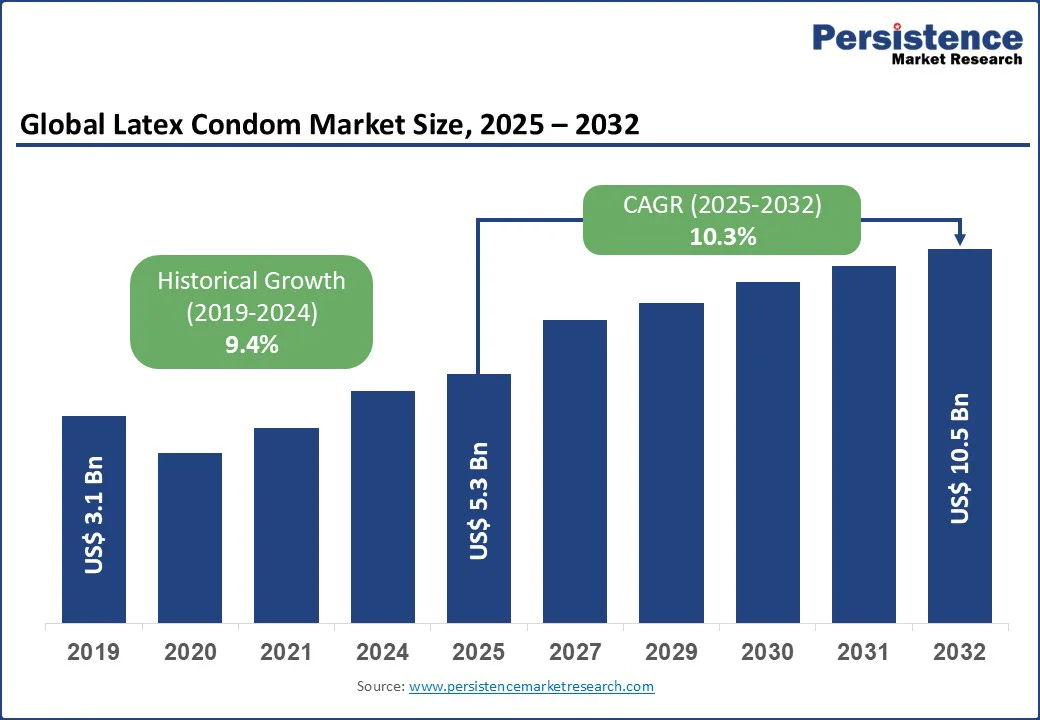
The global latex condoms market size was valued at US$ 5.3 Bn in 2025 and is projected to reach US$ 10.5 Bn by 2032, growing at a CAGR of 10.3% between 2025 and 2032.
Key Industry Highlights:
- New Facility: Cariflex Pte Ltd opened the world’s largest polyisoprene latex manufacturing facility in Singapore in May 2025. The new plant was developed with an investment of US$355 million and plans to serve manufacturers of surgical gloves, condoms, and other healthcare-related products.
- Leading Product Type: Flavored latex condoms hold nearly 64.3% share in 2025, as these help mask latex taste, improve pleasure, and appeal to young consumers.
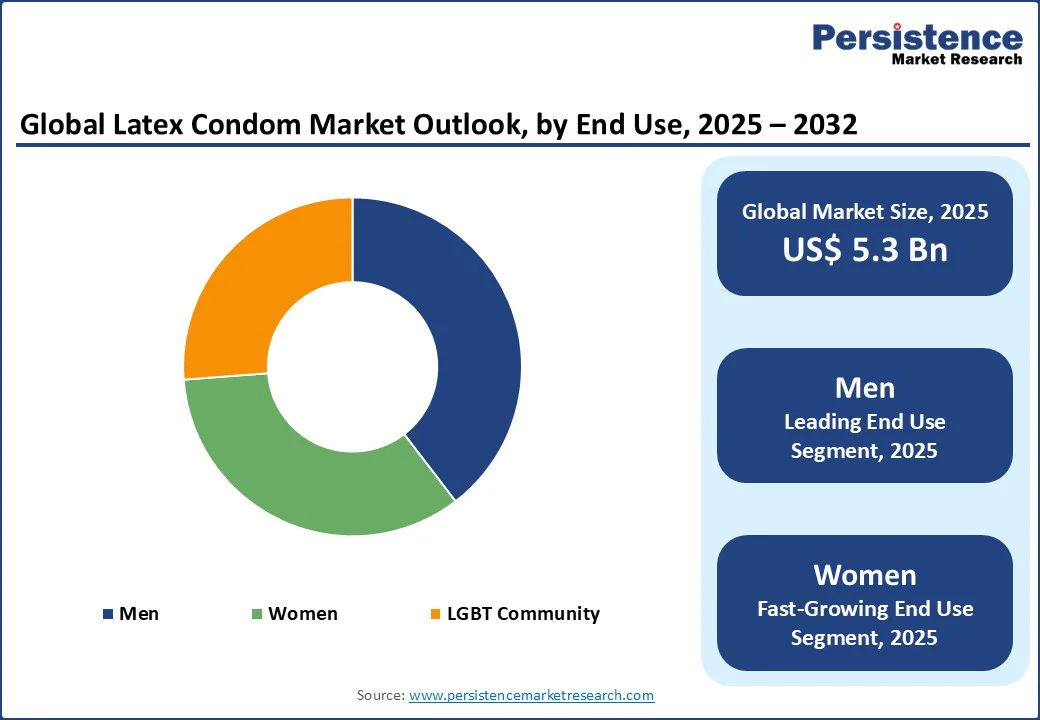
- Dominant End Use: Men, approximately 39.6% of the latex condom market share in 2025.
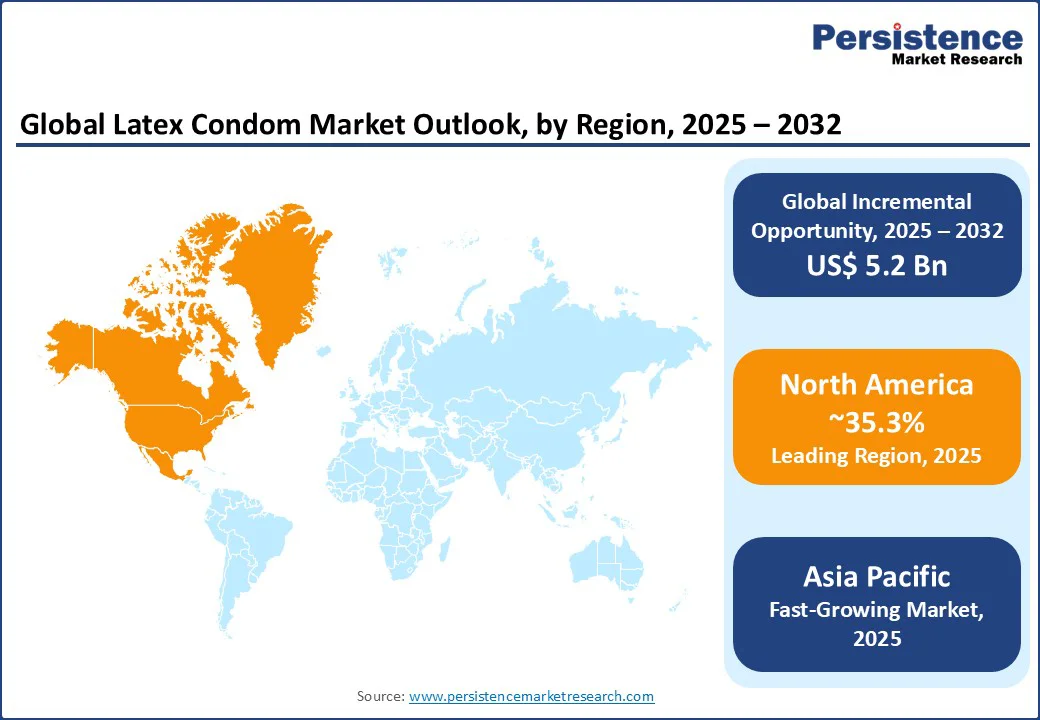
- Leading Region: North America with about 35.3% share in 2025, owing to sexual wellness awareness and rising demand for hypoallergenic products.
- Fastest-growing Region: Asia Pacific, backed by large-scale public health programs and innovation-led campaigns by various brands.
| Global Market Attribute | Key Insights |
|---|---|
| Latex Condom Market Size (2025E) | US$ 5.3 Bn |
| Market Value Forecast (2032F) | US$ 10.5 Bn |
| Projected Growth (CAGR 2025 to 2032) | 10.3% |
| Historical Market Growth (CAGR 2019 to 2024) | 9.4% |
This robust growth trajectory reflects the increasing global awareness regarding sexual health and contraceptive methods. The market expansion is driven by the rising incidence of sexually transmitted infections (STIs), the growing emphasis on family planning initiatives, and technological innovations in latex condom manufacturing.
Government and NGO initiatives promoting safe sex are accelerating market growth in developing regions. Overall, latex condoms dominate, making up about 88.4% of global condom sales.
Market Factors - Trends, Growth, Barriers Analysis
Rising Sexually Transmitted Infections (STIs) and HIV Prevention Awareness
The World Health Organization reports that 374 million new STI infections occurred globally among adults aged 15-49 in 2020, with most preventable through correct condom use. UNAIDS emphasizes that condoms are 98% effective in preventing STIs and HIV transmission, with consistent use reducing HIV transmission risk by up to 85%.
Model simulations estimate that increased condom use since 1990 has preventapproximately 117 million new HIV infections globally. This compelling evidence base drives government health campaigns and educational programs, particularly in high-risk regions like sub-Saharan Africa where HIV rates remain elevated.
Demographic Shifts and Youth Population Growth
The expanding sexually active population, particularly in emerging markets, represents a fundamental growth driver for latex condoms. Asia Pacific countries such as India and China demonstrate significant demographic advantages, with large youth populations becoming increasingly aware of sexual health practices.
Greece leads global sexual activity metrics with approximately 170 sessions annually, while Brazil, Russia, Poland, India, Mexico, and China maintain high sexually active populations. In China, over 70% of the population engages in sexual activities at least weekly, creating substantial market demand.
Government initiatives promoting contraceptive use among younger populations, combined with improved access to sexual education, drive consistent market expansion across these high-growth regions.
Technological Advancements in Manufacturing
Manufacturing innovations use nanotechnology, graphene integration, and self-lubricating coatings significantly enhance product performance and consumer acceptance. Graphene-enhanced latex condoms demonstrate 60% increased strength or enable 20% thinner production while maintaining durability.
These technological breakthroughs address common consumer complaints regarding sensation and comfort, with clinical trials showing graphene condoms preferred 2-to-1 over standard latex alternatives.
Advances in raw material engineering enable ultra-thin condom production without compromising strength, while improvements in self-lubricating coatings enhance user comfort and ensure effective STI protection. These innovations directly translate to premium pricing opportunities and expanded market penetration among quality-conscious consumers.
Restraint Analysis
Cultural and Religious Barriers
Persistent cultural taboos and religious constraints significantly limit market penetration in conservative regions, particularly in rural areas of developing countries. Many communities maintain stigma associated with condom purchases and discussions about sexual health, hindering widespread adoption.
These social barriers create substantial challenges for market expansion, especially in regions where cultural norms discourage open dialogue about contraception. Educational initiatives face resistance in traditional societies, limiting the effectiveness of awareness campaigns and restricting market growth potential. Companies must navigate complex cultural sensitivities while developing region-specific marketing strategies to address these fundamental challenges.
Latex Allergies and Material Limitations
Approximately 4.3% of the global population experiences latex allergies, creating inherent market limitations for natural rubber latex products. While this constraint drives demand for non-latex alternatives like polyurethane and polyisoprene, it represents a fundamental ceiling for latex condom market expansion.
Traditional latex condoms also face performance limitations, including incompatibility with oil-based lubricants and reduced heat transfer compared to synthetic alternatives. These material constraints require ongoing innovation investments and may limit market share growth as consumers increasingly seek enhanced sensation and comfort features available in non-latex products.
Opportunity Analysis
Emerging Market Penetration
Developing regions in Asia Pacific, Latin America, and Africa present substantial untapped opportunities for the latex condom market expansion. India's condom market demonstrates strong growth potential, projected to reach USD 773.82 Mn by 2032. Rising disposable incomes, urbanization trends, and improved healthcare access create favorable conditions for market penetration.
Government initiatives promoting family planning and HIV prevention, combined with NGO distribution programs, establish infrastructure for sustained market growth. Digital marketing and e-commerce platforms enable companies to reach previously inaccessible consumer segments while overcoming traditional distribution barriers.
Premium Product Innovation and Customization
Growing consumer demand for specialized latex condoms, including ultra-thin, flavored, textured, and eco-friendly variants, creates premium pricing opportunities. Flavored condoms market expansion, particularly in North America and Europe, demonstrates consumer willingness to pay premium prices for enhanced experiences.
Sustainable and biodegradable latex condoms appeal to environmentally conscious consumers, addressing growing sustainability concerns. Customization options, personalized flavors, and innovative packaging solutions enable brand differentiation and premium market positioning. Investment in natural and organic ingredients responds to health-conscious consumer preferences while commanding higher profit margins.
Digital Distribution Channel Expansion
E-commerce platforms represent the fastest-growing distribution channel, offering convenience, privacy, and extensive product selection that traditional retail cannot match. Online sales provide 24/7 accessibility and discreet purchasing options, addressing consumer privacy concerns that previously limited market participation.
Digital platforms enable companies to reach younger demographics comfortable with online shopping while expanding into markets with limited physical retail infrastructure. Subscription services ensure consistent supply and customer retention, while mobile apps and telehealth services create integrated sexual wellness ecosystems that enhance customer engagement and brand loyalty.
Category-wise Analysis
Material Type Insights - Natural Latex to Command Leadership
Natural latex condoms maintain market leadership with approximately 88.4% global market share, driven by superior elasticity, affordability, and proven effectiveness. Latex's ability to stretch up to 800% before breaking provides unmatched durability and reliability compared to synthetic alternatives.
The material's natural rubber composition offers excellent barrier protection against STIs and unintended pregnancies, with effectiveness rates reaching 98% when used correctly. Manufacturing cost advantages enable competitive pricing that supports widespread distribution through government and NGO programs in developing regions.
Natural latex's compatibility with water-based lubricants and established supply chains from sustainable rubber plantations creates additional competitive advantages. However, latex allergies affect 4.3% of the population, and performance limitations in heat transfer continue to create opportunities for synthetic alternatives. Despite these constraints, natural latex maintains dominance through continuous innovation in ultra-thin manufacturing and specialized texturing technologies.
Product Type Insights - Notable Demand for Flavored Condoms. Non-flavored to Grow Fast
Flavored condoms dominate the product type segment, driven by widespread availability across diverse flavor profiles, including mint, chocolate, strawberry, and exotic fruit varieties. These products enhance oral sex experiences while maintaining barrier protection, appealing to consumers seeking variety and enjoyment in intimate encounters. The segment benefits from creative marketing strategies targeting younger demographics and couples seeking enhanced intimacy options.
Non-flavored latex condoms maintain a substantial market share through reliability, cost-effectiveness, and universal compatibility across different use cases. This segment serves consumers prioritizing basic protection without additional features, making it essential for government distribution programs and cost-conscious buyers. Traditional non-flavored condoms benefit from established manufacturing processes and economies of scale that enable competitive pricing.
End-use Insights - High Demand for Male Condoms While Awareness for Female Condoms on the Rise
Male condoms account for approximately 98% of total condom sales, reflecting established user preferences, widespread availability, and comprehensive marketing support. This dominance stems from ease of use, proven effectiveness, and extensive product variety catering to different preferences regarding size, texture, and features. Male condoms benefit from robust distribution networks spanning retail, healthcare, and online channels.
Female condoms represent a rapidly growing segment with a positive CAGR, driven by gender equality initiatives and reproductive autonomy awareness. Educational programs focusing on women's control over contraceptive decisions, particularly in regions such as Zambia and neighboring countries, demonstrate significant adoption potential when combined with training and sample distribution.
Regional Insights
North America Latex Condom Market Trends
North America maintains market leadership with 35.5% global revenue share in 2025. The region benefits from comprehensive sex education programs, high per-capita spending on sexual wellness, and strong consumer awareness regarding STI prevention. The United States drives regional growth through robust school and community distribution networks while maintaining volume through expanding online channels.
The region's supportive regulatory framework, led by FDA oversight, ensures product safety while encouraging innovation. Church & Dwight's Trojan brand and other established manufacturers invest heavily in research and development, particularly in ultra-thin and specialty condom technologies. Canada's public insurance coverage and Mexico's manufacturing clusters strengthen regional supply chains while supporting cost-effective production.
Market Dynamics and Consumer Preferences
Consumer preference for non-latex and ultra-thin variants increases average selling prices, reinforcing the region's premium market position. The United States market is projected to reach USD 3.61 billion by 2032, driven by educated populations and greater awareness regarding birth control. Marketing campaigns emphasizing sexual health, pleasure, and inclusivity build strong brand awareness and loyalty among diverse demographic segments.
Europe Latex Condom Market Trends
Europe demonstrates steady CAGR through progressive health policies and universal healthcare systems. The region's market reached USD 4.10 billion in 2024, with strong performance in Germany, the United Kingdom, France, and Spain. Regulatory harmonization across EU markets facilitates efficient distribution while CE marking requirements ensure consistent product quality and safety standards.
European governments actively promote contraceptive use through innovative policy measures, including France's 2018 announcement of condom prescription reimbursement to control HIV and AIDS. The United Kingdom implements targeted digital campaigns for young adults while maintaining demand despite lower birth rates. Germany and France develop migrant health programs with multilingual condom education, addressing diverse population needs.
Asia Pacific Latex Condom Market Trends
Asia Pacific exhibits a robust CAGR, driven by increasing disposable income, young digitally connected populations, and urbanization trends. The region accounts for 52% of global condom market share, with China, India, and Japan leading consumption patterns.
China maintains dominance with 5.8 billion units consumed annually, comprising 46% of regional volume, while India follows with 2.4 billion units. China's 100% Condom Use Programs demonstrate success in reducing HIV prevalence while normalizing e-commerce purchases. Japan focuses on domestic ultra-thin polyurethane production, establishing innovation leadership in next-generation materials.
India expands rural accessibility through public-private initiatives and mobile clinics, despite social barriers in non-metropolitan areas. The India condom market projects growth to USD 773.82 million by 2032. Rise of urban middle-income groups and widespread smartphone adoption drives market expansion, while government programs such as "Condom Hai Zaroori" and National Family Health Survey break down sexual health stigmas.
Competitive Landscape
The global latex condom market is dominated by a few global brands such as LifeStyles, Okamoto, and Durex. It also houses large OEM manufacturers, including Karex and Kossan, in Malaysia and Thailand. Various big brands do not actually produce their own condoms but rely on these large manufacturers, which gives the OEMs superior control over supply.
This creates a split in competition where brands focus on marketing, while manufacturers compete on cost efficiency and large-scale production. Companies are also launching ultra-thin products, condoms with lubricants, and even with antimicrobial coatings.
Key Industry Developments
- In February 2024, Bleu introduced a digital campaign called #ComeClean to promote awareness about the company’s 100% natural latex condoms that are free of harmful chemicals. The brand has joined hands with influencers and media platforms to emphasize on the importance of being mindful of what goes inside the body.
- In February 2024, Canada-based nixit launched a new range of external condoms designed with vaginal health in mind. These are made from natural rubber latex, are vagina-friendly, ultra-thin, and lightly lubricated with pure silicone oil.
Companies Covered in Latex Condom Market
- Lifestyles
- Reckitt Benckiser Group PLC
- Mankind Pharma
- Church & Dwight Co., Inc.
- Okamoto
- Karex Berhad
- Cubid Limited
- Sagami Rubber Industries Co., Ltd.
- One Condoms
- Caution Wear Corp.
- Others
Frequently Asked Questions
The latex condom market is projected to reach US$ 5.3 Bn in 2025.
Rising STD awareness and increasing public health distribution programs are the key market drivers.
The latex condom market is poised to witness a CAGR of 10.3% from 2025 to 2032.
Premiumization and the availability of variants are the key market opportunities.
Lifestyles, Reckitt Benckiser Group PLC, and Mankind Pharma are a few key market players.


