




- Healthcare Services
- Enteral Nutrition Market
Enteral Nutrition Market Size, Share, and Growth Forecast, 2026 - 2033
Enteral Nutrition Market by Formula Type (Standard/Polymeric Formulas, Disease-Specific Formulas, Others), Feeding Route (Nasogastric Feeding, Nasoenteral Feeding, Others), Application, End-user, and Regional Analysis for 2026 - 2033

Enteral Nutrition Market Size and Trends Analysis
The global enteral nutrition market is expected to be valued at US$ 7.5 billion in 2026 and is projected to reach US$ 11.0 billion by 2033, growing at a CAGR of 5.6% between 2026 and 2033.
The market growth is primarily driven by rising demand for nutritional support among patients with gastrointestinal disorders, cancer, neurological conditions, and critical illnesses. Standard/polymeric formulas account for the largest share, while disease-specific formulations create opportunities for specialized clinical nutrition. Hospitals remain the primary end users, although home-based nutritional support is gaining importance. Advances in formula composition, feeding technology, and patient monitoring are expected to influence product development and purchasing decisions through 2033.
Key Industry Highlights
- Leading Region: North America is anticipated to lead the market by holding around 42.7% share in 2026, supported by established hospital infrastructure, clinical nutrition practices, and home-care distribution networks in the U.S. and Canada.
- Fastest-Growing Region: Asia Pacific is projected to register the fastest growth, driven by aging populations, expanding healthcare infrastructure, and increasing adoption of specialized medical nutrition.
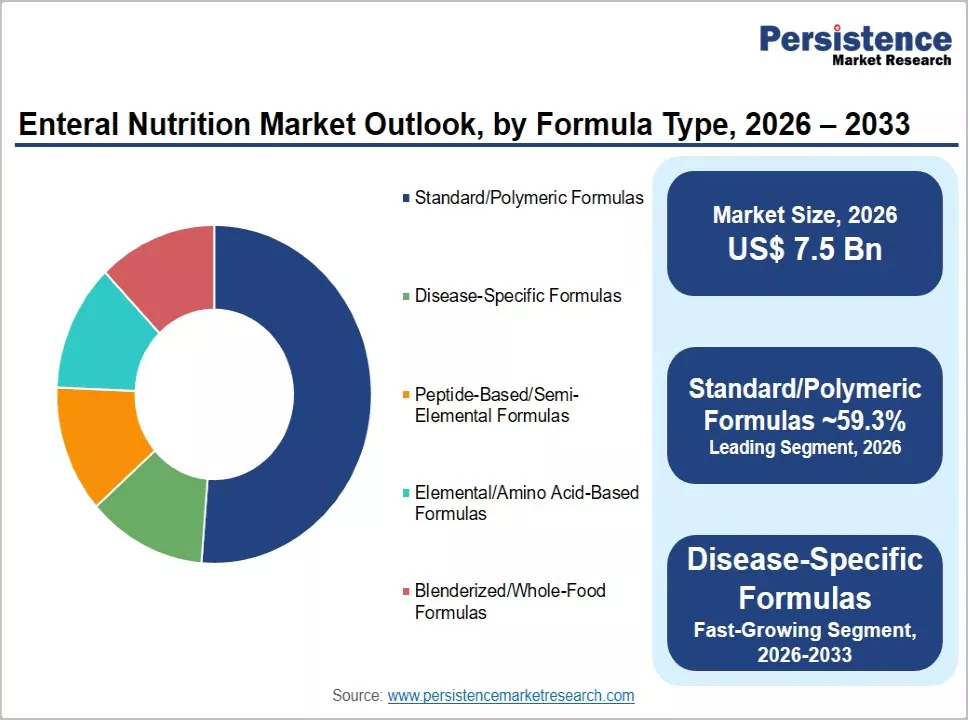
- Dominant Formula Type: Standard/polymeric formulas are anticipated to hold around 59.3% of the market, supported by their broad applicability, nutritionally complete composition, and established use across hospitals, rehabilitation facilities, and home-care settings.
- Leading End-User: Hospitals are likely to dominate the market with a 52.8% share in 2026, driven by demand for nutritional support in critical care, cancer treatment, gastrointestinal disorders, and postoperative recovery.
Market Dynamics
Drivers - Rising demand for nutritional support in chronic diseases and cancer care
The increasing burden of cancer and chronic diseases supports demand for clinically managed nutritional care. The International Agency for Research on Cancer estimated that around 20 million new cancer cases and 9.7 million cancer-related deaths occurred worldwide in 2022. Cancer treatments can cause swallowing difficulties, reduced appetite, gastrointestinal complications, and inadequate nutrient intake, creating a need for nutritional intervention among selected patients.
The U.S. National Cancer Institute projected 2,041,910 new cancer cases in the U.S. in 2025, highlighting the scale of potential supportive care needs. These factors contribute to demand for enteral nutrition products, including specialized formulas, feeding tubes, and delivery systems, for patients who cannot meet their nutritional requirements through regular food intake.
They support the importance of integrating nutritional assessment into treatment pathways. For manufacturers, this creates opportunities to develop specialized formulas for patients with specific nutritional requirements. Oncology-focused, high-protein, peptide-based, and other specialized products can complement standard formulations. Product adoption depends on clinical suitability, patient tolerance, professional recommendations, and reimbursement. Companies need to prioritize evidence-based formulations, appropriate labeling, and collaboration with hospital dietitians and oncology teams.
Population aging and the expansion of home-based care
Population aging is increasing the importance of nutritional support for people experiencing swallowing difficulties, neurological impairment, frailty, and prolonged recovery from illness. Eurostat reported that people aged 65 and older accounted for around 22% of the European Union population on January 1, 2025, representing around 99 million people. China also reported that people aged 60 and older represented around 22% of its population at the end of 2024.
Aging does not automatically create a need for enteral feeding, but it expands the population requiring nutritional assessment and, in some cases, long-term clinical support. Clinical nutrition guidance emphasizes the importance of structured care across hospitals, rehabilitation facilities, and home settings. This creates opportunities for ready-to-use formulas, feeding equipment, caregiver education, and home-delivery services. Healthcare providers can strengthen continuity of care by arranging formula availability, equipment training, monitoring, and follow-up before discharge. Manufacturers that support these requirements can develop relationships with hospitals, home-care providers, and distributors while addressing the practical needs of patients and caregivers.
Restraint - High treatment costs, reimbursement restrictions, and operational complexity
Enteral nutrition involves more than purchasing formula. Depending on the patient's condition, treatment may require feeding tubes, pumps, administration sets, specialist assessments, caregiver training, and ongoing monitoring. These expenses can limit access where reimbursement is restricted, or households need to pay substantial out-of-pocket costs. In the U.S., Medicare covers eligible enteral nutrition under its prosthetic device benefit, subject to medical-necessity and documentation requirements.
The Centers for Medicare & Medicaid Services reported a 23.8% improper payment rate for enteral nutrition in its 2024 fee-for-service supplemental payment data, corresponding to a projected improper payment amount of US$ 31.1 million. These findings highlight documentation and compliance risks rather than measuring the proportion of legitimate claims denied. Suppliers need to maintain accurate records and comply with applicable coverage rules. In lower-income markets, affordability and limited access to specialist care can create additional barriers. Companies can address these challenges through efficient procurement, dependable supply, competitively priced standard formulas, and clear clinical documentation.
Opportunities - Expansion of Disease-Specific and Specialized Formula Portfolios
Disease-specific formulations provide opportunities to address the nutritional requirements of selected patients with cancer, diabetes, renal disease, and impaired digestion or absorption. Standard/polymeric formulas remain suitable for many patients, but some require adjustments in protein composition, energy density, electrolyte content, or protein form. Peptide-based and amino acid-based formulas can be appropriate for particular digestive or absorptive conditions, while disease-specific products are designed for defined clinical needs.
Manufacturers can expand their portfolios by developing products with clear clinical purposes and supporting them with appropriate evidence. Research partnerships with hospitals and clinical nutrition specialists can strengthen product development, professional education, and appropriate use. Companies operating across multiple countries also account for differences in product registration, labeling, and formulation requirements. The strongest commercial propositions are likely to combine a well-defined clinical rationale with consistent product quality, convenient administration, and an acceptable total cost of care. Specialized products can support differentiation, provided that their benefits justify their cost and align with patient requirements.
Home enteral nutrition and emerging Asian healthcare markets
Home-based nutritional support creates opportunities to manage selected patients outside acute-care facilities while maintaining continuity of treatment. This model increases demand for accessible packaging, compatible feeding accessories, caregiver instruction, and dependable replenishment arrangements. Appropriate patient selection and professional oversight remain essential to ensure safe and effective care.
Asia Pacific offers additional opportunities as healthcare providers strengthen clinical nutrition capabilities. India's National Programme for Health Care of the Elderly includes preventive, curative, rehabilitative, and home-based services for older people.
China has also refined its registration framework for foods for special medical purposes, including guidance intended to improve the registration process for eligible products. Manufacturers can respond by strengthening regional production capabilities, working with local distributors, and adapting portfolios to local affordability and nutritional requirements. Success depends on actual patient access, trained healthcare professionals, consistent product quality, and the ability of healthcare systems or households to finance treatment.
Category-wise Analysis
Formula Type Insights
Standard/polymeric formulas are anticipated to account for around 59.3% of the market share in 2026. These nutritionally complete products contain protein, carbohydrates, fats, vitamins, and minerals, supporting routine nutritional care in hospitals, rehabilitation facilities, and home-care settings. Examples include Abbott’s Jevity, Nestlé Health Science’s Isosource, Danone Nutricia’s Nutrison, and Fresenius Kabi’s Fresubin.
Their broad clinical applicability, established use, and suitability for standardized procurement support demand. However, formula selection depends on patients’ digestive function, nutrient requirements, and tolerance, creating opportunities for specialized alternatives.
Disease-specific formulas are anticipated to record the fastest growth as healthcare providers increasingly tailor nutrition to conditions such as diabetes, renal disease, and cancer. Examples include diabetes-oriented formulas such as Glucerna and renal nutrition products such as Nepro, both from Abbott. Segment growth is further depend on clinical suitability, affordability, and access to reimbursement.
Peptide-based formulas, such as Peptamen from Nestlé Health Science, support selected patients with digestive or absorption difficulties. Elemental formulas and whole-food options, including products from Kate Farms, provide additional choices for specific clinical needs.
Feeding Route Insights
Nasogastric feeding represents the leading segment, accounting for around 35% of the market share in 2026. It delivers nutrition through a tube placed through the nose into the stomach and is commonly used for short-term support when patients cannot consume enough food orally but can tolerate gastric feeding.
Its use across hospital wards, intensive-care units, and postoperative settings supports demand for feeding tubes, formulas, and accessories. Products such as the CORFLO nasogastric feeding tubes from Avanos Medical illustrate the associated device market. Correct tube placement, monitoring, and aspiration-risk assessment remain essential.
Nasoenteral feeding represents the fastest-growing segment, as clinicians use post-pyloric feeding for selected patients who cannot tolerate gastric feeding or require delivery beyond the stomach. Adoption depends on clinical protocols, patient suitability, and access to trained professionals.
Other options include gastrostomy tubes, such as PEG systems, for longer-term feeding and jejunostomy tubes for selected patients requiring small-intestinal access. Oral nutritional supplements, such as Ensure from Abbott and Fortisip from Danone Nutricia, support patients who can safely consume nutrition orally, although they differ from tube-feeding products in administration and clinical use.
Regional Analysis
North America Enteral Nutrition Market Trends
North America is anticipated to lead the global enteral nutrition market, accounting for around 42.7% of market share in 2026. The region's leadership is supported by established clinical nutrition practices, extensive hospital procurement networks, and well-developed home-care services. Rising demand for nutritional support among patients with cancer, neurological disorders, gastrointestinal conditions, and age-related health concerns also contributes to market growth.
U.S. Enteral Nutrition Market Trends
The U.S. leads the North American market, supported by extensive hospital infrastructure and home enteral nutrition services. Cancer, neurological disorders, and gastrointestinal conditions drive demand for specialized nutritional products. Abbott's Jevity and Glucerna product ranges address different nutritional requirements across clinical and home-care settings. The National Cancer Institute estimated 2,041,910 new cancer cases in 2025, highlighting the scale of potential nutritional-care needs, although this figure does not represent the population requiring enteral feeding. Medicare coverage criteria and medical-necessity documentation also influence product access and supplier selection.
In July 2025, Danone completed its acquisition of a majority stake in Kate Farms, strengthening its specialized nutrition presence in the U.S. The transaction expands its portfolio alongside Nutricia and reflects growing commercial interest in differentiated and plant-based medical nutrition products.
Canada Enteral Nutrition Market Trends
Canada contributes to the North American market through hospital-based nutritional support and community care, with provincial healthcare systems influencing product access and procurement. Products from Abbott, Nestlé Health Science, and Fresenius Kabi compete across clinical nutrition settings. Market opportunities depend on hospital purchasing, continuity of home-care services, and access to specialized formulas. Provincial funding arrangements, geographic distribution costs, and differences in healthcare access also influence adoption.
Europe Enteral Nutrition Market Trends
Europe represents a significant market, supported by mature healthcare systems, established medical nutrition expertise, and an aging population. People aged 65 and older accounted for around 22% of the European Union population in 2025, reinforcing the importance of nutritional assessment and support across acute, long-term, and community care settings.
Germany Enteral Nutrition Market Trends
Germany's market benefits from established hospital infrastructure and the presence of Fresenius Kabi, whose Fresubin range includes oral nutritional supplements and tube-feeding products. The company's manufacturing capabilities and clinical nutrition portfolio support supply to hospitals and other care settings. Product selection is influenced by clinical suitability, procurement costs, reimbursement arrangements, and healthcare provider preferences.
France Enteral Nutrition Market Trends
France combines an established medical nutrition market with domestic manufacturing capabilities. In September 2026, Danone inaugurated a €70 million medical nutrition production line in Steenvoorde, reinforcing its specialized nutrition manufacturing capacity. The investment highlights the role of production expansion in strengthening supply resilience and product availability. European regulations governing foods for special medical purposes also influence product composition, labeling, and commercialization.
Asia Pacific Enteral Nutrition Market Trends
Asia Pacific is anticipated to be the fastest-growing regional market, supported by healthcare infrastructure development, aging populations, and increasing awareness of clinical nutrition. However, growth varies across countries because affordability, specialist availability, healthcare access, and distribution capabilities differ significantly.
China Enteral Nutrition Market Trends
China's aging population and evolving medical food regulations are shaping demand for enteral nutrition products. People aged 60 and older accounted for around 22% of China's population at the end of 2024. In January 2025, the State Administration for Market Regulation issued registration guidance for full-nutrition foods for special medical purposes, clarifying application and on-site inspection requirements. These measures provide manufacturers with clearer registration procedures while reinforcing regulatory compliance.
Companies offering complete-nutrition and disease-specific formulas are positioned to benefit as clinical nutrition services develop. However, affordability, product registration requirements, and access to specialized healthcare services continue to influence market adoption.
India Enteral Nutrition Market Trends
India presents growth opportunities through expanding healthcare capacity and increasing attention to the health needs of older adults. The government's National Programme for Health Care of the Elderly provides preventive, curative, rehabilitative, and home-based services, supporting a broader care infrastructure for patients requiring nutritional assistance.
In June 2025, Fresenius Kabi expanded its enteral nutrition research and development center in Gurugram. The investment strengthens its research network and supports product development for India and other markets. It also highlights the importance of regional research capabilities in adapting nutritional products to local clinical requirements. Broader adoption depends on affordability, healthcare professional training, reliable distribution, and access to nutritional support beyond major urban hospitals.
Across Asia Pacific, suppliers offering locally relevant products, dependable distribution, and clinical education are positioned to address emerging demand. However, differences in healthcare access, purchasing power, and national regulatory requirements continue to influence the pace of market expansion.
Competitive Landscape
The global enteral nutrition market is highly competitive, led by multinational nutrition companies, specialist medical nutrition suppliers, and manufacturers of enteral feeding devices and accessories. Abbott, Nestlé Health Science, Danone Nutricia, and Fresenius Kabi have established formula portfolios, while B. Braun, ICU Medical, Avanos Medical, and other suppliers participate in related feeding-system markets.
Market leaders focus on portfolio differentiation, manufacturing efficiency, product availability, and geographic expansion. Standard formulas support scale and routine procurement, while disease-specific, peptide-based, and whole-food products target specialized needs. Acquisitions can broaden portfolios and distribution reach, while investment in research and production can improve responsiveness to local markets. Home-care services and healthcare partnerships provide additional opportunities beyond hospital discharge.
Key Industry Developments
- In March 2026, Nestlé announced the launch of Compleat Paediatric Oral Blends in selected European markets, with wider expansion planned later in the year. Designed for children with specialized medical nutrition needs, the product comes in portable pouches and combines fruit and other ingredients with pea and rice proteins, vitamins, and minerals.
Companies Covered in Enteral Nutrition Market
- Abbott
- Nestlé Health Science
- Danone Nutricia
- Fresenius Kabi
- B. Braun
- Baxter International
- ICU Medical
- Avanos Medical
- Cardinal Health
- Moog Inc.
- Vygon
- Cook Medical
- Kate Farms
- Functional Formularies
- Real Food Blends
- Medtrition
Frequently Asked Questions
The global enteral nutrition market is anticipated to reach US$ 7.5 billion in 2026.
The market is projected to reach US$ 11.0 billion by 2033, driven by increasing demand for clinical nutrition and specialized feeding products.
Key trends include growing demand for disease-specific formulas, greater adoption of home-based nutritional support, development of plant-based and whole-food formulas, and investment in research, manufacturing, and specialized medical nutrition portfolios.
Standard/polymeric formulas are the leading formula type segment, accounting for around 59.3% of the market share in 2026. Their broad clinical applicability and use in hospitals and home-care settings support their leading position.
The market is expected to grow at a CAGR of 5.6% from 2026 to 2033.
Abbott, Nestlé Health Science, Danone Nutricia, Fresenius Kabi, and B. Braun are among the key players competing in the market.


