




- Hardware & Software IT Services
- Integrated Workplace Management System (IWMS) Market
Integrated Workplace Management System (IWMS) Market Size, Share, and Growth Forecast, 2026 - 2033
Integrated Workplace Management System (IWMS) Market by Organization Size Type (Large Enterprises and Small & Medium Enterprises (SMEs)), End-user (BFSI, Telecommunication, Healthcare, Manufacturing, Others), and Regional Analysis for 2026 - 2033

Integrated Workplace Management System (IWMS) Market Size and Trends Analysis
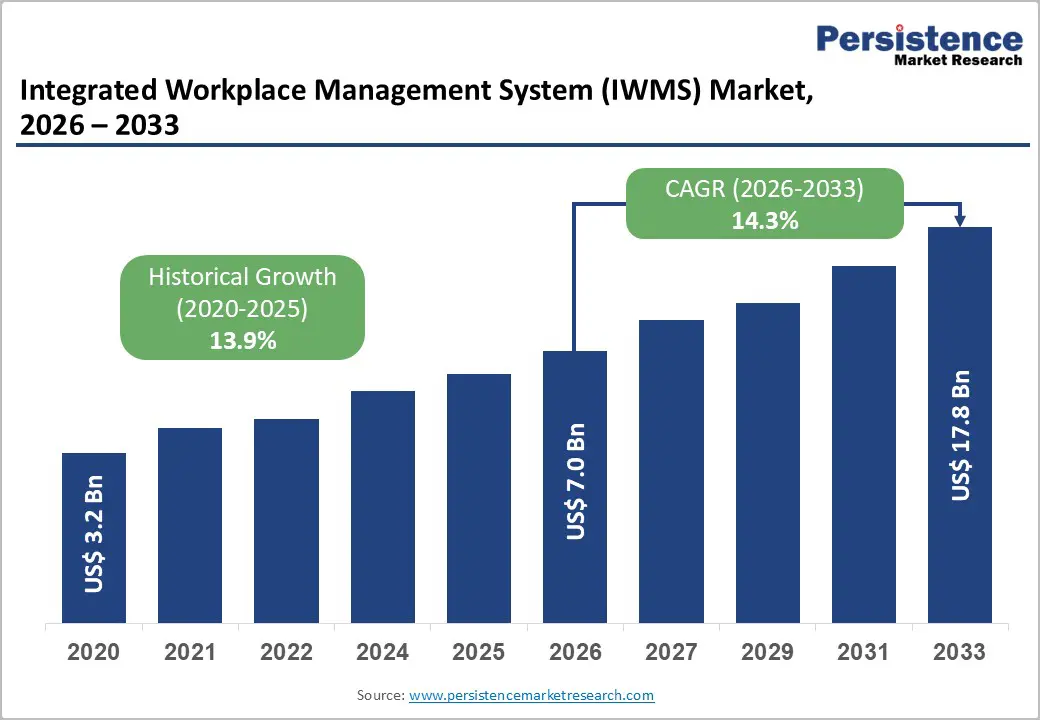
The global integrated workplace management system (IWMS) market size is likely to be valued at US$7.0 billion in 2026 and is expected to reach US$17.8 billion by 2033, growing at a CAGR of 14.3% during the forecast period from 2026 to 2033, driven by accelerated digital transformation across enterprises. Key growth drivers include the rapid shift toward cloud-based IWMS platforms, which offer scalability, remote accessibility, and lower upfront IT costs.
The integration of IoT, AI, and advanced analytics is enabling real-time monitoring of assets, predictive maintenance, space optimization, and energy efficiency. The rising focus on sustainability, ESG reporting, and regulatory compliance is driving adoption, particularly among large enterprises. Post-pandemic workplace transformation, including hybrid work models and flexible space management, has also increased the strategic importance of IWMS solutions in enhancing employee experience, productivity, and operational resilience.
Key Industry Highlights:
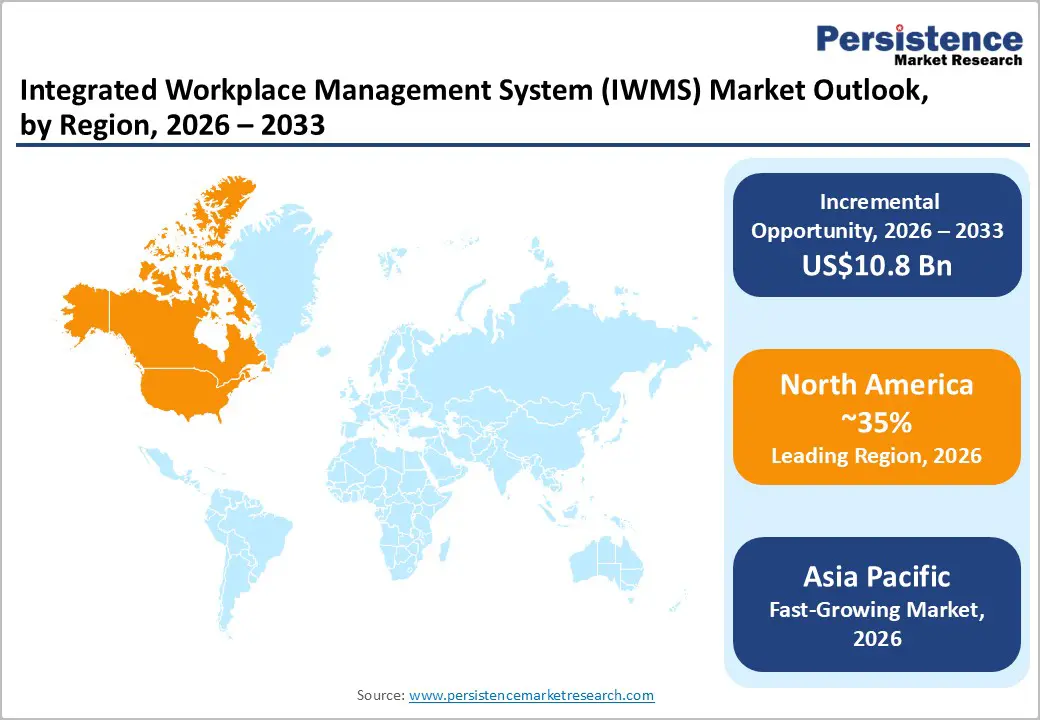
- Leading Region: North America is anticipated to be the leading region, accounting for 35% market share in 2026, driven by U.S. leadership in smart buildings, strong ESG-focused regulations, and advanced adoption of cloud, IoT, and AI-enabled workplace solutions.
- Fastest-growing Region: Asia Pacific is likely to be the fastest-growing region for integrated workplace management systems (IWMS) in 2026, supported by rapid urbanization, smart city initiatives, and strong manufacturing and real estate growth across China, India, Japan, and the ASEAN economies.
- Leading Organization Size Type: Large enterprises are projected to lead in 2026, accounting for 67.5% of revenue share, driven by their complex portfolios, compliance requirements, and budgets for full-suite IWMS deployments across multiple sites.
- Leading End-user: The BFSI (Banking, Financial Services, and Insurance) segment is anticipated to be the leading end-user, accounting for over 45% of revenue in 2026, driven by extensive facility portfolios, regulatory compliance requirements, and the need for efficient asset tracking and management.
| Key Insights | Details |
|---|---|
|
Integrated Workplace Management System (IWMS) Market Size (2026E) |
US$7.0 Bn |
|
Market Value Forecast (2033F) |
US$17.8 Bn |
|
Projected Growth (CAGR 2026 to 2033) |
14.3% |
|
Historical Market Growth (CAGR 2020 to 2025) |
13.9% |
Market Factors - Growth, Barriers, and Opportunity Analysis
Increasing Adoption of Cloud-Based and IoT-Integrated Solutions
Cloud deployment eliminates the need for heavy on-premises IT infrastructure, reducing upfront capital expenditure while enabling remote access and real-time collaboration across multiple locations. Large enterprises benefit from centralized visibility into global operations, while small and medium enterprises (SMEs) leverage cloud solutions for affordable and easily deployable tools. Cloud-based IWMS also allows for automatic updates, seamless integration with enterprise resource planning (ERP) systems, and enhanced data security through advanced encryption and compliance features. The hybrid work models post-pandemic reinforce the need for cloud platforms, enabling organizations to efficiently manage desk booking, occupancy, and space utilization across distributed teams.
The integration of IoT (Internet of Things) and AI with IWMS solutions enhances operational efficiency and workplace intelligence. IoT-enabled sensors and smart devices provide real-time monitoring of space utilization, environmental conditions, energy consumption, and asset performance. Predictive analytics powered by AI enables organizations to anticipate maintenance needs, optimize energy use, and improve the overall facility efficiency. Smart buildings leverage IoT to adjust lighting, heating, and cooling dynamically based on occupancy patterns, contributing to sustainability goals and cost reduction. IoT integration enables enhanced security and compliance monitoring, ensuring regulatory compliance.
Lack of Awareness and Skilled Personnel
Many small and medium enterprises (SMEs), as well as traditional businesses, continue to rely on manual processes or basic software for facility and real estate management. This limited awareness hinders the adoption of advanced IWMS solutions, as decision-makers may underestimate their potential to optimize space utilization, reduce operational costs, and enhance employee productivity. Organizations perceive implementing IWMS as a complex and costly process, especially for large-scale deployments across multiple sites. Without a proper understanding of cloud-based, AI-driven, and IoT-integrated capabilities, companies may delay investment or choose fragmented solutions, thereby reducing the overall effectiveness of workplace management.
The shortage of skilled personnel capable of effectively managing and operating IWMS platforms. These systems require trained staff to handle software configuration, data analytics, IoT device integration, and maintenance workflows. A lack of skilled professionals can lead to improper deployment, underutilization of features, and reduced return on investment for organizations. Industries such as manufacturing, BFSI, and healthcare, which have complex facility operations, face difficulty in hiring talent with combined knowledge of IT, facilities management, and data-driven decision-making. Rapid technological advancements in cloud computing, AI, and IoT demand continuous upskilling, but many companies struggle to provide it.
Technological Convergence with AI, IoT, and Sustainability Features
Artificial Intelligence (AI) enhances predictive analytics, enabling organizations to optimize space utilization, anticipate maintenance requirements, and automate routine facility management tasks. IoT devices, including smart sensors, beacons, and connected HVAC systems, provide real-time data on occupancy, energy usage, and environmental conditions. This convergence allows organizations to make data-driven decisions that reduce operational costs, improve workplace efficiency, and enhance employee experience. Large enterprises, in particular, benefit from integrated solutions that manage multiple facilities and geographies, while SMEs gain access to scalable, cloud-based AI and IoT functionalities.
The adoption of AI and IoT-enabled IWMS solutions facilitates the creation of smart, sustainable, and future-ready workplaces. By combining predictive maintenance, automated energy management, and intelligent space planning, organizations can improve operational continuity and reduce resource wastage. Smart buildings leverage IoT data to optimize lighting, heating, and cooling dynamically based on occupancy patterns, enhancing energy efficiency and employee comfort simultaneously. Sustainability features, such as carbon tracking, water management, and waste monitoring, strengthen corporate social responsibility initiatives. This convergence also opens avenues for vendors to develop value-added services, analytics dashboards, and mobile-enabled workplace management applications.
Category-wise Analysis
Organization Size Insights
Large enterprises are expected to lead the integrated workplace management system (IWMS) market, accounting for approximately 67.5% of revenue in 2026, driven by the complexity of managing multiple sites, global real estate portfolios, and stringent compliance requirements. These organizations typically have the financial capability to invest in full-suite IWMS deployments, enabling centralized management of real estate, facilities, and assets across geographies. For example, IBM Corporation uses IWMS solutions to manage its extensive global office network and data centers, optimizing space utilization, enabling predictive maintenance, and improving energy efficiency. Large enterprises benefit from advanced analytics, cloud integration, and AI-driven insights to improve operational efficiency and support hybrid work models.
Small & medium enterprises (SMEs) are likely to be the fastest-growing segment in 2026, driven by increasing digital adoption and the availability of affordable, cloud-based solutions. SMEs often operate with limited IT resources and budgets, making flexible subscription-based IWMS platforms particularly attractive. Cloud-based deployment reduces upfront infrastructure costs while providing access to advanced features such as asset tracking, occupancy analytics, and space optimization. For example, Accruent’s cloud IWMS solutions allow SMEs to manage facilities efficiently across multiple locations without investing in heavy IT infrastructure. Organizations expand operations, and SMEs increasingly adopt IWMS platforms to improve operational efficiency, optimize resources, and ensure compliance with local regulations.
End-user Insights
The BFSI segment is projected to lead the market, capturing around 45% of the total revenue share in 2026, driven by its extensive facility portfolios and regulatory compliance requirements. Manufacturing companies use IWMS to manage complex production sites, optimize energy consumption, and implement predictive maintenance of critical equipment. For example, Siemens leverages IWMS solutions across its global manufacturing facilities to streamline space management, reduce operational costs, and enhance equipment uptime. BFSI organizations adopt IWMS for large corporate offices and branch networks to monitor occupancy, track assets, and comply with strict security and financial regulations.
The healthcare segment is likely to be the fastest-growing end-user in 2026, driven by increasing demand for efficient space utilization, enhanced patient experience, and strict regulatory compliance in facility operations. Hospitals and medical centers adopt IWMS solutions to optimize operating rooms, patient rooms, and administrative spaces, while also ensuring compliance with health and safety regulations. For example, Mayo Clinic utilizes IWMS platforms to monitor occupancy, manage preventive maintenance, and improve energy efficiency across its hospital network. The adoption of IoT-enabled devices, AI-based analytics, and cloud platforms helps healthcare organizations streamline operations, reduce costs, and improve service quality.
Regional Insights
North America Integrated Workplace Management System (IWMS) Market Trends
North America is anticipated to be the leading region, accounting for a market share of 35% in 2026, driven by advanced technological adoption, regulatory compliance requirements, and a strong innovation ecosystem. Organizations in the U.S. are increasingly implementing smart building solutions that integrate IoT, AI, and cloud-based IWMS platforms to optimize facility operations, energy consumption, and space utilization. Key trends include the rise of hybrid work models, which necessitate flexible desk booking, occupancy tracking, and collaborative workspace management. The emphasis on sustainability and ESG compliance is also influencing adoption, as companies leverage IWMS solutions to monitor carbon footprints, energy efficiency, and waste reduction across office buildings and industrial facilities.
Companies are actively adopting these technologies to enhance operational efficiency. For example, SAP SE deployed its cloud-based IWMS solutions across multiple corporate offices in North America, enabling real-time space and asset management, predictive maintenance, and energy optimization. The integration of IoT sensors and AI analytics allows organizations to monitor occupancy patterns, adjust HVAC and lighting dynamically, and improve employee experience. The use of cloud platforms facilitates seamless data sharing, centralized reporting, and multi-site coordination, which is critical for large enterprises and government institutions managing complex infrastructure.
Europe Integrated Workplace Management System (IWMS) Market Trends
Europe is likely to be a significant market for integrated workplace management systems (IWMS) in 2026, due to stringent sustainability regulations, strong corporate commitments to energy performance, and the rapid digitization of facility and real estate operations. European companies are increasingly deploying cloud-based IWMS platforms integrated with IoT sensors and analytics to monitor energy usage, track occupancy, and optimize maintenance and space planning across corporate offices, industrial sites, and public buildings. Regulatory frameworks such as the EU’s corporate sustainability reporting requirements and energy efficiency directives are key factors driving this adoption, as they push organizations to collect and report detailed operational data that IWMS can provide.
Vendors in the region are enhancing platforms with mobile access, predictive maintenance modules, and sustainability dashboards to align with these needs. European IWMS deployments are especially high in Germany, the U.K., and France, where environmental performance metrics are increasingly tied to compliance reporting and operational optimization. A European company driving innovation in IWMS is Planon, a Netherlands-based provider of integrated workplace and facility management software. Planon’s IWMS platform leverages real-time IoT data for monitoring space utilization and energy consumption, helping organizations comply with EU environmental regulations while enhancing workplace efficiency.
Asia Pacific Integrated Workplace Management System (IWMS) Market Trends
The Asia Pacific region is likely to be the fastest-growing region in 2026, driven by rapid urbanization, increasing industrialization, and significant investments in digital infrastructure across key economies such as China, India, Japan, and Southeast Asian nations. Organizations are increasingly adopting IWMS platforms to support digital transformation, streamline facility and real estate operations, and optimize space utilization amid expanding corporate portfolios and infrastructure projects. The proliferation of cloud computing and improved network infrastructure in the region facilitates scalable and cost-effective IWMS deployment, enabling real-time integration of IoT sensors for occupancy monitoring and energy management.
Enterprises across sectors, including manufacturing, BFSI, telecommunications, and healthcare, are leveraging IWMS tools to manage hybrid work models and comply with regional regulatory requirements. For example, IWMS adoption in the Asia Pacific is eFACiLiTY® by SIERRA, an IWMS and CAFM software used by organizations in India and Malaysia for integrated facility management and workplace optimization. This platform enables companies to centralize real estate, maintenance, and space planning data, improving decision-making and operational efficiency across multiple sites. The solution’s capabilities in asset tracking, preventive maintenance scheduling, and energy monitoring support the region’s push toward smart, sustainable workplaces, while showcasing how localized IWMS offerings are gaining traction alongside vendors.
Competitive Landscape
The global integrated workplace management system (IWMS) market exhibits a moderately fragmented structure, driven by a mix of large enterprise software vendors, specialized proptech providers, and emerging cloud-native challengers competing for market share across industries and geographies. Established players such as IBM, Oracle, SAP SE, Planon, and Accruent offer comprehensive platforms that integrate real-time facility analytics, space optimization, and sustainability reporting, catering especially to large enterprises and multinational corporations with complex workplace portfolios.
With key leaders including IBM and Oracle alongside fast-growing vendors such as ServiceNow, Nuvolo, and Facilio, the competitive landscape is shaped by differentiated strategies and evolving customer demands. IBM’s TRIRIGA platform continues to lead through integration with hybrid cloud services and advanced analytics, while Oracle focuses on seamless connectivity with its enterprise software ecosystem to deliver enhanced operational visibility and automation. These players compete through continuous innovation, strategic acquisitions, partnerships, and the expansion of sales channels to address growing demand for scalable, sustainable, and AI-enabled workplace technologies.
Key Industry Developments:
- In January 2025, Service Now Inc., a leader in AI-driven enterprise platforms, announced a strategic integration with Oracle to strengthen its Workflow Data Fabric capabilities. The collaboration enables real-time, zero-copy data sharing between Oracle’s Autonomous Database and ServiceNow’s platform, connecting transactional, analytical, and unstructured data across enterprises. This integration aims to enhance AI-powered insights, operational efficiency, and decision-making at scale, while leveraging Oracle’s automated threat detection to strengthen security. The partnership is expected to reduce time-to-action and boost operational agility for enterprise customers.
- In October 2024, Nakisa, a leader in cloud-native enterprise software, launched its next-generation Integrated Workplace Management System (IWMS) Product Portfolio at Nakisa Week 2024. The new portfolio is designed for large enterprises seeking fully cloud-native solutions to manage real estate portfolios, capital projects, facilities, and workplace operations. The platform bridges financial and operational data, providing real-time insights into portfolio management, facility operations, energy efficiency, and sustainability initiatives, while enabling significant cost savings.
Companies Covered in Integrated Workplace Management System (IWMS) Market
- IBM Corporation
- SAP SE
- Trimble Inc.
- Nemetschek Group
- Accruent
- FM:Systems
- MRI Software LLC
- Planon
Frequently Asked Questions
The global integrated workplace management system (IWMS) market is projected to reach US$ 7.0 billion in 2026.
The integrated workplace management system (IWMS) market is driven by the increasing demand for cloud-based solutions that leverage AI and IoT to optimize space utilization, lower operational costs, support hybrid work models, and ensure sustainability and regulatory compliance.
The integrated workplace management system (IWMS) market is expected to grow at a CAGR of 14.3% from 2026 to 2033.
Key market opportunities include AI- and IoT-powered smart building solutions, increased cloud adoption by SMEs, sustainability management driven by ESG goals, and rapid growth in emerging markets.
IBM Corporation, SAP SE, Trimble Inc., Nemetschek Group, and Accruent are the leading players.


