




- Industrial Goods & Service
- Industrial Disconnect Switch Market
Industrial Disconnect Switch Market Size, Share, and Growth Forecast, 2026 - 2033
Industrial Disconnect Switch Market by Voltage Rating (Low Voltage, High Voltage, Others), Mounting Type (Panel Mounted, DIN Rail, Others), Fuse Type, Application, and Regional Analysis for 2026 - 2033

Industrial Disconnect Switch Market Size and Trends Analysis
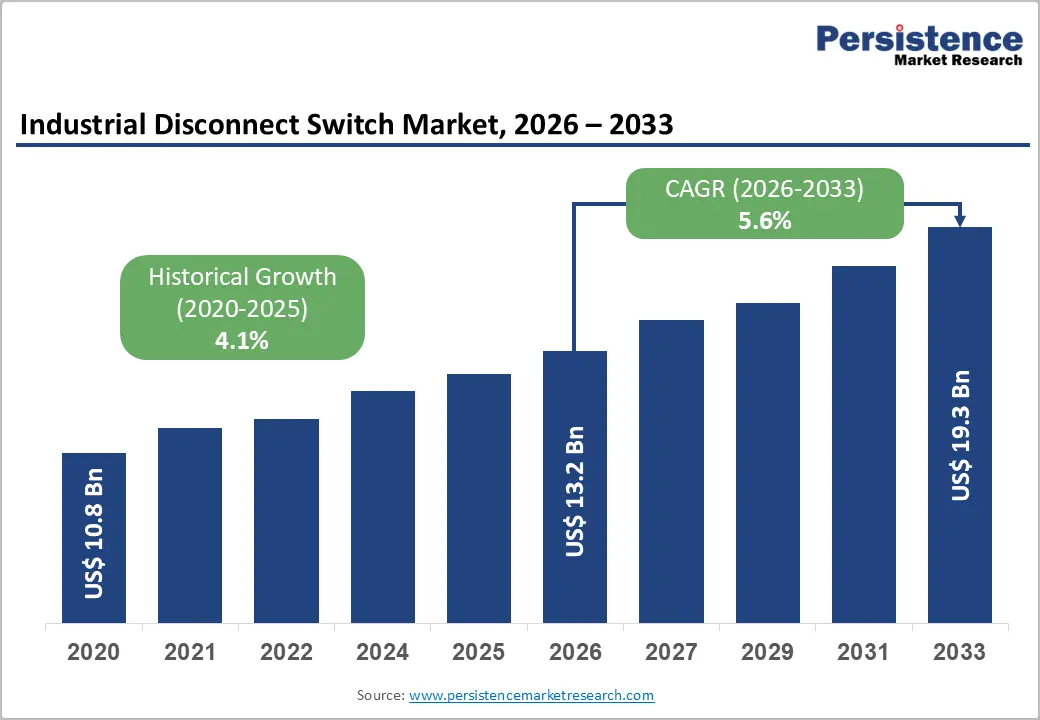
The global industrial disconnect switch market size is likely to be valued at US$13.2 billion in 2026 and is expected to reach US$19.3 billion by 2033, growing at a CAGR of 5.6% between 2026 and 2033, driven by industrial electrification, grid modernization, and stricter enforcement of electrical safety standards. Rising electricity demand and sustained infrastructure investment are increasing the number of circuits requiring safe isolation, positioning disconnect switches as essential components in power distribution systems.
Key Industry Highlights:
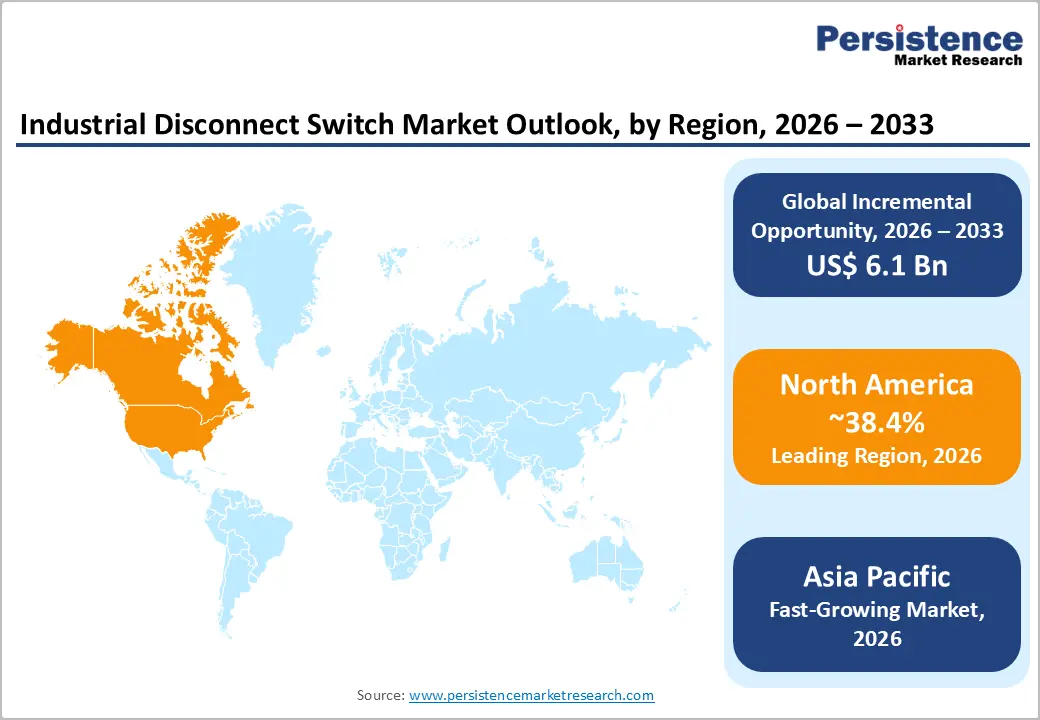
- Leading Region: North America is projected to account for approximately 38.4% of the market share, supported by strong regulatory enforcement, a mature industrial base, and high replacement demand.
- Fastest-growing Region: Asia Pacific is the fastest-growing region, driven by rapid industrialization and infrastructure expansion, with growth significantly outpacing the global average due to rising electricity demand in China, India, and Southeast Asia.
- Investment Plans: Global investments in grid modernization and renewable energy infrastructure are exceeding USD1.5 trillion annually in the electricity sector, directly supporting increased deployment of disconnect switches across power and industrial applications.
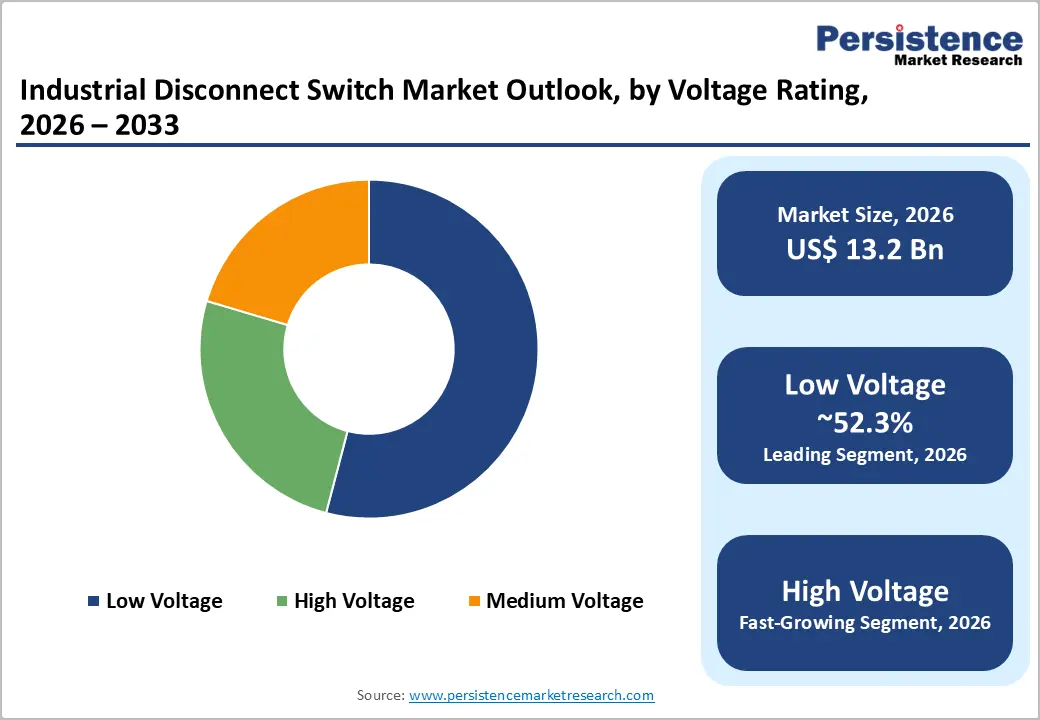
- Dominant Voltage Rating: Low-voltage disconnect switches dominate the market, anticipated to account for approximately 52.3% of market share, due to their widespread use in industrial panels, buildings, and motor control systems.
- Leading Mounting Type: Panel-mounted disconnect switches hold the leading position with approximately 57.2% market share, driven by their extensive use in control cabinets, switchboards, and industrial electrical panels.
| Key Insights | Details |
|---|---|
| Industrial Disconnect Switch Market Size (2026E) | US$13.2 Bn |
| Market Value Forecast (2033F) | US$19.3 Bn |
| Projected Growth (CAGR 2026 to 2033) | 5.6% |
| Historical Market Growth (CAGR 2020 to 2025) | 4.1% |
Market Factors - Driver, Restraint, and Opportunity Analysis
Driver Analysis - Electrification, Grid Expansion, and Rising Switchgear Demand
Global electrification trends across the industrial, transportation, and building sectors are significantly increasing the need for reliable power distribution infrastructure. Investments in renewable energy, grid modernization, and energy storage systems are accelerating, leading to higher deployment of switchgear components, including disconnect switches. As industrial facilities expand capacity and utilities upgrade transmission and distribution networks, the number of electrical circuits requiring isolation rises proportionally. This directly increases demand for disconnect switches across substations, renewable installations, and industrial control systems, making them critical to ensuring operational safety and system reliability.
Stringent Safety Regulations and Compliance Requirements
Electrical safety regulations mandate the use of disconnect switches to isolate hazardous energy during maintenance and emergencies. Standards such as lockout/tagout procedures and electrical safety codes require facilities to implement reliable isolation mechanisms. Industries including manufacturing, oil & gas, chemicals, and food processing rely heavily on these devices to maintain compliance and reduce workplace risks. This regulatory-driven demand creates a stable replacement cycle, as companies must regularly upgrade or replace equipment to meet evolving safety standards. Compliance-related purchases are less sensitive to economic fluctuations, supporting consistent market growth.
Industrial Automation and Modular System Integration
The increasing adoption of industrial automation and modular electrical systems is reshaping demand patterns for disconnect switches. Modern manufacturing facilities require compact, standardized, and flexible components that can integrate seamlessly into control panels and distributed systems. The shift toward modular panel designs, DIN rail configurations, and remote-controlled operations is driving innovation in disconnect switch technologies. Automation-driven environments require reliable isolation solutions that support high uptime and minimal maintenance interruptions, strengthening the role of advanced disconnect switches in next-generation industrial infrastructure.
Restraint Analysis - High Upfront Costs for Advanced Configurations
Fused, enclosed, and high-voltage disconnect switches involve higher material costs, engineering complexity, and certification requirements compared to basic isolation devices. These cost factors increase the overall capital expenditure for industrial projects, particularly in price-sensitive markets. Small and medium-sized enterprises may delay upgrades or opt for lower-cost alternatives where regulations permit. This cost sensitivity can limit the adoption of advanced or premium disconnect solutions, especially in emerging markets with constrained budgets.
Standards Fragmentation and Certification Complexity
The industrial disconnect switch market operates across multiple regional and international standards, including UL, IEC, and other national certifications. Manufacturers must design and test products to meet diverse regulatory requirements, increasing development costs and time-to-market. For global OEMs and panel builders, managing compliance across different regions adds engineering complexity and supply chain challenges. This fragmentation slows standardization and reduces economies of scale, creating barriers to streamlined product deployment.
Opportunity Analysis - Growth in Renewable Energy and High-Voltage Applications
The expansion of renewable energy, particularly utility-scale solar and wind projects, is creating strong demand for high-voltage disconnect switches. These applications require specialized isolation solutions capable of handling higher voltages, fluctuating loads, and harsh environmental conditions while ensuring system safety and reliability. As energy systems transition toward higher efficiency and lower transmission losses, developers are increasingly adopting higher-voltage architectures, which directly increase the technical requirements for switching components. Disconnect switches are becoming critical in solar combiner boxes, inverter systems, and grid interconnection points. This shift is not only increasing demand volume but also elevating product value, as high-voltage solutions typically command higher margins due to their engineering complexity and certification requirements. Furthermore, the global push toward decarbonization is accelerating renewable capacity additions, leading to a sustained pipeline of large-scale energy projects. These projects require long-term, durable electrical components, creating recurring demand for advanced disconnect technologies. Manufacturers that can deliver high-performance, certified solutions for renewable infrastructure are well-positioned to capture premium segments of the market.
Rapid Industrialization and Infrastructure Development in Asia Pacific
Asia Pacific offers significant growth potential due to expanding industrial capacity, urbanization, and large-scale infrastructure investments. Countries such as China and India are witnessing rapid increases in electricity demand, driven by manufacturing expansion, population growth, and urban development. This is prompting substantial investments in power generation, transmission, and distribution networks, all of which require reliable isolation equipment. Disconnect switches are widely used in industrial plants, substations, and commercial infrastructure, making them integral to regional electrification efforts. The development of manufacturing hubs, smart cities, and industrial corridors is further strengthening demand for electrical components. Governments across the region are also promoting domestic manufacturing through policy incentives, encouraging localization of production and supply chains. This creates a dual opportunity for market players: capturing high-volume demand while establishing localized manufacturing and distribution capabilities. As infrastructure projects scale up, the need for standardized, cost-effective, and durable disconnect solutions continues to grow, reinforcing Asia Pacific’s position as the fastest-growing regional market.
Adoption of Smart and Automated Switching Solutions
The integration of automation and digital monitoring systems is transforming the role of disconnect switches from passive safety devices to active components within intelligent power systems. Motor-operated and automatic disconnect switches enable remote operation, reducing the need for manual intervention and enhancing worker safety in hazardous environments. These solutions are increasingly integrated with industrial control systems and energy management platforms, allowing real-time monitoring, diagnostics, and predictive maintenance. Industries with critical power requirements, such as data centers, utilities, and advanced manufacturing, are prioritizing automated switching solutions to ensure uninterrupted operations and minimize downtime. The growing adoption of Industry 4.0 practices is further accelerating this trend, as facilities seek greater visibility and control over electrical assets. This evolution is creating a high-value segment within the market, where disconnect switches are no longer standalone devices but part of a connected, data-driven ecosystem. Manufacturers that invest in smart features, interoperability, and digital integration are likely to gain a competitive advantage in this emerging segment.
Category-wise Analysis
Voltage Rating Insights
Low-voltage disconnect switches are anticipated to account for approximately 52.3% of market revenue in 2026, maintaining their position as the dominant segment throughout the forecast period. This leadership is driven by their extensive use across industrial panels, motor control centers, HVAC systems, and building electrical distribution networks. These applications require multiple isolation points to ensure safe maintenance and operational continuity, which results in consistently high unit demand. Low-voltage switches are also easier to install, cost-effective, and compatible with existing electrical infrastructure, making them the preferred choice for both new installations and retrofit projects. In practical terms, low-voltage disconnect switches are widely used in manufacturing plants for isolating conveyor systems, pumps, and motors, as well as in commercial buildings for managing electrical loads in lighting and HVAC systems. Their versatility and widespread applicability ensure a stable and recurring demand base, particularly in sectors with high equipment density and frequent maintenance cycles.
High-voltage disconnect switches are anticipated to be the fastest-growing segment, driven by increasing investments in power transmission, renewable energy, and large-scale infrastructure projects. These applications require robust isolation solutions capable of handling higher electrical loads, ensuring safety in high-capacity systems such as substations, wind farms, and utility-scale solar installations. The global transition toward renewable energy is accelerating the deployment of high-voltage systems to improve transmission efficiency and reduce energy losses. For example, disconnect switches are critical in solar farms for isolating inverter blocks and grid connections, while in wind energy systems, they are used to safely disconnect turbines during maintenance. This segment benefits from higher value per unit and growing adoption in energy-intensive applications, making it a key contributor to overall market value growth despite lower unit volumes compared to low-voltage products.
Mounting Type Insights
Panel-mounted disconnect switches are anticipated to hold approximately 57.2% of the market share in 2026, making them the leading mounting type across industrial and commercial applications. Their dominance is attributed to their integration within electrical panels, control cabinets, and switchboards, where accessibility, safety, and space optimization are critical. These switches are designed to provide clear visibility and easy manual operation, often featuring door interlocking mechanisms that enhance operator safety. In industrial environments, panel-mounted disconnect switches are commonly used in motor control centers and process automation systems, where they enable safe isolation of machinery such as compressors, conveyors, and assembly lines. In commercial buildings, they are installed in distribution boards to manage electrical circuits efficiently. Their compatibility with standardized panel designs and widespread use in OEM equipment reinforces their continued leadership in the market.
DIN rail-mounted disconnect switches are anticipated to be the fastest-growing segment, supported by the increasing adoption of modular, compact, and flexible electrical systems. These switches are designed for quick installation on standardized DIN rails, significantly reducing assembly time and simplifying maintenance processes. Their compact form factor makes them particularly suitable for modern control panels where space constraints and scalability are important considerations. DIN rail-mounted switches are widely used in automated production lines, robotics systems, and smart building applications, where modularity and rapid system reconfiguration are essential. For instance, in industrial automation setups, DIN rail components allow engineers to easily add or replace modules without redesigning the entire panel. This mounting type aligns with the shift toward modular engineering and Industry 4.0 practices, driving its accelerated adoption across advanced industrial and commercial environments.
Regional Insights
North America Industrial Disconnect Switch Market Trends - Compliance-Driven Demand with Data Center Expansion and Smart Switch Integration
North America is projected to lead with approximately 38.4% of market share in 2026, supported by a well-established industrial base and a strict regulatory framework. The U.S. dominates the regional market due to strong enforcement of electrical safety standards and widespread adoption of advanced industrial technologies. The region continues to benefit from ongoing investments in grid modernization, renewable energy, and large-scale data center infrastructure, particularly across states such as Texas and California. These developments are increasing the number of electrical nodes requiring reliable isolation, directly supporting demand for disconnect switches.
Regulatory compliance plays a central role in market growth, as industries must adhere to stringent safety standards governing electrical systems. This drives consistent demand for disconnect switches in both new installations and retrofit projects. Companies such as Eaton Corporation and Rockwell Automation have expanded their low-voltage and heavy-duty disconnect switch portfolios in North America, focusing on UL-certified and safety-enhanced designs. These product developments are enabling industrial users to upgrade legacy systems while maintaining compliance with evolving standards. The presence of leading manufacturers, strong distribution networks, and a large installed base ensures a steady replacement-driven market.
Innovation is another key factor shaping the region. Companies like Schneider Electric are integrating digital monitoring and remote operation capabilities into switchgear solutions, aligning with the broader shift toward smart manufacturing and connected infrastructure. The rapid expansion of hyperscale data centers by companies such as Amazon Web Services and Microsoft is also increasing demand for high-reliability electrical components, including disconnect switches. North America’s market is characterized by high replacement rates, strong compliance-driven demand, and continuous innovation in safety and digital integration.
Europe Industrial Disconnect Switch Market Trends-Energy Efficiency Focus with Modular, Standardized Disconnect Solutions
Europe represents a significant market driven by regulatory harmonization and a strong focus on energy efficiency and sustainability. Key countries such as Germany, the U.K., France, and Spain contribute substantially to regional demand due to their advanced industrial sectors and commitment to renewable energy expansion. The region’s push toward decarbonization is accelerating investments in wind, solar, and energy storage projects, all of which require reliable electrical isolation systems.
The regulatory environment encourages the use of certified and standardized electrical components, which supports consistent demand for disconnect switches across industrial and commercial applications. Companies such as ABB Ltd. and Siemens AG have introduced energy-efficient and compact switch-disconnector solutions tailored to European standards, improving performance while reducing energy losses. These innovations align with regional goals of improving energy efficiency across industrial operations.
European manufacturers emphasize compact, modular designs that support space optimization and ease of installation. Firms such as Legrand and Hager Group continue to expand their modular switchgear portfolios for residential, commercial, and industrial applications. Investment in industrial automation and smart infrastructure, particularly in Germany’s manufacturing sector, is further supporting market growth. Europe’s market remains highly specification-driven, where compliance, performance efficiency, and sustainability requirements strongly influence purchasing decisions.
Asia Pacific Industrial Disconnect Switch Market Trends - Rapid Industrialization and Renewable Expansion Driving High-Volume Demand
Asia Pacific is the fastest-growing region, driven by rapid industrialization, urbanization, and expanding energy demand. Countries such as China, India, Japan, and Southeast Asian economies are investing heavily in power infrastructure and manufacturing capacity. Rising electricity consumption is prompting large-scale investments in generation, transmission, and distribution networks, which significantly increases the need for disconnect switches across utility and industrial applications.
The growth of renewable energy projects is also accelerating demand for advanced disconnect solutions. China continues to lead global solar and wind capacity additions, while India is rapidly expanding its renewable energy portfolio through national initiatives. Companies such as Tata Power and Adani Green Energy are actively developing large-scale solar and wind projects, which require high-performance isolation systems. Global manufacturers such as Schneider Electric and ABB Ltd. are expanding manufacturing and R&D facilities in India and China to strengthen their regional presence and meet local demand.
Government initiatives supporting industrial development, such as “Make in India” and China’s manufacturing expansion strategies, are further boosting market growth. The rise of smart cities and industrial corridors is increasing the deployment of advanced electrical infrastructure, including automated and modular disconnect solutions. Asia Pacific offers strong growth potential through a combination of high-volume demand, cost-sensitive markets, and increasing adoption of advanced technologies, making it a key focus area for both global and regional players.
Competitive Landscape
The global industrial disconnect switch market is moderately fragmented, with several global and regional players competing across different segments. Leading companies hold significant market shares but face competition from specialized manufacturers offering region-specific solutions. Competitive positioning is influenced by product quality, certification capabilities, pricing strategies, and distribution networks. The market rewards companies that can balance global scale with local adaptability. Key players are focusing on product innovation, regional expansion, and compliance with global standards. Strategies include developing compact and energy-efficient solutions, integrating digital capabilities, and expanding distribution networks. Companies are also investing in localization and customization to meet region-specific requirements and strengthen their competitive positioning.
Key Industry Developments:
- In November 2025, ABB Ltd. announced the launch of its OT Plus switch-disconnector range, covering 16-160A applications, aimed at improving energy efficiency and installation flexibility in industrial and commercial power distribution systems, with up to 53% lower power losses.
- In December 2025, ABB Ltd. completed the acquisition of Gamesa Electric’s power electronics business, strengthening its capabilities in renewable energy systems, including solar inverters and wind converters, which are closely linked to high-voltage disconnect and switching applications.
Companies Covered in Industrial Disconnect Switch Market
- ABB Ltd.
- Schneider Electric SE
- Siemens AG
- Eaton Corporation plc
- Rockwell Automation, Inc.
- Socomec Group S.A.
- Legrand S.A.
- Hager Group
- Mitsubishi Electric Corporation
- Fuji Electric Co., Ltd.
- Littelfuse, Inc.
- Havells India Limited
- Larsen & Toubro Limited
- General Electric Company
- Lovato Electric S.p.A.
- WEG S.A.
Frequently Asked Questions
The global industrial disconnect switch market is estimated to be valued at US$13.2 billion in 2026.
The industrial disconnect switch market is projected to reach US$19.3 billion by 2033.
Key trends include the growing adoption of high-voltage disconnect switches for renewable energy projects, increasing demand for automated and motor-operated switching solutions, and the shift toward modular and DIN rail-based installations in industrial automation.
The low-voltage segment is the leading category, accounting for approximately 52.3% of the market share, driven by its extensive use in industrial panels and building electrical systems.
The industrial disconnect switch market is expected to grow at a CAGR of 5.6% from 2026 to 2033.
Some of the major players include ABB Ltd., Schneider Electric SE, Siemens AG, Eaton Corporation plc, and Rockwell Automation, Inc.


