




- Beverages
- India Alcohol Market
India Alcohol Market Size, Share, Growth, and Forecast, 2026 to 2033
India Alcohol Market by Product Type (Spirits, Beer, Wine), Disease Area (On-Trade, Off-Trade), Analysis from 2026 to 2033

India Alcohol Market Share and Trends Analysis
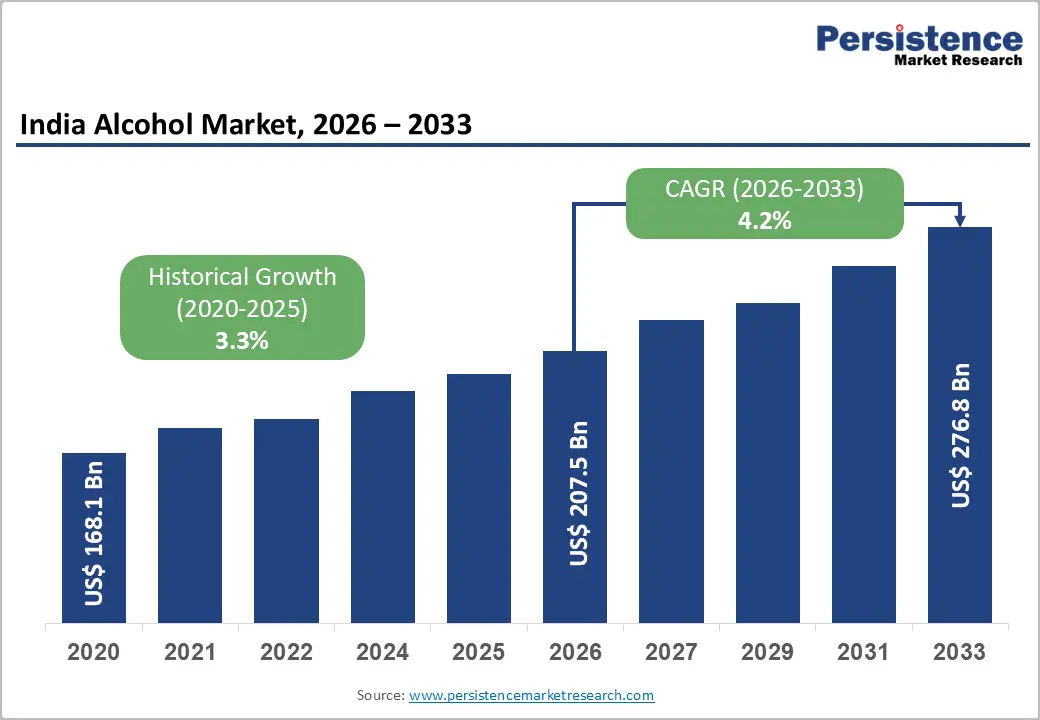
The India alcohol market is estimated to grow from US$ 207.5 billion in 2026 to US$ 276.8 billion by 2033. The market is projected to record a CAGR of 4.2% during the forecast period from 2026 to 2033, expanding steadily, driven by rising disposable incomes, urbanization, and shifting consumer lifestyles.
Premiumisation trends, increasing young adult consumption, and growth in organized retail and on-trade outlets support demand. State excise reforms and product innovation, including craft spirits and RTDs, further accelerate market development across urban and semi-urban regions.
Key Industry Highlights
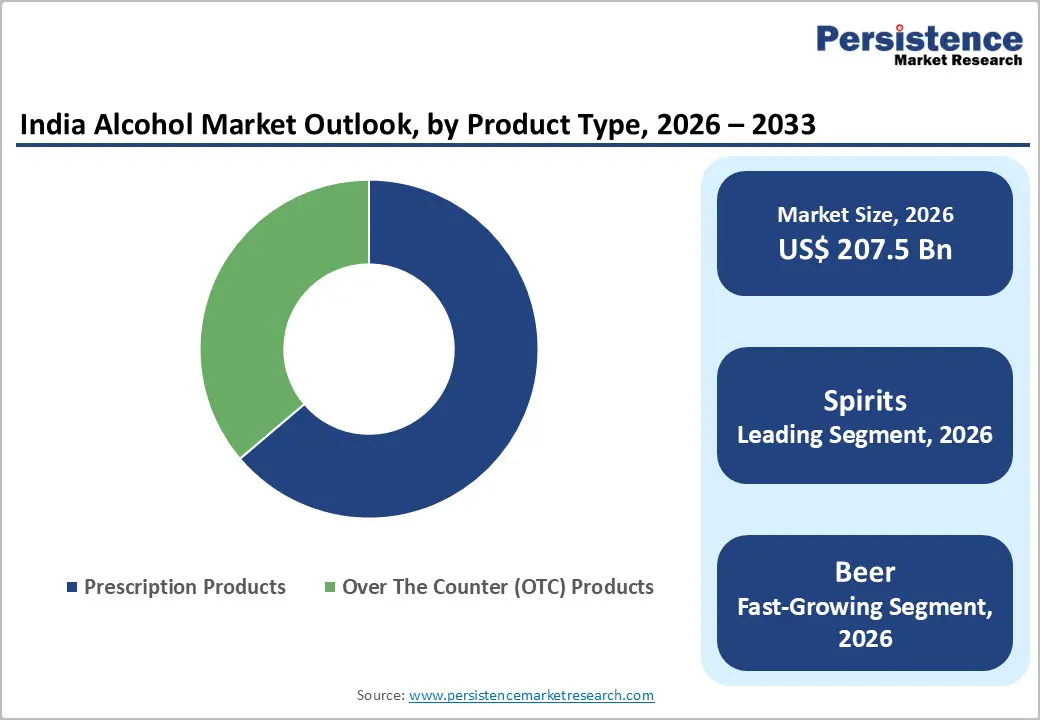
- Dominant Segment: Spirits account for approximately 74.2% share of India alcohol market in 2025, driven by strong demand for whisky and rum. Premiumisation trends, brand loyalty, and broad distribution through state retail networks support continued dominance in the beer and wine segments.
- Growth Indicators: Rising disposable incomes, rapid urbanization, an expanding middle-class population, a growing young-adult demographic, premium product launches, increasing on-trade outlets, evolving consumer preferences, and supportive state excise reforms are key factors driving market growth nationwide.
- Market Opportunity: Opportunities include growth of premium and craft spirits, expansion of ready-to-drink (RTD) beverages, rising demand for imported brands, digital-enabled retail and home delivery in permitted states, tourism-driven consumption, and strategic capacity expansion by domestic and multinational alcohol producers.
| Key Insights | Details |
|---|---|
| India Alcohol Market Size (2026E) | US$ 207.5 Bn |
| Market Value Forecast (2033F) | US$ 276.8 Bn |
| Projected Growth (CAGR 2026 to 2033) | 4.2% |
| Historical Market Growth (CAGR 2020 to 2025) | 3.3% |
Market Dynamics
Driver: Rising Disposable Incomes and Urbanization
Rapid economic growth and rising disposable incomes in India are key drivers boosting alcohol demand. India’s gross national disposable income (GNDI) has been growing strongly, from 169.6 trillion in FY2018 to INR305.9 trillion in FY2024, with projected continued increases as the economy expands. Higher GNDI directly correlates with greater consumer spending on discretionary categories like alcoholic beverages, especially premium spirits and craft products. Urbanisation reinforces this trend: projections indicate that by 2028, nearly 39% of India’s population will live in urban areas, where incomes and consumption patterns are above rural averages. Urban residents typically have higher per capita disposable income and spend more on lifestyle products, including alcoholic drinks.
Alcohol consumption patterns mirror this economic shift. Per capita pure alcohol consumption in India rose from 2.4 litres in 2005 to 5.7 litres by 2016, and is expected to increase to around 6.7 litres by 2030, reflecting growing consumer uptake as affordability improves. Young urban consumers, changing social norms, and higher purchasing power are expanding market segments such as premium spirits and ready-to-drink beverages. This increase in consumption is not only a function of population growth but also of the greater economic capacity of urban populations to purchase and consume alcohol.
Restraints: Strict State-Level Licensing and Taxation Policies
One of the primary restraints on the Indian Alcohol Market is the complex, restrictive, and highly variable state-level excise and licensing regime. Alcohol is outside the purview of the Goods and Services Tax (GST) in India and is instead taxed and regulated by individual states. This results in excise duty rates ranging from around 50% to over 200% of the base value, depending on the state and product type, combined with additional value-added tax (VAT), customs duties (for imports), license fees, and cesses. In many states, excise and related charges can constitute 60-75% of the final retail price of alcoholic products.
This fragmented taxation landscape creates high administrative barriers and cost impediments for producers, distributors, and consumers. Imported spirits, for example, attract both central customs duty (up to 150%) and high local excise taxes, inflating prices and reducing competitive parity with local brands. In some cases, differential levies at the state level have skewed market dynamics, such as reduced duty on BIO (imported bottled in origin) products compared with domestic Indian Made Foreign Liquor, leading to a surge in BIO sales from roughly 5,000 to 42,000 cases per month between 2021 and 2024 in Maharashtra, while premium domestic spirits growth slowed.
Beyond revenue concerns, the stringent licensing structure and frequent policy changes (excise duty hikes, reserved fees, and varied license conditions) can deter investment in new manufacturing facilities and complicated distribution planning. The high tax burden also constrains consumer affordability and drives some demand into informal or illicit markets, challenging regulation and revenue collection.
Opportunity: Growth of Premium, Craft, and Imported Spirits
The growth of premium, craft, and imported spirits represents a significant opportunity within India alcohol market as consumer preferences evolve with rising incomes and aspirational spending behaviour. Premium spirits, particularly Indian single malts and craft brands, are gaining traction among urban and affluent consumers who are willing to pay higher prices for differentiated products. Data indicate that demand for premium products in India is climbing, with overall alcohol consumption rising across key states; for instance, IMFL consumption reached over 32 crore cases in the first nine months of FY2025-26, signalling strong uptake across premium segments.
India’s market structure also favours diversification into higher-end categories; while overall per capita consumption remains lower than in many Western markets, it is rising steadily, and younger urban drinkers are increasingly open to premium, imported, and craft spirits. Global data also show India as one of the fastest-growing alcohol markets by volume, with total beverage alcohol consumption growing by ~7% in early 2025, a rate higher than many other major economies. This trend is driven by premiumisation and evolving taste preferences.
Category-wise Analysis
By Product Type Insights
In India, spirits overwhelmingly dominate overall alcohol consumption, accounting for roughly 74.2% of the market by value and more than 80% of total recorded pure-alcohol consumption, according to government-linked data and industry overviews. Spirits include Indian Made Foreign Liquor (IMFL), such as whisky, rum, vodka, and brandy, with whisky alone accounting for nearly two-thirds of all spirits sales in India. This dominance reflects long-standing cultural preferences; India is the largest whisky-consuming nation globally, and domestic spirits are deeply entrenched in both urban and semi-urban drinking patterns.
The historical and demographic context further reinforces the preference for spirits. Indian consumers have traditionally favoured higher-alcohol-strength beverages, which offer stronger perceived value per unit volume than beer or wine. Spirit consumption is also supported by extensive local production networks and lower distribution costs for domestic distillers, enabling greater availability across regional markets. Even though beer and wine show growth in urban centres, spirits remain the foundation of national alcohol consumption due to entrenched consumer behaviour and high per-adult preference.
By Distribution Channel Insights
In India’s alcohol distribution landscape, the off-trade channel (retail), including licensed liquor stores, state-run outlets, supermarkets, and retail shops, accounts for the vast majority of sales, typically around 85-90% of total alcohol volume. This pattern emerges because the majority of alcohol consumption occurs at home or through take-home purchases, driven by cultural consumption habits and pricing considerations, as opposed to on-trade settings such as bars and restaurants.
State excise structures and regulatory frameworks also amplify off-trade dominance. In many states, government corporations control wholesale and retail liquor distribution, channeling most alcohol through retail shelves, making off-trade the most accessible and widely used distribution channel. Even within spirit categories like whisky, around 84% of sales by value occur through retail outlets, underscoring the reliance on off-trade channels for mainstream alcohol purchasing. In contrast, on-trade channels remain significant primarily for premium imported spirits, but they represent a much smaller overall share due to licensing restrictions, higher costs, and limited hospitality penetration outside major urban centres.
Competitive Landscape
India's alcohol market is highly competitive, driven by domestic producers such as United Spirits, Radico Khaitan, and Allied Blenders, alongside multinational brands. Competition focuses on pricing, portfolio diversification, premium and craft offerings, regulatory compliance, localized production, and strategic distribution through retail, on-trade, and government-licensed procurement channels nationwide.
Key Developments:
- March 2026, Allied Blenders & Distillers acquired a 50% stake in Kion Blenders to expand production capacity and increase profitability. The deal enabled Allied Blenders to scale operations, enhance its product portfolio, and strengthen market presence, aiming to capture greater market share in the growing Indian alcoholic beverages sector.
- June 2025, Diageo India (United Spirits Ltd) acquired NAO Spirits, the maker of premium Indian craft gin brands ‘Greater Than’ and ‘Hapusa’. The acquisition strengthened Diageo’s presence in the fast-growing craft spirits segment, adding niche, high-quality gin offerings to its portfolio and enhancing its appeal to urban and premium consumers nationwide.
Companies Covered in India Alcohol Market
- United Spirits Ltd ( Diageo PLC)
- United Breweries Ltd
- Radico Khaitan Ltd
- Allied Blenders & Distillers Ltd
- Tilaknagar Industries Ltd
- Globus Spirits Ltd
- Som Distilleries & Breweries Ltd
- Sula Vineyards Ltd
- G M Breweries Ltd
- Associated Alcohols & Breweries Ltd
- Jagatjit Industries Ltd
- John Distilleries Pvt Ltd
- Pincon Spirit Ltd
- Pernod Ricard India
- Amrut Distilleries
- Grover Zampa Vineyards
- Fratelli Wines
- Others
Frequently Asked Questions
India alcohol market is projected to be valued at US$ 207.5 Bn in 2026.
Rising incomes, urbanization, premiumisation trends, young adult consumption, expanding retail and on-trade channels drive growth.
The India alcohol market is poised to witness a CAGR of 4.2% between 2026 and 2033.
Growth in premium spirits, craft beverages, RTDs, imported brands, digital retail, and tourism-driven consumption opportunities.
United Spirits Ltd (Diageo PLC), United Breweries Ltd , Radico Khaitan Ltd , Allied Blenders & Distillers Ltd , Tilaknagar Industries Ltd , Globus Spirits Ltd.


