




- Technology
- Image Tagging Market
Image Tagging Market Size, Share, and Growth Forecast, 2026 - 2033
Image Tagging Market by Tagging Method (Object Detection, Scene Recognition, Facial Recognition & Attributes, Activity/Action Recognition, Text/OCR Detection, Others), Technology (Manual Tagging, Semi-Automated Tagging, Fully Automated Tagging), Deployment (Cloud‑based, On‑premises, Hybrid), Industry and Regional Analysis for 2026 - 2033

Image Tagging Market Size and Trends
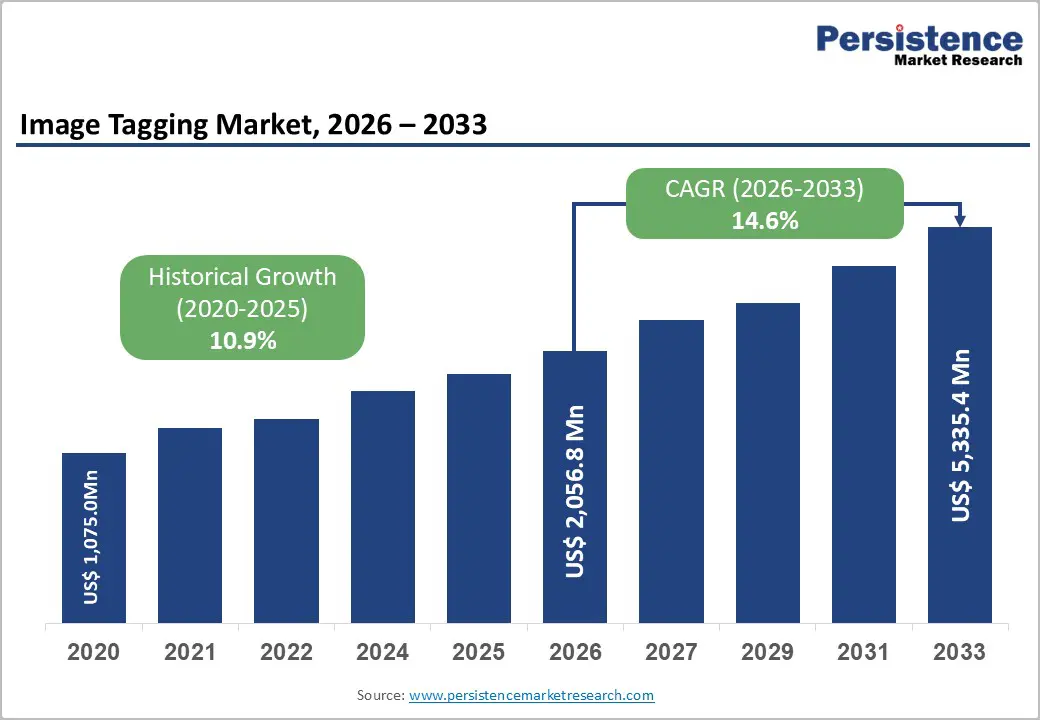
The global image tagging market size is projected to rise from US$2,056.8 million in 2026 to US$5,335.4 million by 2033. It is anticipated to witness a CAGR of 14.6% during the forecast period from 2026 to 2033, propelled by the exponential proliferation of artificial intelligence (AI) and machine learning (ML) applications across industries ranging from autonomous vehicles and healthcare diagnostics to retail e-commerce and defense, where accurately labeled visual data is foundational.
The convergence of deep learning architectures, particularly Convolutional Neural Networks (CNNs) and transformer-based vision models, has dramatically improved tagging accuracy and throughput, incentivizing large-scale enterprise adoption.
Key Industry Highlights:
- Leading Tagging Method: Object Detection dominates with over 30% market share in 2026, valued at more than US$ 617 Mn, driven by rising demand for precise object-level identification in AI training datasets across automotive, retail, and security applications. Activity/Action Recognition is the fastest growing, fueled by the increasing need for contextual behavioral insights in surveillance, healthcare, and sports analytics.
- Leading Technology: Fully Automated Tagging leads with over 54% share in 2026, valued at more than US$ 1,110.7 Mn, supported by strong demand for scalable, cost-efficient, and real-time annotation across large visual datasets. Semi-Automated Tagging is the fastest-growing, driven by the need for human validation in high-precision industries such as healthcare and legal applications.
- Leading Deployment: Cloud-based solutions command over 57% market share in 2026, valued at more than US$ 1,172.4 Mn, due to scalability, remote accessibility, and seamless integration with AI workflows. Hybrid deployment is the fastest-growing segment, expanding at a 20.1% CAGR as enterprises balance data security, compliance, and operational flexibility.
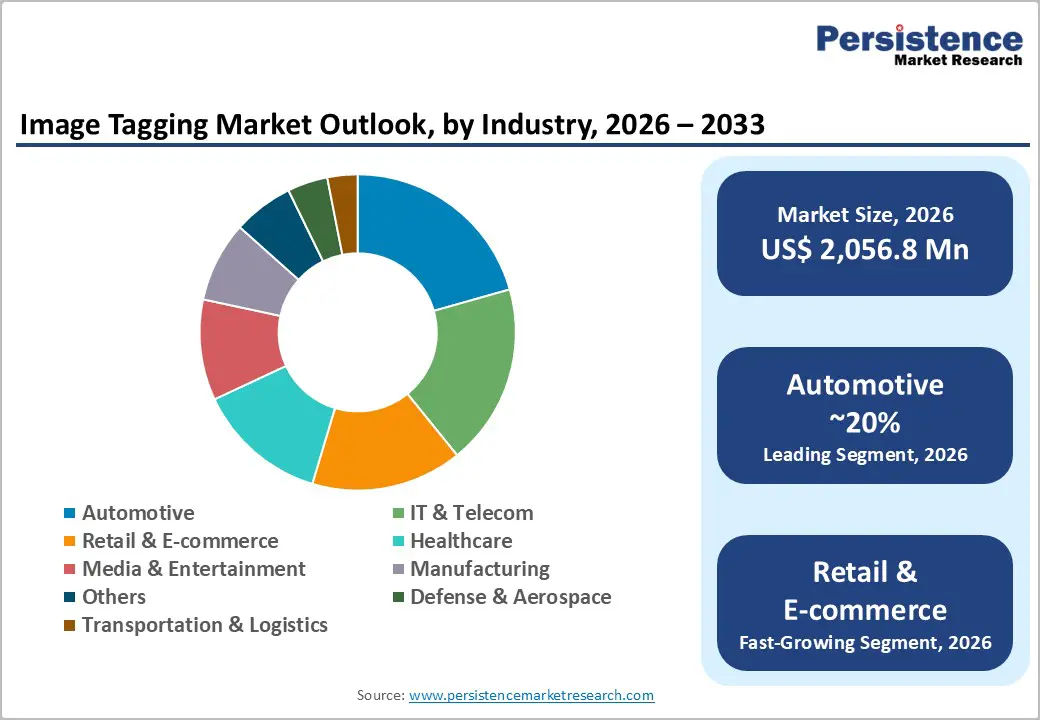
- Leading Industry: Automotive leads with over 20% market share in 2026, valued at more than US$ 411.4 Mn, driven by strong adoption in ADAS, autonomous driving systems, and AI-based perception models. Retail & E-commerce is the fastest-growing industry, fueled by the rapid expansion of visual search, personalized recommendations, and AI-driven product discovery.
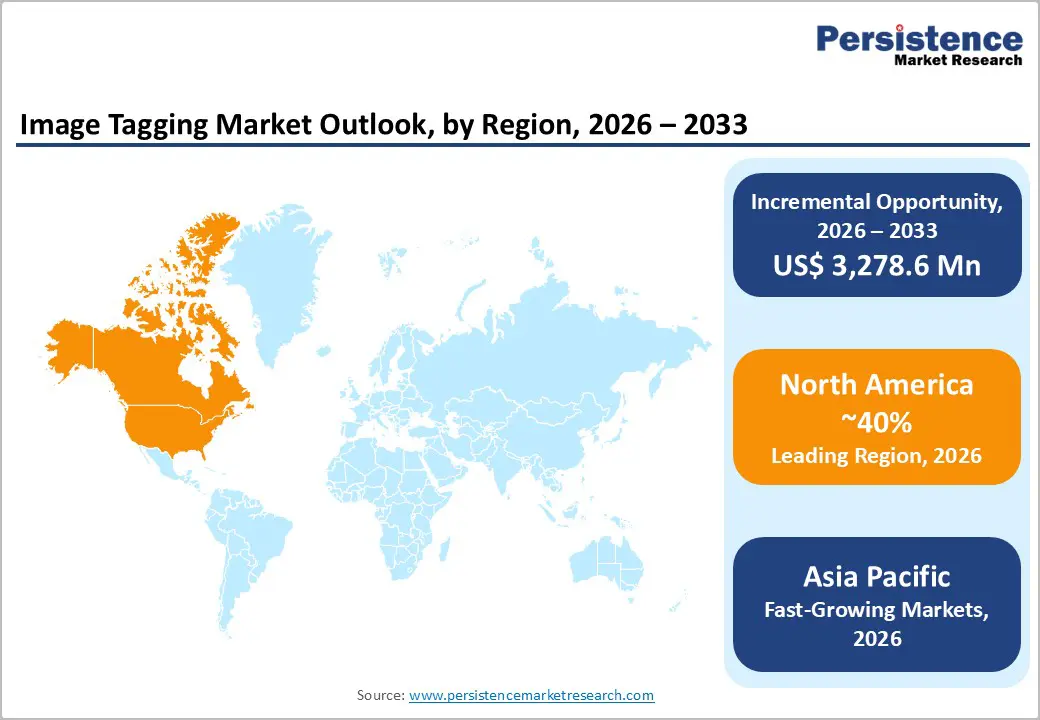
- Leading Region: North America leads with over 40% share in 2026, valued at approximately US$ 822.7 Mn, driven by a strong AI ecosystem, hyperscaler cloud infrastructure, and early enterprise adoption across key sectors. Asia Pacific is the fastest-growing region, registering a CAGR of 19.8%, supported by rapid digital transformation, large-scale government AI initiatives, and strong adoption of computer vision technologies.
| Key Insights | Details |
|---|---|
| Image Tagging Market Size (2026E) | US$2,056.8 Mn |
| Market Value Forecast (2033F) | US$5,335.4 Mn |
| Projected Growth (CAGR 2026 to 2033) | 14.6% |
| Historical Market Growth (CAGR 2020 to 2025) | 10.9% |
Market Dynamics
Driver - Growing Demand for High-Quality Labeled Data in AI Model Training
AI systems spanning autonomous vehicles, robotic manufacturing, and medical imaging grow increasingly complex, the requirement for precisely labeled visual data intensifies proportionally. The global data creation and replication will exceed 230-240 zettabytes by 2026, with unstructured visual content comprising a significant share. Autonomous vehicle manufacturers alone require millions of annotated frames to train perception systems capable of detecting pedestrians, road markings, and traffic signals with high confidence.
Healthcare AI applications demand meticulously tagged medical images for disease classification and diagnostic support. This structural need for high-volume, high-quality annotated imagery is expected to sustain robust demand across the image tagging ecosystem.
Rapid Integration of Computer Vision Across Industry Verticals
The broadening deployment of computer vision technology across verticals is amplifying the relevance of image tagging as an enabling infrastructure layer. In the retail segment, image tagging powers visual search engines, automated product cataloging, and personalized recommendation systems, thereby directly enhancing customer conversion rates. AI-driven personalization in retail lifts revenues by 10-15%, validating substantial enterprise investment.
The IT & Telecom sector, leveraging computer vision for network surveillance, content moderation, and smart infrastructure management, has emerged as the leading application domain of AI annotation demand. The cross-industry diffusion of these use cases underpins the market's structural growth trajectory.
Restraint - Stringent Data Privacy Regulations and Biometric Data Compliance Risks
The global regulatory landscape presents a formidable barrier, particularly for those operating in segments involving facial recognition and activity detection. The European Union's General Data Protection Regulation (GDPR) imposes strict requirements on the processing of biometric data, triggering mandatory Data Protection Impact Assessments (DPIAs) under Article 35 for high-risk AI visual systems. Since 2018, European authorities have issued cumulative GDPR fines totaling over €5.65 billion, with enforcement escalating sharply in 2025 alone, accounting for €2.3 billion in penalties.
Expanding privacy laws such as the EU AI Act (fully applicable by August 2026) and India's Digital Personal Data Protection Act further complicate cross-border data flows critical to cloud-based image tagging, potentially constraining vendor flexibility and significantly increasing compliance costs.
High Annotation Cost and Labor-Intensiveness of Ground-Truth Data Creation
Generating high-quality ground-truth datasets for training image tagging models remains resource-intensive and expensive. Industries requiring specialized labeling, such as radiology imaging or autonomous vehicle perception, demand expert-annotated datasets that are difficult to scale rapidly. Manual annotation still accounts for the dominant share of the data labeling market, and inconsistencies in annotation quality directly impair model accuracy. For small and mid-sized enterprises, the upfront capital needed for annotation infrastructure, human labelers, and quality assurance workflows presents a significant adoption barrier, slowing market penetration in emerging economies and cost-sensitive verticals.
Opportunity - Generative AI and Multimodal Foundation Models Enabling Next-Generation Auto-Tagging
The emergence of multimodal foundation models capable of jointly understanding images and text is opening a transformative opportunity. Technologies such as Meta's SAM (Segment Anything Model) have introduced prompt-driven object selection workflows that dramatically reduce annotation and tagging timelines. In June 2025, Sama launched Sama Multimodal, an AI solution that combines multiple data modalities with human-in-the-loop validation, achieving a 35% improvement in accuracy and a 10% reduction in product returns in early implementations.
Meta's 2025 acquisition of a 49% stake in Scale AI for US$ 14.3 billion, doubling Scale AI's valuation to approximately US$ 29 billion, signals elite-level investment in the automated data intelligence space. These developments collectively point toward a future where generative AI enables fully automated, context-aware, and domain-adaptive image tagging at unprecedented scale and cost efficiency.
Healthcare Imaging and AI-Assisted Diagnostics as a High-Growth Frontier
The integration of AI in medical imaging, including radiology, pathology, and ophthalmology, requires highly accurate, specialized image tagging to train diagnostic models. In June 2024, Merck Invests in Qure.ai to Boost Healthcare AI Innovation. iMerit launched ANCOR, an AI-driven Annotation Copilot for Radiology, in December 2024, delivering a 38% improvement in annotation accuracy and a 2x increase in workflow output speed for applications such as mammography and cardiology.
As healthcare organizations globally accelerate their digital transformation, demand for AI-certified image tagging tools in clinical environments is expected to compound significantly, creating lucrative long-term opportunities for vertically specialized vendors.
Category-wise Analysis
Tagging Method Insights
Object detection is likely to capture more than 30% share in 2026, with a value exceeding US$ 617 Mn, driven by the growing need for precise object identification in images. Businesses require high-accuracy tagging to improve searchability, recommendation engines, and operational automation. The expansion of visual data across industries has intensified the need for scalable object-level tagging.
Advancements in deep learning models enable real-time detection, fulfilling enterprise demands for speed and efficiency. Increasing reliance on AI-driven analytics further strengthens adoption.
Activity/Action Recognition is expected to grow rapidly as demand rises for contextual understanding beyond static object identification. Industries such as security, sports analytics, and healthcare increasingly require interpreting human actions and behaviors from images and videos. This method addresses the need for deeper insights, enabling predictive analytics and enhanced decision-making. The surge in video-based content and smart surveillance systems is accelerating adoption.
Technology Insights
Fully automated tagging holds over 54% market share in 2026, with a value exceeding US$ 1,110.7 Mn, due to the strong need for scalability and cost efficiency in managing massive volumes of visual data. Organizations prioritize automation to reduce human intervention, minimize errors, and accelerate processing time. It meets the demand for real-time tagging across digital platforms, social media, and enterprise databases. Integration with AI and machine learning enhances consistency and accuracy. As businesses shift toward data-driven strategies, automated tagging becomes essential for operational efficiency.
Semi-Automated tagging is expected to grow significantly due to the need for balancing accuracy with human oversight in complex tagging scenarios. Certain industries, such as healthcare and legal, require high precision that automated systems alone cannot achieve. It allows human validation, improving reliability and reducing risks. This method is increasingly adopted in quality-sensitive applications. It also supports training AI models by providing curated datasets, driving long-term improvements in automation systems.
Deployment Insights
Cloud-based command the largest market share at over 57% in 2026, with a value exceeding US$ 1,172.4 Mn, driven by demand for scalable, flexible, and cost-effective infrastructure. Cloud platforms enable organizations to process and store large volumes of image data without heavy upfront investments. Businesses benefit from remote accessibility, seamless integration, and faster deployment. The rise of digital transformation initiatives and remote operations further drives cloud adoption. Cloud environments support continuous updates and AI model improvements, enhancing overall system performance.
Hybrid is expected to achieve a 20.1% CAGR due to the growing need for data security and operational flexibility. Organizations handling sensitive data prefer on-premises control while leveraging cloud capabilities for scalability. Hybrid models address compliance requirements and reduce latency issues in critical applications. This approach is particularly relevant in regulated industries such as finance and healthcare. It allows businesses to optimize performance while maintaining control over critical data assets.
Industry Insights
Automotive holds over 20% market share in 2026, with a value exceeding US$ 411.4 Mn, driven by the rising demand for advanced driver-assistance systems (ADAS) and autonomous vehicle technologies. Image tagging plays a critical role in training AI models for object detection, road recognition, and safety analysis. Automotive companies rely on large annotated datasets to improve vehicle intelligence and decision-making capabilities. The push toward smart mobility and connected vehicles further drives demand. Continuous innovation in computer vision enhances the importance of tagging solutions in this sector.
Retail & E-commerce is expected to grow rapidly due to the increasing need for enhanced customer experience and efficient product discovery. Image tagging enables visual search, personalized recommendations, and automated catalog management. With the explosion of online shopping, businesses require accurate tagging to handle vast product inventories. It also supports targeted marketing and improves conversion rates. The integration of AI-driven visual analytics is transforming how retailers engage with customers, fueling rapid adoption.
Regional Insights
North America Image Tagging Market Trends
North America holds over 40% share in 2026, reaching US$ 822.7 Mn value, driven by the United States’ strong ecosystem of AI enterprises, cloud hyperscalers, and research institutions. Major players drive innovation in automated image tagging and computer vision. The region benefits from strong venture capital funding, advanced cloud infrastructure, and early adoption across healthcare, retail, and defense sectors.
The U.S. AI ecosystem is further supported by initiatives such as the American AI Initiative and large-scale investments, such as Microsoft’s US$ 3 billion AI Co-Innovation Lab in Wisconsin. The U.S. National Institute of Standards and Technology (NIST) AI Risk Management Framework provides voluntary guidance that encourages responsible AI adoption without imposing prohibitive compliance burdens.
Asia Pacific Image Tagging Market Trends
Asia Pacific is expected to grow at a significant rate with a CAGR of 19.8%. China leads with government-backed initiatives such as the New Generation Artificial Intelligence Development Plan, which supports smart surveillance, retail analytics, and public services. India's Digital India initiative and the government's push for AI integration in public services, from agricultural monitoring to healthcare diagnostics, are expanding the application base for image tagging. Japan and South Korea contribute advanced robotics and semiconductor capabilities that intersect with image tagging in smart manufacturing and autonomous systems. ASEAN markets, led by Singapore, Malaysia, and Indonesia, are attracting AI infrastructure investment and emerging as important consumption markets for cloud-based image tagging APIs.
Europe Image Tagging Market Trends
Europe is expected to hold more than 21% share by 2026, led by Germany, the United Kingdom, France, and Spain, with strong demand from automotive, healthcare, and industrial sectors. Germany’s automotive industry drives the adoption of image tagging in ADAS and autonomous driving systems, while the U.K. and Germany lead in industrial inspection and smart city applications.
Strict regulations such as GDPR and the EU AI Act shape market adoption and compliance requirements. Despite higher regulatory costs, Europe is advancing privacy-preserving AI and trustworthy image tagging technologies. The United Kingdom, post-Brexit, is pursuing a more principles-based AI regulatory approach through the AI Safety Institute, which may attract AI technology investment and create a competitive regulatory environment relative to the EU.
Competitive Landscape
The global image tagging market exhibits a semi-consolidated structure, with a handful of hyperscale technology companies commanding significant market share through comprehensive cloud-based vision APIs. These leaders differentiate through platform depth, model accuracy, and seamless ecosystem integration. Mid-tier specialists compete on domain-specific customization, pre-built vertical models, and developer-friendly tooling.
The market is witnessing active consolidation via strategic acquisitions alongside intensified R&D in generative AI-powered auto-annotation and multimodal foundation models, which are redefining competitive differentiation across the industry.
Key Developments:
- In February 2026, the Government of India introduced stricter AI regulations requiring the use of AI-generated labels for digital content such as images, videos, and audio. Platforms will also need to implement automatic tagging and metadata-based identification to clearly disclose AI-created material. These rules aim to improve transparency and traceability of synthetic content across digital platforms.
- In June 2025, Meta acquired a 49% stake in Scale AI for about US$ 14.3 billion, effectively doubling Scale AI’s valuation to around US$ 29 billion. The investment strengthens Scale AI’s capabilities in automated data labeling and image annotation, which are critical for training advanced AI models.
Companies Covered in Image Tagging Market
- Google LLC
- Microsoft
- Amazon Web Services, Inc. (AWS)
- IBM
- Huawei Technologies Co., Ltd.
- Intel Corporation
- Oracle Corporation
- Clarifai, Inc.
- ViSenze
- Roboflow
- V7
- Imagga Technologies Ltd.
- Others
Frequently Asked Questions
The global image tagging market is projected to be valued at US$2,056.8 Mn in 2026.
The growing need for high-quality labeled datasets to train AI and machine learning models, especially in computer vision applications are key driver of the market.
The image tagging market is expected to witness a CAGR of 14.6% from 2026 to 2033.
Generative AI and multimodal foundation models enabling next-generation auto-tagging are creating strong growth opportunities.
Google LLC, Microsoft, Amazon Web Services, Inc. (AWS), IBM, Huawei Technologies Co., Ltd., Intel Corporation, Oracle Corporation, Clarifai, Inc., ViSenze are among the leading key players.


