




- Specialty & Fine Chemicals
- Hexyl Cinnamic Aldehyde Market
Hexyl Cinnamic Aldehyde Market Size, Share, and Growth Forecast, 2026 - 2033
Hexyl Cinnamic Aldehyde Market by Purity (99.5%, 99.0%, 98.5%), Application (Fragrance Perfumery, Cosmetics, Personal Care, Flavored Beverages), End-User (Consumer Goods, Pharmaceuticals, Food & Beverages), and Regional Analysis for 2026 - 2033

Hexyl Cinnamic Aldehyde Market Share and Trends Analysis
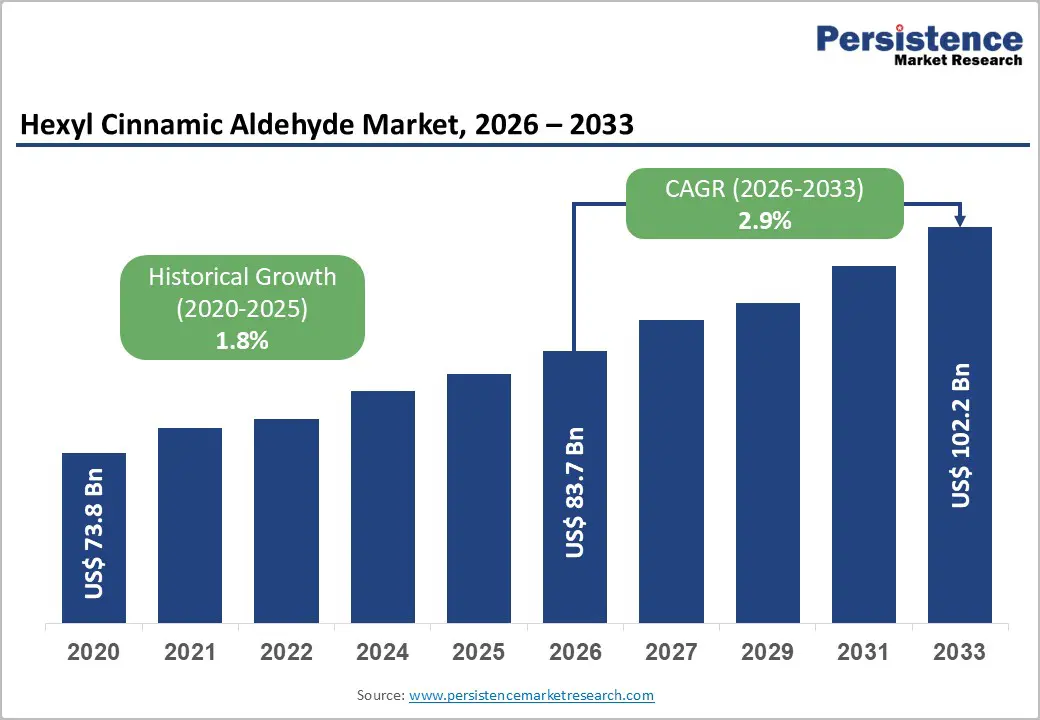
The global hexyl cinnamic aldehyde market size is likely to be valued at US$ 83.7 billion in 2026, and is projected to reach US$ 102.2 billion by 2033, growing at a C AGR of 2.9% during the forecast period 2026−2033.
Growth remains steady and structurally supported by expanding consumer demand for fragranced and sensorial products across personal care and household categories. Rising urbanization and growth in disposable income increase consumption of cosmetics, detergents, and fine fragrances, thereby directly boosting demand for aromatic aldehydes.
Regulatory emphasis on ingredient transparency and safety enhances the adoption of standardized aroma chemicals, improving consistency in formulations. Technological advancements in synthesis and purification improve product quality and cost efficiency, enabling broader industrial applications across multiple sectors. Healthcare and wellness awareness indirectly contribute by increasing the use of hygiene and personal care products, thereby strengthening downstream demand.
Key Industry Highlights
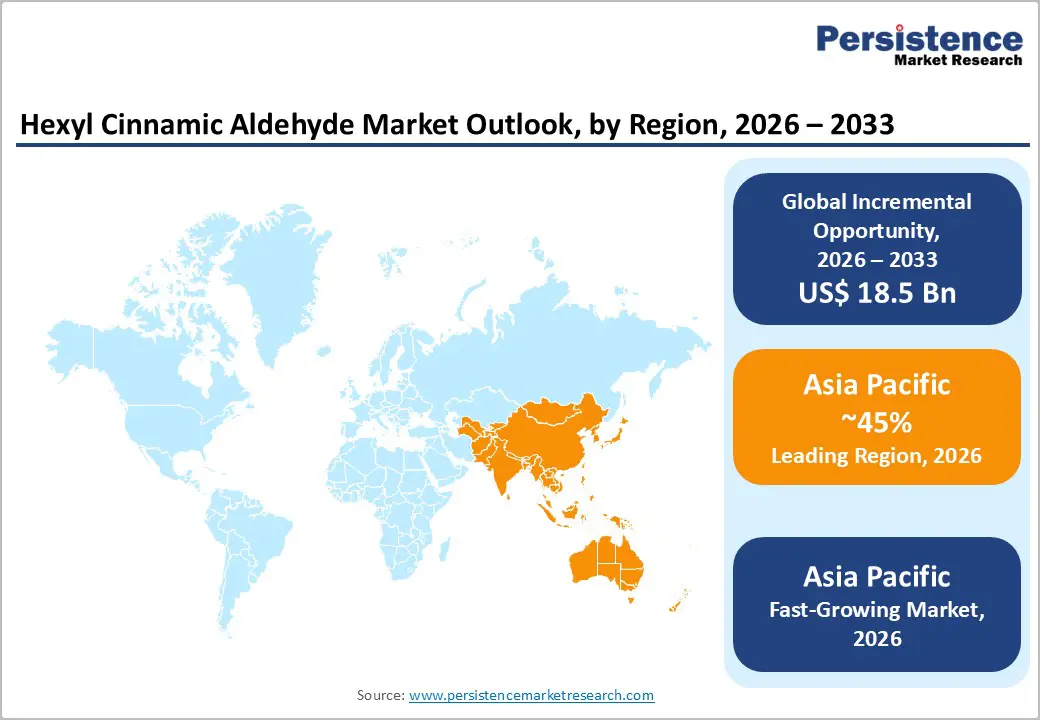
- Dominant Region: Asia Pacific is projected to lead the market share in 2026, driven by production efficiency and high consumption.
- Fastest-growing Regional Market: By 2033, Asia Pacific is forecasted as the fastest-growing regional market, fueled by rising incomes and expanding personal care demand.
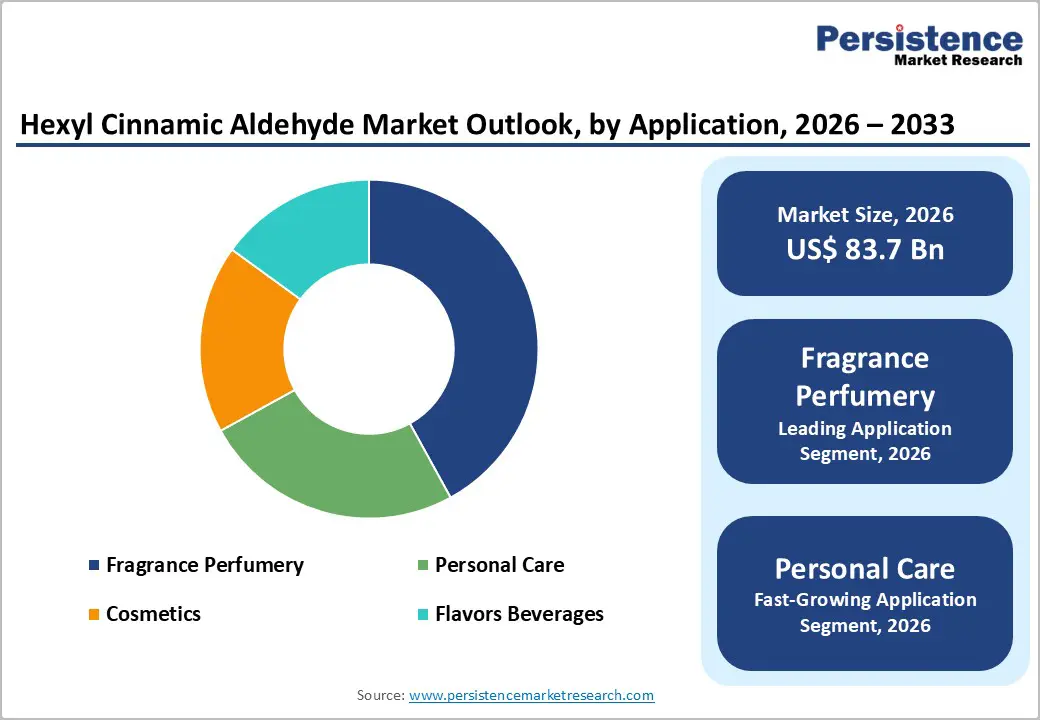
- Leading Application: Fragrance perfumery is projected to lead the market in 2026 with over 42% revenue share, supported by consumer preference.
- Fastest-growing Application: Personal care is expected to be the fastest-growing segment, driven by rising hygiene awareness and the adoption of daily-use products.
| Key Insights | Details |
|---|---|
|
Hexyl Cinnamic Aldehyde Market Size (2026E) |
US$ 83.7 Bn |
|
Market Value Forecast (2033F) |
US$ 102.2 Bn |
|
Projected Growth (CAGR 2026 to 2033) |
2.9% |
|
Historical Market Growth (CAGR 2020 to 2025) |
1.8% |
Market Factors - Growth, Barriers, and Opportunity Analysis
Increasing Consumer Spending on Lifestyle and Grooming Products
Rising spending on lifestyle and grooming products reflects a clear shift toward appearance, wellness, and personal identity. Government fiscal policy in 2025 increased disposable income across middle-income groups and improved spending capacity. The Government of India introduced a revised tax regime with zero tax liability up to INR 12 lakh, which supports higher discretionary purchases. Consumers allocate more funds to fragrances and cosmetics, thereby increasing product penetration. Premium product adoption rises steadily, and purchase frequency increases across urban populations. Manufacturers respond by enhancing formulations, where fragrance ingredients such as hexyl cinnamic aldehyde play a key role in product differentiation.
Consumer behavior aligns with aspirational lifestyles and structured grooming routines across urban and semi-urban regions. Fragrances are now integrated into daily personal care usage rather than occasional application. Digital platforms and social influence shape purchasing decisions and brand preferences. Demand increases for diverse and long-lasting scent profiles across skincare, haircare, and home care products. Companies expand product portfolios and accelerate innovation cycles to meet evolving preferences. Retail expansion and e-commerce growth improve accessibility across regions. Continuous engagement in self-care practices supports repeat purchases, which strengthens demand for fragrance-enhancing ingredients across both mass-market and premium product segments.
Growing Popularity of Home Fragrance Products
Rising use of home fragrance products reflects a shift toward sensory-driven living environments and controlled indoor experiences. Air-conditioned spaces and limited natural ventilation increase reliance on artificial scenting solutions to maintain freshness. Consumers prefer layered fragrance profiles that evolve over time, which requires stable and compatible aroma compounds. Product formats such as reed diffusers and slow-release candles demand ingredients with low volatility and strong blending performance. Hexyl cinnamic aldehyde meets these requirements by anchoring floral notes and enhancing fragrance longevity. This functional role strengthens its importance in formulations designed for extended indoor diffusion.
Interior design trends increasingly integrate scent as a component of space personalization and mood setting. Fragrance zoning within homes, such as distinct scents for living rooms and bedrooms, drives higher product usage per household. Subscription-based delivery models and refill systems encourage continuous consumption cycles. Brands focus on signature scents to build identity and consumer recall. Premium packaging and design aesthetics influence purchase decisions in lifestyle segments. Growth of compact urban housing supports demand for efficient fragrance diffusion solutions.
Risk of Skin Sensitization and Allergic Reactions
Growing scrutiny of skin sensitization and allergic reactions imposes clear constraints on the use of fragrance ingredients in consumer products. Regulatory authorities such as the European Chemicals Agency enforce allergen classification and labeling requirements, as well as strict concentration thresholds. Compliance increases formulation complexity and extends manufacturers' development timelines. Safety assessments, toxicological testing, and documentation become essential before product launches. Hexyl cinnamic aldehyde remains under controlled usage due to its sensitization profile, which limits flexibility in formulations. These regulatory pressures reduce application scope, particularly in sensitive-skin and hypoallergenic product categories across global personal care segments.
Consumer awareness regarding ingredient safety influences purchasing behavior and brand positioning across skincare and hygiene markets. Preference shifts toward mild, dermatologically tested, and low-fragrance formulations in daily-use products. Brands reformulate to reduce allergen exposure and improve end-user safety perceptions. Fragrance intensity levels are adjusted to meet evolving expectations. Product developers adopt precise dosing techniques and controlled delivery systems to manage irritation risks. Marketing strategies emphasize transparency and ingredient disclosure. Frequent reformulation cycles increase operational complexity and costs, which restrict consistent use of sensitization-prone fragrance ingredients across diverse product applications globally.
Availability of Substitute Fragrance Ingredients
The widespread presence of alternative fragrance ingredients creates strong competitive pressure on formulation decisions in personal care and home care products. Perfumers and product developers have access to a broad palette of synthetic and natural aroma chemicals that replicate floral and jasmine-like scent profiles. Ingredient selection depends on cost efficiency, regulatory acceptance, and formulation compatibility across applications. Substitutes such as Linalool and Hydroxycitronellal provide comparable olfactory performance with varying stability and safety characteristics. This flexibility reduces reliance on any single ingredient and limits consistent demand concentration across large-scale production environments globally.
Formulation strategies prioritize adaptability and risk control across evolving product portfolios and regulatory landscapes. Companies maintain diversified sourcing practices to manage compliance shifts and raw material availability challenges. Fragrance houses introduce new molecules and blends that deliver similar sensory outcomes with improved performance benchmarks. Price sensitivity across mass-market segments encourages selection of cost-effective substitutes when suitable. Product reformulation cycles occur frequently to align with consumer preferences and safety standards. This dynamic environment increases substitution rates and reduces long-term reliance on specific aroma compounds, constraining stable demand growth within fragrance ingredient supply chains.
Rising Demand for Natural and Sustainable Fragrance Ingredients
Shifting consumer preference toward natural and sustainable products is redefining ingredient sourcing and formulation strategies across the fragrance industry. Environmental awareness and clean-label expectations influence purchasing decisions in personal care and home care categories. Policy direction from the United Nations Environment Programme (UNEP) promotes reduced chemical impact and responsible production practices. Manufacturers invest in green chemistry, renewable feedstocks, and biodegradable inputs. Bio-based development pathways gain attention for fragrance ingredients. Hexyl cinnamic aldehyde presents opportunity through sustainable variants that align with performance requirements while supporting eco-conscious positioning in premium and mid-range product formulations globally.
Product innovation focuses on transparency, traceability, and environmentally responsible sourcing across supply chains. Brands emphasize sustainable certifications, ethical sourcing, and reduced carbon footprint in communication strategies. Demand increases for fragrance ingredients aligned with circular economy principles and low environmental impact profiles. Research teams explore plant-based synthesis and fermentation technologies to create alternative aroma compounds. Premium product segments integrate such ingredients to meet evolving expectations and regulatory alignment. Expansion of eco-focused product lines strengthens differentiation and supports new revenue channels for fragrance ingredient manufacturers across personal care and home fragrance applications worldwide.
Innovation in Fragrance Formulation and Customization
Advancements in fragrance formulation and customization are transforming product development across the personal care and home care industries. Brands aim to create distinct scent identities for different consumer segments and regions. Digital tools and data analytics support precise formulation design and faster product cycles. Ingredient flexibility becomes essential for stable and balanced compositions. Hexyl cinnamic aldehyde supports blending with multiple notes and enhances floral accords. This property allows development of customized scent profiles with consistent performance. Manufacturers use such ingredients to meet changing preferences and improve product differentiation across premium and mass-market categories.
Consumer demand for personalized products drives expansion of tailored fragrance solutions and niche offerings. Customization platforms, including AI-based scent selection, support direct consumer engagement. Product life cycles are shorter, which increases need for continuous innovation in fragrance combinations. Companies invest in encapsulation and controlled release systems to improve scent longevity. Collaboration between fragrance developers and brands strengthens exclusive product creation. Expanding use across skincare, haircare, and home fragrance products increases reliance on adaptable aroma ingredients that support varied formulation needs and maintain consistent sensory quality across applications.
Category-wise Analysis
Purity Insights
99.5% purity is likely to be the leading segment with approximately 49% hexyl cinnamic aldehyde market revenue share in 2026, due to high application reliability and formulation stability requirements. High-purity variants ensure consistent fragrance performance across premium products, supporting precise scent delivery and uniform quality standards. Manufacturers prefer these grades for cosmetics and fine perfumery where stability is critical. Improved chemical composition reduces degradation risks and enhances shelf life. Regulatory frameworks support higher purity levels, which lowers compliance risks. Premium product positioning strengthens demand concentration, while advanced purification technologies ensure consistent supply, driving adoption across developed markets and supporting quality-focused manufacturing strategies.
99.0% purity is expected to witness the fastest growth between 2026 and 2033, as cost-performance balance gains importance across mass-market applications. This segment offers reliable formulation efficiency at lower cost, which supports large-scale consumer product manufacturing. Rising demand from price-sensitive markets strengthens adoption across emerging economies. Manufacturers select this grade to optimize production expenses and maintain competitive pricing. Advancements in refining processes improve consistency and quality, increasing acceptance across applications. Expansion of mid-tier product categories further supports growth momentum and encourages wider utilization in personal care and home care formulations.
Application Insights
Fragrance perfumery is poised to lead with a forecasted over 42% market share in 2026, owing to strong consumer preference for scented products and premium fragrances. Perfume formulations rely on aroma compounds to create distinctive and long-lasting scent profiles, which strengthens demand concentration. Increasing awareness regarding personal grooming supports consistent product usage across consumer segments. Retail expansion and digital commerce platforms improve accessibility and product visibility. Cultural acceptance across diverse regions supports widespread adoption. Continuous innovation in fragrance composition enhances differentiation, enabling brands to introduce new scent experiences and expand presence across premium and mass-market categories.
Personal care is anticipated to be the fastest-growing segment between 2026 and 2033, driven by expanding hygiene awareness and rising adoption of daily-use products. Items such as lotions, creams, and deodorants increasingly include fragrance ingredients to enhance sensory appeal and user experience. Growth in preventive hygiene practices supports consistent consumption across diverse demographic groups. Digital commerce expansion improves product accessibility, especially in emerging markets. Continuous formulation innovation enhances product performance and stability. Manufacturers focus on quality and branding, which strengthens consumer trust and repeat purchases, supporting sustained demand for fragranced personal care products across global markets.
Regional Insights
North America Hexyl Cinnamic Aldehyde Market Trends
North America demonstrates a highly innovation-driven market structure supported by advanced research capabilities and strong presence of global fragrance manufacturers. Regulatory oversight from the U.S. Food and Drug Administration (FDA) shapes formulation standards, labeling practices, and safety compliance across personal care products. High consumer spending on premium cosmetics and fine fragrances sustains demand for high-performance aroma ingredients. Established production and distribution networks ensure consistent supply across applications. Market participants focus on formulation precision, product differentiation, and long-lasting scent performance. Strong integration between research laboratories and commercial production supports rapid development of new fragrance compositions.
Consumer trends emphasize personalization, wellness-oriented products, and experiential purchasing behavior. Demand for customized fragrances and niche scent profiles continues to expand across premium segments. Digital platforms and direct-to-consumer models influence product discovery and purchasing patterns. Clean-label positioning and transparency drive reformulation strategies across brands. Companies invest in sustainable sourcing and advanced delivery systems such as encapsulation technologies to enhance fragrance longevity. Retail structure combines specialty stores, large chains, and online channels that improve accessibility.
Europe Hexyl Cinnamic Aldehyde Market Trends
Europe represents a mature and highly regulated market environment with strong focus on product safety, transparency, and formulation quality. Oversight from the European Chemicals Agency (ECHA) enforces strict compliance standards, including allergen disclosure and controlled usage levels. This framework drives demand for high-purity ingredients and precise formulation practices. Established fragrance hubs in France and Germany support innovation in perfumery and cosmetics. Premium product positioning sustains demand for refined aroma chemicals. Strong research capabilities and quality standards maintain stable consumption across personal care and luxury fragrance applications.
Consumer behavior emphasizes sustainability, ethical sourcing, and clean-label formulations across product categories. Demand shifts toward biodegradable and environmentally responsible ingredients influence procurement strategies. Manufacturers invest in green chemistry and traceable supply chains to align with regulatory expectations. Product differentiation focuses on niche fragrances and customized scent profiles. Retail structure includes specialty outlets and expanding digital platforms that improve accessibility. Innovation in formulation and controlled-release systems enhances product performance. Stable demand across premium segments and strict regulatory alignment support consistent utilization of fragrance ingredients across diverse end-use applications.
Asia Pacific Hexyl Cinnamic Aldehyde Market Trends
Asia Pacific is expected to lead with an estimated 45% of the hexyl cinnamic aldehyde market share in 2026, supported by strong integration between upstream chemical production and downstream personal care manufacturing. High concentration of aroma chemical facilities enables cost-efficient synthesis and reliable supply. Industrial clusters across China and India provide access to raw materials, skilled labor, and export infrastructure. Large population base supports high consumption of fragranced daily-use products. Domestic manufacturers focus on volume-driven production, which increases procurement of fragrance intermediates. Export competitiveness strengthens through favorable production economics and established trade linkages.
Asia Pacific is forecasted to be the fastest-growing market for hexyl cinnamic aldehyde between 2026 and 2033, stimulated by rising income levels and rapid expansion of personal care consumption. Demand structure reflects strong growth in mid-tier and affordable product categories across urban and semi-urban areas. Regional brands scale through contract manufacturing and private-label production, which increases ingredient utilization. Digital commerce platforms improve market penetration and product accessibility. Localization of fragrance profiles based on cultural preferences increases formulation diversity. Continuous investment in manufacturing capacity and supply chain efficiency supports accelerated growth and strengthens global demand contribution.
Competitive Landscape
The global hexyl cinnamic aldehyde market demonstrates a moderately fragmented structure with presence of global and regional manufacturers competing across application areas. Leading players such as BASF, Givaudan, Symrise, Firmenich International, and International Flavors & Fragrances hold significant share through integrated supply chains and diversified portfolios. Competitive focus remains on quality, cost efficiency, and innovation in formulation performance.
Smaller and mid-sized manufacturers compete through niche applications and regional distribution advantages. Flexible production models enable faster response to changing demand patterns. Local players leverage proximity to end-use industries and cost benefits to capture specific segments. Product differentiation includes customized fragrance blends and targeted solutions. Continuous innovation and regulatory compliance drive competition, while evolving consumer preferences require ongoing adaptation across both established and emerging participants.
Key Industry Highlights
- KALAMA® Hexyl Cinnamic Aldehyde is a high-purity aroma chemical with a jasmine-like floral scent, used widely in perfumes, personal care, and household products. It is a clear yellow liquid that enhances fragrance longevity and acts as a fixative, with applications across soaps, detergents, deodorants, and air care formulations.
Companies Covered in Hexyl Cinnamic Aldehyde Market
- BASF SE
- Givaudan SA
- Symrise AG
- Firmenich International SA
- International Flavors & Fragrances Inc.
- Takasago International Corporation
- Mane SA
- Robertet Group
- Kao Corporation
- Solvay SA
- Lanxess AG
- Merck KGaA
Frequently Asked Questions
The hexyl cinnamic aldehyde market is projected to reach US$ 83.7 billion in 2026.
Rising demand for fragrances and flavors in personal care, cosmetics, and household products is driving the market.
The market is poised to witness a CAGR of 2.9% from 2026 to 2033.
Expansion in natural and premium fragrance products and growth in emerging markets present key opportunities for the market.
Some of the key market players include BASF, Givaudan, Symrise, Firmenich International, and International Flavors & Fragrances.


