




- Specialty & Fine Chemicals
- Amphoteric Surfactant Market
Amphoteric Surfactant Market Size, Share, and Growth Forecast, 2026 - 2033
Amphoteric Surfactant Market by Product Type (Betaine, Amphoacetates, Others), Application (Personal Care, Oil & Gas, Others), Origin, and Regional Analysis for 2026 - 2033

Amphoteric Surfactant Market Size and Trends Analysis
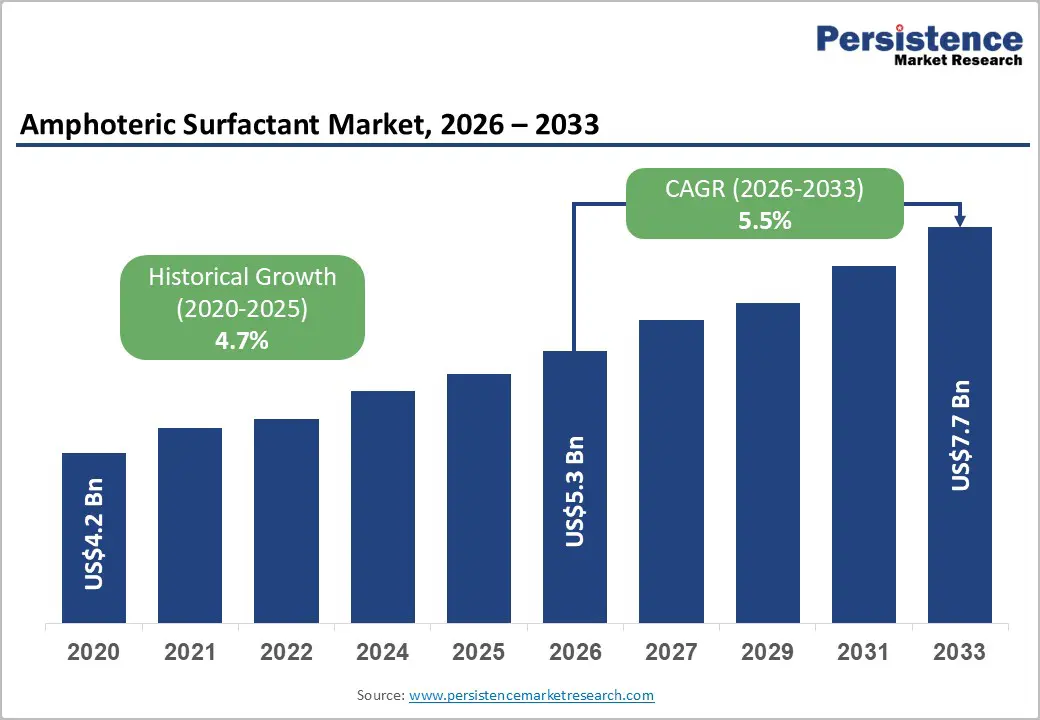
The global amphoteric surfactant market size is likely to be valued at US$5.3 billion in 2026 and is expected to reach US$7.7 billion by 2033, growing at a CAGR of 5.5% between 2026 and 2033, driven by rising adoption of mild and multifunctional surfactants in personal care formulations, increasing regulatory focus on biodegradable ingredients, and expanding investments in bio-based surfactant technologies.
Manufacturers are also prioritizing sustainable product development and localized production strategies to strengthen supply chain resilience and meet evolving environmental standards.
Key Industry Highlights:
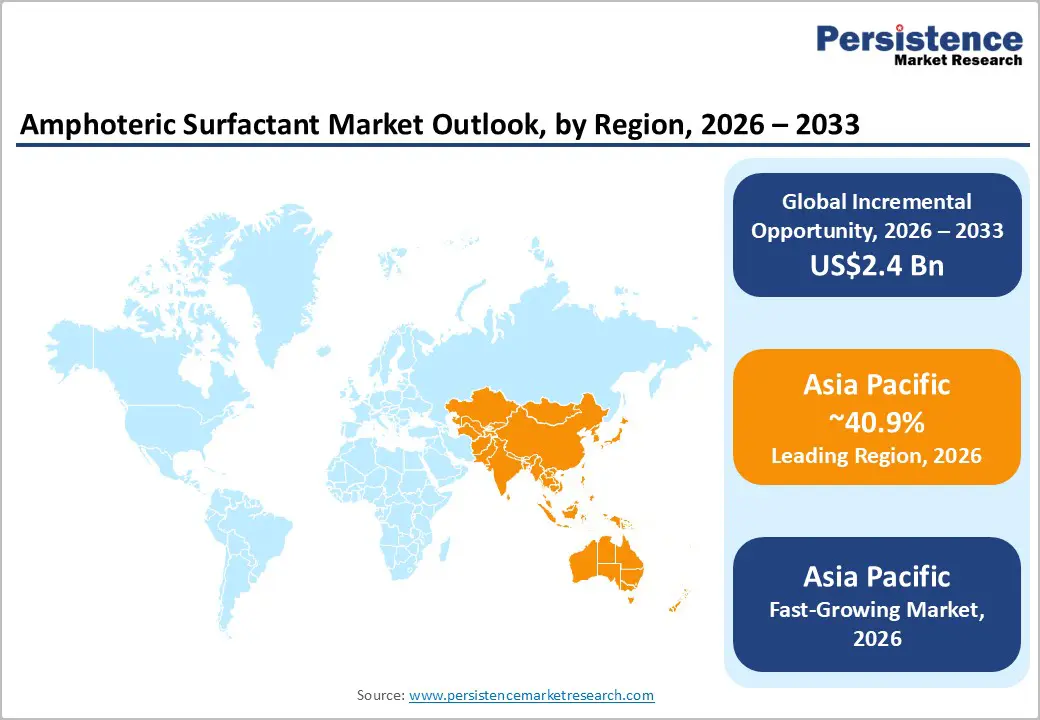
- Leading Region: Asia Pacific is projected to account for 40.9% of market share, supported by large-scale chemical manufacturing, rising personal care consumption, and expanding surfactant production capacity across China, Japan, India, and ASEAN countries.
- Fastest-growing Region: Asia Pacific is also projected to remain the fastest-growing regional market, driven by increasing demand for sulfate-free personal care products, cost-efficient manufacturing infrastructure, and growing investments in bio-based surfactant technologies.
- Investment Plans: Colonial Chemical announced a 15% expansion of production capacity for amphoteric and imidazoline surfactants in North America, while BASF expanded its sustainable betaine surfactant offerings targeting premium personal care applications.
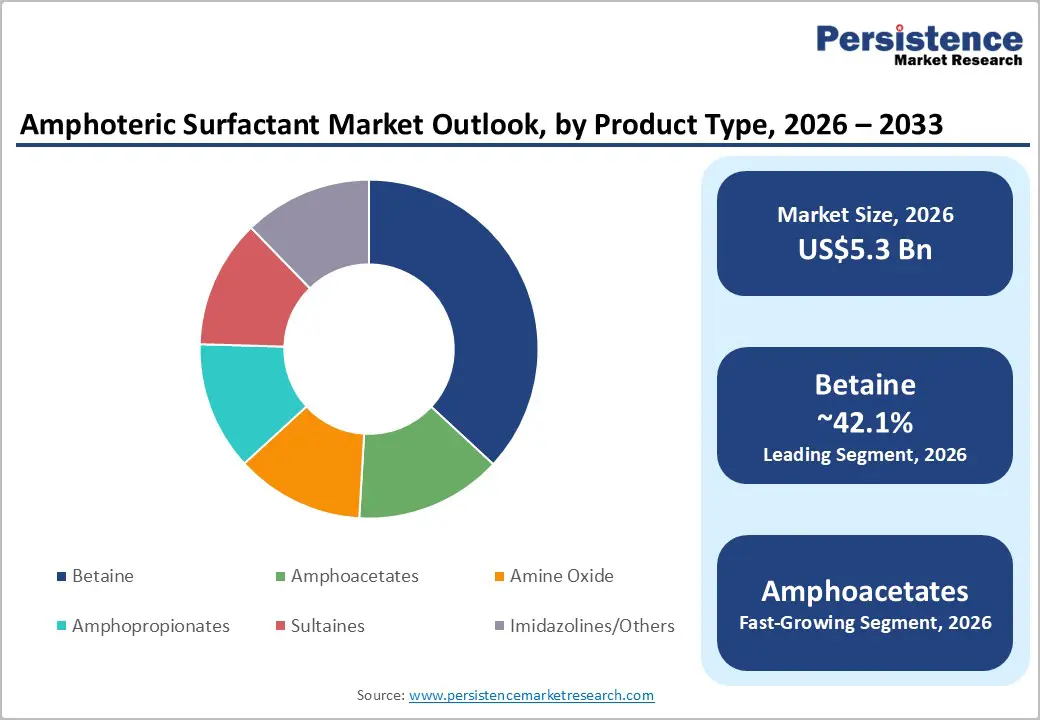
- Dominant Product Type: Betaine is anticipated to lead, accounting for 42.1% market share, due to its widespread use in shampoos, facial cleansers, body washes, and baby care products requiring mildness, foam stability, and sulfate-free compatibility.
- Leading Application: Personal care is estimated to dominate with approximately 49.6% market share, supported by growing demand for skin-sensitive formulations, premium cleansing products, sulfate-free shampoos, and biodegradable surfactant systems.
DRO Analysis
Driver - Rising Demand for Mild and Multifunctional Ingredients in Personal Care
Consumer preference for gentler cleansing formulations continues to strengthen demand for amphoteric surfactants across shampoos, body washes, facial cleansers, and baby care products. These surfactants are valued for their ability to improve foam stability, reduce skin irritation, and maintain compatibility with anionic and nonionic surfactants. The growing focus on skin-sensitive and sulfate-free formulations has accelerated their adoption in premium personal care products.
Demographic trends are also influencing market expansion. The aging global population and increasing awareness of skin health are encouraging manufacturers to develop products with lower irritation potential. Amphoteric surfactants support this transition because they provide effective cleansing performance without compromising mildness. Betaine-based surfactants remain particularly important in rinse-off formulations due to their viscosity-building properties and enhanced sensory performance.
Sustainability Regulations and Cleaner-Label Reformulation
Environmental regulations and sustainability standards are becoming critical purchasing and formulation criteria across the surfactant industry. Regulatory agencies in North America and Europe are increasing scrutiny on biodegradability, aquatic toxicity, ingredient transparency, and environmental persistence. This has accelerated demand for surfactants that comply with safer chemical frameworks and sustainable sourcing requirements.
Amphoteric surfactants are well positioned for this transition because many formulations exhibit favorable biodegradability profiles and lower irritation potential than conventional alternatives. Manufacturers are increasingly introducing bio-based and renewable-content amphoteric surfactants to align with sustainability targets established by consumer goods companies.
Recent product launches have focused on biodegradable betaines, biomass-balanced intermediates, and certified sustainable feedstocks. These innovations allow formulators to reduce carbon footprints while maintaining performance standards in hair care, skin care, and household cleaning applications.
Restraint - Cost Pressure, Compliance Burden, and Substitution Risk
The amphoteric surfactant market faces ongoing pressure from volatility in raw materials, energy-intensive production requirements, and regulatory compliance costs. Production depends on specialty intermediates and complex manufacturing processes, making profitability sensitive to fluctuations in feedstock availability and utility costs. Smaller manufacturers often face higher operational burdens because they lack economies of scale and integrated supply chains.
Regulatory compliance also creates additional cost challenges. Stricter biodegradability testing, labeling requirements, and sustainability documentation increase operational complexity for producers serving regulated markets. In highly price-sensitive applications such as industrial cleaning and home care, formulators may substitute lower-cost anionic or nonionic surfactants when performance specifications allow. This substitution risk limits pricing flexibility for amphoteric surfactant suppliers. As a result, competitive advantage increasingly depends on manufacturing efficiency, technical support capabilities, and regulatory readiness rather than volume-based pricing alone.
Opportunity - Bio-Based and Biomass-Balanced Surfactants
Bio-based amphoteric surfactants represent one of the most significant long-term growth opportunities in the specialty chemicals sector. Consumer goods manufacturers are actively seeking renewable and traceable raw materials to support sustainability targets and reduce environmental impact across product portfolios. Amphoteric surfactants derived from renewable feedstocks are gaining traction because they combine mild performance characteristics with environmentally responsible sourcing.
Manufacturers are investing in biomass-balanced production systems, certified renewable feedstocks, and circular raw material supply models. Product innovation is increasingly focused on coconut-derived betaines, biodegradable amphoterics, and low-carbon surfactant systems designed for premium personal care applications. These developments allow brands to strengthen sustainability positioning without compromising foam quality, formulation stability, or cleansing efficiency. The opportunity is especially attractive in high-value segments such as sulfate-free shampoos, baby care products, and eco-conscious home care formulations, where consumers are willing to pay premium prices for environmentally aligned ingredients.
Industrial Cleaning and Oil & Gas Reformulation
Industrial cleaning and oilfield applications are emerging as important secondary growth areas for amphoteric surfactants. In industrial cleaning systems, these surfactants provide foam stabilization, grease removal, hard-water compatibility, and improved formulation flexibility. Demand is increasing across institutional cleaning, food processing, sanitation, and heavy-duty industrial maintenance products.
The oil and gas industry also presents a specialized growth opportunity. Amphoteric surfactants are increasingly used in enhanced oil recovery, drilling fluids, and chemical flooding applications because they reduce interfacial tension and improve fluid mobility under challenging reservoir conditions. Growing interest in performance-driven and environmentally safer oilfield chemicals is encouraging suppliers to develop advanced amphoteric formulations capable of operating in high-salinity and high-temperature environments.
Category-wise Analysis
Product Type Insights
Betaine is anticipated to remain the dominant product type, accounting for 42.1% market share in 2026. The segment maintains leadership due to widespread use in personal care formulations, particularly shampoos, facial cleansers, baby products, and body washes. Betaine surfactants provide excellent foam enhancement, viscosity control, and irritation reduction, making them highly compatible with sulfate-free and mild cleansing systems. Their strong formulation familiarity also reduces development risk for consumer goods manufacturers, allowing faster commercialization of new products.
The segment benefits from growing demand for premium personal care products emphasizing dermatological compatibility and sensory performance. Betaine-based surfactants also support formulation stability in multifunctional cleansing products, which strengthens their position across mass-market and premium categories.
Amphoacetates are projected to register the fastest growth during the forecast period. Growth is being supported by rising adoption in sensitive-skin formulations, sulfate-free shampoos, and environmentally friendly cleansing products. These surfactants are valued for their mild cleansing performance, broad formulation compatibility, and low irritation characteristics. Manufacturers are increasingly incorporating amphoacetates into premium cleansing systems designed for consumers seeking gentle and biodegradable formulations. The segment is also benefiting from clean-label product positioning and expanding use in high-performance cosmetic applications.
Application Insights
Personal care is estimated to represent the leading application segment, accounting for approximately 49.6% market share in 2026. Amphoteric surfactants are extensively used in shampoos, facial cleansers, body washes, hand soaps, and baby care products because they improve foam quality, enhance mildness, and support sulfate-free formulations. Rising consumer awareness of skin sensitivity and scalp health is strengthening demand for gentler cleansing ingredients.
Premiumization trends in beauty and personal care are also contributing to segment growth. Brands increasingly position products around mildness, sustainability, and skin compatibility, all of which closely align with the performance characteristics of amphoteric surfactants.
The oil & gas segment is expected to record the fastest growth. Amphoteric surfactants are increasingly utilized in enhanced oil recovery processes, drilling operations, and reservoir stimulation systems because they improve fluid mobility and reduce interfacial tension under extreme operating conditions. The market is also benefiting from growing demand for environmentally safer oilfield chemicals capable of maintaining performance in high-temperature and high-salinity environments.
Technical-service-driven product development is becoming increasingly important in this segment, as operators seek customized chemical solutions optimized for specific reservoir characteristics. Industrial cleaning, home care, agrochemicals, and flame retardant applications continue to provide stable demand, though oilfield chemistry remains the strongest emerging growth area.
Regional Insights
North America Amphoteric Surfactant Market Trends
North America represents a mature yet technologically advanced amphoteric surfactant market, driven primarily by the U.S. The region benefits from strong demand across personal care, home care, industrial cleaning, and oilfield chemical applications.
U.S. Amphoteric Surfactant Market Trends
The U.S. remains the leading contributor because of its established personal care manufacturing base, advanced chemical processing infrastructure, and high consumer spending on premium beauty and hygiene products.
The U.S. market has witnessed increasing investments in sustainable surfactant innovation. Companies such as Lubrizol, Stepan Company, and Colonial Chemical continue expanding specialty surfactant portfolios focused on sulfate-free and mild cleansing formulations. In 2025, Colonial Chemical announced a 15% production capacity expansion for amphoteric and imidazoline surfactants in Tennessee to address growing demand from personal care and industrial cleaning manufacturers. This expansion strengthened regional supply reliability and reduced lead-time dependency for domestic customers.
Regulatory focus on ingredient safety and environmental performance is also shaping formulation trends. Personal care brands such as Procter & Gamble, Johnson & Johnson, and Unilever North America are increasing the use of biodegradable and lower-toxicity surfactants in shampoos, facial cleansers, and baby care products. These developments are accelerating adoption of amphoteric surfactants in sulfate-free product lines and premium skin-sensitive formulations.
North America also benefits from a strong innovation ecosystem involving specialty chemical producers, formulation laboratories, and consumer goods manufacturers. Investments are increasingly directed toward renewable-content surfactants, localized production capabilities, and technical-service-led partnerships. Oilfield applications remain strategically important in the region due to ongoing investments in enhanced oil recovery technologies and shale drilling activities across Texas and the Gulf Coast. As a result, North America remains a key market for premium amphoteric surfactant technologies and environmentally aligned formulation innovation.
Europe Amphoteric Surfactant Market Trends
Europe remains one of the most regulation-driven amphoteric surfactant markets globally. Regulatory harmonization across the European Union continues to increase pressure on manufacturers to improve biodegradability, ingredient traceability, and carbon transparency. Companies are responding through investments in biomass-balanced production systems, circular feedstock models, and specialty surfactant innovation.
Germany Amphoteric Surfactant Market Trends
Germany remains the largest amphoteric surfactant market in Europe, driven by its advanced specialty chemical manufacturing base and strong industrial formulation capabilities. Companies such as BASF and Evonik Industries are leading innovation in biodegradable and biomass-balanced surfactants for personal care and industrial cleaning applications. In 2025, BASF expanded its portfolio of renewable-content betaine surfactants targeted at sulfate-free shampoos and mild skin cleansers. This development strengthened Europe’s transition toward lower-carbon surfactant systems and encouraged premium personal care manufacturers to adopt more sustainable sourcing models for ingredients.
German manufacturers are increasingly investing in process optimization and energy-efficient production technologies due to rising operating costs and stricter carbon-reduction regulations. These investments are helping maintain Europe’s competitiveness in high-value specialty surfactants despite elevated energy prices.
U.K. Amphoteric Surfactant Market Trends
The U.K. continues to experience strong growth in premium cosmetics and sulfate-free hair care formulations. Brands operating in the region are emphasizing clean-label and skin-sensitive product positioning, which supports higher amphoteric surfactant adoption. The U.K. market is also benefiting from rising consumer demand for vegan, biodegradable, and ethically sourced ingredients in beauty and hygiene products.
Innovation activity remains particularly strong in premium cosmetics, hair care, and institutional cleaning applications. Strategic partnerships and sustainable ingredient launches are reshaping competitive positioning across the region. Europe, therefore, continues to play a central role in sustainability-focused surfactant development and advanced formulation technologies.
Asia Pacific Amphoteric Surfactant Market Trends
Asia Pacific is projected to lead the market, accounting for 40.9% market share, while also representing the fastest-growing regional market with a projected CAGR of 4.88%. The region benefits from large-scale manufacturing infrastructure, expanding personal care consumption, cost-efficient production capabilities, and growing investments in sustainable surfactant technologies.
China Amphoteric Surfactant Market Trends
China accounts for approximately 12% of global market share, making it the largest country-level market in the region. The country benefits from a highly integrated specialty chemicals supply chain, extensive export capabilities, and rapidly growing domestic consumption of personal care and home hygiene products. Companies such as Clariant and BASF continue expanding production and formulation activities in China to strengthen local supply capabilities and improve responsiveness to regional demand.
China’s fast-growing premium beauty market is also encouraging higher use of mild and sulfate-free cleansing systems. Domestic beauty brands are increasingly adopting amphoteric surfactants in shampoos, facial cleansers, and sensitive-skin products to compete with international cosmetic companies. Growth in e-commerce beauty sales and premium skincare consumption is further strengthening market demand.
Japan Amphoteric Surfactant Market Trends
Japan accounts for approximately 6.1% of market share and remains a key center for high-performance cosmetic formulations and advanced personal care technologies. Japanese companies such as Kao Corporation continue emphasizing premium cleansing formulations with mild surfactant systems designed for sensitive skin and scalp health. Japan’s mature cosmetics market strongly favors high-quality, multifunctional ingredients, which supports stable demand for amphoteric surfactants in premium shampoos and facial care products.
The country is also investing in sustainable and biodegradable chemical technologies to align with long-term environmental objectives and consumer preferences for environmentally responsible products.
The region is witnessing increasing adoption of sustainable surfactant technologies, particularly in premium personal care and export-oriented manufacturing segments. Bio-based ingredient partnerships, renewable feedstock initiatives, and biomass-balanced production models are becoming increasingly visible. Combined with strong industrial expansion and rising middle-class consumption, these factors position the Asia Pacific as the most strategically important region for long-term amphoteric surfactant market growth.
Competitive Landscape
The global amphoteric surfactant market is moderately consolidated, with large multinational specialty chemical companies competing alongside regional manufacturers and application-focused suppliers. Major companies maintain competitive advantages through integrated manufacturing capabilities, technical formulation expertise, sustainability certifications, and established customer relationships in personal care and industrial markets.
Leading companies are prioritizing sustainability-driven innovation, renewable feedstock integration, regional manufacturing expansion, and customized formulation support. Competitive differentiation increasingly depends on biodegradable product portfolios, technical collaboration capabilities, supply chain reliability, and alignment with global environmental standards.
Key Industry Developments
- In April 2025, BASF SE launched Dehyton® PK45 GA/RA, a Rainforest Alliance-certified cocamidopropyl betaine derived from sustainably sourced coconut oil, aimed at strengthening its sustainable personal care ingredient portfolio for shampoos, bath products, and skin cleansers.
- In April 2025, Nouryon introduced Armocare® Aqua 12, an ISCC PLUS-certified biodegradable surfactant designed for high-performance hair care formulations.
Companies Covered in Amphoteric Surfactant Market
- BASF SE
- Evonik Industries AG
- Stepan Company
- Clariant AG
- Croda International Plc
- Nouryon
- The Lubrizol Corporation
- Solvay SA
- Galaxy Surfactants Ltd.
- Kao Corporation
- Colonial Chemical Inc.
- Innospec Inc.
- Huntsman Corporation
- Indovinya (Indorama Ventures)
- Lonza Group AG
- Oxiteno SA Industries Químicas


