




- Transportation & Logistics
- Hand Truck and Dolly Market
Hand Truck and Dolly Market Size, Share, and Growth Forecast 2026 - 2033
Hand Truck and Dolly Market by Product Type (Hand Truck, Dolly), Material (Steel, Aluminum), Sales Channel (Online, Offline), End-user (Retail and E-commerce, Manufacturing and Industrial), and Regional Analysis, 2026 - 2033

Hand Truck and Dolly Market Size and Trends Analysis
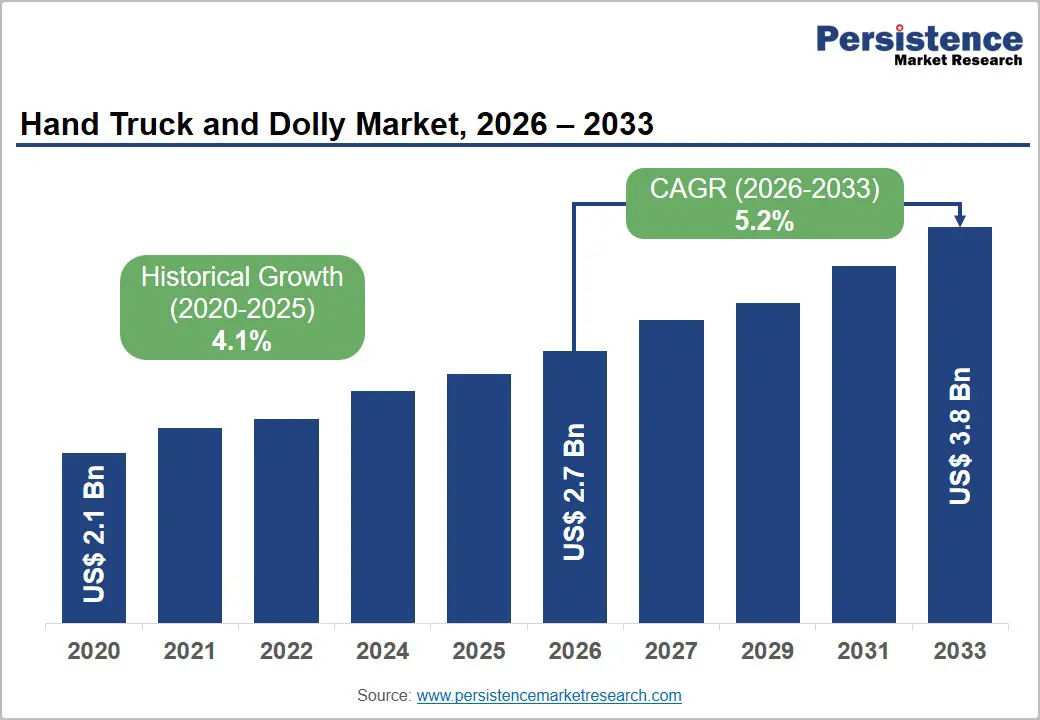
The global hand truck and dolly market size is likely to be valued at US$2.7 billion in 2026 and is estimated to reach US$3.8 billion by 2033, growing at a CAGR of 5.2% during the forecast period from 2026 to 2033, driven by the ongoing expansion of e-commerce logistics and last-mile delivery networks across urban areas.
Increasing focus on workplace safety and ergonomic material handling, as highlighted by agencies such as the Occupational Safety and Health Administration, is also encouraging adoption of manual handling equipment.
Key Industry Highlights:
- Latest Upgrades: In 2026, Magline increased the load capacity of its Gemini Convertible Hand Truck series as part of the next-generation product launch. The upgraded models offer higher carrying capacities in both two-wheel and four-wheel configurations, enabling users to transport heavier loads while maintaining maneuverability.
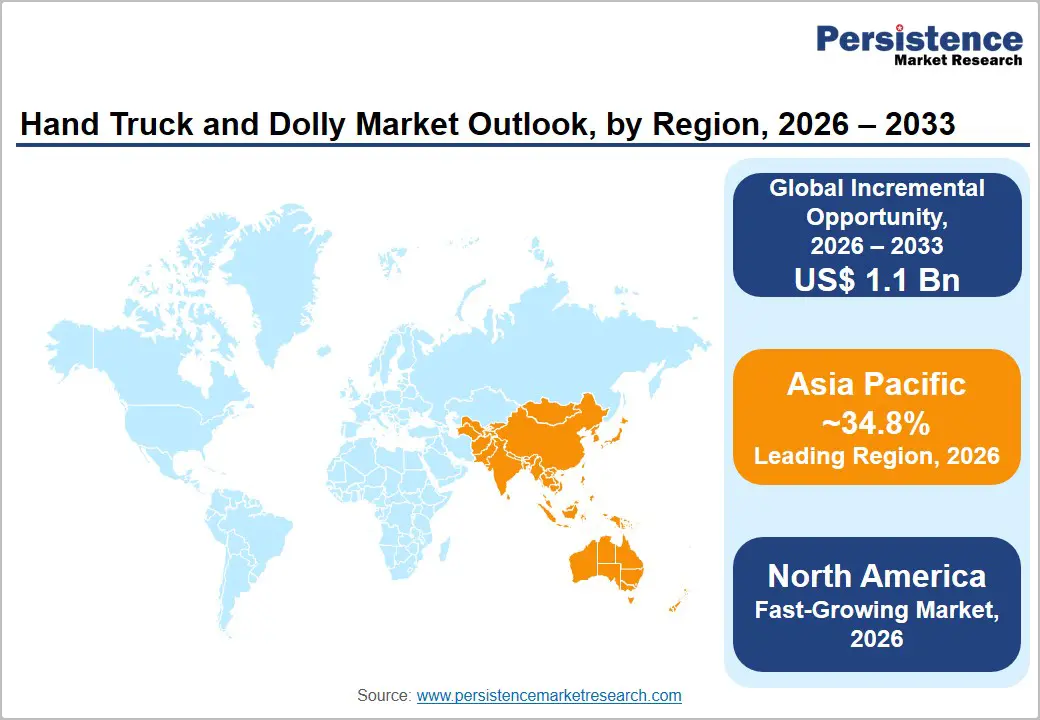
- Leading Region: Asia Pacific, with about 34.8% share in 2026, owing to its high manufacturing output and exponential growth in e-commerce logistics.
- Fast-growing Region: North America, as companies increasingly adopt ergonomic material handling tools to improve worker safety.
- Leading Product Type: Hand trucks, approximately 69.4% share in 2026, because they allow a single worker to move heavy loads easily.
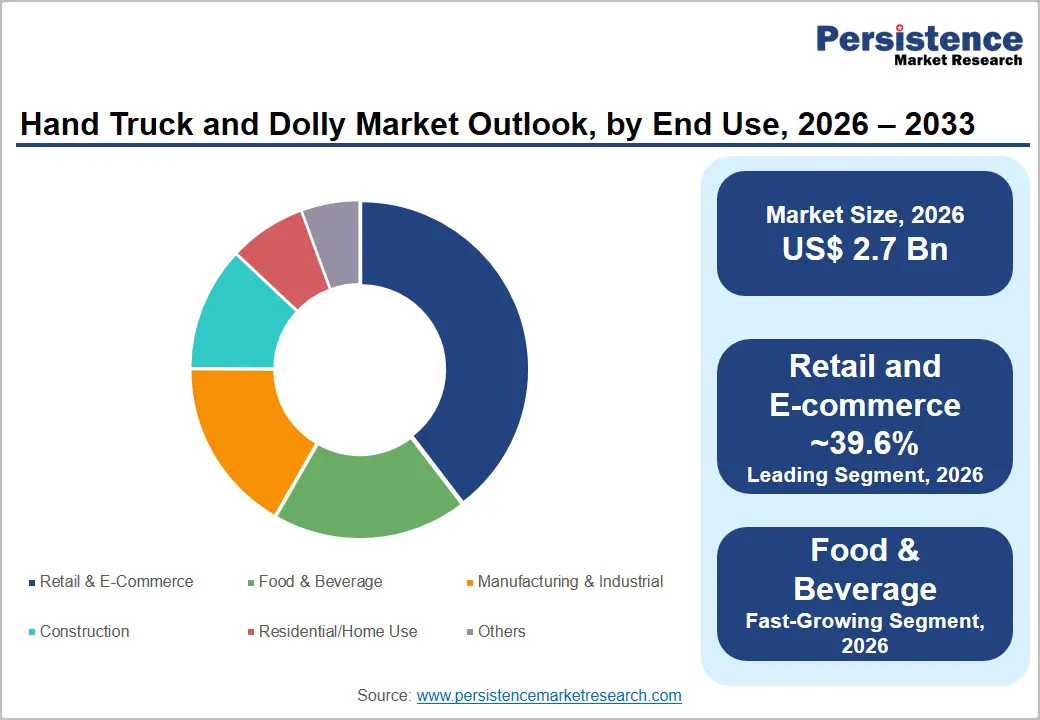
- Dominant End Use: Retail and e-commerce 39.6% share in 2026, as they involve frequent multi-stage handling of goods.
DRO Analysis
Driver - Surging Package Volumes to Create High Demand for Manual Handling Tools
The expansion of last-mile delivery operations has reached a point where hand trucks and dollies are essential operational equipment, not optional accessories. According to the U.S. Census Bureau's February 2024 data, fourth-quarter 2023 online sales in the U.S. hit US$324.8 billion, representing a 7.2% year-over-year jump and accounting for 17.1% of all retail transactions. This translates into high daily parcel volumes for delivery personnel.
Foldable, lightweight hand trucks allow single drivers to unload and transport multiple packages efficiently between vehicles and doorsteps, without requiring additional labor. The retail and e-commerce end-use segment held the largest share of the global market in 2024, specifically boosted by rising order fulfillment and last-mile delivery needs. As e-commerce penetration continues rising, the per-driver reliance on these tools will likely surge.
Food and Retail Supply Chains Relying on Daily Inventory Movement
Supermarkets, convenience chains, and food service distributors use hand trucks and dollies as a daily operational necessity. These tools move beverage kegs, stacked crates, refrigerated products, and bulk dry goods from receiving docks to cold storage and store floors. The food and beverage segment is anticipated to register significant growth in the market, bolstered specifically by the expansion of grocery delivery services and food logistics requiring compact, hygienic, and maneuverable models.
The growth of grocery delivery services is further spurring demand for compact and maneuverable models suited for cold storage environments. Distribution centers, supermarkets, commercial kitchens, and restaurants use these tools for daily stock movement, delivery operations, and cold storage transfers. It makes replacement and fleet expansion a recurring procurement cycle across the food supply chain.
Restraint - Stability, Surface, and Strain Limitations to Create Workplace Injury Risk
Hand trucks and dollies reduce manual effort in several scenarios but introduce their own set of physical and operational risks. Tipping during load transport, loss of control on uneven or sloped surfaces, and awkward loading postures are well-documented injury mechanisms. According to the U.S. Bureau of Labor Statistics (BLS) Survey of Occupational Injuries and Illnesses (SOII), private industry employers reported 2.5 million non-fatal workplace injuries and illnesses in 2024.
Freight and stock movers, the primary users of hand trucks, are among the occupational groups with the highest rates of musculoskeletal injuries. Manual material handling tasks, including lifting, lowering, carrying, pushing, and pulling, are a primary contributor to Work-Related Musculoskeletal Disorders (WMSDs). These often expose workers to biomechanical risk factors such as forceful exertions, non-neutral postures, and repetitive motions. Until hand truck design further reduces these biomechanical hazards, injury risk will likely continue to limit operational confidence in high-frequency use settings.
Opportunity - Lightweight High-Strength Materials to Raise Load Capacity
Material development is changing what hand trucks can carry and where they can be used. Replacing conventional steel frames with aircraft-grade aluminum alloys and reinforced engineering plastics significantly reduces total equipment weight while maintaining or exceeding structural load ratings. The Magliner, a widely adopted aluminum hand truck in logistics operations, uses an aerospace-derived extruded aluminum frame that keeps unit weight below 13 lbs while supporting loads of up to 1,000 lbs, and is used by prominent U.S. carriers including UPS and FedEx.
At the heavy-duty end, PowerMate's M-1 stair-climbing dolly uses an extruded aluminum frame to achieve a 1,500 lb load capacity while remaining light enough for single-operator use. This combination of low self-weight and high load rating is important for delivery drivers who must lift their hand trucks in and out of vehicles repeatedly during a shift. It is a task that becomes hazardous with heavier steel-framed alternatives.
Stair-Navigating Wheel Systems to Enable Single-Operator Heavy Load Delivery
Tri-wheel and motorized stair-climbing hand trucks are solving one of the longest-standing challenges in last-mile and appliance delivery, i.e., moving heavy items up and down stairs without a second operator. Tri-wheel designs use a rotating cluster of three wheels that maintain continuous ground contact across each step. These hence distribute load and reduce the jerk forces that make stair navigation with conventional two-wheel hand trucks difficult as well as physically damaging. Motorized variants take this further.
The PowerMate L-1, built from extruded aluminum, uses an electric drive system to carry loads of up to 650 lbs upstairs. It can self-load onto delivery vehicles without ramps or attachments. At the higher end, the XSTO CT420SC stair climber handles up to 925 lbs via joystick control, enabling a single operator to manage vending machines or large appliances in multi-story buildings. These systems are relevant as appliance delivery volumes rise alongside e-commerce, and same-day delivery mandates increase pressure on two-person delivery crews to operate independently.
Category-wise Analysis
Product Type Insights
Hand trucks are predicted to lead with a share of approximately 69.4% in 2026, as they solve a very specific problem, i.e., moving heavy loads with minimal effort. Their two-wheel design reduces friction and allows a single worker to move loads that would otherwise need two people. This improves labor productivity. The Occupational Safety and Health Administration highlights that manual lifting is a key cause of workplace injuries. Using handling equipment such as hand trucks lowers strain on the back and shoulders, which is why several warehouses now mandate their use.
Dollies are estimated to be the fastest-growing in the forecast period as they support bulk and flat-load movement. Unlike hand trucks, they can carry large and irregular items such as furniture, crates, and appliances. This makes them useful across warehouses, retail backrooms, and manufacturing units. The rise in urban relocation and furniture movement is a key driver. According to housing mobility insights from the U.S. Census Bureau, millions of people move homes every year, increasing demand for moving equipment such as dollies. This trend is visible globally in urban rental markets.
End-user Insights
Retail and e-commerce is anticipated to dominate with a share of nearly 39.6% in 2026, owing to the sheer frequency of goods movement. Every product goes through multiple handling stages such as warehouse, sorting center, delivery hub, and final delivery. Hand trucks and dollies are used at each step. The expansion of online shopping is a prominent factor. The U.S. Census Bureau reported that e-commerce accounts for a surging share of total retail sales, with consistent year-on-year growth even after the pandemic surge. This translates into higher parcel volumes and more handling activity.
The food and beverage segment is expected to remain in the second position in 2026, because of high delivery frequency and strict handling requirements. Products such as beverages, dairy, and packaged food require frequent restocking due to short shelf life. This increases the use of handling equipment. The expansion of cold chain logistics is a key driver. According to the Food and Agriculture Organization, reducing food loss requires better handling and transport systems. Manual handling tools such as hand trucks are widely used in cold storage facilities where forklifts may not always be practical.
Regional Insights
Asia Pacific Hand Truck and Dolly Market Trends
Asia Pacific is anticipated to lead in 2026 with a share of nearly 34.8%, as it combines high manufacturing output with fast-growing logistics demand. China, India, and Southeast Asian nations are producing and moving large volumes of goods daily. This creates constant demand for simple material handling tools. Another key factor is the boom of e-commerce. The United Nations Conference on Trade and Development has highlighted that Asia Pacific accounts for a major share of global online retail activity. This leads to high parcel movement, especially in urban clusters. Hand trucks and dollies are widely used in sorting hubs and last-mile delivery.
China Hand Truck and Dolly Market Trends
China will likely lead in Asia Pacific in 2026 with a share of around 48.3%, owing to its unmatched logistics expansion. The country handles billions of parcels every year. According to the State Post Bureau of China, China’s express delivery volume crossed 130 billion parcels recently. Even with automation, manual tools remain essential for short-distance handling. Manufacturing density is another driver. China’s factories require constant internal movement of goods. Dollies are widely used for moving components across assembly lines, which is common in electronics and automotive clusters.
India Hand Truck and Dolly Market Trends
In 2026, India is projected to account for a share of approximately 27.2%, owing to gradual formalization of logistics. The government’s push through initiatives such as GST has improved supply chain efficiency. The Ministry of Commerce and Industry India has reported steady growth in logistics and warehousing infrastructure. E-commerce expansion is a key factor. Platforms such as Flipkart and Amazon are increasing warehouse capacity across tier-2 and tier-3 cities. These facilities rely heavily on manual handling tools.
North America Hand Truck and Dolly Market Trends
North America is predicted to be the fastest-growing market in 2026 with a global share of approximately 27.6%, backed by rising focus on efficiency and worker safety. Companies are upgrading from basic tools to ergonomic and specialized designs. The Occupational Safety and Health Administration promotes reducing manual lifting injuries, which boosts the adoption of handling equipment. E-commerce is another prominent driver. The U.S. Census Bureau shows that online retail continues to expand steadily. This increases demand for quick and safe material movement.
U.S. Hand Truck and Dolly Market Trends
A regional share of nearly 59.1% is expected to be held by the U.S. in 2026, driven by last-mile delivery and workplace safety rules. Parcel carriers handle very high daily volumes. This creates continuous demand for hand trucks in residential deliveries. Workplace injury data supports this trend. The U.S. Bureau of Labor Statistics reports thousands of cases of musculoskeletal disorders each year. Companies are hence investing in handling tools to reduce these injuries.
Europe Hand Truck and Dolly Market Trends
Europe will likely see decent growth in the forecast period, with a regional share of nearly 18.9% in 2026, due to surging regulatory focus on worker safety. The European Agency for Safety and Health at Work promotes reducing physical strain in workplaces. This supports the use of ergonomic handling tools. Urban logistics is another factor. Several cities have narrow streets and restrictions on large vehicles. Hand trucks are hence widely used for final deliveries in such areas.
Germany Hand Truck and Dolly Market Trends
Germany will likely register a substantial regional share of approximately 43.3% in 2026, backed by its well-established industrial base. Manufacturing sectors such as automotive and machinery require constant material movement. Dollies are widely used on factory floors. Germany is also a key logistics hub in Europe. High warehouse density increases demand for handling tools. According to Germany Trade & Invest, the country continues to extend logistics infrastructure to support trade flows.
U.K. Hand Truck and Dolly Market Trends
A regional share of around 20.6% is predicted to be held by the U.K. in 2026, fueled by e-commerce and grocery retail. Online shopping remains high, which increases parcel handling needs. Workplace safety regulations also play a key role. The Health and Safety Executive enforces strict rules on manual handling, which encourage the use of hand trucks and dollies. Urban delivery demand is high, especially in cities such as London. Delivery workers often use compact and foldable hand trucks to manage multiple parcels.
Competitive Landscape
The global hand truck and dolly market is moderately fragmented, with no single manufacturer dominating worldwide. Leading companies include Magline, Inc., Harper Trucks, Inc., Wesco Industrial Products, LLC, B&P Manufacturing, Milwaukee Hand Trucks, Cosco Home & Office Products, and WOODEVER INDUSTRIAL CO., LTD. These companies compete through extensive product portfolios, established dealer networks, and strong brand recognition in logistics, warehousing, retail, beverage delivery, and industrial applications.
Competition is increasingly shifting from basic load-carrying equipment toward ergonomic and application-specific solutions. Manufacturers are introducing lightweight aluminum frames, convertible 2-in-1 and 4-in-1 models, foldable designs, stair-climbing configurations, and modular accessories to differentiate their portfolios. Companies with superior relationships across industrial distributors, e-commerce platforms, warehouse equipment suppliers, and rental channels enjoy a significant advantage.
Key Industry Developments:
- In January 2026, Magline launched the Next-Generation Gemini Convertible Hand Truck, marking the most significant update to its flagship product in more than 50 years. The new model introduced ergonomic secondary handles, rotating handle grips, enhanced latch-lock systems, frame end caps, and higher load capacities. According to the company, the redesign was intended to improve safety, versatility, and productivity for route delivery and warehouse professionals.
- In October 2025, Godrej Enterprises Group introduced the GEPT 20, India’s first 48V Li-ion-powered electric hand pallet truck. The new equipment delivers three times higher productivity than conventional hand pallet trucks. It combines fast lifting, long runtime, precise control, and robust durability to improve performance in warehouses, retail backrooms, and industrial facilities.
- In January 2025, Vestil Manufacturing partnered with Lifting Equipment Store USA (LES USA) to expand the availability of its material handling portfolio. Through the partnership, more than 600 product lines and over 6,000 SKUs were added to LES USA's platform, including industrial carts, dollies, hand trucks, and ergonomic material handling solutions. The collaboration was aimed at improving workplace efficiency and strengthening Vestil's distribution reach across North America.
Companies Covered in Hand Truck and Dolly Market
- Magline, Inc.
- Harper Trucks, Inc.
- B&P Manufacturing
- Wesco Industrial Products, LLC.
- BIL Group
- Milwaukee Hand Trucks
- The Hand Truck Company
- WOODEVER INDUSTRIAL CO., LTD.
- Cosco Home & Office Products
- Shunhe
- Others
Frequently Asked Questions
The global hand truck and dolly market is projected to be valued at US$2.7 billion in 2026.
The hand truck and dolly market is expected to reach US$3.8 billion by 2033.
The key market trends include rising demand for ergonomic designs and growth of foldable as well as multi-function equipment.
Hand trucks are expected to be the leading product type with a share of nearly 69.4% in 2026, owing to their low cost, portability, and ability to operate efficiently in narrow spaces.
The hand truck and dolly market is expected to grow at a CAGR of 5.2% from 2026 to 2033.
Magline, Inc., Harper Trucks, Inc., and B&P Manufacturing are a few key market players.


