




- Medical Devices
- Hemodialysis Catheters Market
Hemodialysis Catheters Market Size, Share, and Growth Forecast 2026 - 2033
Hemodialysis Catheters Market by Design (Single Lumen, Double Lumen, Triple Lumen), Component (Catheter, Catheter Kit), Material (Polyurethane, Silicone), Application (Chronic Kidney Disease), and Regional Analysis, 2026 - 2033

Hemodialysis Catheters Market Size and Trends Analysis
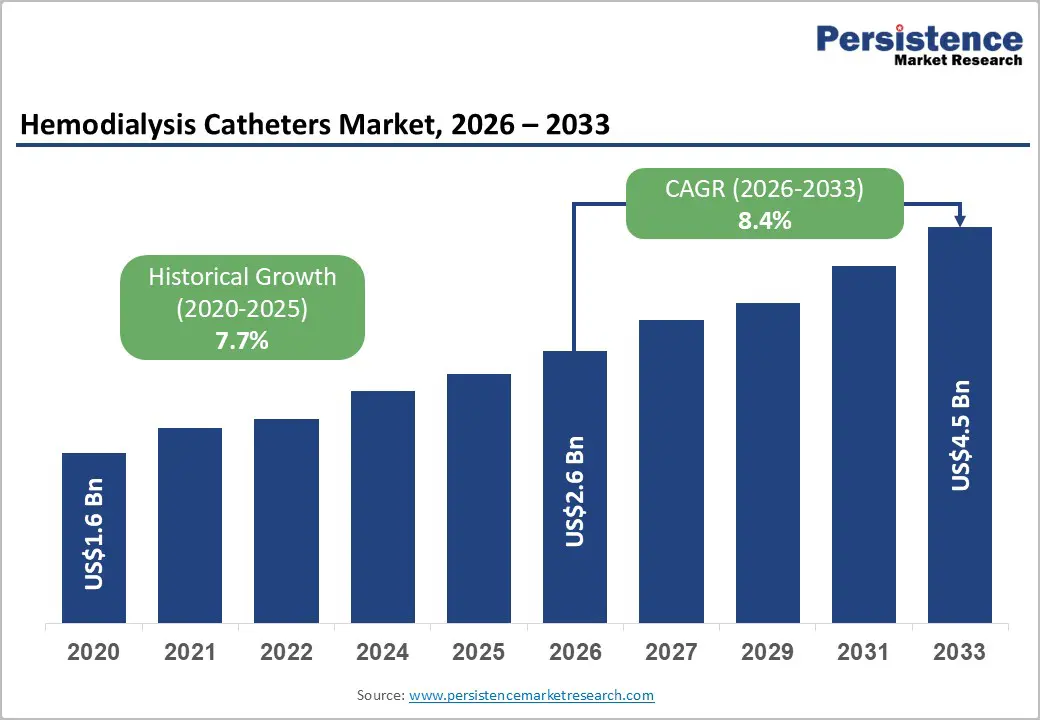
The global hemodialysis catheters market size is likely to be valued at US$2.6 billion in 2026 and is expected to reach US$4.5 billion by 2033, growing at a CAGR of 8.4% during the forecast period from 2026 to 2033, driven by the rising prevalence of Chronic Kidney Disease (CKD) and End-Stage Renal Disease (ESRD). Surging burden of diabetes and hypertension worldwide is also predicted to boost the market.
Key Industry Highlights:
- Pilot Program: In May 2026, the American Society of Nephrology (ASN) declared that it will create a Centers of Excellence in Home Dialysis pilot program. It aims to increase access to home dialysis, strengthen home dialysis programs, and improve patient outcomes. This is anticipated to propel demand for hemodialysis catheters.
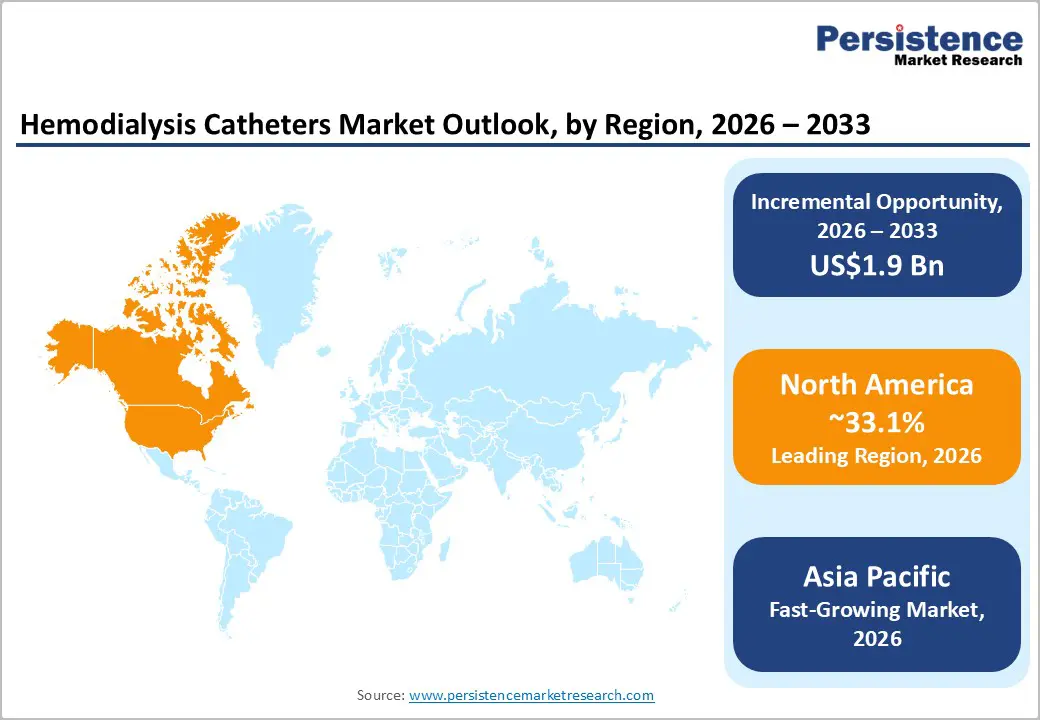
- Leading Region: North America, with about 33.1% share in 2026, backed by its advanced dialysis infrastructure and favorable reimbursement policies.
- Fast-growing Region: Asia Pacific, spurred by increasing CKD burden and improving healthcare access.
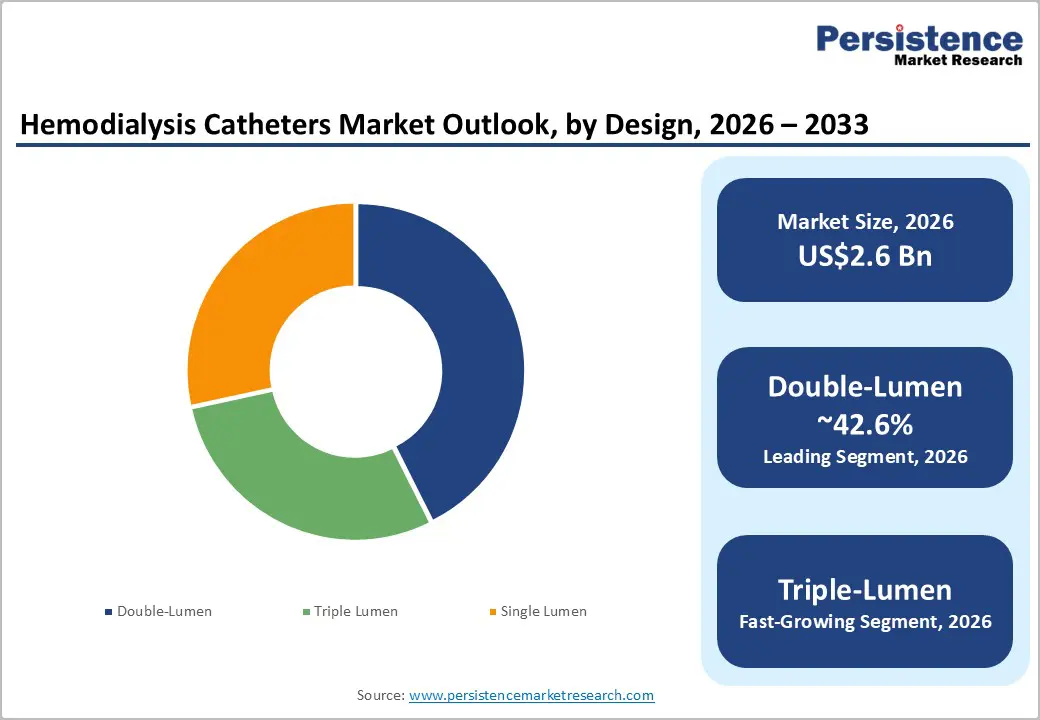
- Leading Design: Double-lumen catheters, approximately 42.6% share in 2026, as they enable efficient two-way blood flow during hemodialysis while maintaining lower complexity and reduced infection risk compared to multi-lumen devices.
- Dominant Application: Chronic kidney disease, nearly 83.4% in 2026, as rising cases of diabetes and hypertension are steadily increasing progression to end-stage renal disease worldwide.
DRO Analysis
Driver - Urgent Requirement for Dialysis among Patients
When kidney function drops suddenly, patients cannot wait weeks for a surgical access site to be created. A hemodialysis catheter can be inserted and used almost immediately, making it the only practical option in emergency settings. This reality is reflected in national data. According to the 2024 U.S. Renal Data System (USRDS) Annual Data Report, 74.3% of patients in the U.S. initiated hemodialysis with a catheter only in 2022, rising from 60.3% in 2013, an increase of 23.2% in relative terms.
Even among patients who had over a year of pre-dialysis care under a nephrologist, a 2024 article in the Journal of the American Society of Nephrology found that 55% still initiated dialysis with a central venous catheter only. This persistent gap between ideal and actual practice keeps demand for catheters consistently high.
Delayed AVF Maturation to Raise Dependence on Hemodialysis Catheters
Even when a patient is eligible for a surgical arteriovenous fistula (AVF), the fistula cannot be used right away. It requires time to develop before it can support dialysis safely. As per the NKF KDOQI Vascular Access Clinical Practice Guidelines, fistulas should not be used until at least 6 to 8 weeks after creation, and maturation failure rates of 20% to 60% of AVFs are widely reported, compelling prolonged catheter dependence.
A meta-analysis referenced in clinical trial documentation found that nearly two-thirds of AVFs require the use of a bridging tunneled dialysis catheter while awaiting maturation. Approximately 20% of AVFs are abandoned without ever being used. Until better tools exist to propel or predict fistula maturation, catheters will likely remain the essential interim solution.
Restraint - High Risk of Infections
Catheters carry a significantly higher infection risk compared to other dialysis access types. Bacteria can travel along the catheter surface into the bloodstream, causing Catheter-Related Bloodstream Infections (CRBSIs), a serious and often fatal complication. A prospective study published in 2025, conducted across a nephrology unit in Northeast India between May 2024 and April 2025, found that CRBSI incidence and mortality exceeded rates reported in high-resource settings, with Gram-negative infections observed in 55% of non-survivors.
A separate 2025 study in Journal of the American Society of Nephrology noted that in-hospital mortality among hemodialysis patients with CRBSIs stood at 15%, with Gram-positive organisms responsible for 55.6% of fatal cases. These infections require hospitalization, IV antibiotics, and often catheter removal, further adding substantial cost and burden. This persistent infection risk remains a key reason clinicians push for early transition away from catheter-based dialysis access.
Opportunity - Carbothane Copolymers to Extend Catheter Service Life
Conventional catheter materials such as standard polyurethane degrade when exposed to iodine, alcohol, or peroxide. These substances are routinely used for catheter care and exit site maintenance. Carbothane, a polycarbonate-urethane copolymer, was developed to address this. A peer-reviewed article published in Anesthesiology Intensive Therapy noted that thermoplastic polyurethane such as Carbothane is resistant to the damaging effects of alcohol, iodine, and hydrogen peroxide, while also becoming more pliable at body temperature.
A review in PMC further confirmed that the current trend is toward carbothane-based dialysis catheters, with the key benefit being chemical resistance that increases catheter longevity. Products such as Mozarc Medical's Mahurkar Chronic Carbothane catheters already incorporate this material in clinical practice. The rising preference for chemically resistant and long-lasting catheters is pushing further adoption of carbothane-based designs.
Emergence of Non-Heparin Antimicrobial Lock Solutions
Heparin has long been the standard catheter lock solution, but it carries risks such as heparin-induced thrombocytopenia and bleeding complications. Non-heparin alternatives, especially taurolidine-citrate combinations, have gained superior clinical backing. The pivotal Phase 3 LOCK-IT-100 trial, which led to FDA approval of DefenCath in November 2023, found that taurolidine and heparin catheter lock solution resulted in a 71% risk reduction in CRBSIs compared to heparin alone.
A 2025 study published in Journal of Vascular Access, conducted at Hospital Clínic de Barcelona, also found that systematic use of taurolidine-citrate-heparin locking solution reduced CRBSI incidence from 7.43% to 3.38% in ICU hemodialysis patients. DefenCath's real-world study showed similarly strong results, with a 72% reduction in CRBSIs across approximately 7,000 patients. These findings are bolstering clinical adoption of non-heparin antimicrobial lock solutions as a standard of care.
Category-wise Analysis
Design Insights
Double-lumen catheters are predicted to lead with a share of approximately 42.6% in 2026, as they are considered the clinical standard for routine hemodialysis. These catheters have one lumen for withdrawing blood and another for returning filtered blood to the body. This design supports continuous high blood flow during dialysis while keeping the procedure simple and reliable. According to the National Institute of Diabetes and Digestive and Kidney Diseases (NIDDK), hemodialysis requires strong and stable blood circulation to efficiently remove toxins and excess fluid. Double-lumen systems are specifically designed for this purpose.
Triple-lumen catheters are estimated to be the fastest growing segment over the forecast period, as hospitals increasingly want multifunctional vascular access devices, especially in intensive care units. These catheters include a third lumen that can be used for medication delivery, blood sampling, or pressure monitoring while dialysis is running simultaneously. This reduces the requirement for inserting additional central venous catheters in critically ill patients. A 2026 study published in The American Journal of the Medical Sciences reported that triple-lumen hemodialysis catheters may reduce concurrent central venous catheter use in ICU patients, lowering the risk of catheter-related bloodstream infections.
Application Insights
The Chronic Kidney Disease (CKD) segment is anticipated to dominate with a share of nearly 83.4% in 2026, as it is the primary cause of long-term kidney failure globally. Patients with advanced CKD often require lifelong hemodialysis several times every week, creating continuous demand for dialysis catheters. The Centers for Disease Control and Prevention (CDC) reported in 2024 that more than 35 million adults in the U.S. are estimated to have CKD, while around 360 people begin dialysis treatment every day due to kidney failure.
The Acute Kidney Injury (AKI) segment is expected to remain in the second position in 2026, as hospitals are reporting rising numbers of critically ill patients developing sudden kidney failure during ICU admission. AKI frequently occurs in patients with sepsis, major surgery, trauma, severe infections, cardiac disease, and drug-induced toxicity. A 2024 multicenter cohort study analyzing more than 2 million hospital encounters found that AKI affected about 14% of hospitalized patients and more than half of ICU patients in severe care settings.
Regional Insights
North America Hemodialysis Catheters Market Trends
In 2026, North America is estimated to dominate with a share of approximately 33.1%, as the region has one of the highest dialysis treatment rates in the world. The U.S. alone has a very large population suffering from End-Stage Renal Disease (ESRD), diabetes, obesity, and hypertension. These conditions increase the demand for long-term hemodialysis access.
According to the CDC, more than 800,000 people in the U.S. live with ESRD, and most require regular dialysis treatment. The region also benefits from advanced dialysis infrastructure and favorable reimbursement policies. Medicare in the U.S. covers dialysis treatment for ESRD patients regardless of age, which is uncommon for various chronic diseases globally.
U.S. Hemodialysis Catheters Market Trends
The U.S. continues to exhibit swift growth due to rising CKD prevalence and increasing dialysis dependency among aging populations. Diabetes and hypertension remain key contributors to kidney failure. The country is also witnessing increasing use of home hemodialysis and outpatient dialysis centers, creating demand for user-friendly vascular access solutions. Large providers such as Fresenius and DaVita continue to broaden renal care services across urban and semi-urban regions.
Another important growth factor in the U.S. is the rising number of hospitalized patients requiring temporary dialysis. The Centers for Medicare & Medicaid Services (CMS) has extended reimbursement for AKI dialysis treatment, encouraging hospitals to provide broad renal replacement therapy access. Increasing ICU admissions related to sepsis, cardiac disease, and drug-induced kidney injury are further supporting high use of temporary dialysis catheters.
Asia Pacific Hemodialysis Catheters Market Trends
Asia Pacific is anticipated to become the fastest-growing market with a share of nearly 26.7% in 2026. Growth is attributed to its increasing population of untreated and underdiagnosed CKD patients. Rising diabetes rates, unhealthy diets, and hypertension are sharply raising kidney disease across China, India, Indonesia, and Southeast Asia. Governments are now investing in dialysis access programs as kidney disease has become a prominent public health burden.
Public hospitals, private renal chains, and insurance-backed dialysis programs are increasing access in small cities and rural areas. Several countries are moving beyond basic dialysis services and adopting novel hemodialysis machines, portable systems, and digital patient monitoring platforms.
China Hemodialysis Catheters Market Trends
China’s growth outlook remains highly positive as the country has one of the world’s largest CKD patient pools. Rising diabetes and hypertension cases continue to increase dialysis demand across both urban and semi-urban populations. The country’s government has expanded reimbursement support and dialysis center development under public healthcare reforms.
Large hospitals are also integrating AI-based renal monitoring systems and predictive analytics for kidney disease management. China is also becoming a key innovation market for renal therapeutics and dialysis technologies. In 2026, for instance, the country’s National Medical Products Administration approved Zydus Lifesciences’ Desidustat for CKD-related renal anemia treatment.
India Hemodialysis Catheters Market Trends
India is witnessing decent growth as CKD cases are increasing steadily, owing to diabetes, hypertension, and poor early-stage diagnosis. Government-supported dialysis schemes are improving treatment accessibility for low-income populations. Several states are extending free dialysis programs in public hospitals through public-private partnerships. India is also expanding dialysis infrastructure in Tier-2 and rural regions.
Gujarat recently reported that dialysis procedures at government centers more than doubled within five years, while Delhi added hundreds of dialysis machines across government hospitals to reduce waiting periods. Tamil Nadu has additionally introduced nutritional support programs for dialysis patients to improve treatment outcomes. These developments show that renal care is becoming a large public healthcare priority in India.
Europe Hemodialysis Catheters Market Trends
Europe will account for a share of around 18.4% in 2026, as the region has a rapidly aging population and a high prevalence of chronic diseases associated with kidney failure. Countries across Western Europe have well-established dialysis reimbursement systems and superior infection-control standards. Local hospitals are now adopting tunneled catheters, antimicrobial coatings, and advanced vascular access monitoring systems to reduce hospitalization risks.
The region also benefits from favorable clinical guidelines and widespread early CKD screening programs. Several domestic healthcare systems focus heavily on reducing catheter-related bloodstream infections and improving dialysis quality standards. This is supporting consistent replacement demand for upgraded catheter systems and safe vascular access technologies.
Germany Hemodialysis Catheters Market Trends
Germany is seeing exponential growth as it has one of the most well-established healthcare infrastructures in Europe and a high elderly population vulnerable to kidney disease. The country also has a large network of dialysis clinics and nephrology specialists, allowing quick diagnosis and treatment initiation. It is among the leading adopters of technologically advanced dialysis systems and infection-prevention protocols.
The country is additionally benefiting from increased demand for home-based renal therapies and digital healthcare integration. Local hospitals and renal centers are now using remote patient monitoring and automated dialysis management systems. This trend supports the demand for reliable long-term vascular access devices and premium catheter products.
U.K. Hemodialysis Catheters Market Trends
The U.K. is showing stable growth as CKD cases are rising steadily among the National Health Service (NHS) patient population. Diabetes, obesity, cardiovascular disease, and aging demographics continue to increase dialysis demand across the country. The NHS is also investing in early CKD detection and improved dialysis access pathways to reduce emergency dialysis initiation.
The U.K. is further encouraging home dialysis and integrated renal care models to reduce hospital burden. This shift is raising demand for durable and easy-to-manage dialysis catheters suitable for outpatient and home settings. Infection prevention remains a key focus area across NHS dialysis units, which is encouraging adoption of antimicrobial and tunneled catheter technologies.
Competitive Landscape
The global hemodialysis catheters market is moderately consolidated, with a small group of multinational renal care and vascular access companies controlling a large share. Companies such as Becton, Dickinson and Company, Medtronic, Baxter International, Teleflex, B. Braun, and Fresenius Medical Care dominate due to their broad dialysis portfolios, hospital relationships, and established distribution networks. Industry estimates suggest leading players collectively account for nearly half of the global market revenue.
Competition is heavily centered on infection prevention, catheter longevity, and blood flow efficiency rather than simple pricing. Manufacturers are investing in antimicrobial coatings, thrombus-resistant lumen designs, soft biocompatible materials, and tunneled catheter systems that reduce complications during long-term dialysis treatment. Companies are also differentiating through complete dialysis access kits that combine catheters, introducers, guidewires, and placement accessories to improve procedural efficiency in hospitals and dialysis centers.
Key Industry Developments
- In May 2026, Amplifi Vascular successfully initiated the AMPLIFI-1 Trial at Brigham and Women's Hospital. The AMPLIFI-1 Trial is designed to evaluate the safety and effectiveness of the Amplifi Vein Dilation System in patients requiring distal arteriovenous fistula creation for hemodialysis access.
- In January 2026, Outset Medical received FDA 510(k) clearance for its next-generation Tablo Hemodialysis System, with a commercial launch planned for Q2 2026. With this clearance, Tablo became the first hemodialysis system to incorporate the FDA's most rigorous and recent guidance on medical device cybersecurity, published in June 2025.
- In August 2025, CorMedix Inc. announced a definitive agreement to acquire Melinta Therapeutics LLC for US$300 million in total upfront consideration. The deal was described as transformational, expanding and diversifying CorMedix's commercial product portfolio with seven innovative drug products and near-term revenue growth potential.
Companies Covered in Hemodialysis Catheters Market
- Medtronic
- BD
- Merit Medical Systems
- Teleflex Incorporated
- B. Braun SE
- Advin Health Care
- Joline GmbH & Co. KG
- Vygon
- Mozarc Medical Holding LLC.
- Medical Components, Inc.
- Tianck Medical CO., Ltd.
- Polymedicure
- Integer Holdings Corporation
- Healthline Medical Products
- Manish Medi Innovation
- Others
Frequently Asked Questions
The global hemodialysis catheters market is projected to be valued at US$2.6 billion in 2026.
The hemodialysis catheters market is expected to reach US$4.5 billion by 2033.
Key market trends include the rising adoption of antimicrobial and tunneled catheters and increasing demand for home hemodialysis.
Chronic kidney disease is expected to be the leading application with a share of nearly 83.4% in 2026, as it creates a large pool of patients requiring long-term and repeated dialysis treatments.
The hemodialysis catheters market is expected to grow at a CAGR of 8.4% from 2026 to 2033.
Medtronic, BD, Merit Medical Systems, and Teleflex Incorporated are a few key market players.


