




- Renewable Energy
- Grid-Forming Micro-Inverter Market
Grid-Forming Micro-Inverter Market Size, Share, and Growth Forecast, 2026 - 2033
Grid-Forming Micro-Inverter Market by Product Type (Micro-Inverters, String Inverters, Others), Power Rating (Below 10 kW, Others), Application, and Regional Analysis for 2026 - 2033

Grid-Forming Micro-Inverter Market Size and Trends Analysis
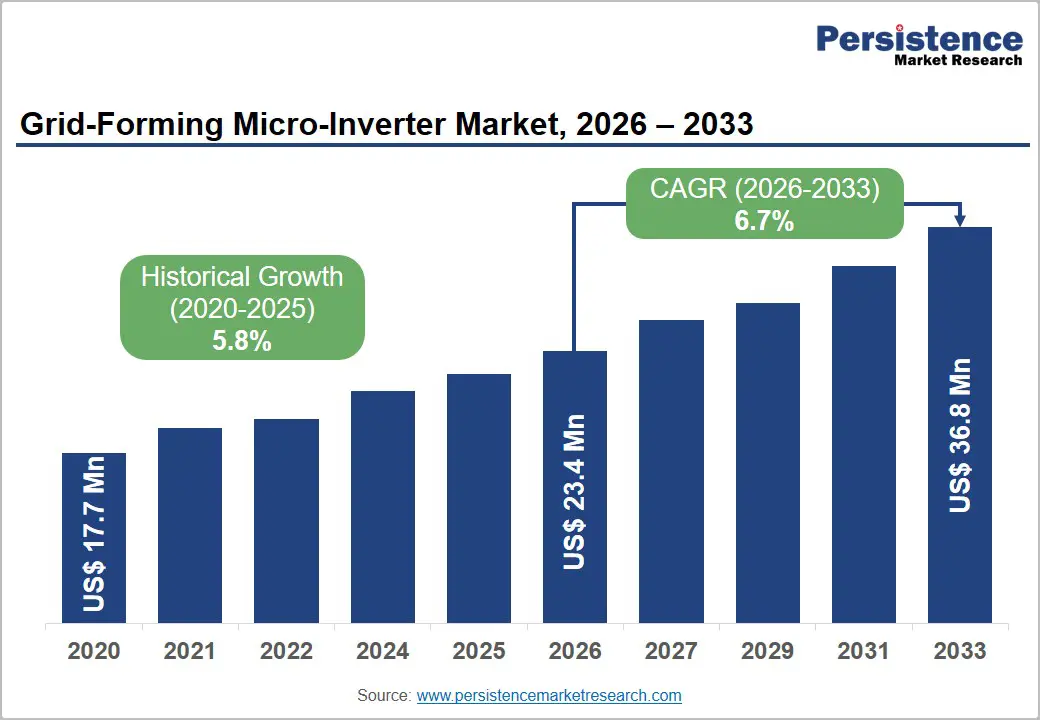
The global grid-forming micro-inverter market size is likely to be valued at US$23.4 million in 2026 and is expected to reach US$36.8 million by 2033, growing at a CAGR of 6.7% between 2026 and 2033, driven by the growing deployment of grid-forming inverter technology capable of maintaining voltage and frequency stability while supporting higher penetration of inverter-based renewable energy resources.
Utilities, commercial facilities, and residential consumers are increasingly prioritizing resilient energy infrastructure that can maintain stable operation during grid disturbances. Continuous investments in distributed energy resources, battery energy storage systems, and microgrids are expected to strengthen the demand for advanced micro-inverters with grid-forming capabilities. Regulatory initiatives supporting decarbonization, energy security, and grid modernization further reinforce long-term market growth.
Key Industry Highlights:
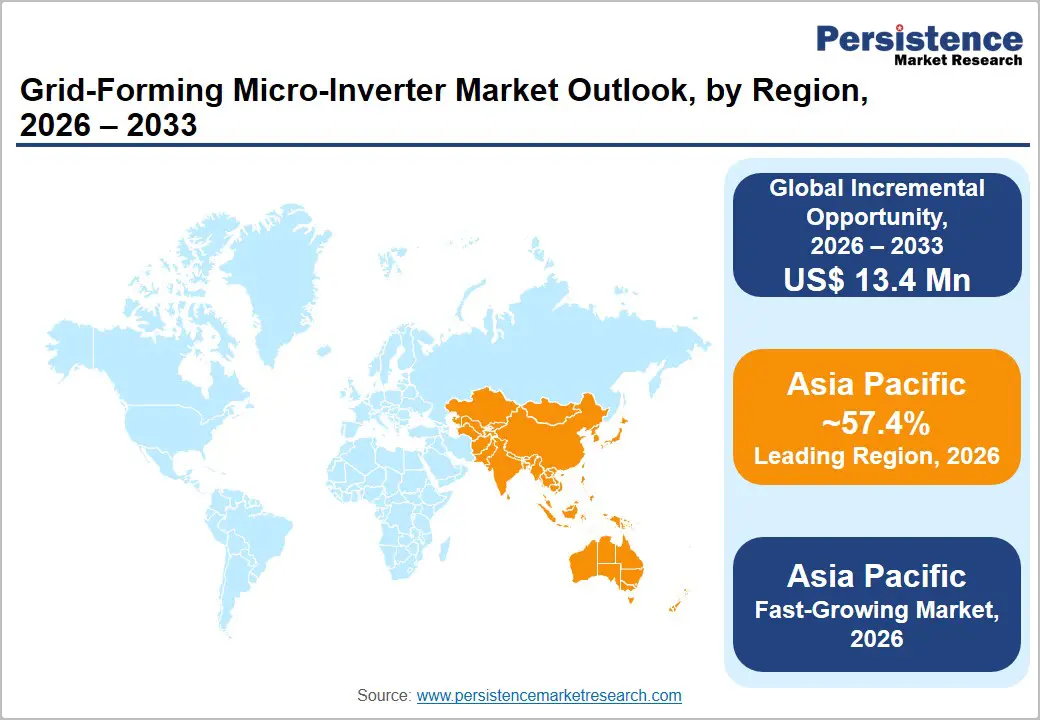
- Leading Region: Asia Pacific is projected to account for 57.4% market share, driven by large-scale photovoltaic manufacturing, strong distributed solar deployment, and continued investments in grid modernization.
- Fastest-growing Region: Asia Pacific is expected to register the highest growth through 2033, supported by rapid renewable energy expansion across China, India, Japan, and ASEAN economies
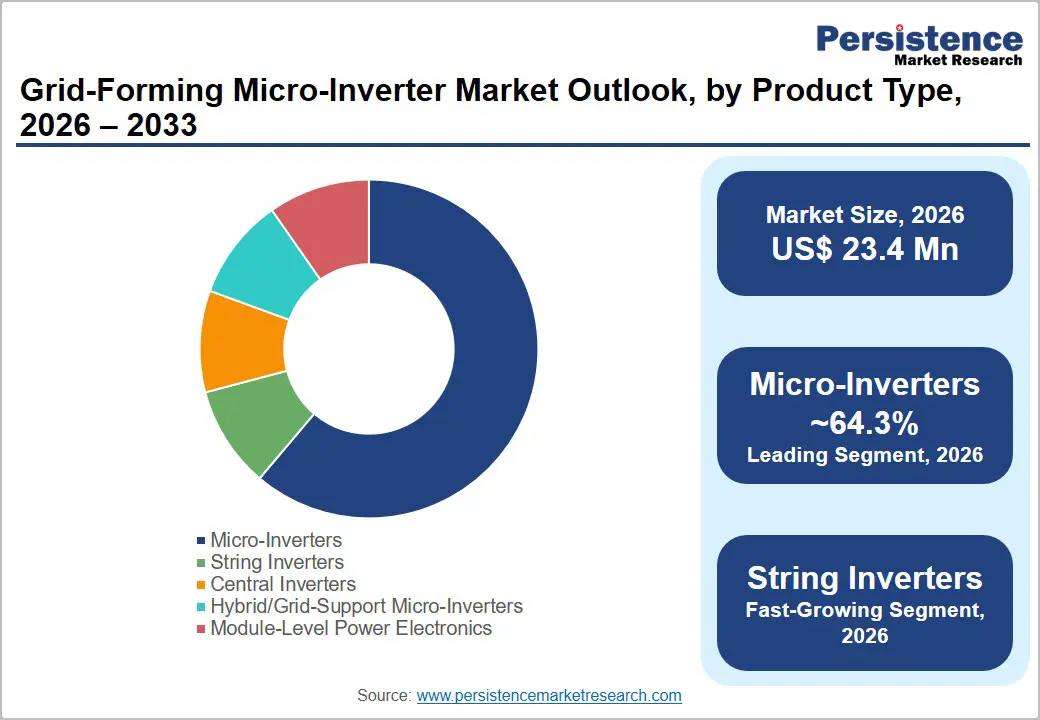
- Dominant Product Type: Micro-inverters are anticipated to account for approximately 64.3% of the market share in 2026, owing to their superior panel-level optimization, enhanced safety, and growing adoption in residential and commercial rooftop solar systems.
- Leading Power Rating: The below 10 kW segment is expected to hold 37.93% of the market in 2026, driven by strong adoption of residential rooftop solar and the benefits of micro-inverters, including panel-level optimization, enhanced safety, and higher energy yield.
DRO Analysis
Drivers - Growing Deployment of Distributed Solar Energy Systems
Distributed solar generation continues to expand worldwide as governments encourage renewable energy adoption through tax incentives, net-metering policies, and decarbonization initiatives. Residential and commercial rooftop installations are increasing because consumers seek lower electricity costs, greater energy independence, and reduced carbon emissions. Unlike conventional inverters, grid-forming micro-inverters actively regulate voltage and frequency while improving system stability, making them increasingly attractive as renewable penetration rises. Modern electricity networks require inverter technologies capable of supporting weak grids and maintaining reliable operation during fluctuations in renewable generation. As distributed energy resources become a larger portion of electricity production, demand for intelligent micro-inverter architectures is expected to accelerate steadily throughout the forecast period.
Increasing Investment in Grid Modernization and Energy Resilience
Electric utilities worldwide are investing heavily in transmission modernization, smart grids, distributed energy management systems, and battery storage infrastructure. As renewable electricity replaces conventional synchronous generation, grid operators require advanced inverter technologies capable of providing synthetic inertia, black-start capability, voltage regulation, and frequency stabilization. Grid-forming micro-inverters address these requirements by enabling distributed solar assets to contribute actively to overall grid reliability. Rising electricity demand, electrification of transportation, increasing climate-related power disruptions, and greater reliance on renewable generation are encouraging governments and utilities to integrate advanced inverter technologies into future grid planning. This transition significantly strengthens long-term market demand.
Restraint - High System Costs and Complex Grid Integration Requirements
Despite significant technological progress, grid-forming micro-inverters remain more expensive than conventional inverter technologies because they require sophisticated control algorithms, advanced semiconductor components, enhanced communication systems, and extensive certification testing. Installation costs also increase when systems incorporate battery storage and advanced energy management platforms. Furthermore, grid interconnection standards continue evolving across different countries, creating certification complexity for manufacturers serving multiple regions. Supply chain concentration for semiconductor devices and power electronics components may further increase procurement costs and extend product lead times. These factors can delay adoption among cost-sensitive residential consumers and smaller commercial installers despite the technology's long-term operational benefits.
Opportunities - Expansion of Solar-Plus-Storage and Microgrid Applications
Solar-plus-storage systems are emerging as one of the strongest growth opportunities for grid-forming micro-inverters. Businesses, residential users, healthcare facilities, educational institutions, military installations, and critical infrastructure increasingly require uninterrupted electricity during grid outages. Grid-forming micro-inverters enable battery-supported solar systems to operate independently while maintaining stable voltage and frequency, making them ideal for resilient microgrid applications. Growing investments in distributed energy infrastructure, coupled with declining battery costs, are expected to create substantial opportunities for manufacturers offering integrated solar, storage, and energy management solutions throughout the forecast period.
Rapid Renewable Energy Expansion across Emerging Economies
Emerging economies throughout Asia Pacific, Latin America, the Middle East, and Africa continue expanding renewable energy investments to improve electricity access while reducing dependence on fossil fuels. Urbanization, industrialization, and increasing electricity consumption are encouraging governments to support distributed renewable generation through favorable policy frameworks and investment incentives. Grid-forming micro-inverters provide enhanced reliability for regions experiencing weak grid infrastructure, making them particularly suitable for distributed generation projects. Manufacturers expanding localized production, regional partnerships, and country-specific certification capabilities are expected to capture significant growth opportunities as emerging markets accelerate renewable energy deployment
Category-wise Analysis
Product Type Insights
Micro-inverters are anticipated to account for approximately 64.3% of the market share in 2026, making them the leading product segment. Their dominance is driven by panel-level optimization, higher energy yield, improved safety, and simplified system expansion. Unlike centralized architectures, micro-inverters minimize shading losses and improve system reliability through distributed power conversion. Solutions such as Enphase Energy's IQ8 Series and APsystems' DS3 platform demonstrate the growing preference for module-level intelligence in residential and small commercial rooftop installations.
String inverters are expected to record the fastest growth among adjacent technologies as commercial rooftop projects increasingly prioritize lower installation costs and simplified maintenance. Hybrid grid-support micro-inverters are also gaining traction for battery-integrated systems that require backup power and grid-forming capabilities. For example, Sungrow and GoodWe continue expanding hybrid inverter portfolios to support distributed solar-plus-storage applications.
Power Rating Insight
The Below 10 kW segment is anticipated to account for approximately 37.93% of the market share in 2026, making it the leading power rating category. Its dominance is driven by the widespread adoption of residential rooftop solar systems, where micro-inverters provide superior panel-level optimization, enhanced safety, simplified installation, and higher energy yield. This power range is ideally suited for single-family homes, small residential buildings, and distributed solar installations, making it the primary application area for grid-forming micro-inverter technology.
The Below 10 kW segment is also expected to register the fastest growth during the forecast period, supported by the rapid expansion of residential rooftop solar installations and increasing homeowner investments in battery-integrated solar systems. Rising demand for energy independence, backup power, and smart home energy management is accelerating the deployment of advanced grid-forming micro-inverters in this capacity range, particularly across North America, Europe, and Asia-Pacific.
Regional Insights
North America Grid-Forming Micro-Inverter Market Trends
North America is one of the most technologically advanced markets for grid-forming micro-inverters, driven by strong renewable energy investments, mature rooftop solar adoption, and extensive grid modernization initiatives. The region benefits from favorable clean energy policies, increasing battery storage deployment, and growing investments in distributed energy resources (DERs). Utilities are increasingly adopting advanced inverter technologies capable of improving voltage regulation, frequency stability, and grid resilience as renewable energy penetration continues to rise.
U.S. Grid-Forming Micro-Inverter Market Trends
The U.S. dominates the regional market owing to widespread residential rooftop solar installations, rising battery energy storage adoption, and continuous investments in smart grid infrastructure. Federal tax incentives, state-level renewable energy programs, and evolving grid interconnection standards continue to support demand for advanced micro-inverter technologies.
California remains the leading state due to its large installed rooftop solar base and battery storage capacity, while Texas, Florida, Arizona, and New York are witnessing strong growth driven by expanding residential and commercial solar deployments. Growing adoption of virtual power plants (VPPs), home energy management systems, and resilient backup power solutions further supports market expansion.
Canada Grid-Forming Micro-Inverter Market Trends
Canada is steadily expanding its distributed solar market through provincial clean energy initiatives and investments in grid modernization. Increasing deployment of commercial rooftop solar systems, particularly in Ontario and Alberta, coupled with rising demand for resilient energy infrastructure, is creating new opportunities for grid-forming micro-inverter manufacturers. Continued electrification and renewable energy investments are expected to support long-term market growth.
Europe Grid-Forming Micro-Inverter Market Trends
Europe remains a significant market for grid-forming micro-inverters, supported by ambitious climate targets, renewable energy expansion, and long-term energy security strategies. The region continues accelerating distributed solar deployment through favorable regulations, rooftop solar incentives, and investments in battery storage and smart grid infrastructure. Increasing renewable energy penetration is encouraging utilities to deploy advanced inverter technologies capable of maintaining grid stability and supporting distributed energy resources.
Germany Grid-Forming Micro-Inverter Market Trends
Germany leads the European market through its extensive residential rooftop solar installations, advanced energy transition policies, and strong adoption of battery storage systems. Continued investments in decentralized energy generation and commercial rooftop solar projects are driving demand for intelligent micro-inverter technologies capable of supporting grid-forming functions.
U.K. Grid-Forming Micro-Inverter Market Trends
The U.K. is witnessing growing adoption of distributed solar systems supported by decarbonization policies, commercial rooftop installations, and investments in smart electricity networks. Increasing focus on energy resilience and grid flexibility continues to strengthen demand for advanced inverter solutions.
Asia Pacific Grid-Forming Micro-Inverter Market Trends
Asia Pacific dominates the global grid-forming micro-inverter market, accounting for approximately 57.4% of the global market revenue in 2026, and is projected to remain the fastest-growing regional market throughout the forecast period. The region benefits from large-scale photovoltaic manufacturing, rapid urbanization, expanding distributed solar deployment, and substantial government investment in renewable energy infrastructure. Strong electronics manufacturing capabilities and competitive production costs further accelerate technology commercialization and adoption.
China Grid-Forming Micro-Inverter Market Trends
China represents the largest market due to its world-leading photovoltaic manufacturing capacity, extensive domestic solar installations, and continuous investments in smart grid modernization. The country's vertically integrated solar supply chain and strong policy support continue driving innovation in advanced inverter technologies, including grid-forming micro-inverters.
Japan Grid-Forming Micro-Inverter Market Trends
Japan continues expanding resilient distributed energy systems as energy security, disaster preparedness, and battery storage adoption remain national priorities. Residential solar coupled with energy storage systems is creating favorable conditions for advanced micro-inverter deployment across both residential and commercial sectors.
India Grid-Forming Micro-Inverter Market Trends
India is emerging as one of the fastest-growing markets in the region due to ambitious renewable energy targets, expanding rooftop solar programs, rapid urbanization, and increasing electricity demand. Government initiatives supporting distributed solar generation and commercial rooftop installations are expected to significantly increase demand for intelligent micro-inverter solutions over the coming years.
Competitive Landscape
The global grid-forming micro-inverter market remains moderately fragmented, with several global and regional manufacturers competing through technological innovation, product reliability, software integration, and distribution network expansion. Leading companies continue investing in advanced power electronics, intelligent energy management platforms, battery compatibility, and digital monitoring capabilities to strengthen their competitive positions. Market competition is expected to intensify as distributed energy resources become increasingly important within future electricity systems.
Leading manufacturers continue emphasizing technological innovation, product differentiation, software-enabled energy management, battery storage integration, strategic geographic expansion, and stronger installer partnerships. Companies are increasingly transitioning from standalone inverter suppliers toward comprehensive distributed energy solution providers capable of integrating solar generation, storage, electric vehicle charging, monitoring platforms, and intelligent energy management into unified customer ecosystems.
Key Industry Developments:
- In February 2026, APsystems officially launched its EZ1 Plug-in Microinverter in the U.S., expanding its residential product portfolio with a simplified plug-and-play solution designed for balcony and small-scale distributed solar installations.
- In May 2025, Enphase Energy launched the IQ® Balcony Solar System in Germany, a plug-and-play solar solution powered by IQ8 Microinverters, targeting apartment dwellers and homeowners with limited rooftop space while expanding its distributed solar portfolio in Europe.
Companies Covered in Grid-Forming Micro-Inverter Market
- Enphase Energy
- APsystems
- Hoymiles
- Tigo Energy
- SMA Solar Technology
- Sungrow Power Supply
- Huawei Digital Power
- GoodWe Technologies
- Growatt New Energy
- Ginlong Solis
- Deye
- Fronius International
- Delta Electronics
- Schneider Electric
- FIMER
- SolarEdge
Frequently Asked Questions
The global grid-forming micro-inverter market is estimated to be valued at US$23.4 million in 2026.
The grid-forming micro-inverter market is projected to reach US$36.8 million by 2033.
Major trends include increasing deployment of distributed solar PV, growing adoption of solar-plus-storage systems, rising investments in grid modernization, expansion of virtual power plants (VPPs), and increasing demand for intelligent grid-forming inverters that enhance grid stability and energy resilience.
Micro-inverters are the leading product segment, anticipated to account for approximately 64.3% of the global market, driven by their superior panel-level optimization, improved safety, and strong adoption across residential and commercial rooftop solar applications.
The grid-forming micro-inverter market is expected to grow at a CAGR of 6.7% between 2026 and 2033.
Major companies with strong product portfolios include GoodWe, Growatt, Deye, and Delta.


