




- Pharmaceuticals
- Glucosamine Supplements Market
Glucosamine Supplements Market Size, Share, and Growth Forecast 2026 - 2033
Glucosamine Supplements Market by Source (Shellfish, Vegetarian), Formulation (Capsules, Tablets), Distribution Channel (Online Retail, Pharmacy), End-User (Athletes, Senior Citizens), and Regional Analysis, 2026 - 2033

Glucosamine Supplements Market Size and Trends Analysis
The global glucosamine supplements market size is likely to be valued at US$5.7 billion in 2026 and is estimated to reach US$8.1 billion by 2033, growing at a CAGR of 5.3% during the forecast period from 2026 to 2033, driven by the rising focus on joint health and healthy aging, surging participation in fitness and sports activities, and increasing consumer preference for preventive wellness and convenient supplement formats.
Key Industry Highlights:
- Leading Source: Shellfish, about 40.8% share in 2026, as shrimp and crab shells provide chitin, an established raw material for commercial glucosamine production.
- Dominant Formulation: Capsules, around 48.5% share in 2026, as these provide a convenient and precise way to deliver relatively high glucosamine doses, including commonly used 1,500-mg daily regimens.
- Leading Region: North America, with about 42.3% share in 2026, due to a mature dietary-supplement industry, strong consumer awareness of joint-health products, and extensive retail and online distribution.
- Fast-growing Region: Asia Pacific, backed by a large aging population, expanding nutraceutical consumption, growing regional research, and clinical interest in glucosamine.
- Latest Study: In July 2026, researchers published a network meta-analysis comparing glucosamine plus chondroitin with celecoxib, probiotics, krill oil, and metformin for knee osteoarthritis. The study reflects continued research into where glucosamine combinations may fit within broad multimodal approaches to osteoarthritis management.
DRO Analysis
Driver - Rising Fitness Participation to Push Demand for Joint Support Solutions
Surging participation in fitness, recreational sports, walking, running, and other physical activities is increasing consumer attention toward joint mobility and recovery. This creates a broader customer base for glucosamine supplements beyond people already diagnosed with osteoarthritis. Products are now positioned for consumers who want to maintain mobility while following active lifestyles.
This is also encouraging brands to combine glucosamine with other ingredients such as chondroitin, MSM, turmeric, and botanical extracts. Such combinations allow companies to target different joint-health needs within a single product. However, product positioning needs to remain evidence-based because the National Institutes of Health (NIH) notes that studies of glucosamine for knee osteoarthritis have produced conflicting results.
Healthy Aging to Encourage Early Focus on Mobility
The growing emphasis on healthy aging is encouraging consumers to pay attention to mobility before serious limitations develop. Osteoarthritis becomes more common with age, and the condition affects more than 32 million adults in the U.S. alone. This creates a large population interested in maintaining normal movement and joint function. Glucosamine supplements benefit from strong consumer familiarity because they have been studied and marketed for joint health for decades.
The availability of capsules, powders, gummies, and combination products also makes it easier for brands to integrate joint-support supplements into daily wellness routines. At the same time, increasing consumer awareness means companies need to differentiate products through ingredient quality, dosage transparency, and credible evidence rather than relying only on broad joint-health claims.
Restraint - Digestive Discomfort May Limit Regular Use
Gastrointestinal complaints can restrict long-term adherence among some glucosamine users. Reported problems can include stomach upset, nausea, heartburn, diarrhea, and constipation. Cochrane's review identified stomach upset among the reported side effects in glucosamine trials, although overall adverse-event rates were generally similar to placebo.
NCCIH likewise reports that large studies have not identified major safety problems, but notes potential concerns such as changes in blood glucose and interaction with warfarin. These considerations can encourage consumers to stop supplementation or seek alternative joint-health ingredients. They also increase the importance of clear labeling and appropriate consumer guidance.
Opportunity - Vegan Formulas to Expand the Addressable Consumer Base
Plant-derived glucosamine provides an opportunity to reach consumers who avoid shellfish or animal-derived ingredients. Conventional glucosamine is commonly produced from chitin obtained from shellfish, but commercially available products now also use corn-derived glucosamine. This gives manufacturers an additional route to develop vegan and shellfish-free formulations. It can also help brands address consumers who are concerned about shellfish allergies. The opportunity extends beyond a simple source change.
Companies can combine plant-derived glucosamine with vegan chondroitin alternatives, botanical ingredients, and clean-label excipients to create products aimed at the growing plant-based supplement segment. The NIH Dietary Supplement Label Database already contains products using non-GMO corn-derived glucosamine, confirming that this approach has moved into commercial products.
Clinical Validation to Strengthen Product Differentiation
There is an opportunity for manufacturers to compete through stronger clinical validation and standardized formulations. Evidence for glucosamine is not uniform. NIH notes that different clinical guidelines have reached different conclusions, with some recommending against glucosamine while other guidance has recognized possible benefits for selected patients or specific preparations.
This creates room for companies to distinguish products based on the specific glucosamine form, dosage, manufacturing quality, and supporting clinical evidence. Research focused on standardized glucosamine sulfate may be particularly valuable because different formulations should not automatically be treated as equivalent. Brands can also use third-party quality testing and transparent labeling to build consumer confidence. This approach could shift competition away from basic price comparisons toward evidence, consistency, and formulation quality.
Category-wise Analysis
Source Insights
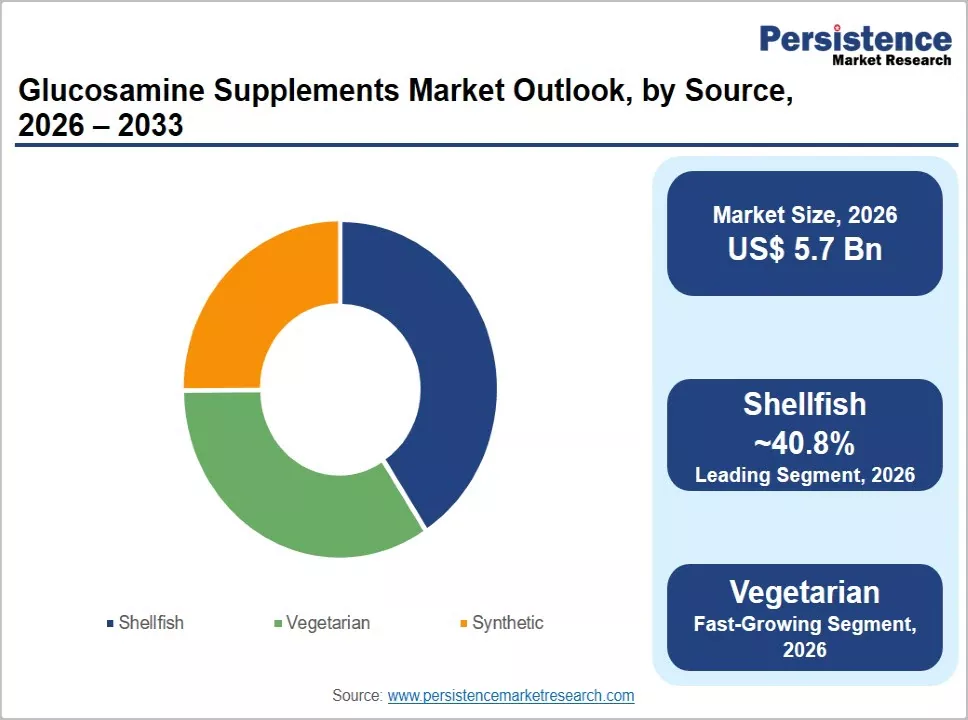
Shellfish is predicted to lead with a share of about 40.8% in 2026, as glucosamine has traditionally been produced from chitin found in shrimp and crab shells, creating an established and scalable raw-material supply chain; NIH sources identify shellfish-derived chitin as the primary traditional U.S. source. The source is also commercially attractive because shellfish processing generates large quantities of shells containing chitin, which can be processed into glucosamine rather than requiring a completely new feedstock system.
Vegetarian glucosamine is estimated to be the fastest-growing type over the forecast period, as manufacturers can offer non-animal alternatives for consumers avoiding shellfish or animal-derived ingredients. NIH's Dietary Supplement Label Database already documents glucosamine products derived from non-GMO corn and marketed as vegetarian or vegan, demonstrating established commercial demand for this source. The segment also benefits from allergen avoidance and broader clean-label positioning.
Formulation Insights
Capsules are anticipated to dominate with a share of around 48.5% in 2026, as they can deliver a relatively high glucosamine dose in a convenient, familiar format without requiring consumers to measure or mix the ingredient; NIH-listed products commonly provide glucosamine in capsule form, including products delivering 1,500 mg per daily serving. Capsules further allow manufacturers to combine glucosamine with ingredients such as MSM, chondroitin, turmeric, or botanical extracts while maintaining a portable dosage format.
Powder is expected to be the fastest-growing, as it allows manufacturers to provide higher-dose glucosamine in drinks and other functional products without requiring consumers to swallow several large capsules. It also fits the broader shift toward mixable supplements and sports-nutrition products, where consumers already use powders in water, shakes, and other beverages. The format provides room for combination formulas and flavored products, although taste, solubility, and dosing accuracy remain important formulation challenges.
Regional Insights
North America Glucosamine Supplements Market Trends
North America is predicted to dominate with a global share of approximately 42.3% in 2026, as it has an established dietary-supplement ecosystem, strong consumer familiarity with glucosamine, and extensive access through pharmacies, health stores, supermarkets, specialist nutrition retailers, and e-commerce. The U.S. is particularly important because glucosamine is already a well-established dietary supplement rather than a new category. NIH reports that about half of U.S. adults use dietary supplements, while its 2025-2029 strategic plan identifies more than 100,000 dietary supplement products in the U.S. market.
U.S. Glucosamine Supplements Market Trends
In North America, a share of nearly 56.8% is expected to be held by the U.S. in 2026, supported by a large population with joint-health concerns and a highly developed supplement distribution system. NCCIH estimates that more than 32 million U.S. adults have osteoarthritis, with risk increasing with age. Joint injury, obesity, and family history can also increase the risk. This creates sustained consumer interest in products positioned around mobility and joint support. The country's strong e-commerce infrastructure is another important factor. Consumers can compare dosage, ingredient sources, certifications, and formulation types before purchasing.
Asia Pacific Glucosamine Supplements Market Trends
Asia Pacific is anticipated to be the fastest-growing region globally in 2026, with a share of around 29.3%, due to a large population, rising disposable incomes in several economies, increasing awareness of dietary supplements, and growing interest in healthy aging.
The region also has established pharmaceutical and nutraceutical manufacturing capabilities, allowing companies to produce and distribute joint-health products at different price points. Another important factor is the increasing integration of Western-style supplements into established health and wellness practices. Consumers in countries such as China, Japan, South Korea, India, and Australia have access to both domestic and international nutraceutical brands.
China Glucosamine Supplements Market Trends
China will likely lead in Asia Pacific in 2026 with a share of about 37.5%, as it has a large potential consumer base for mobility and healthy-aging products. Its aging population is increasing interest in products associated with maintaining physical function and quality of life. China's nutraceutical and pharmaceutical manufacturing capabilities allow domestic companies to participate across the ingredient, formulation, and finished-product stages. E-commerce is particularly important. Consumers can access domestic brands as well as imported supplements through online retail channels. This has widened the range of glucosamine formulations available to consumers and increased competition
India Glucosamine Supplements Market Trends
In 2026, India is projected to account for a share of just about 26.2% in Asia Pacific, supported by its large population, expanding nutraceutical sector, and growing consumer interest in preventive health. The country also has a strong pharmaceutical manufacturing ecosystem, which provides technical capabilities for producing standardized active ingredients and finished formulations. A further advantage is the growing availability of supplements through pharmacies and online platforms. This allows consumers outside major metropolitan areas to access joint-health products more easily than in the past.
Europe Glucosamine Supplements Market Trends
Europe will witness steady growth over the forecast period with a share of roughly 17.7% in 2026 globally. Its development is closely linked to differences in regulatory treatment and clinical evidence across countries. Certain glucosamine preparations are treated as medicines in some European markets, while other products are sold as supplements. This distinction is commercially important because local consumers may encounter products with different regulatory status, dosage standards, and evidence requirements. NCCIH notes that the European ESCEO position has specifically distinguished prescription crystalline glucosamine sulfate from other glucosamine formulations.
Germany Glucosamine Supplements Market Trends
Germany is predicted to register a substantial share of approximately 33.6% in 2026 in Europe, as consumers have strong access to pharmacies, health retailers, and established supplement brands. The country's health-product market also places considerable emphasis on product quality and consumer information. For glucosamine manufacturers, this creates opportunities for products with clear dosage information, standardized ingredients, and transparent sourcing. Pharmacy and health-store channels can be particularly relevant for products positioned toward older consumers seeking mobility support.
U.K. Glucosamine Supplements Market Trends
In Europe, a share of nearly 20.3% is predicted to be held by the U.K. in 2026, backed by pharmacies, health retailers, supermarkets, and online platforms. Glucosamine has been familiar to British consumers for several years, mainly among people interested in joint and mobility products. The country's large research infrastructure also contributes to continued interest in glucosamine. Researchers have used data from the UK Biobank to investigate associations between supplement use and health outcomes, creating a substantial evidence base for studying dietary supplements in a large population.
Competitive Landscape
The global glucosamine supplements market is fragmented, with competition spread across large supplement companies, specialist joint-health brands, pharmaceutical-grade ingredient suppliers, and regional nutraceutical manufacturers. Companies compete through glucosamine sulfate versus hydrochloride formulations, combination products containing chondroitin or MSM, vegetarian sources, dosage formats, and quality certifications. The market also has a strong branded-product layer.
Companies such as Nutramax, NOW Foods, Nature’s Bounty, Solgar, Doctor’s Best, Swanson, Life Extension, GNC, Blackmores, Holland & Barrett, and Jamieson offer glucosamine products. The wide variation in clinical evidence also makes formulation quality and ingredient standardization important areas of differentiation. NCCIH notes that evidence for glucosamine in knee osteoarthritis remains inconsistent, while different clinical guidelines have reached different conclusions.
Key Industry Developments:
- In September 2025, SUPPLE Pets launched Hip & Joint Care Chews containing human-grade glucosamine and European pharmaceutical-grade chondroitin. The launch shows how established human joint-health ingredient expertise is also being extended into the companion-animal segment.
- In July 2025, SUPPLE introduced its Premium Glucosamine & Chondroitin and Boswellia products through its SUPPLE Squad initiative, targeting military personnel, veterans, first responders, and working K9 communities. The company positioned the products around joint comfort, mobility, flexibility, and physical demands.
- In January 2025, Pilly Labs launched its Joint Support Gummies, combining glucosamine sulfate with chondroitin, MSM, turmeric, ginger, and black pepper extract. The launch illustrates the industry's move beyond conventional tablets and capsules toward easier-to-consume gummy formats.
Companies Covered in Glucosamine Supplements Market
- Nutramax Laboratories
- NOW Foods
- Nature's Bounty
- Solgar
- Doctor's Best
- Swanson Health Products
- Life Extension
- GNC Holdings
- Jarrow Formulas
- Kirkland Signature
- Blackmores
- Holland & Barrett
- Jamieson Wellness
- Webber Naturals
- Douglas Laboratories
- Others
Frequently Asked Questions
The global glucosamine supplements market is projected to be valued at US$5.7 billion in 2026.
The glucosamine supplements market is expected to reach US$8.1 billion by 2033.
Key market trends include plant-derived glucosamine, combination formulas, and convenient formats such as gummies and powders.
Shellfish is expected to be the leading source with a share of around 40.8% in 2026, due to its established processing infrastructure and availability as a by-product of seafood processing.
The glucosamine supplements market is expected to grow at a CAGR of 5.3% from 2026 to 2033.
Nutramax Laboratories, NOW Foods, and Nature's Bounty are a few key market players.


