




- Specialty & Fine Chemicals
- Fracking Water Treatment Market
Fracking Water Treatment Market Size, Share, and Growth Forecast 2026 - 2033
Fracking Water Treatment Market by Water Source (Flowback Water, Produced Water), Process (Media Filtration, Electrocoagulation, Reverse Osmosis), Application (Treatment and Recycle), and Regional Analysis, 2026 - 2033

Fracking Water Treatment Market Size and Trends Analysis
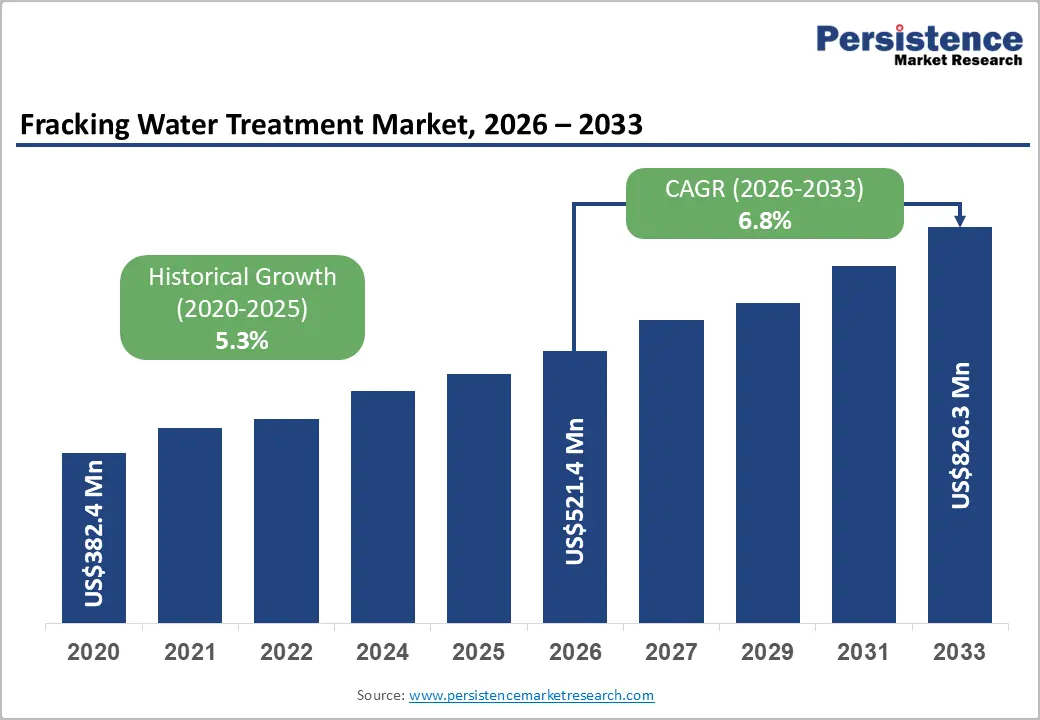
The global fracking water treatment market size is likely to be valued at US$521.4 million in 2026 and is expected to reach US$826.3 million by 2033, growing at a CAGR of 6.8% during the forecast period from 2026 to 2033, driven by rising need for produced water recycling, increasing shale oil and gas exploration activities, and strict environmental regulations on wastewater disposal. Growth is further supported by the shift toward water reuse to reduce freshwater dependency.
Key Industry Highlights:
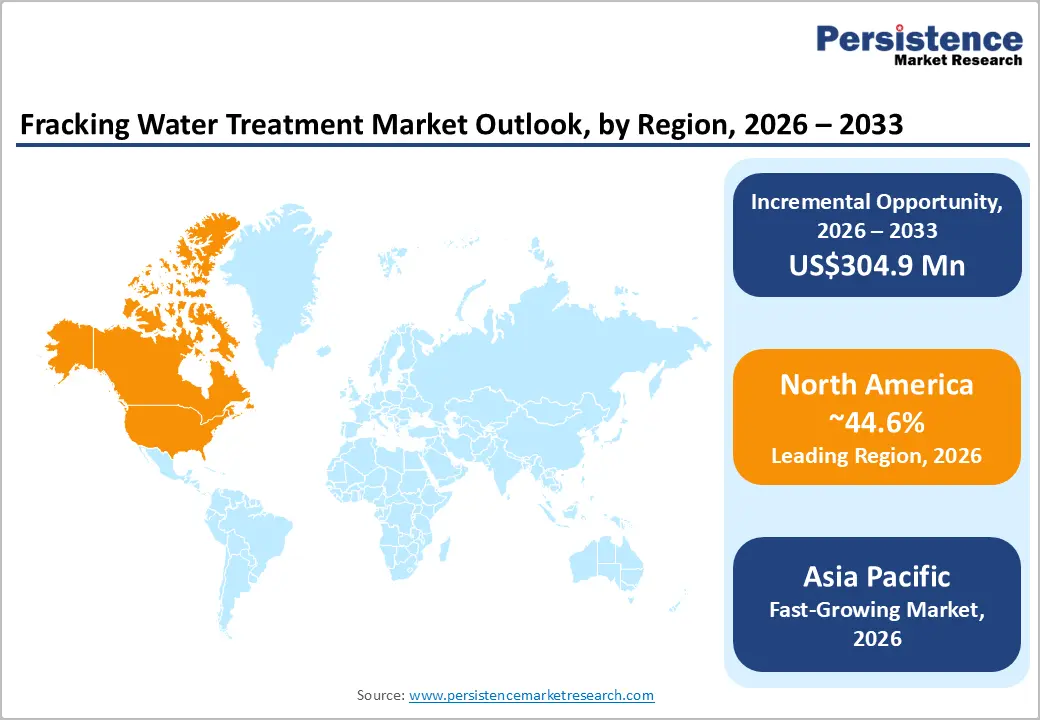
- Leading Region: North America, with about 44.6% share in 2026, owing to its mature shale industry and strict wastewater disposal regulations.
- Fast-growing Region: Asia Pacific, spurred by rising unconventional drilling in countries such as China and increasing government focus on water reuse.
- Leading Water Source: Produced water, approximately 66.3% share in 2026, as aging wells produce high water-to-oil ratios, thereby increasing its volume significantly over time.
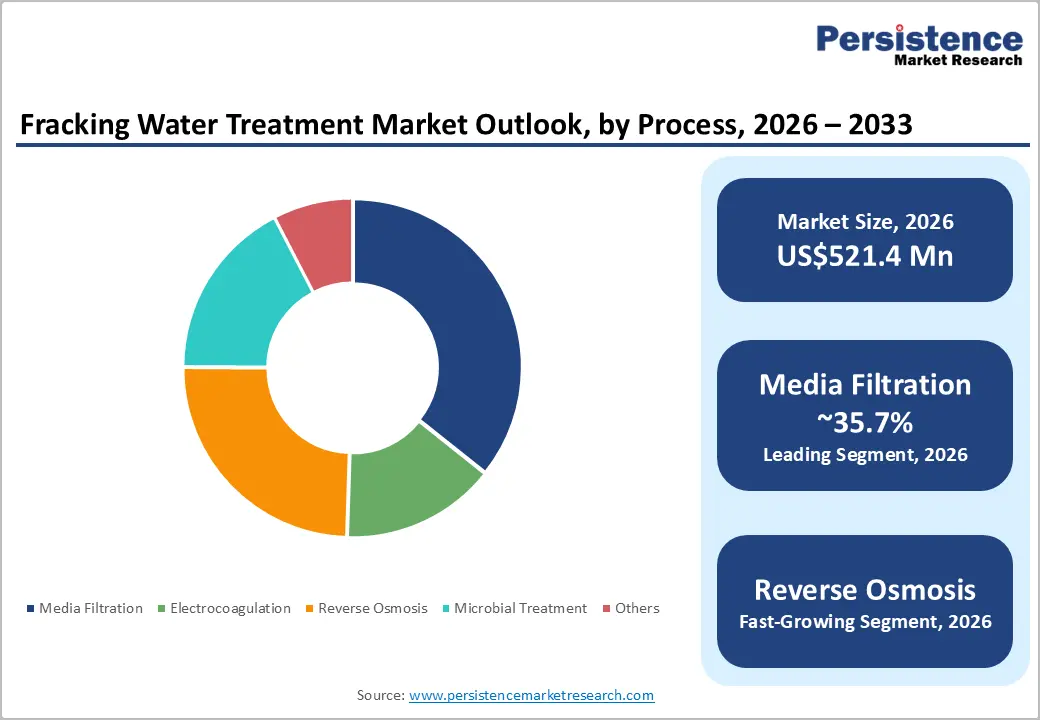
- Dominant Process: Media filtration, nearly 35.7% in 2026, as it delivers a low-cost and high-volume solution for removing suspended solids.
- Latest Collaboration: In October 2025, WaterTectonics, in partnership with Clearvale Capital, launched WT Oil & Gas. It is a new subsidiary formed to deliver high-volume produced water recycling and reuse solutions for operators across the Permian and Delaware Basins.
DRO Analysis
Driver - High Wastewater Output from Hydraulic Fracturing Operations
The sheer volume of water produced during fracking has made treatment an operational necessity, not a choice. The Permian Basin alone generates an estimated 168 billion gallons of produced water annually, according to a 2022 report. What makes this particularly pressing is the rate of growth. A Duke University study found that wastewater volumes from fracked wells surged by 1,440% between 2011 and 2016.
On a per-well basis, a single horizontal well uses nearly 45 million liters of water on average, according to the Groundwater Protection Council. Further, a 2024 study published in Nature Water, analyzing over 620,000 wells across North America, found that more than 355 billion tons of salts were produced from 2005 to 2019. Hydraulic fracturing wells contributed to over 85% of that total. These numbers continue to trend upward, pushing operators toward structured treatment solutions.
Strict Government Rules on Wastewater Disposal and Discharge
Regulatory pressure from both federal and state agencies has become a catalyst for treatment investment. The U.S. Environmental Protection Agency (EPA) established pretreatment standards in 2016 that prohibit discharges of wastewater pollutants from onshore unconventional oil and gas facilities into publicly owned treatment works. States are now adding their own layers of oversight.
New Mexico's Environmental Department proposed supplemental regulations focused specifically on produced water from oil and gas operations, with public hearings held throughout 2024. In Texas, the Texas Commission on Environmental Quality received four permit applications in 2023 and 2024 to discharge treated produced water, each requiring proof of treatment compliance before approval. These evolving mandates are augmenting operators to move beyond simple deep-well injection toward verifiable and technology-backed treatment processes.
Restraint - Hazardous Solid Waste Left Behind After Treatment
While treatment removes contaminants from wastewater, it concentrates them into a solid byproduct that creates its own disposal problem. This byproduct is called TENORM or Technologically Enhanced Naturally Occurring Radioactive Material. According to the EPA, TENORM in oil and gas operations is found in sludge, sediments, pipe scale, and filters, with radium being especially mobile in groundwater due to its solubility.
Under the Resource Conservation and Recovery Act (RCRA), oil and gas waste is not classified as hazardous waste. TENORM-laden sludge often ends up in nearby landfills or incinerators with little formal oversight. Landfills used for this purpose can remain contaminated for thousands of years, with leachate seeping into ground and surface water supplies. Until a standardized disposal pathway for TENORM sludge exists, this byproduct will remain a serious long-term liability for operators investing in treatment infrastructure.
Opportunity - Next-Generation Membrane Systems for High-Salinity Produced Water
Standard reverse osmosis membranes cap out at around 80,000 mg/L TDS, i.e., well below the salinity levels found in multiple produced water streams. New ultra-high pressure RO membranes rated for 1,740 psi raise the practical concentration limit to 130,000 mg/L TDS, a 1.6x improvement over conventional seawater-grade membranes. Saltworks Technologies' XtremeRO system is one commercial example of this. XtremeRO concentrates brine up to 130,000 mg/L TDS, while its FusionRO hybrid pushes performance further to over 200,000 mg/L TDS using cascading ultra-high pressure RO and nanofiltration loops.
Compared to thermal evaporation, XtremeRO is around three times more energy efficient, which significantly lowers operating costs for operators facing high disposal volumes. These systems reduce the volume of brine requiring final disposal, cutting both cost and environmental exposure. This is a compelling combination as disposal well capacity tightens in key basins such as the Permian.
On-Site Treatment through Mobile and Modular Systems
Trucking produced water to off-site disposal facilities adds significant cost and carbon load to fracking operations. Mobile treatment units eliminate this by processing water directly at the wellpad. In late 2023, Halliburton introduced a compact mobile treatment system that reportedly reduces total dissolved solids by over 90%, cutting disposal volumes by half. It is a meaningful gain for remote shale basins with limited infrastructure. The emissions case is equally clear.
A project funded by Emissions Reduction Alberta found that recycling fracking water on-site is projected to cut CO2 emissions by approximately 42% by reducing the requirement for water transport and disposal trucking. Companies such as Ecologix have built their market position around this model, delivering mobile and modular units designed specifically for rapid deployment in U.S. shale basins, with a focus on reducing trucking miles, disposal costs, and freshwater dependency. As ESG reporting requirements surge and fuel costs remain high, the economics of on-site treatment are becoming difficult to ignore.
Category-wise Analysis
Water Source Insights
Produced water is predicted to lead with a share of approximately 66.3% in 2026, as it is continuously generated throughout the life of a well. Produced water starts flowing after the initial fracking phase and continues for years during oil and gas production. This makes it far more abundant than any other source. According to the EPA, produced water can account for the largest share of wastewater generated from oil and gas operations, especially in mature wells where water output increases as hydrocarbons decline. This steady and long-term availability makes it the main feedstock for treatment and reuse systems.
The flowback water segment is estimated to be the fastest-growing over the forecast period, due to high intensity fracking designs. Flowback water returns to the surface in the first few weeks after hydraulic fracturing. Its growth is linked to changes in well design. Operators now use longer laterals and inject large fluid volumes per well. The U.S. Geological Survey has highlighted that modern shale wells use significantly more water than older designs, leading to higher flowback volumes.
Process Insights
The media filtration segment is anticipated to dominate with a share of nearly 35.7% in 2026, as it is simple, low-cost, and effective for bulk solids removal. Media filtration is widely used as the first treatment step. It removes suspended solids, sand, and debris before advanced treatment. The U.S. Department of Energy has noted in its produced water treatment reports that pre-treatment steps such as media filtration are essential to protect downstream systems, including membranes. The process is easy to deploy in remote oilfields and does not require complex infrastructure.
The Reverse Osmosis (RO) segment is expected to remain in the second position in 2026, as operators want high-quality reusable water. RO is gaining traction as companies aim for near-complete water recycling. Traditional methods cannot remove dissolved salts effectively, but RO can produce high-purity water suitable for reuse in fracking. The National Energy Technology Laboratory, under the U.S. DOE, has published studies showing that advanced membrane systems are becoming more viable due to improvements in fouling resistance and energy efficiency. In regions facing water scarcity and strict discharge rules, operators are investing in RO to reduce dependence on freshwater sources.
Regional Insights
North America Fracking Water Treatment Market Trends
North America is predicted to dominate with a share of approximately 44.6% in 2026, as no other region comes close in terms of raw fracking volume and the infrastructure built around it. The region is being pushed by its extensive shale gas and oil production infrastructure in the U.S., which includes key formations such as the Permian Basin, Marcellus, and Bakken.
Stringent regulations governing wastewater management, combined with a rising emphasis on water recycling and sustainability, have further fueled market growth. Canada adds to this through Alberta and British Columbia, where significant shale reserves are actively developed. The presence of established oil and gas companies and technological developments in water treatment infrastructure bolster market growth across both countries.
U.S. Fracking Water Treatment Market Trends
In 2026, the U.S. is estimated to account for a share of nearly 82.3% in North America. The country's major shale basins each present distinct water management dynamics. In the Marcellus region of Pennsylvania, limited underground injection capacity compelled early adoption of water recycling and reuse. Operators there have effectively avoided the seismic and cost risks now facing peers in Texas who relied heavily on deep-well injection. The intensity of this recycling effort is striking. Pennsylvania's geology and state regulations have resulted in fewer than 15 permitted saltwater disposal facilities in the state, culminating in the recycle of approximately 90% of produced water generated there.
Asia Pacific Fracking Water Treatment Market Trends
Asia Pacific is anticipated to be the fastest-growing region with a share of around 26.7%, as the region is still in the early stages of building its fracking and water treatment infrastructure. Countries such as China and India increasingly explore shale gas reserves to meet rising energy demands. Government targets are directly fueling this.
China's National Energy Administration has set ambitious targets for natural gas production, aiming to increase its share in the energy mix. Its focus on shale gas development is anticipated to push demand for advanced water treatment systems in the region. Australia is also contributing through broadened unconventional gas production. Beyond production growth, water scarcity is making treatment a necessity rather than a choice across much of Asia Pacific.
China Fracking Water Treatment Market Trends
China holds the most shale gas outside of North America, but the path to commercializing those reserves is water-intensive. It is precisely what is augmenting water treatment demand. Between 2012 and 2022, a total of 2,740 shale gas wells were hydraulically fractured in the country, primarily in Sichuan and Chongqing Province, consuming 113 million cubic meters of water and generating 8.56 million cubic meters of flowback and produced water annually as of 2022. Production has been growing fast. China's shale gas output has grown at 21% annually since 2017, with a long-term national energy strategy calling for continued expansion, requiring over 6,000 new wells to be drilled in the Yangtze River Basin alone.
India Fracking Water Treatment Market Trends
India's growth is tied to its long-term energy ambitions, even though large-scale fracking has not yet begun. The country has confirmed shale resources across multiple basins and has started moving toward commercial-scale extraction. India has characterized shale gas as a transitional energy source and has announced 56 fracking projects spread across six states, with shale gas exploration already underway. Cairn Oil & Gas has taken a notable step in this direction by partnering with Halliburton to start shale exploration in the Lower Barmer Hill formation in Western Rajasthan.
Europe Fracking Water Treatment Market Trends
Europe is predicted to showcase decent growth over the forecast period and generate a share of nearly 16.8% in 2026. Most countries in Western Europe have either banned or heavily restricted onshore fracking, yet offshore production, mainly in the North Sea, continues to generate significant produced water volumes that require treatment.
Europe's market is being driven by its commitment to environmentally sustainable treatment solutions as energy demands evolve. The regulatory environment is a double-edged sword. Strict standards slow new development but ensure that whatever production does occur requires high-quality treatment. Poland holds promise as an outlier. It has substantial shale gas reserves and the government has shown interest in developing the industry.
Norway Fracking Water Treatment Market Trends
Norway leads in Europe as it has the most active offshore fracking program on the continent, paired with some of the world's strictest produced water discharge regulations. The country established a zero-discharge target for hazardous substances released from petroleum activities as far back as 1997. Produced water discharges are regulated both at the national level through the Pollution Control Act and internationally through the OSPAR Convention. OSPAR requires that oil content in produced water discharged to sea must be lower than 30 ppm, and the European Commission is pushing to tighten this further to 15 mg/L for existing installations, with a zero-discharge goal for new ones.
U.K. Fracking Water Treatment Market Trends
The U.K.'s trajectory on fracking is currently moving in reverse. After years of policy swings, the current Labor government has committed to making its fracking ban permanent. In October 2025, Energy Secretary Ed Miliband announced plans to legislate a total ban on fracking at the earliest opportunity, stating that fracking would ‘not take a penny off bills’ and would ‘trash our climate commitments.’ While the U.S. has large, flat, and thick shale formations that are relatively straightforward to drill, the U.K. has thinner and more geologically complex shale formations.
It makes drilling difficult, earthquake risks higher, and yields lower. For fracking water treatment specifically, this means the near-term U.K. market is propelled by offshore North Sea produced water management rather than onshore shale development.
Competitive Landscape
The global fracking water treatment market is moderately consolidated, with a small group of large oilfield service and water technology companies controlling a significant share of projects. Companies are competing on their ability to reduce freshwater dependency, lower trucking costs, and help shale operators meet strict environmental norms. Large multinational firms such as Halliburton, Baker Hughes, Veolia, Xylem, and DuPont dominate through broad treatment portfolios, digital monitoring systems, and strong relationships with shale operators in the Permian and Marcellus basins.
The market is witnessing consolidation through mergers and acquisitions as companies try to build end-to-end produced water infrastructure. Technology differentiation has become a key competitive factor. Firms are investing in reverse osmosis, electrocoagulation, membrane filtration, advanced oxidation, and modular treatment systems that can operate directly at remote fracking sites. Reverse osmosis adoption is propelling as operators now seek high-purity recycled water for reuse in hydraulic fracturing operations.
Key Industry Developments:
- In February 2026, Natura Resources LLC signed an agreement with NGL Water Solutions Permian LLC to combine Natura's 100-megawatt molten-salt reactor technology with thermal desalination for large-scale produced water treatment in the Permian Basin.
- In January 2026, WT Oil & Gas and EnviroKlean launched the Zero Solids Recycle system, a next-generation, solids-free produced water recycling system built for high-volume Permian Basin operations. The system is designed to process up to 150,000 barrels per day, allowing operators to recycle produced water without generating waste solids.
- In February 2025, Halliburton Labs partnered with Oregon-based start-up Espiku to bolster produced water recycling solutions for oilfield operations. The collaboration focuses on developing modular treatment units capable of recycling produced water directly at the wellhead and extracting valuable minerals.
Companies Covered in Fracking Water Treatment Market
- DuPont de Nemours Inc.
- Ecologix Environmental Systems LLC
- Halliburton Co.
- Veolia Environnement SA
- Xylem Inc.
- Calfrac Well Services Ltd.
- Alfa Laval AB
- Baker Hughes Co.
- Aquatech International LLC
- Filtra System Co.
- LiqTech International Inc.
- Evoqua Water Technologies LLC
- Fluence Corporation Ltd.
- Ecolab Inc.
- OriginClear Inc.
- Others
Frequently Asked Questions
The global fracking water treatment market is projected to be valued at US$521.4 million in 2026.
The fracking water treatment market is expected to reach US$826.3 million by 2033.
Key market trends include the shift toward water recycling and rising adoption of modular treatment systems.
Produced water is expected to be the leading water source with a share of nearly 66.3% in 2026, as it is generated continuously over the full lifespan of oil and gas wells, unlike short-term flowback water.
The fracking water treatment market is expected to grow at a CAGR of 6.8% from 2026 to 2033.
DuPont de Nemours Inc., Ecologix Environmental Systems LLC, and Halliburton Co. are a few key market players.


