




- Processed Food
- Foie Gras Market
Foie Gras Market Size, Share, and Growth Forecast, 2026 - 2033
Foie Gras Market by Product Type (Duck, Goose), Form (Fresh, Frozen), Processing (Block, Mousse, Whole Lobe), Sales Channel (Foodservice, Retail), and Regional Analysis for 2026 - 2033

Foie Gras Market Size and Trends Analysis
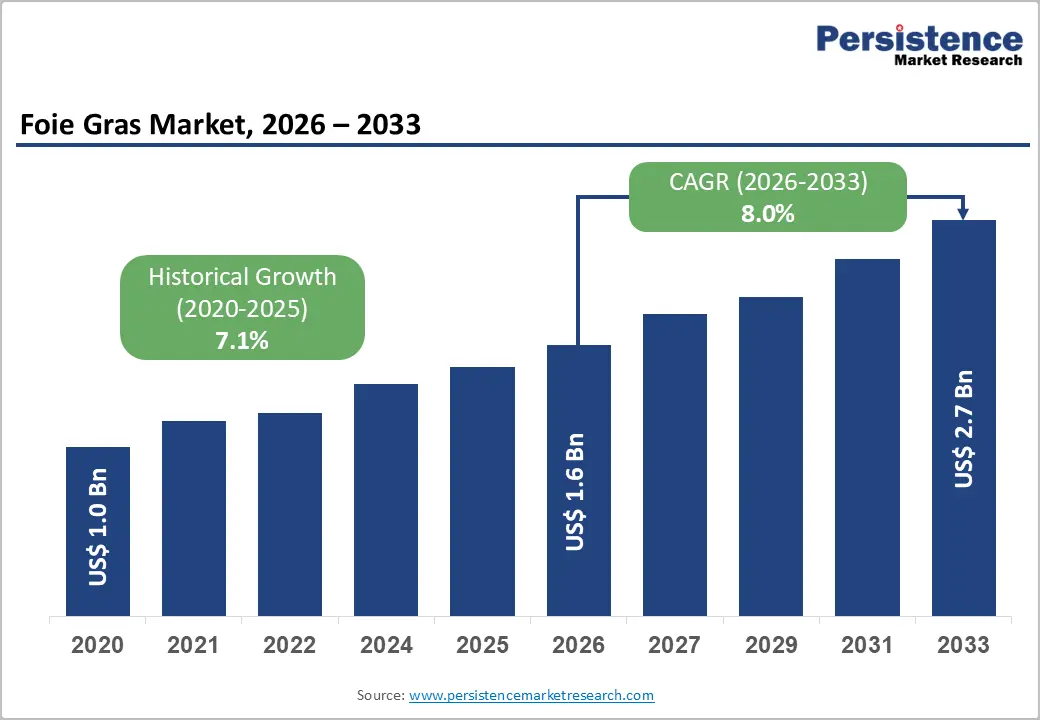
The global foie gras market size is likely to be valued at US$1.6 billion in 2026, and is expected to reach US$2.7 billion by 2033, growing at a CAGR of 8.0% during the forecast period from 2026 to 2033, driven by the rising global demand for premium gourmet products and increasing acceptance in international cuisine. Foie gras is a luxurious delicacy made from the enlarged liver of force-fed ducks or geese, prized for its rich, buttery texture and delicate flavor. It is widely used in fine dining, gourmet retail, and high-end foodservice.
Key Industry Highlights:
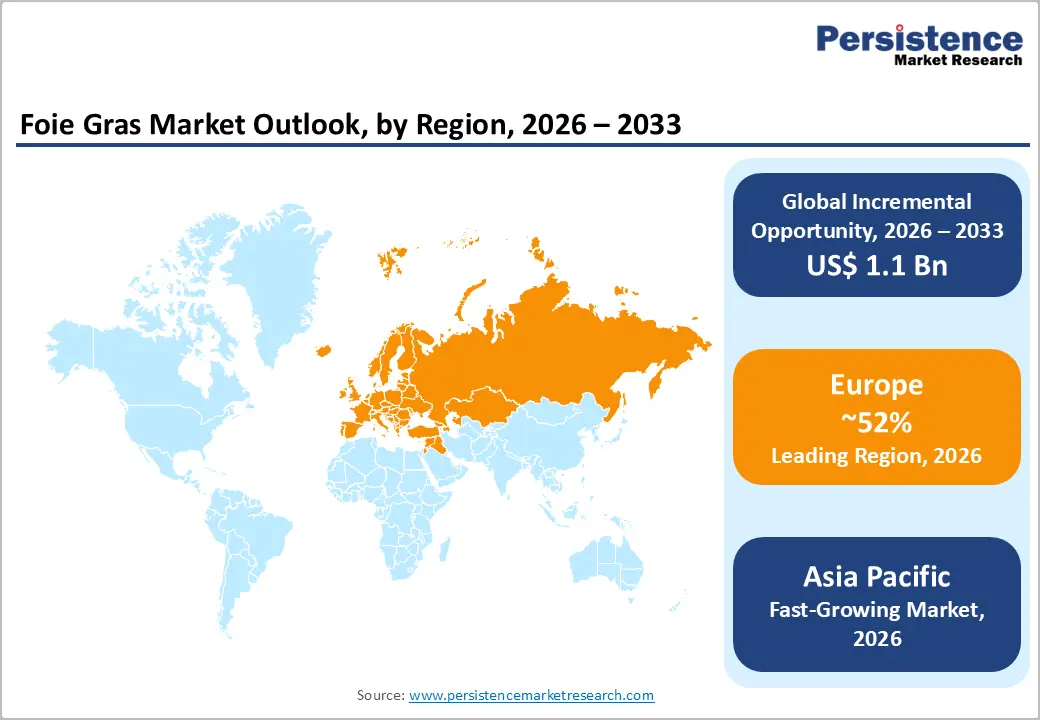
- Dominant Region: Europe is projected to dominate with 52% revenue share in 2026, supported by traditional production and strong culinary heritage.
- Fastest-growing Region: Asia Pacific is expected to be the fastest-growing region with a projected CAGR of 9.8% (2026-2033), driven by rising luxury consumption in China and Southeast Asia.
- Dominant Product Type: The duck segment is expected to dominate with 75% share in 2026, due to higher production volume and affordability.
- Leading Sales Channel: Foodservice is projected to lead with the 60% share, owing to the demand for premium restaurants.
DRO Analysis
Driver - Global Expansion of Luxury Fine-Dining Culture and Rising Ultra-High-Net-Worth Consumer Populations Driving Sustained Foie Gras Demand
The most powerful structural growth driver for the foie gras market is the sustained global expansion of luxury fine-dining culture and the commensurate growth of ultra-high-net-worth (UHNW) and high-net-worth (HNW) consumer populations who represent the core demand constituency for premium foie gras products. According to Knight Frank's Wealth Report, the global UHNW population, defined as individuals with net assets exceeding US$30 million, has grown consistently, with the Asia Pacific region recording the fastest expansion of this demographic cohort over the past decade. This expanding wealth base is translating directly into growing fine-dining expenditure, luxury hotel and resort F&B revenue, and premium food gifting culture in markets, including China, Japan, South Korea, Singapore, the United Arab Emirates, and Saudi Arabia.
The global fine-dining restaurant market has experienced strong growth, driven in part by the steady expansion of the Michelin Guide across Asia, including key markets such as China, Japan, South Korea, Thailand, and Singapore. This expansion has helped formalize a culinary prestige framework that continues to position French classical cuisine, and foie gras in particular, as a symbol of gastronomic excellence. Each newly Michelin-recognized restaurant in emerging markets typically establishes institutional procurement relationships with premium foie gras suppliers, generating a ripple effect that accelerates demand as the fine-dining ecosystem develops across Asia Pacific and the Middle East.
Restraint - Supply Chain Vulnerability from Avian Influenza Outbreaks Disrupting Production in Key Origin Regions
The foie gras market is exposed to severe and recurring supply chain disruption from Highly Pathogenic Avian Influenza (HPAI) outbreaks that periodically devastate duck and goose populations in primary production regions, particularly in southwestern France, which accounts for the majority of global foie gras supply. France has experienced multiple devastating HPAI outbreak cycles, with the 2016–2017 outbreak resulting in the culling of approximately 4.2 million birds across the Landes, Gers, and Périgord production regions and causing acute foie gras supply shortages and price spikes that disrupted foodservice procurement across European markets.
HPAI outbreak risk is compounding as the geographic spread of avian influenza strains increases, with the H5N1 strain demonstrating progressively broader wild bird reservoir populations that increase re-introduction risk to commercial poultry operations regardless of biosecurity investment.
Opportunity - Alternative and Ethical Foie Gras Innovation: Unlocking Restricted Markets and Emerging Consumer Segments
The development of ethical foie gras alternatives produced without force-feeding through innovative natural fattening techniques or through food technology approaches, including cultivated meat and cellular agriculture, represents a transformative opportunity to access markets currently restricted by production bans and to capture a growing consumer segment that appreciates foie gras flavor and culinary tradition but is constrained by animal welfare concerns from purchasing conventionally produced product.
Spanish producer Eduardo Sousa has demonstrated that foie gras can be produced from geese that fatten their livers naturally through voluntary overeating before migration, a production method that has achieved international recognition and culinary validation, including winning the Coup de Coeur award at the Salon International de l'Alimentation (SIAL) in Paris. This 'ethical foie gras' concept has the potential to unlock production and sale in markets where force-feeding bans apply, including the U.K., Germany, and California, dramatically expanding the addressable market for producers that can achieve scale with humane production methods.
Category-wise Analysis
Product Type Insights
The duck segment is anticipated to dominate with the 75% share in 2026. Duck foie gras (foie gras de canard) dominates the market due to its significantly higher global production volume, reflecting the Moulard duck's faster production cycle, higher liver yield, and greater feed-conversion efficiency relative to geese, making it the commercially viable form for both industrial-scale processing and premium artisanal production. The Rougié Company focused on Moulard duck foie gras and distributed its products across more than 120 countries, demonstrating the large-scale commercial viability of duck-based production.
The goose segment is emerging as the fastest-growing product type, supported by its ultra-premium positioning, limited availability compared to duck foie gras, and a rising base of affluent consumers and culinary connoisseurs across Asia Pacific and the Middle East who seek highly exclusive dining experiences. Hungary remains the leading global producer of goose foie gras, widely regarded as the most refined and prestigious variant. Featured prominently in top-tier restaurants across Europe and Asia, goose foie gras is often selected by leading chefs worldwide as a centerpiece ingredient for creating exceptional, high-end dishes.
Form Insights
The fresh segment is projected to dominate, holding the 48% revenue share in 2026, driven by the expansion of French-origin and European-production fresh foie gras availability in international premium retail and fine-dining foodservice channels, enabled by improving cold-chain logistics infrastructure and air freight networks connecting European production regions to end-use markets in Asia Pacific and the Middle East within commercially viable shelf-life windows. Lafitte Foie Gras exported fresh foie gras from France to premium restaurants and gourmet retailers in Asia and the Middle East, leveraging cold-chain logistics and air freight to maintain product quality and shelf life.
The frozen segment is projected to be the fastest-growing form, supported by its ability to facilitate year-round global distribution of French and European-origin foie gras to markets where fresh supply is constrained by distance, logistical complexity, or seasonal production limitations. Companies such as Rougié have expanded their international presence by leveraging frozen formats to supply Asia, North America, and the Middle East, ensuring consistent quality and reliable availability across long-distance export markets.
Processing Insights
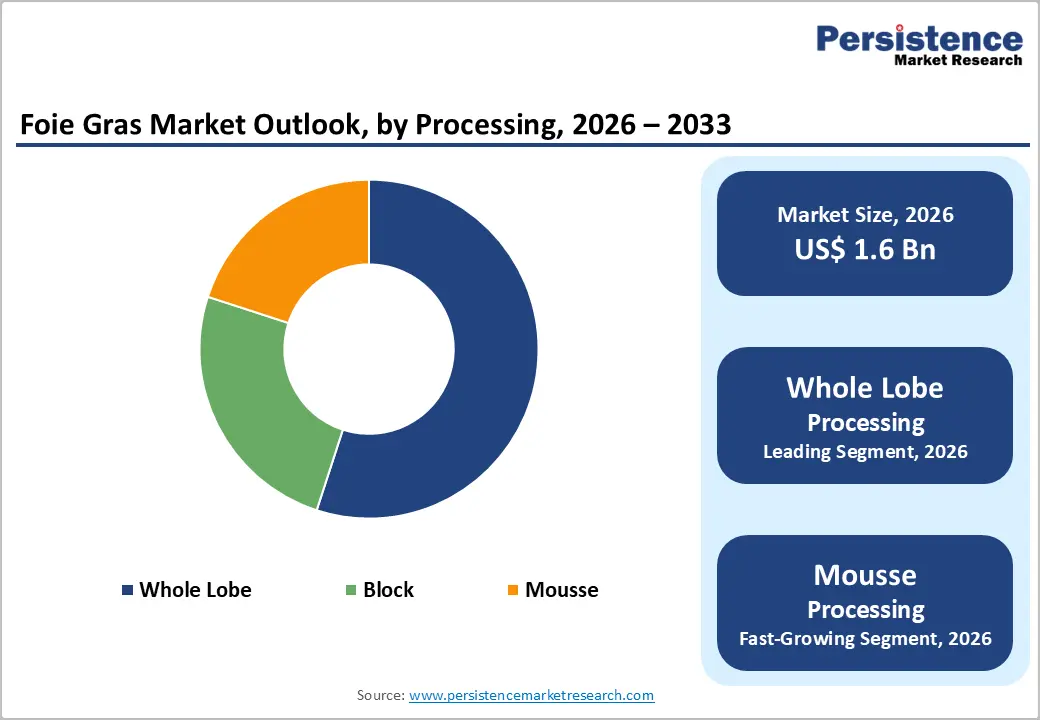
The whole lobe segment is expected to lead the market, accounting for approximately 55% share in 2026. Whole lobe foie gras, characterized by a minimally processed, intact duck or goose liver and governed by strict EU standards requiring more than 90% liver content by weight, represents the highest benchmark of quality and prestige within the category. This format commands premium pricing across both retail and foodservice channels. For instance, Rougié offers whole lobe foie gras made from one or more intact lobes, preserving its natural structure and reinforcing its position as a high-value product in fine dining and luxury retail.
In contrast, the mousse segment is projected to be the fastest-growing, driven by its greater accessibility and appeal as both a retail product and a gifting option. It attracts a wider consumer base, including first-time buyers seeking the taste and prestige of foie gras in a more convenient, easy-to-serve format. Lafitte Foie Gras, for example, offers duck foie gras mousse with approximately 50–55% foie gras content, designed as a ready-to-spread product that enhances convenience and broadens consumer reach compared to whole foie gras formats.
Sales Channel Insights
The foodservice segment is projected to dominate the foie gras market with a ~60% share in 2026, driven by demand from fine-dining restaurants, luxury hotels, Michelin-starred establishments, and premium catering, where foie gras is primarily prepared by professional chefs. For example, D'Artagnan supplied foie gras directly to fine-dining restaurants across the U.S. through its dedicated chef-focused distribution network, reinforcing foodservice as the primary consumption channel.
The retail segment is expected to be the fastest-growing sales channel, driven by the expansion of premium food retail infrastructure globally and the rapid growth of specialty and luxury food e-commerce that is enabling foie gras brands to reach affluent home consumers directly, particularly during the holiday gifting season and in markets where restaurant consumption infrastructure may be limited. D'Artagnan expanded its direct-to-consumer e-commerce platform, allowing customers to purchase foie gras online with overnight delivery in insulated packaging, making premium products accessible to home consumers, especially during festive and gifting seasons.
Regional Insights
North America Foie Gras Market Trends
North America is projected to account for approximately 16% of the global foie gras market revenue in 2026 and is expected to grow at a CAGR of approximately 6.8% through 2033. The region's market is shaped by a significant regulatory complexity, California's foie gras sales ban remaining the most significant market access restriction alongside a deeply engaged fine-dining community in New York, Chicago, Las Vegas, Miami, and other major culinary cities that maintain strong institutional demand for premium foie gras.
The U.S. is the dominant national market, hosting a sophisticated fine-dining sector that has historically been among the most significant global markets for French luxury food ingredients. Hudson Valley Foie Gras Inc. in New York State is the primary domestic U.S. producer, providing an alternative domestic-origin supply narrative for foodservice buyers and consumers seeking to avoid import logistics or support domestic production.
Canada represents a growing secondary market with no federal restrictions on foie gras production or sale, and a domestic production industry in Quebec and British Columbia that supplies both domestic foodservice and limited export demand. Toronto, Vancouver, and Montreal host active fine-dining scenes with strong French culinary influence that maintain consistent institutional foie gras demand.
Europe Foie Gras Market Trends
Europe is projected to dominate the foie gras market with an estimated 52% revenue share in 2026, growing at a CAGR of approximately 6.5% through 2033. France remains the undisputed epicenter of the global foie gras market, accounting for the vast majority of the region's production and consumption, with the French CIFOG estimating French foie gras production at approximately 18,000 tonnes annually in stable seasons, representing over two-thirds of global supply.
France's CAGR is estimated at approximately 5.8% through 2033, with growth driven by the expansion of export revenues to Asia Pacific and the Middle East rather than domestic volume growth, which is relatively mature.
Spain is a significant and growing European market with domestic production infrastructure in Navarre and Extremadura, and a fine-dining scene in Barcelona and Madrid that actively incorporates foie gras, including the ethical production of Eduardo Sousa into creative contemporary gastronomy. Spain's CAGR is estimated at approximately 7.0% through 2033. Germany, the United Kingdom, Belgium, and Switzerland represent important import markets for French foie gras, with luxury food retail, premium hospitality procurement, and holiday gifting demand sustaining consistent import volumes.
Asia Pacific Foie Gras Market Trends
Asia Pacific is expected to be the fastest-growing regional market for foie gras, expanding at a CAGR of approximately 9.8% through 2033, from an estimated 18% revenue share in 2026. The region's exceptional growth trajectory is driven by the world's fastest-expanding luxury consumer populations, deeply embedded luxury food gifting cultures, and the global reach of French fine-dining prestige that has positioned foie gras as a benchmark luxury food in the most aspirational dining and gifting contexts across the region.
Japan is the largest and most developed foie gras market in Asia Pacific, with Tokyo hosting the world's highest density of Michelin-starred restaurants outside France and a culinary culture that has deeply integrated foie gras into both French-classical and innovative Japanese-French fusion restaurant menus.
China represents the highest-growth individual national market in the region, with a CAGR estimated at approximately 11.0% through 2033, driven by the explosive growth of the Chinese UHNW consumer population, the expansion of French fine-dining restaurants in Shanghai, Beijing, and Guangzhou, and the cultural significance of premium French food in Chinese luxury gifting contexts.
Competitive Landscape
The global foie gras market is served by a concentrated group of predominantly French heritage producers alongside a small number of international participants competing across distinct market tiers defined by origin prestige, processing quality, distribution geography, and brand equity. The market is led by major French consolidated groups, including Labeyrie Fine Foods SA, Euralis Holding SA, Maison Delpeyrat SA, and M. Rougié SAS, that combine significant production scale, vertically integrated operations spanning live bird procurement through finished product distribution, and established brand portfolios serving both institutional foodservice and premium retail channels across Europe, North America, and Asia Pacific.
The artisanal and specialist tier of the market is represented by Comtesse Du Barry, Ducs de Gascogne SA, Agro-Top Produits S.A., Lafitte Foie Gras, and Georges Bruck, each competing on heritage brand positioning, regional origin specificity, and the premium artisanal craftsmanship narrative that commands the highest retail price points and strongest gifting occasion relevance in French and export premium markets. Maison Delpeyrat and the Comtesse Du Barry brand maintain a strong French domestic retail presence while building international luxury food export channels.
Key Industry Developments:
- In November 2024, Australian food-tech company Vow launched its cultured Japanese quail foie gras and became the first company to commercialize multiple cultivated meat products. The company introduced the products under its Forged brand and expanded availability from restaurants to at-home consumers through limited releases.
Companies Covered in Foie Gras Market
- Agro-Top Produits S.A.
- Comtesse Du Barry
- D'Artagnan LLC
- Ducs de Gascogne SA
- Euralis Holding SA
- Georges Bruck
- Gourmet Food World
- Hudson Valley Foie Gras Inc.
- Jiajia Food Group Co., Ltd
- Labeyrie Fine Foods SA
- Lafitte Foie Gras
- M. Rougié SAS
- Maison Delpeyrat SA
- Petrossian SAS
- The Artisan Food Company
Frequently Asked Questions
The global foie gras market is projected to reach US$1.6 billion in 2026.
The foie gras market is primarily driven by growth in luxury foodservice, rising global affluence, and increasing appreciation for gourmet French cuisine worldwide.
The foie gras market is poised to witness a CAGR of 8.0% from 2026 to 2033.
Key opportunities in the foie gras market include expansion in Asia Pacific luxury markets, development of convenient processed formats, and innovation in ethical and sustainable production methods.
Key players in the foie gras market include Agro-Top Produits S.A., Comtesse Du Barry, D'Artagnan LLC, Ducs de Gascogne SA, and Euralis Holding SA.


