


- Executive Summary
- Global Fiber Optics Market Snapshot 2025 and 2032
- Market Opportunity Assessment, 2025-2032, US$ Mn
- Key Market Trends
- Industry Developments and Key Market Events
- Demand Side and Supply Side Analysis
- PMR Analysis and Recommendations
- Market Overview
- Market Scope and Definitions
- Value Chain Analysis
- Macro-Economic Factors
- Global GDP Outlook
- Global GDP Overview
- Global Telecommunication Industry Overview
- Forecast Factors – Relevance and Impact
- COVID-19 Impact Assessment
- PESTLE Analysis
- Porter's Five Forces Analysis
- Geopolitical Tensions: Market Impact
- Regulatory and Technology Landscape
- Market Dynamics
- Drivers
- Restraints
- Opportunities
- Trends
- Price Trend Analysis, 2019 – 2032
- Region-wise Price Analysis
- Price by Segments
- Price Impact Factors
- Global Fiber Optics Market Outlook:
- Key Highlights
- Global Fiber Optics Market Outlook: Fiber Type
- Introduction/Key Findings
- Historical Market Size (US$ Mn) and Volume (Tons) Analysis by Fiber Type, 2019-2023
- Current Market Size (US$ Mn) and Volume (Tons) Analysis and Forecast, by Fiber Type, 2025-2032
- Glass Optical Fiber
- Plastic Optical Fiber (POF)
- Market Attractiveness Analysis: Fiber Type
- Global Fiber Optics Market Outlook: Cable Type
- Introduction/Key Findings
- Historical Market Size (US$ Mn) and Volume (Tons) Analysis by Cable Type, 2019-2023
- Current Market Size (US$ Mn) and Volume (Tons) Analysis and Forecast, by Cable Type, 2025-2032
- Single-Mode Fiber
- Multi-Mode Fiber
- Market Attractiveness Analysis: Cable Type
- Global Fiber Optics Market Outlook: Application
- Introduction/Key Findings
- Historical Market Size (US$ Mn) and Volume (Tons) Analysis by Application, 2019-2023
- Current Market Size (US$ Mn) and Volume (Tons) Analysis and Forecast, by Application, 2025-2032
- Telecommunications
- Oil & Gas
- Military & Aerospace
- Banking, Financial Services, and Insurance (BFSI)
- Medical
- Railway
- Others
- Market Attractiveness Analysis: Application
- Global Fiber Optics Market Outlook: Deployment
- Introduction/Key Findings
- Historical Market Size (US$ Mn) and Volume (Tons) Analysis by Deployment, 2019-2023
- Current Market Size (US$ Mn) and Volume (Tons) Analysis and Forecast, by Deployment, 2025-2032
- Underground
- Aerial
- Underwater
- Market Attractiveness Analysis: Deployment
- Global Fiber Optics Market Outlook: Region
- Key Highlights
- Historical Market Size (US$ Mn) and Volume (Tons) Analysis by Region, 2019-2023
- Current Market Size (US$ Mn) and Volume (Tons) Analysis and Forecast, by Region, 2025-2032
- North America
- Europe
- East Asia
- South Asia & Oceania
- Latin America
- Middle East & Africa
- Market Attractiveness Analysis: Region
- North America Fiber Optics Market Outlook:
- Key Highlights
- Pricing Analysis
- North America Market Size (US$ Mn) and Volume (Tons) Analysis and Forecast, by Country, 2025-2032
- U.S.
- Canada
- North America Market Size (US$ Mn) and Volume (Tons) Analysis and Forecast, by Fiber Type, 2025-2032
- Glass Optical Fiber
- Plastic Optical Fiber (POF)
- North America Market Size (US$ Mn) and Volume (Tons) Analysis and Forecast, by Cable Type, 2025-2032
- Single-Mode Fiber
- Multi-Mode Fiber
- North America Market Size (US$ Mn) and Volume (Tons) Analysis and Forecast, by Application, 2025-2032
- Telecommunications
- Oil & Gas
- Military & Aerospace
- Banking, Financial Services, and Insurance (BFSI)
- Medical
- Railway
- Others
- North America Market Size (US$ Mn) and Volume (Tons) Analysis and Forecast, by Deployment, 2025-2032
- Underground
- Aerial
- Underwater
- Europe Fiber Optics Market Outlook:
- Key Highlights
- Pricing Analysis
- Europe Market Size (US$ Mn) and Volume (Tons) Analysis and Forecast, by Country, 2025-2032
- Germany
- Italy
- France
- U.K.
- Spain
- Russia
- Rest of Europe
- Europe Market Size (US$ Mn) and Volume (Tons) Analysis and Forecast, by Fiber Type, 2025-2032
- Glass Optical Fiber
- Plastic Optical Fiber (POF)
- Europe Market Size (US$ Mn) and Volume (Tons) Analysis and Forecast, by Cable Type, 2025-2032
- Single-Mode Fiber
- Multi-Mode Fiber
- Europe Market Size (US$ Mn) and Volume (Tons) Analysis and Forecast, by Application, 2025-2032
- Telecommunications
- Oil & Gas
- Military & Aerospace
- Banking, Financial Services, and Insurance (BFSI)
- Medical
- Railway
- Others
- Europe Market Size (US$ Mn) and Volume (Tons) Analysis and Forecast, by Deployment, 2025-2032
- Underground
- Aerial
- Underwater
- East Asia Fiber Optics Market Outlook:
- Key Highlights
- Pricing Analysis
- East Asia Market Size (US$ Mn) and Volume (Tons) Analysis and Forecast, by Country, 2025-2032
- China
- Japan
- South Korea
- East Asia Market Size (US$ Mn) and Volume (Tons) Analysis and Forecast, by Fiber Type, 2025-2032
- Glass Optical Fiber
- Plastic Optical Fiber (POF)
- East Asia Market Size (US$ Mn) and Volume (Tons) Analysis and Forecast, by Cable Type, 2025-2032
- Single-Mode Fiber
- Multi-Mode Fiber
- East Asia Market Size (US$ Mn) and Volume (Tons) Analysis and Forecast, by Application, 2025-2032
- Telecommunications
- Oil & Gas
- Military & Aerospace
- Banking, Financial Services, and Insurance (BFSI)
- Medical
- Railway
- Others
- East Asia Market Size (US$ Mn) and Volume (Tons) Analysis and Forecast, by Deployment, 2025-2032
- Underground
- Aerial
- Underwater
- South Asia & Oceania Fiber Optics Market Outlook:
- Key Highlights
- Pricing Analysis
- South Asia & Oceania Market Size (US$ Mn) and Volume (Tons) Analysis and Forecast, by Country, 2025-2032
- India
- Southeast Asia
- ANZ
- Rest of SAO
- South Asia & Oceania Market Size (US$ Mn) and Volume (Tons) Analysis and Forecast, by Fiber Type, 2025-2032
- Glass Optical Fiber
- Plastic Optical Fiber (POF)
- South Asia & Oceania Market Size (US$ Mn) and Volume (Tons) Analysis and Forecast, by Cable Type, 2025-2032
- Single-Mode Fiber
- Multi-Mode Fiber
- South Asia & Oceania Market Size (US$ Mn) and Volume (Tons) Analysis and Forecast, by Application, 2025-2032
- Telecommunications
- Oil & Gas
- Military & Aerospace
- Banking, Financial Services, and Insurance (BFSI)
- Medical
- Railway
- Others
- South Asia & Oceania Market Size (US$ Mn) and Volume (Tons) Analysis and Forecast, by Deployment, 2025-2032
- Underground
- Aerial
- Underwater
- Latin America Fiber Optics Market Outlook:
- Key Highlights
- Pricing Analysis
- Latin America Market Size (US$ Mn) and Volume (Tons) Analysis and Forecast, by Country, 2025-2032
- Brazil
- Mexico
- Rest of LATAM
- Latin America Market Size (US$ Mn) and Volume (Tons) Analysis and Forecast, by Fiber Type, 2025-2032
- Glass Optical Fiber
- Plastic Optical Fiber (POF)
- Latin America Market Size (US$ Mn) and Volume (Tons) Analysis and Forecast, by Cable Type, 2025-2032
- Single-Mode Fiber
- Multi-Mode Fiber
- Latin America Market Size (US$ Mn) and Volume (Tons) Analysis and Forecast, by Application, 2025-2032
- Telecommunications
- Oil & Gas
- Military & Aerospace
- Banking, Financial Services, and Insurance (BFSI)
- Medical
- Railway
- Others
- Latin America Market Size (US$ Mn) and Volume (Tons) Analysis and Forecast, by Deployment, 2025-2032
- Underground
- Aerial
- Underwater
- Middle East & Africa Fiber Optics Market Outlook:
- Key Highlights
- Pricing Analysis
- Middle East & Africa Market Size (US$ Mn) and Volume (Tons) Analysis and Forecast, by Country, 2025-2032
- GCC Countries
- South Africa
- Northern Africa
- Rest of MEA
- Middle East & Africa Market Size (US$ Mn) and Volume (Tons) Analysis and Forecast, by Fiber Type, 2025-2032
- Glass Optical Fiber
- Plastic Optical Fiber (POF)
- Middle East & Africa Market Size (US$ Mn) and Volume (Tons) Analysis and Forecast, by Cable Type, 2025-2032
- Single-Mode Fiber
- Multi-Mode Fiber
- Middle East & Africa Market Size (US$ Mn) and Volume (Tons) Analysis and Forecast, by Application, 2025-2032
- Telecommunications
- Oil & Gas
- Military & Aerospace
- Banking, Financial Services, and Insurance (BFSI)
- Medical
- Railway
- Others
- Middle East & Africa Market Size (US$ Mn) and Volume (Tons) Analysis and Forecast, by Deployment, 2025-2032
- Underground
- Aerial
- Underwater
- Competition Landscape
- Market Share Analysis, 2025
- Market Structure
- Competition Intensity Mapping
- Competition Dashboard
- Company Profiles
- FOLAN
- Company Overview
- Product Portfolio/Offerings
- Key Financials
- SWOT Analysis
- Company Strategy and Key Developments
- Thorlabs, Inc.
- Prysmian Group
- Yangtze Optical Fiber and Cable Joint Stock Limited Company
- ROSENDAHL NEXTROM
- OFS Fitel, LLC
- Heraeus Covantics
- CommScope Holding Company, Inc.
- STL Tech
- Corning Incorporated.
- Birla Furukawa Fiber Optics Private Limited
- Nokia
- Optical Cable Corporation (OCC)
- Molex
- Shin-Etsu Chemical Co., Ltd.
- FOLAN
- Appendix
- Research Methodology
- Research Assumptions
- Acronyms and Abbreviations


- Telecommunications
- Fiber Optics Market
Fiber Optics Market Size, Share, Growth, and Regional Forecast for 2025 - 2032
Fiber Optics Market by Fiber Type (Glass Optical Fiber, Plastic Optical Fiber (POF)), Cable Type (Single-Mode Fiber, Multi-Mode Fiber), Application (Telecommunications, Oil & Gas, Banking, Financial Services, and Insurance (BFSI), Others), Deployment, and Regional Analysis for 2025 - 2032
Fiber Optics Market Share and Trends Analysis
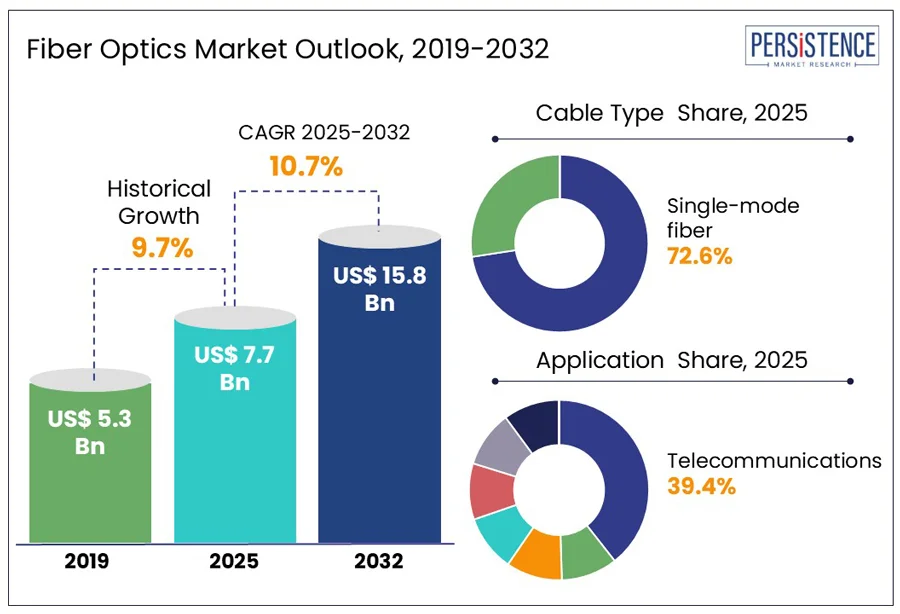
The global fiber optics market size is expected to grow from US$ 7.7 billion in 2025 to US$ 15.8 billion, with a CAGR of 10.7% by 2032. According to the Persistence Market Research report, the fiber optics industry is experiencing strong growth, driven by increasing demand for high-speed data transmission and the expansion of telecommunications infrastructure. Fiber optics are used in various applications, including internet services, healthcare, defense, and industrial automation, offering unparalleled bandwidth, security, and durability. Additionally, advancements in 5G technology, cloud computing, and the Internet of Things (IoT) are further accelerating the global expansion and innovation.
Key Industry Highlights:
- Increasing penetration of the internet and demand for faster broadband connectivity are driving the widespread deployment of fiber optics globally.
- Single-mode fiber is widely used for long-distance telecommunications and data transmission, establishing it as a leading segment in the market.
- The accelerated rollout of 5G technology worldwide presents significant opportunities for fiber optic suppliers to support high-capacity network infrastructures.
- Advances in fiber cable types, optical components, and deployment methods enhance network efficiency and increase market competitiveness.
- The growing use of underwater and aerial fiber optic cables is facilitating global connectivity, even in remote areas and across continents.
- The rising demand for secure and reliable communication in the defense sector drives the development of specialized fiber optic solutions.
- There is also a growing reliance on fiber optics for high-speed data transfer in medical imaging and telemedicine, which is creating new market opportunities.
|
Global Market Attribute |
Key Insights |
|
Fiber Optics Market Size (2025E) |
US$ 7.7 Bn |
|
Market Value Forecast (2032F) |
US$ 15.8 Bn |
|
Projected Growth (CAGR 2025 to 2032) |
10.7% |
|
Historical Market Growth (CAGR 2019 to 2024) |
9.7% |
Market Dynamics
Driver - Increasing internet penetration and demand for high-speed broadband fuels the global fibre-optic deployment
Increasing internet penetration and demand for high-speed broadband is recognized as key driver of the fiber optics market. Widespread adoption of digital technologies has prompted the extensive deployment of fiber optic networks, with infrastructure upgrades being accelerated to enable faster data transmission and enhanced network reliability. Fiber optic cables are preferred for their high bandwidth capacity and low signal attenuation, positioning them as essential components in modern communication systems. As a result, the expansion of fiber optic infrastructure is being prioritized across residential, commercial, and industrial applications.
In March 2025, Corning’s GlassWorks AI™ solutions were launched to meet the evolving demands of AI data centers, emphasizing the growing need for advanced fiber optic technologies. Key innovations include the Contour™ Flow Cable, which doubles fiber capacity within existing diameters, and the SMF-28® Contour fiber, designed for improved bend resilience in high-density settings. These developments are aimed at supporting rapid deployments of AI-driven interconnected data networks.
Restraints - Increasing internet penetration and demand for high-speed broadband is fueling global fibre optic deployment
Despite the rapid increase in internet penetration and demand for high-speed broadband, the fiber optics market growth is hindered by the complexity involved in infrastructure deployment. The installation of fiber optic cables is often delayed due to regulatory approvals and rights-of-way challenges, which vary significantly across regions. Additionally, disruptions caused by existing underground utilities and environmental restrictions impose further obstacles.
The maintenance and upgrading of existing networks are slowed down by technical difficulties in integrating new fiber technologies with legacy systems. Moreover, the need for specialized labor to carry out precise splicing and installation processes contributes to project slowdowns. As a result, the pace of fiber optic deployment is impacted, limiting the speed at which high-speed broadband caters to the growing demand.
Opportunity - Growing investments in 5G infrastructure globally present a strong opportunity for fibre optic suppliers
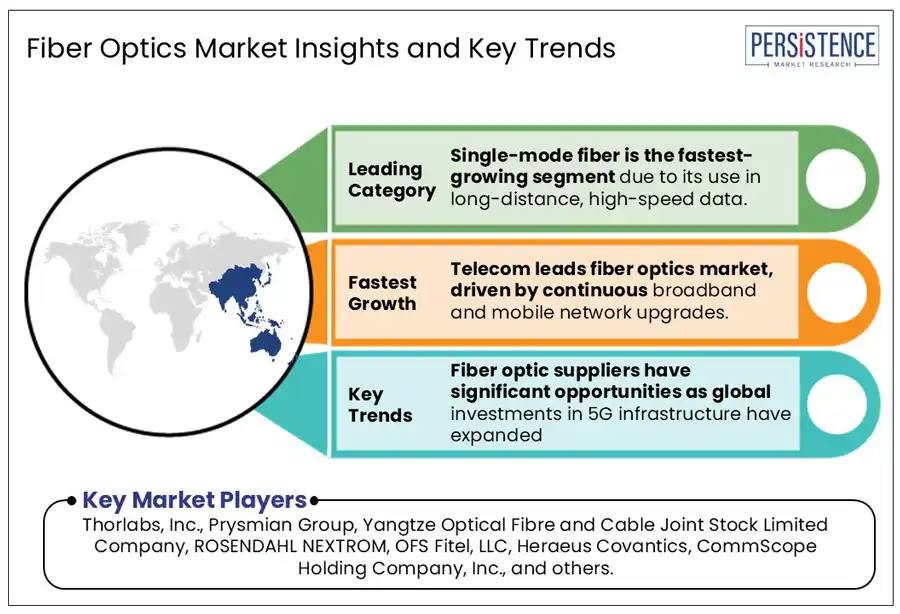
Fiber optic suppliers have significant opportunities as global investments in 5G infrastructure have expanded. The deployment of 5G networks has required the installation of high-capacity fiber optic cables to accommodate increased data traffic and low latency requirements. Network densification efforts are accelerated, resulting in heightened demand for fiber connectivity across cell towers, data centers, and core networks. Advanced fiber optic technologies are adopted to ensure scalable and reliable network performance.
In October 2024, a state-of-the-art fiber skilling training center was established by STL in Telangana, India, through an investment of INR 50 crore. This initiative was launched to equip local talent with expertise in advanced fiber network deployment, supporting India’s BharatNet program. Emphasis has been placed on modern techniques such as robotic trenching and AI-driven planning, aligning with national digital infrastructure goals.
Category Wise Analysis
Cable Type Insights
Single-mode fiber has been identified as the fastest-growing segment in the fiber optics market, owing to its extensive use in long-distance telecommunication and high-speed data transmission applications. Its ability to transmit signals over long distances with minimal attenuation and dispersion has made it the preferred choice for backbone networks and undersea communication systems. The performance and reliability of single-mode fiber is enhanced through advanced manufacturing techniques that improve fiber purity and optimize core dimensions. As a result, its adoption has been increasingly prioritized to meet the rising demand for efficient and robust communication infrastructure.
In July 2024, STL introduced its 864F Micro Cable at the Fibre Connect 2024 event in South Carolina. This cable, incorporating STL's bend-insensitive HD A2 200-micron single-mode fiber, was engineered to accommodate 864 fibers within an 11.4 mm diameter. Designed for rapid deployment in 14mm ducts up to 1,500 meters, it offers significant reductions in plastic usage and civil construction costs, supporting 5G and AI-driven data centers.
Application Insights
The telecommunication sector is recognized as the leading application segment within the fiber optics market, driven by ongoing broadband and mobile network upgrades. An extensive fiber optic infrastructure is being deployed to support higher data transmission speeds and improved network reliability. The expansion of mobile networks, including 5G and future technologies, is enabled by fiber connectivity linking cell towers, data centers, and core networks. Simultaneously, broadband services are enhanced to meet the increasing demand for high-speed internet among consumers and enterprises. Consequently, fiber optic technology adoption supports global communication advancements.
In March 2025, CommScope introduced its Propel XFrame™ solution, a compact, floor-mounted fiber frame designed to accommodate the evolving needs of data centers and high-performance computing environments. Featuring a flexible modular design, the Propel XFrame allows for quick changes and reconfigurations, optimizing fiber connections as networks scale. This innovation reflects the sector’s growth toward space-efficient, scalable fiber optic solutions in telecommunications infrastructure.
Regional Insights
North America Fiber Optics Market Trends
In the U.S. fiber optic market, the deployment is accelerated by increased investments in smart city infrastructure. Advanced technologies such as IoT devices, intelligent transportation systems, and smart utilities are supported through high-speed, reliable fiber optic connectivity. The local government has prioritized the integration of robust networks to facilitate real-time communication and efficient data transmission across urban environments. The performance and capacity of fiber optic cables enabled improvements in public services, energy management, and urban security systems. Consequently, infrastructure expansion is undertaken to meet the growing demands of these smart city initiatives.
In March 2023, a US$47 million investment was announced by CommScope to expand fiber optic cable production in North Carolina, focusing on the manufacture of HeliARC fiber optic cables. These cables are designed for rapid and cost-effective deployment, particularly in rural and underserved areas. The initiative supports federal broadband goals and the Build America, Buy America (BABA) Act, with production expected to connect 500,000 households annually.
Europe Fiber Optics Market Trends
In Europe, the expansion of fiber optic networks is driven by digital transformation initiatives and the enforcement of stringent data localization laws. Regulatory frameworks are implemented to ensure data sovereignty and strengthen cybersecurity prompting the deployment of advanced and secure fiber optic infrastructure. Significant investments are directed toward broadband upgrades enhancing connectivity for cloud computing, edge computing, and data centers in domestic markets. Due to their high bandwidth and secure data transmission capabilities, fiber optic cables meet compliance with evolving data protection requirements.
In October 2023, Prysmian Group launched-Connect to Lead strategy, which includes a €2.7 billion investment plan for 2023–2027 aimed at expanding fiber optic infrastructure. This initiative involves scaling up manufacturing capacity for high-performance optical fibers and cables to meet growing demands for data localization. The strategy aligns with the EU’s Digital Agenda, reinforcing Prysmian’s role in supporting Europe’s digital transformation.
Asia Pacific Fiber Optics Market Trends
In Asia Pacific, large-scale fiber optic deployments are driven by rapid urbanization and government-supported broadband initiatives. Infrastructure development is accelerated to meet the connectivity needs of expanding urban population and fulfill the rising demand for high-speed internet access. Public investments and supportive policy frameworks are implemented to extend broadband coverage across both urban and rural areas. Fiber optic networks are preferred for their ability to deliver high-bandwidth and reliable communication services. Consequently, infrastructure expansion fosters digital inclusion and stimulate economic development throughout the region.
In April 2025, STL was awarded a multi-year contract valued at approximately ?1,800 crore by Telangana Fiber Grid Corporation Ltd. (T-Fiber) to design, build, and manage a rural broadband network across 3,000 gram panchayats in Telangana, India. As part of the BharatNet program, the project involves deploying 64,000 kilometers of optical fiber and incorporating GPON and IP MPLS technologies to connect 6 million rural citizens.
Competitive Landscape
The global fiber optics market is characterized by the presence of several prominent manufacturers and technology providers competing to innovate and expand their footprints. Leading companies such as Corning Incorporated, Prysmian Group, OFS Fitel, LLC, and CommScope Holding Company, Inc. are actively investing in advanced fiber optic technologies and infrastructure projects worldwide. These key players focus on strategic partnerships, mergers, and acquisitions to strengthen their product portfolios and geographic reach. Innovations in single-mode and multi-mode fiber cables, as well as the development of high-performance optical components, are driving competition.
Manufacturers such as Nokia and STL Tech emphasize sustainable and scalable solutions to address growing demands from telecommunications, data centers, and smart city initiatives. Regional players, including Birla Furukawa Fibre Optics Private Limited and Yangtze Optical Fibre and Cable Joint Stock Limited Company, also play vital roles, particularly in Asia Pacific. Overall, competition is intensified by the need to meet increasing bandwidth requirements, enhance network reliability, and reduce deployment complexity.
Key Industry Developments
- In July 2024, OFS introduced the AccuRoll® Rollable Ribbon FTTH cabling, a next-generation solution designed for the evolution of fiber plant networks. This innovation aims to streamline fiber-to-the-home deployments, enhancing both efficiency and scalability in broadband infrastructure.
- In April 2024, STL introduced its Rapid series of fiber optic cables, which comply with the 'Build America, Buy America' provisions. These cables are manufactured at STL's Palmetto Plant in South Carolina and are designed to support BEAD-funded projects. They feature high-capacity ribbonized and ruggedized designs suitable for a variety of applications.
Companies Covered in Fiber Optics Market
- FOLAN
- Thorlabs, Inc.
- Prysmian Group
- Yangtze Optical Fibre and Cable Joint Stock Limited Company
- ROSENDAHL NEXTROM
- OFS Fitel, LLC
- Heraeus Covantics
- CommScope Holding Company, Inc.
- STL Tech
- Corning Incorporated.
- Birla Furukawa Fibre Optics Private Limited
- Nokia
- Optical Cable Corporation (OCC)
- Molex
- Shin-Etsu Chemical Co., Ltd.
Frequently Asked Questions
The global Fiber Optics Market is projected to be valued at 7.7 bn in 2025.
The Fiber Optics Market is driven by increasing internet penetration and demand for high-speed broadband is fueling global fibre optic deployment.
The Fiber Optics Market is poised to witness a CAGR of 10.7% from 2025 to 2032.
Growing investments in 5G infrastructure globally present a strong opportunity for fibre optic suppliers.
Major players in the Fiber Optics Market include Thorlabs, Inc., Prysmian Group, Yangtze Optical Fibre and Cable Joint Stock Limited Company, ROSENDAHL NEXTROM, OFS Fitel, LLC, Heraeus Covantics, CommScope Holding Company, Inc., and others.


