




- Healthcare Services
- Esoteric Testing Market
Esoteric Testing Market Size, Share, and Growth Forecast 2026 - 2033
Esoteric Testing Market by Test Type (Oncology, Infectious Disease, Genetic Testing), Technology (Chemiluminescence Immunoassay, Enzyme-Linked Immunosorbent Assay), End User (Hospital-Based Laboratories), and Regional Analysis, 2026 - 2033

Esoteric Testing Market Size and Trends Analysis
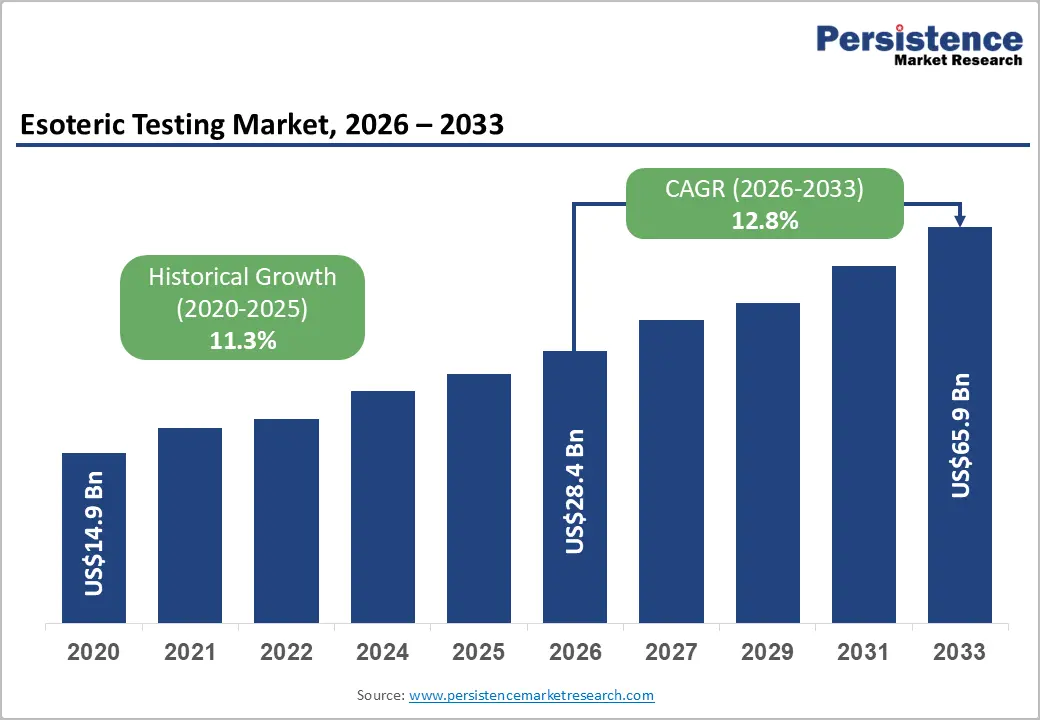
The global esoteric testing market size is likely to be valued at US$28.4 billion in 2026 and is expected to reach US$65.9 billion by 2033, growing at a CAGR of 12.8% during the forecast period from 2026 to 2033, driven by rising use of biomarker-based diagnostics in oncology and rare diseases as well as increasing adoption of next-generation sequencing and liquid biopsy technologies. The expansion of companion diagnostics alongside targeted therapies, supported by approvals from the U.S. Food and Drug Administration, is further strengthening testing volumes.
Key Industry Highlights:
- Leading Region: North America, with about 33.5% share in 2026, spurred by surging integration of companion diagnostics with drug approvals.
- Fast-growing Region: Asia Pacific, backed by expanding healthcare infrastructure and rising cancer burden.
- Latest Collaboration: In September 2025, Quest Diagnostics and Epic announced a first-of-its-kind collaboration to improve laboratory testing experiences for healthcare providers and patients across the U.S. Epic will deliver a suite of technologies, including Aura, Beaker Laboratory, Care Everywhere, MyChart, and Resolute Professional Billing & Claims, as part of Project Nova.
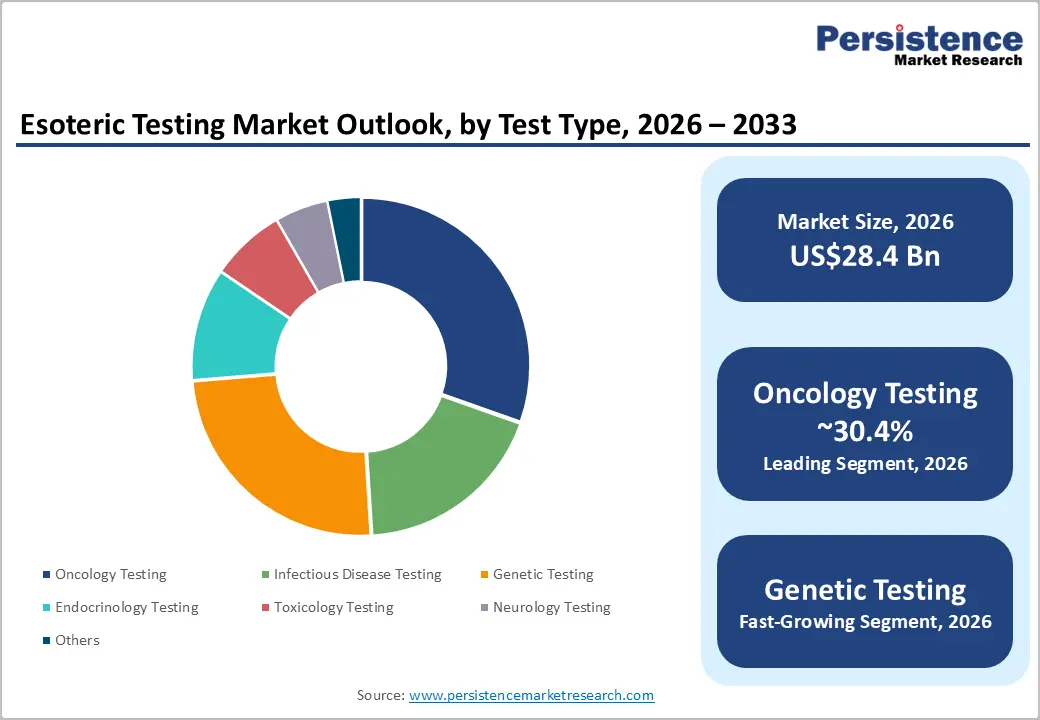
- Leading Test Type: Oncology testing, approximately 30.4% share in 2026, as targeted therapies require continuous biomarker testing for treatment selection and monitoring.
- Dominant Technology: Chemiluminescence immunoassay, nearly 27.2% in 2026, boosted by its high sensitivity and automation capability.
DRO Analysis
Driver - Increasing Prevalence of Chronic and Complex Conditions
Chronic diseases such as cancer, autoimmune disorders, and endocrine conditions are now pushing a steady rise in demand for advanced diagnostics. These conditions rarely respond well to generic testing. Clinicians require detailed molecular insights to decide treatment pathways. National Institutes of Health’s (NIH) Office of Autoimmune Disease Research notes at least 80 acute and chronic illnesses classified as autoimmune, many of which are disabling.
In January 2025, NIH also released its inaugural strategic plan for autoimmune disease research, showcasing a federal priority to improve diagnostics for these conditions. In August 2025, Mayo Clinic Laboratories introduced a mass spectrometry-based test for precise therapeutic drug monitoring in oncology. It was a clear signal that complex disease management is pushing esoteric platforms into routine clinical use.
Surging Demand for Rare-Disease Identification
Rare diseases have historically been underdiagnosed due to limited testing options. That gap is closing fast. AI-supported tools such as AI-MARRVEL now achieve 98% diagnostic precision, doubling solve rates compared to manual curation. Gene therapy pipelines are another factor. A vibrant pipeline of gene therapies now requires a confirmed molecular diagnosis before prescribing, strengthening the clinical value of broad-based sequencing.
Investment is following this trend. In Q1 2025, Invitae raised US$100 million to accelerate development of advanced esoteric genetic tests for rare diseases. Meanwhile, Quest Diagnostics launched a comprehensive genomic sequencing panel for rare neurological disorders covering more than 500 genetic markers in October 2025.
Restraint - Heavy Compliance Burden to Hamper Lab Operations
Regulatory complexity has long been a friction point for esoteric test developers. Recent years have made it worse. The Food and Drug Administration’s (FDA) proposed LDT final rule would have required laboratories to comply with four stages of medical device oversight over four years, covering adverse event reporting, device registration, labeling, and quality system requirements. Even though the FDA formally rescinded the rule in September 2025 following a federal court ruling that it had exceeded statutory authority, the long-term regulatory outlook remains unclear.
Whether the FDA will appeal, pursue new rulemaking, or redirect its efforts toward lobbying Congress to pass the VALID Act is still unknown, leaving labs in a state of regulatory limbo. Small-scale labs often face difficulty absorbing compliance costs when the rules keep shifting. The College of American Pathologists noted that the FDA's rulemaking threatened patient access to countless safe LDTs by saddling laboratories with unnecessary requirements.
Opportunity - Next-Generation Platforms to Create New Diagnostic Possibilities
Breakthroughs in molecular biology and multi-omics tools are opening new diagnostic possibilities that were not feasible even five years ago. Combining genomics, transcriptomics, proteomics, and metabolomics in a single workflow lets clinicians see disease biology at a much finer resolution. A 2025 PMC review confirmed that integrating multi-omics approaches has emerged as a key strategy for overcoming diagnostic hurdles in rare diseases, especially in pediatric cases.
The commercial side reflects this too. Natera processed around 528,200 oncology tests in 2024, a 54.9% increase over the prior year. It was propelled by rising clinical adoption of its blood-based monitoring tools. Tempus AI further reported genomics revenue of US$451.7 million in 2024, a 24.4% year-over-year rise, showing the surging dependence on AI-backed platforms to interpret complex esoteric diagnostic data.
Outcome-Linked Coverage to Boost Panel Adoption
Reimbursement associated with clinical outcomes is gradually replacing blanket denials for complex diagnostic panels. This shift benefits high-impact esoteric tests. The Centers for Medicare & Medicaid Services’ (CMS) national coverage determination for NGS-based companion diagnostics established that FDA-approved tests identifying patients eligible for targeted therapies automatically receive full Medicare coverage. This is a prominent policy anchor for labs developing such panels.
More recently, effective January 1, 2026, CMS granted reimbursement for Illumina's TruSight Oncology Comprehensive test at US$2,989.55 under the Clinical Laboratory Fee Schedule, creating a predictable payment pathway for Medicare beneficiaries. This type of outcome-based coverage points to labs that investing in clinically validated and high-impact esoteric panels can now yield sustainable reimbursement.
Category-wise Analysis
Test Type Insights
Oncology testing is predicted to lead with a share of approximately 30.4% in 2026, as cancer care now depends on biomarker-based decisions at almost every stage. Doctors require molecular tests to choose targeted drugs, monitor relapse, and assess treatment response. This has made esoteric tests a routine part of cancer pathways rather than optional tools. For example, the National Cancer Institute highlights that biomarkers such as HER2, EGFR, and PD-L1 guide therapy selection in breast, lung, and other cancers. This shift has increased repeat testing per patient, not just one-time diagnosis.
The genetic testing segment is estimated to be the fastest-growing segment over the forecast period, as it is moving beyond rare diseases into mainstream healthcare. It is now used in reproductive health, oncology, cardiology, and even preventive screening. Governments are also pushing genomics programs. For instance, the U.K. Biobank and national genome initiatives in countries such as the U.K. and the U.S. are sequencing large populations to improve disease prediction. This is pushing demand for high-complexity testing services.
Technology Insights
The chemiluminescence immunoassay (CLIA) segment is anticipated to dominate with a share of nearly 27.2% in 2026, as it provides high sensitivity and quick processing in automated systems. Large laboratories prefer CLIA as it can handle thousands of samples daily with minimal manual intervention. This makes it suitable for high-volume esoteric testing such as hormone panels, infectious disease markers, and tumor markers.
Enzyme-linked Immunosorbent Assay (ELISA) is expected to remain in the second position in 2026, as it remains a cost-effective and flexible testing method, especially for emerging and decentralized settings. While CLIA dominates high-end labs, ELISA is widely used in research labs, small hospitals, and diagnostic centers due to lower equipment costs and ease of use. This makes it suitable for extending healthcare systems in Asia Pacific, Africa, and Latin America.
Regional Insights
North America Esoteric Testing Market Trends
In 2026, North America will likely dominate with a share of approximately 33.5%, owing to the integration between diagnostics, pharma, and clinical research. Esoteric tests are routinely used in drug development and clinical trials, not just hospitals. The U.S. Food and Drug Administration (FDA) has approved a rising number of companion diagnostics linked to targeted therapies, making advanced testing essential in treatment pathways. This creates consistent demand for high-complexity tests.
Another factor is the presence of large reference labs and academic centers. Institutions such as Mayo Clinic and ARUP Laboratories handle rare and complex cases globally. The region also benefits from favorable reimbursement policies and early adoption of technologies such as NGS and liquid biopsy.
U.S. Esoteric Testing Market Trends
The U.S. is expected to capture a share of nearly 31.8% in 2026 in North America, spurred by precision medicine programs and routine biomarker testing in oncology and chronic diseases. The National Institutes of Health is expanding initiatives such as the All of Us Research Program, which aims to collect genetic and health data from over one million people. This is increasing the use of genomic testing in real-world care.
There is also growth in home-based and decentralized testing. In recent years, the FDA has cleared more at-home genetic and diagnostic kits, which extends access beyond hospitals. Demand is also rising from biopharma companies that require advanced testing for clinical trials and drug monitoring.
Asia Pacific Esoteric Testing Market Trends
Asia Pacific is anticipated to be the fastest-growing region in 2026 with a share of nearly 26.7%, backed by improving healthcare infrastructure and rising awareness of early disease detection. Governments are investing in molecular diagnostics and local lab capacity. Japan, South Korea, and Singapore are promoting precision medicine through national programs. Another factor is the large patient base. The World Health Organization (WHO) highlights that Asia Pacific carries a decent share of the global disease burden, including cancer and infectious diseases. This creates high demand for specialized testing. Private diagnostic chains are also expanding their presence in urban areas, increasing access to esoteric services.
China Esoteric Testing Market Trends
China is advancing swiftly due to superior government support and local innovation. The government has included precision medicine in national health plans and funded large genomics projects. Companies such as BGI have built large-scale sequencing capabilities across the country. Hospitals are also partnering with local labs instead of relying on foreign services. This has reduced turnaround time and costs. In recent years, China has expanded cancer screening programs, which include molecular and genetic tests. This is increasing the routine use of esoteric diagnostics in public healthcare.
India Esoteric Testing Market Trends
India is seeing steady growth propelled by private diagnostic chains and increasing awareness of preventive testing. Companies such as Dr Lal PathLabs and Metropolis Healthcare are extending their novel testing portfolios, including genetic and oncology diagnostics. Government initiatives are also supporting diagnostics. The Indian Council of Medical Research has released guidelines for genetic testing and is supporting research in rare diseases. There is also rising demand for prenatal and cancer screening tests in urban areas. However, access in rural regions remains limited, which creates a gap but also future growth potential.
Europe Esoteric Testing Market Trends
Europe is projected to account for a share of around 18.6% in 2026 and exhibit a steady growth, owing to structured healthcare systems and strict norms. Countries follow standardized diagnostic pathways, which ensures consistent use of advanced tests in clinical practice. The European Medicines Agency has strengthened rules around companion diagnostics, linking them more closely with drug approvals. Another growth boosting factor is public funding for genomics. Several EU countries are investing in national genome projects and rare disease programs. This supports long-term demand for esoteric testing, especially in oncology and inherited conditions.
Germany Esoteric Testing Market Trends
Germany shows stable growth, fostered by its well-established laboratory network and insurance coverage. Various advanced tests are reimbursed under statutory health insurance, which supports adoption. The country also has a strong base of diagnostic companies and research institutes. Germany is investing in digital health and genomics. Government-backed initiatives are promoting the use of electronic health records and molecular diagnostics. This is improving data integration and supporting more personalized treatment approaches.
U.K. Esoteric Testing Market Trends
The U.K. is progressing well due to centralized healthcare and large-scale genomics programs. The Genomics England has completed large sequencing projects, including the 100,000 Genomes Project. This has helped integrate genetic testing into routine NHS care. The National Health Service is extending genomic medicine services across the country. More hospitals are now providing genetic and rare disease testing as part of standard care. This is improving access and pushing consistent demand for esoteric diagnostics across the country.
Competitive Landscape
The global esoteric testing market is moderately fragmented, with a few large reference laboratory chains dominating high-volume specialty diagnostics. Companies are competing through swift turnaround time, broad test menus, AI-enabled pathology interpretation, and advanced platforms such as Next-Generation Sequencing (NGS), liquid biopsy, flow cytometry, and mass spectrometry. Oncology and genetic testing remain the most contested segments as pharmaceutical firms now require companion diagnostics for targeted therapies.
Labcorp and Quest Diagnostics continue to hold superior competitive influence owing to their nationwide logistics networks, physician relationships, and ability to process high-complexity tests. These firms are also expanding through acquisitions instead of building capabilities organically. Kindstar Globalgene Technology and H.U. Group Holdings are extending specialized cancer and genetic testing portfolios, especially in Asia Pacific where demand for molecular diagnostics is rising.
Key Industry Developments:
- In May 2026, Guardant Health and its research collaborators announced 38 abstracts to be presented at the 2026 ASCO Annual Meeting. These include new performance data demonstrating the validity of Guardant360 Liquid CDx as a comprehensive pan-cancer companion diagnostic.
- In January 2026, Illumina announced that CMS granted reimbursement for its FDA-approved TruSight Oncology Comprehensive test at a rate of US$2,989.55 per test under the Clinical Laboratory Fee Schedule using PLA code 0543U. The test enables clinicians to simultaneously assess hundreds of cancer-related genes.
- In November 2025, Guardant Health extended its Guardant Reveal blood test to include late-stage therapy response monitoring for patients with solid tumors. It tracks more than 20,000 epigenomic signals to measure changes in circulating tumor DNA levels without requiring a tissue sample.
Companies Covered in Esoteric Testing Market
- Labcorp.
- OPKO HEALTH, INC.
- Quest Diagnostics Incorporated
- Sonic Healthcare Limited
- H.U. Group Holdings, Inc.
- Kindstar Globalgene Technology, Inc.
- Stanford Health Care
- Mayo Foundation for Medical Education and Research
- ARUP Laboratories
- Athena Esoterix
- ACM Global Laboratories
- Healius Limited
- Others
Frequently Asked Questions
The global esoteric testing market is projected to be valued at US$28.4 billion in 2026.
The esoteric testing market is expected to reach US$65.9 billion by 2033.
Key market trends include the growing adoption of next-generation sequencing and rising use of liquid biopsy.
Oncology testing is expected to be the leading test type with a share of nearly 30.4% in 2026, as the shift toward immunotherapy and precision oncology has made molecular profiling essential before initiating treatment.
The esoteric testing market is expected to grow at a CAGR of 12.8% from 2026 to 2033.
Labcorp., OPKO HEALTH, INC., and Quest Diagnostics Incorporated are a few key market players.


