




- Electrical Equipment & Services
- Electrolyzer Test System Market
Electrolyzer Test System Market Size, Share, and Growth Forecast 2026 - 2033
Electrolyzer Test System Market by Technology (Proton Exchange Membrane [PEM], Alkaline Electrolyzers [AEL], Solid Oxide Electrolyzers [SOEC], Anion Exchange Membrane [AEM], Hybrid/Novel Technologies), Power Capacity (0.5-1 MW, 1-2 MW, 2-5 MW), End-user, and Regional Analysis, 2026 - 2033

Electrolyzer Test System Market Size and Trend Analysis
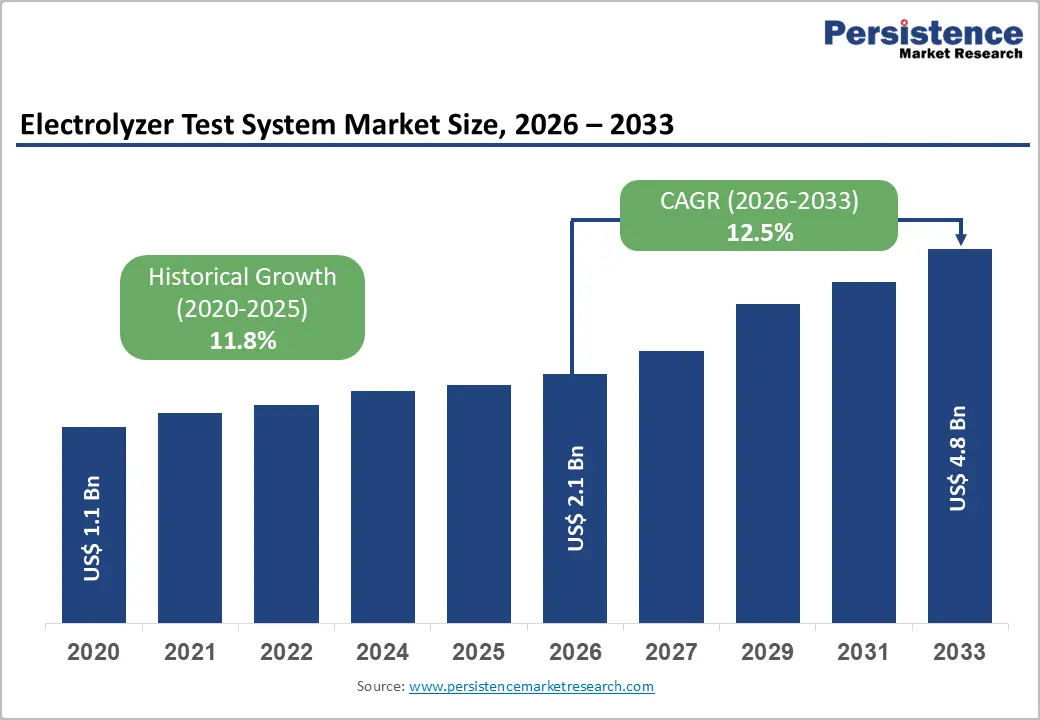
The global electrolyzer test system market size is expected to be valued at US$ 2.1 billion in 2026 and projected to reach US$ 4.8 billion by 2033, growing at a CAGR of 12.5% between 2026 and 2033.
The market's robust trajectory is underpinned by the unprecedented global scale-up of green hydrogen production capacity, which requires every electrolyzer unit, from prototype to MW-scale stack, to undergo rigorous performance validation before deployment.
Government-mandated hydrogen strategies across the European Union, United States, China, Japan, and India are collectively directing hundreds of billions of dollars toward electrolyzer manufacturing capacity, making test system infrastructure a non-negotiable prerequisite for quality assurance, certification, and bankability of hydrogen projects. The transition from laboratory-scale research to gigawatt-scale commercial production is simultaneously expanding the addressable test system market across every electrolyzer technology platform.
Key Industry Highlights
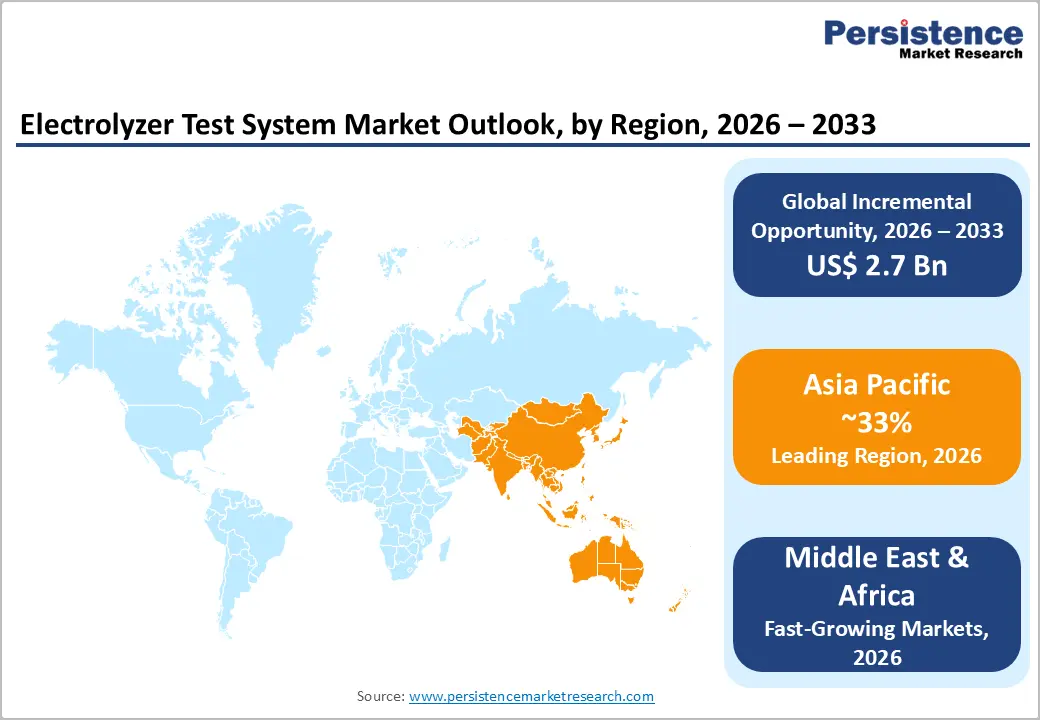
- Leading Region: Asia Pacific leads the global electrolyzer test system market with approximately 33% revenue share in 2026, anchored by China's dominant alkaline electrolyzer manufacturing ecosystem, accounting for over 60% of global AEL production capacity, and Japan and South Korea's PEM-focused hydrogen programs.
- Fast-Growing Region: Middle East & Africa is the fastest-growing regional market through 2033, driven by NEOM's 2.2 GW electrolyzer deployment, Oman's green hydrogen export strategy, and the African Green Hydrogen Alliance collectively creating unprecedented regional test infrastructure demand in a previously nascent market.
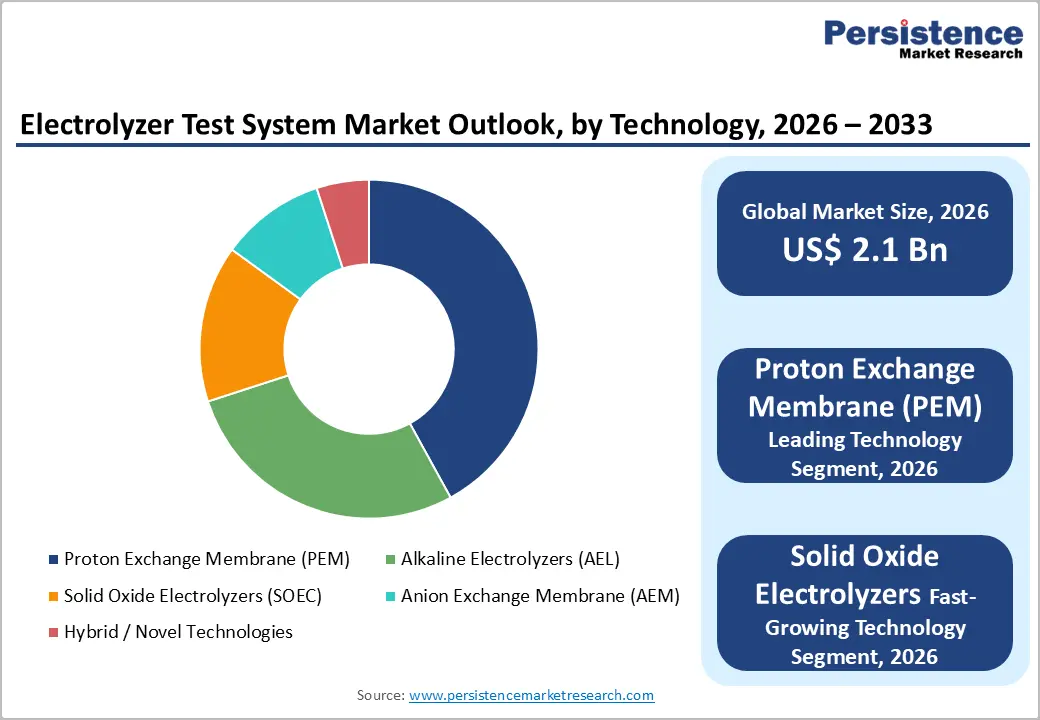
- Dominant Segment: Proton Exchange Membrane (PEM) dominates the technology segment with approximately 41% share in 2026, reflecting its leadership in announced commercial green hydrogen projects in North America and Europe and its compatibility with variable renewable energy sources requiring dynamic load-following test validation.
- Fastest Growing Segment: Solid Oxide Electrolyzers (SOEC) represent the fastest-growing technology segment at a projected CAGR of 15% by 2033, driven by Sunfire and Topsoe's commercialization progress and the technology's high-temperature co-electrolysis capability, compelling development of specialized test platform investments.
- Key Market Opportunity: Market opportunities are likely to emerge in SOEC-specific test platform development and Middle East & Africa market entry, where test system vendors are establishing first-mover positioning through regional service infrastructure and NEOM/Oman project partnerships can capture a disproportionate share of the US$ 2.7 billion incremental opportunity.
DRO Analysis
Drivers - Government-Mandated Hydrogen Scale-Up Programs Compelling Electrolyzer Validation Infrastructure
The codification of national hydrogen strategies across the world's largest economies has created mandatory electrolyzer deployment pipelines that intrinsically require test system procurement at every stage of the value chain. The European Commission's REPowerEU Plan targets 10 million tons of domestic green hydrogen production and 10 million tons of imports annually by 2030, requiring electrolyzer manufacturing capacity at a scale never previously achieved.
The U.S. Department of Energy (DOE)'s Hydrogen Earthshot program targets green hydrogen production cost of US$ 1/kg by 2031, catalyzing US$ 9.5 billion in public investment under the Bipartisan Infrastructure Law. Each of these programs mandates rigorous stack validation, system-level performance certification, and durability testing protocols that directly drive procurement of automated electrolyzer test systems across OEMs, EPCs, and national research laboratories.
Rapid Commercialization of Electrolyzer Manufacturing Requiring Quality Assurance at Scale
The transition of electrolyzer production from bespoke fabrication to high-volume manufacturing, driven by cost reduction imperatives and project pipeline development, is fundamentally reshaping test system demand from a research tool market to an industrial quality assurance infrastructure market. Companies including Nel ASA, ITM Power, Plug Power, Thyssenkrupp Nucera, and John Cockerill are scaling manufacturing facilities to hundreds of megawatts and, imminently, gigawatt annual capacity levels.
The International Energy Agency (IEA) reported in its Global Hydrogen Review 2024 that announced electrolyzer manufacturing capacity exceeded 130 GW/year globally, though actual production remained below 5 GW/year, a gap that represents precisely the scale-up phase in which quality testing infrastructure deployment is most critical. Multi-station automated test benches capable of parallel stack qualification are replacing single-unit R&D test systems as the dominant market format.
Restraints - High Capital Cost and Long Lead Times for Customized High-Power Test Systems
Electrolyzer test systems designed for MW-scale stack validation involve complex power electronics, hydrogen safety infrastructure, precision measurement instrumentation, and custom control software that aggregate into capital costs ranging from US$ 500,000 to over US$ 5 million per fully configured station. These costs create significant procurement barriers for smaller electrolyzer OEMs, academic research institutes, and emerging market players with constrained capital budgets.
Lead times for customized high-power test systems, particularly those requiring bespoke power supply configurations, cryogenic hydrogen handling systems, or specialized safety-rated enclosures, can extend to 12-18 months, creating bottlenecks in new facility commissioning timelines and slowing the qualification of new electrolyzer designs.
Lack of Standardized International Testing Protocols Across Electrolyzer Technologies
The absence of harmonized international testing standards for electrolyzer performance, durability, and safety characterization represents a structural market constraint that increases test complexity, cost, and time-to-certification. While organizations, including the International Electrotechnical Commission (IEC), International Organization for Standardization (ISO), and Hydrogen Europe, are developing frameworks such as IEC 62282 and the ISO/TC 197 hydrogen technology standards, comprehensive test protocols covering PEM, AEL, SOEC, and AEM technologies remain incomplete or non-mandatory across most jurisdictions.
This fragmentation compels test system operators to configure multi-protocol systems capable of meeting divergent customer specifications, increasing system complexity and reducing cross-customer standardization benefits that would otherwise drive cost efficiencies.
Opportunities - Solid Oxide Electrolyzer (SOEC) Testing Infrastructure as a High-Growth Specialization
Solid Oxide Electrolyzer Cell (SOEC) technology, which operates at high temperatures (700-900°C) and can co-electrolyze water and CO2 to produce syngas, is advancing rapidly from laboratory demonstration toward pre-commercial deployment, creating a structurally distinct and highly specialized test system demand vertical. SOEC systems require test infrastructure with precision thermal management, high-temperature gas handling, specialized impedance spectroscopy capabilities, and extended durability cycling protocols fundamentally different from ambient-temperature PEM and AEL systems.
The European Commission's Horizon Europe program and Fuel Cells and Hydrogen Joint Undertaking (FCH JU) have funded multiple SOEC demonstration projects, including those led by Sunfire GmbH and Topsoe, that are generating near-term demand for specialized SOEC test platforms. With SOEC projected at a CAGR of 15% as the fastest-growing electrolyzer technology segment, test system vendors that develop validated SOEC-specific platforms now will establish first-mover positioning in this high-margin emerging segment.
Middle East & Africa Emerging as a Strategic Frontier for Green Hydrogen Test Infrastructure
The Middle East & Africa region is emerging as the fastest-growing geography for electrolyzer test system demand, driven by a cluster of large-scale green hydrogen export projects that require indigenous test and validation infrastructure to qualify locally assembled or manufactured electrolyzers. Saudi Arabia's NEOM project, targeting 2.2 GW of electrolyzer capacity to produce 600 tons/day of green ammonia, and Oman's national green hydrogen strategy targeting 30% of energy exports from green hydrogen by 2050 represent anchor demand for regional test infrastructure.
The African Green Hydrogen Alliance, backed by South Africa, Kenya, Egypt, Morocco, and Mauritania, is aligning export-oriented green hydrogen strategies with international offtake agreements that require IEC-certified stack performance validation. Test system vendors partnering with local engineering firms and establishing regional service presence in the UAE, Saudi Arabia, and South Africa are positioned to capture this strategically important frontier market.
Category-wise Analysis
Technology Insights
The Proton Exchange Membrane (PEM) technology segment leads the Electrolyzer Test System market, commanding approximately 41% of total market share in 2026. PEM electrolyzers' dominance in test system procurement reflects their superior dynamic response characteristics, critical for integration with variable renewable energy sources, and their status as the preferred technology for most large-scale commercial green hydrogen projects globally. PEM systems require highly specialized test infrastructure, including precision humidification control, membrane electrode assembly (MEA) diagnostics, and high-current-density power supplies capable of replicating rapid load-following scenarios.
The IEA's Global Hydrogen Review 2024 confirmed PEM as the leading electrolyzer technology for announced projects in North America and Europe. Vendors including Greenlight Innovation, AVL List GmbH, and HORIBA FuelCon have built comprehensive PEM-specific test platform portfolios that reinforce this segment's technological and commercial leadership.
Power Capacity Insights
The 1-2 MW power capacity segment leads the electrolyzer test system market, accounting for approximately 38% of market share in 2026. This capacity range represents the optimal intersection of commercial relevance and test system manageability, sufficient to validate stacks for industrial-scale hydrogen production applications while remaining within the infrastructure and footprint constraints of most OEM test facilities. The 1-2 MW range has become the de facto standard for electrolyzer stack qualification across PEM and AEL platforms, as leading manufacturers including Nel ASA, ITM Power, and Plug Power have converged on stack architectures in this power class for their modular commercial product lines.
The 2-5 MW segment is the fastest growing, driven by the scaling ambitions of next-generation stack architectures being developed for GW-scale manufacturing, including Thyssenkrupp Nucera's containerized 20 MW alkaline modules requiring high-power sub-system validation.
End-user Insights
Electrolyzer OEMs constitute the dominant end-user segment for electrolyzer test systems, representing approximately 35% of global market share in 2026. Almost every commercial electrolyzer product requires validated test data for performance specification, warranty support, and regulatory certification, making test system investment a cost of doing business rather than an optional capital expenditure. The rapid expansion of OEM manufacturing capacity globally, with companies including Plug Power (targeting 1 GW/year production capacity), Nel ASA, Siemens Energy, and John Cockerill investing in dedicated gigafactory facilities, translates directly into parallel test infrastructure investment.
Research Institutes & Universities represent the second most active procurement segment, driven by public research funding directed toward electrolyzer technology development under EU Horizon Europe, DOE programs, and national hydrogen research initiatives across Japan, South Korea, China, and India.
Regional Analysis
North America Electrolyzer Test System Market Trends and Insights
North America holds approximately 28% of the global Electrolyzer Test System market revenue in 2026, driven by the U.S. DOE's unprecedented US$ 9.5 billion hydrogen investment package, the emergence of seven Regional Clean Hydrogen Hubs (H2Hubs), and the rapid scale-up of domestic electrolyzer manufacturing capacity by Plug Power, Nel ASA, and Cummins. The region's test infrastructure is primarily concentrated in OEM manufacturing facilities in New York, Ohio, and California, alongside national laboratories including Argonne, NREL, and Sandia.
U.S. Electrolyzer Test System Market Size
The U.S. Electrolyzer Test System market is valued at approximately US$ 480 Mn in 2026, anchored by the DOE's Hydrogen Earthshot initiative and the seven designated H2Hubs collectively awarded US$ 7 billion to develop regional hydrogen ecosystems. Each Hub's electrolyzer deployment mandate generates associated test infrastructure procurement, particularly for PEM and AEL stack qualification, supporting sustained test system demand through the 2026 - 2033 forecast period.
Europe Electrolyzer Test System Market Trends and Insights
Europe represents the second-largest regional market at approximately 26% of global revenue in 2026, shaped by the EU's REPowerEU hydrogen targets, the European Hydrogen Bank's inaugural auction awarding €720 million to green hydrogen projects, and Germany's National Hydrogen Strategy committing €9 billion to hydrogen infrastructure. The region hosts the highest concentration of dedicated electrolyzer test system specialists globally, including HORIBA FuelCon, AVL, LeanCAT, and Flusys, reflecting Europe's institutional depth in hydrogen technology validation.
Germany Electrolyzer Test System Market Size
Germany's electrolyzer test system market is valued at approximately US$ 185 Mn in 2026, reflecting the country's position as Europe's largest green hydrogen investment market and home to the National Hydrogen Centre (Nationales Wasserstoffzentrum) and multiple Fraunhofer Institute hydrogen research facilities. Germany's €9 billion national hydrogen strategy and its anchor role in the European Hydrogen Backbone initiative sustain structural test infrastructure demand across OEM, research, and EPC segments.
U.K. Electrolyzer Test System Market Size
The U.K. Electrolyzer Test System market is valued at approximately US$ 98 Mn in 2026, supported by the country's Low Carbon Hydrogen Standard framework, ITM Power's Sheffield gigafactory representing Europe's largest PEM electrolyzer manufacturing facility, and Innovate UK's sustained hydrogen technology R&D funding. The Net Zero Hydrogen Fund is committing £240 million to early-stage hydrogen production projects to anchor domestic test infrastructure demand.
France Electrolyzer Test System Market Size
France's electrolyzer test system market is valued at approximately US$ 72 Mn in 2026, driven by the country's National Hydrogen Plan allocating €9 billion through 2030 and strategic projects including the HyGreen Provence green hydrogen production hub. CEA (Commissariat à l'énergie atomique) and CNRS are significant test system procurers for SOEC and AEM technology development, creating a research-intensive demand profile alongside OEM qualification requirements.
Asia Pacific Electrolyzer Test System Market Trends and Insights
Asia Pacific leads the global electrolyzer test system market with approximately 33% revenue share in 2026, anchored by China's dominant electrolyzer manufacturing ecosystem. China is home to over 60% of global alkaline electrolyzer production capacity (per IEA Global Hydrogen Review 2024), with manufacturers including PERIC Hydrogen Technologies, Tianjin Mainland Hydrogen Equipment, and Shandong Saikesaisi driving massive domestic test system demand. Japan and South Korea contribute significant PEM-focused test infrastructure procurement aligned with their national hydrogen mobility and energy storage programs.
India Electrolyzer Test System Market Size
India's electrolyzer test system market is valued at approximately US$ 68 Mn in 2026, catalyzed by the National Green Hydrogen Mission targeting 5 million tons/year of green hydrogen production by 2030 and US$ 2.4 billion in production-linked incentives for electrolyzer manufacturing. Anchor institutions including NTPC, Indian Oil Corporation, and IIT hydrogen research centers are the primary test system procurers, creating public-sector-led demand as domestic OEM manufacturing capacity develops.
Japan Electrolyzer Test System Market Size
Japan's Electrolyzer Test System market is valued at approximately US$ 112 Mn in 2026, reflecting the country's long-standing hydrogen leadership and its Green Growth Strategy targeting 3 million tons/year of hydrogen supply by 2030. NEDO (New Energy and Industrial Technology Development Organization) funds extensive electrolyzer R&D and demonstration programs, while corporate players, including Asahi Kasei, IHI Corporation, and Mitsubishi Power, drive OEM-level test system procurement for both domestic and export-oriented product development.
Southeast Asia Electrolyzer Test System Market Size
Southeast Asia's combined electrolyzer test system market is estimated at approximately US$ 45 Mn in 2026, with Singapore, Malaysia, and Vietnam representing the primary demand centers. Singapore's Low-Carbon Energy Research Funding Initiative (LCER FI) and its Low-Carbon Hydrogen Import Framework are developing domestic electrolyzer testing capability to support import certification and quality validation requirements, while Malaysia's National Energy Transition Roadmap includes green hydrogen export ambitions that require standardized test validation infrastructure.
Competitive Landscape
The global electrolyzer test system market is moderately fragmented, with a mix of established instrumentation and test equipment specialists, including HORIBA FuelCon GmbH, AVL List GmbH, Greenlight Innovation, and Scribner Associates, competing alongside agile specialist startups and Asian manufacturers including Wuxi Lead Intelligent Equipment, KEWELL Technology, and GoRealGreat. Market leaders differentiate through electrolyzer-technology-specific platform depth, software automation and data management capabilities, and safety-certified hydrogen handling systems.
A notable strategic trend is the shift toward turnkey test facility solutions encompassing hardware, software, and commissioning services, rather than component-only supply, enabling vendors to capture recurring service revenue. Emerging players are competing on cost and speed-to-delivery, particularly in China's high-volume AEL test infrastructure segment.
Key Developments
- In March 2025, HORIBA FuelCon GmbH launched its FuelCon Evaluator EL next-generation PEM electrolyzer test platform featuring integrated EIS (electrochemical impedance spectroscopy) and automated MEA conditioning protocols, targeting OEM production line qualification at MW-scale throughput.
- In January 2025, Greenlight Innovation Inc. announced expansion of its electrolyzer test system portfolio with a new high-power G80 EL Series capable of testing stacks up to 2 MW, featuring modular architecture enabling parallel multi-stack qualification to support gigafactory deployment timelines.
- In October 2024, AVL List GmbH unveiled its AVL HYDROGENTM Test Systems platform integrating real-time digital twin simulation with physical electrolyzer test benches, enabling predictive performance modeling and accelerated durability testing for both PEM and AEL stack developers.
Companies Covered in Electrolyzer Test System Market
- Greenlight Innovation Inc.
- HORIBA FuelCon GmbH
- AVL List GmbH
- Bosch Manufacturing Solutions (BMG)
- Scribner Associates Inc.
- LeanCAT s.r.o.
- Flusys GmbH
- BioLogic SAS
- redox.me Sp. z o.o.
- Wuxi Lead Intelligent Equipment
- KEWELL Technology
- GoRealGreat
- Hydrogen Contango Pte. Ltd.
- H2Next Private Limited
- Avantium R&D Solutions
- Metrohm Autolab
- Gamry Instruments
- National Instruments
Frequently Asked Questions
The global Electrolyzer Test System market is valued at US$ 2.1 billion in 2026, up from US$ 1.1 billion in 2020, reflecting a historical CAGR of 11.8%. It is projected to reach US$ 4.8 billion by 2033 at a CAGR of 12.5%, representing an absolute incremental opportunity of US$ 2.7 billion.
The two primary drivers are government-mandated green hydrogen scale-up programs, including the EU's REPowerEU targeting 10 million tons/year of domestic green hydrogen and the rapid commercialization of electrolyzer manufacturing requiring industrial-grade quality assurance test infrastructure as OEMs scale to GW-level annual production capacities.
Asia Pacific leads with approximately 33% revenue share in 2026, anchored by China's over 60% share of global alkaline electrolyzer production capacity and Japan's NEDO-funded electrolyzer R&D programs.
The convergence of SOEC technology commercialization and Middle East & Africa market emergence represents the most compelling dual opportunity.
The market is led by HORIBA FuelCon GmbH (Germany), Greenlight Innovation Inc. (Canada), AVL List GmbH (Austria), Bosch Manufacturing Solutions (Germany), and Scribner Associates Inc. (USA) at the premium OEM and research segment level.


