




- Medical Devices
- Dental Turbines Market
Dental Turbines Market Size, Share, and Growth Forecast 2026 - 2033
Dental Turbines Market by Product (Air-Driven Turbines, Electric-Driven Turbines, Hybrid Air-Electric Turbines), by Speed (High-speed Turbine Handpiece, Low-speed Turbine Handpiece), End-user (Dental Clinics, Hospitals, Others), and Regional Analysis, 2026 - 2033

Dental Turbines Market Size and Trend Analysis
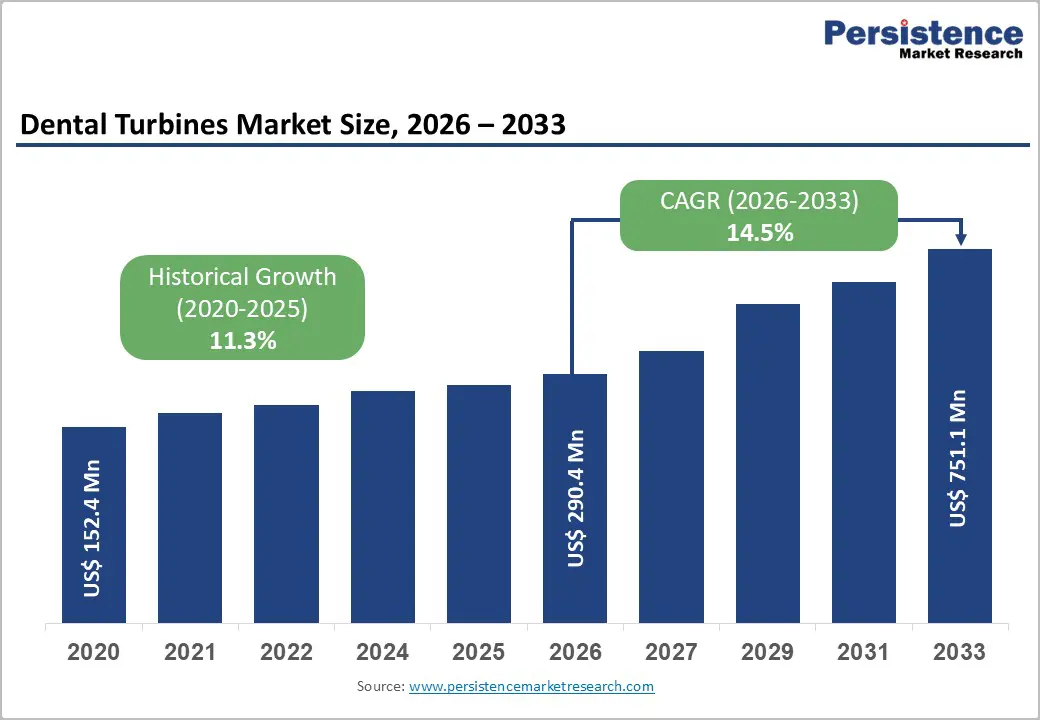
The global dental turbines market size is expected to be valued at US$ 290.4 million in 2026 and projected to reach US$ 751.1 million by 2033, growing at a CAGR of 14.5% between 2026 and 2033. It is witnessing exceptional, above-industry-average growth, driven by rising global dental procedure volumes and rapid technological advancements in dental handpieces.
The increasing adoption of electric dental turbine systems, offering superior torque control, improved precision, and reduced noise levels, is reshaping clinical efficiency and patient comfort. According to the World Health Organization (WHO), oral diseases affect nearly 3.5 billion people worldwide, creating a vast and expanding patient base requiring restorative and surgical dental procedures that depend on high-performance turbine technology. Expansion of dental clinic infrastructure across Asia-Pacific and Latin America, coupled with rising dentist-to-population ratios in emerging economies, is accelerating demand. Meanwhile, premiumization trends and replacement demand in North America and Europe further strengthen global market growth momentum.
Key Industry Highlights
- Leading Region - North America leads with ~38% share in 2025, driven by 200,000+ U.S. clinics, DSOs standardization, CDCP in Canada, and strong KaVo®/Dentsply presence.
- Fastest Growing Region - Asia-Pacific grows fastest due to China’s Healthy China 2030, India’s rising dental graduates, and cost-effective handpieces boosting ASEAN and South Asian access.
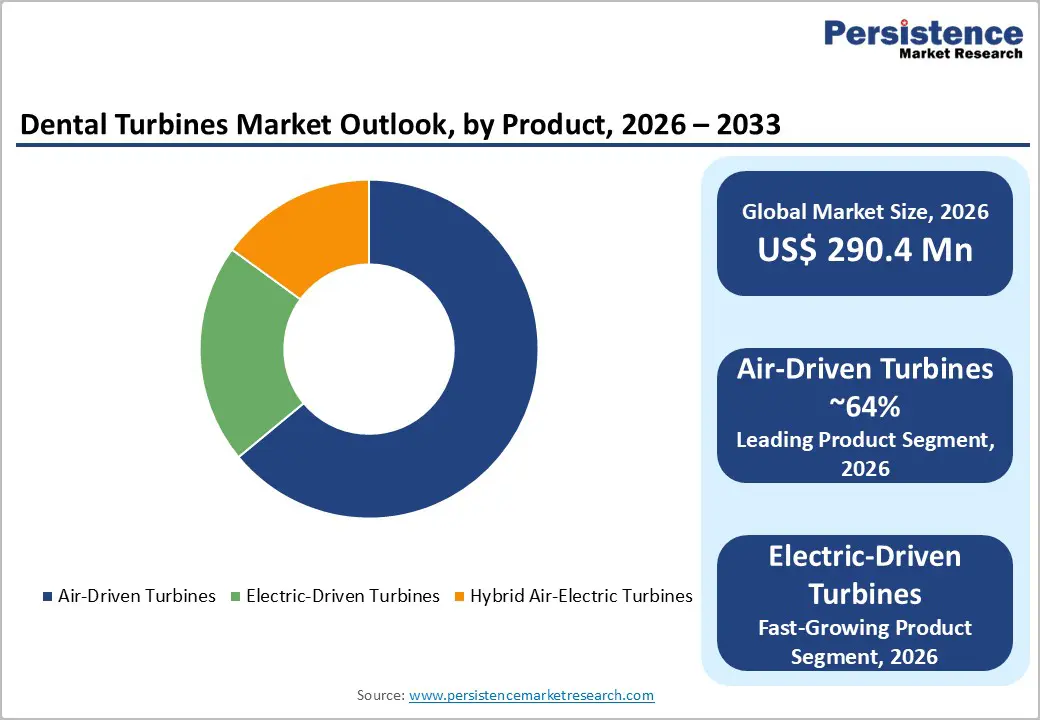
- Dominant Segment - Air-driven turbines dominate with ~64% share, supported by low US$100-400 cost, 450,000 RPM speed, and widespread compatibility across global dental infrastructure.
- Fastest Growing Segment - Electric turbines grow fastest, offering constant torque at 200,000 RPM, superior clinical outcomes, and innovation from NSK® and W&H in brushless motor systems.
- Key Opportunity - Strong growth from China clinic expansion, India’s dental education system, and Thailand’s dental tourism creates a significant multi-hundred-million-dollar incremental opportunity through 2033.
Market Dynamics
Drivers - Rising Dental Procedures and Expanding Global Clinic Infrastructure Fuel Demand
The dental turbines market is primarily driven by the exponential rise in global restorative, cosmetic, and surgical dental procedures, all of which require high-precision turbine handpieces for efficient clinical performance. The growing prevalence of oral diseases and the growing demand for aesthetic dentistry are significantly expanding procedure volumes worldwide. According to the American Dental Association (ADA), the United States alone has nearly 200,000 active dental practices, each using multiple high-speed turbines for procedures such as caries removal, crown preparation, and implant site drilling. This widespread clinical dependence on turbine-based systems reinforces consistent replacement and upgrade demand across both developed and emerging markets. Additionally, rising patient awareness regarding oral health and cosmetic treatments is further contributing to higher utilization rates of advanced dental equipment.
In emerging economies, the rapid expansion of healthcare infrastructure is acting as a key growth catalyst for the dental turbines market. China’s Healthy China 2030 initiative is accelerating large-scale dental clinic development, while India’s Dental Council of India (DCI) oversees more than 315 dental colleges, continuously increasing the pool of trained dental professionals. With each new dental practice requiring an estimated 3-5 handpieces for routine operations, procurement volumes are expanding steadily across regions. This strong infrastructure buildup, combined with rising clinical capacity and growing patient inflow, is reinforcing sustained global demand growth for dental turbine systems across both public and private dental care settings.
Restraints - High Costs and Maintenance Burden Restrict Adoption in Emerging Markets
Despite strong growth potential, the dental turbines market faces significant restraints due to the high acquisition and maintenance costs of advanced electric turbine systems. Premium electric handpieces typically range from US$ 500 to over US$ 2,500 per unit, compared to much lower-priced air-driven alternatives costing US$ 100-US$ 400. This cost disparity creates a major adoption barrier, particularly in price-sensitive regions such as Southeast Asia, Sub-Saharan Africa, and parts of Latin America.
Additionally, electric turbines require compatible control units, specialized servicing, and periodic motor maintenance, increasing the total cost of ownership for dental clinics. Independent practitioners with limited capital often prioritize low-cost equipment, delaying technology upgrades. As a result, while high-end markets in North America and Europe continue to adopt premium systems, price sensitivity in developing economies significantly slows penetration of advanced turbine technologies.
Opportunities - Electric Turbines Emerging as Fastest Growing Precision Dentistry Segment
Electric dental turbines are emerging as the fastest-growing segment in the global dental turbines market, driven by increasing demand for precision dentistry, improved ergonomics, and seamless integration with digital dental workflows. Unlike air-driven turbines, which often experience torque loss under load, electric handpieces maintain consistent torque output even at speeds reaching up to 200,000 RPM. This ensures more controlled and accurate cutting performance, particularly in complex procedures such as crown preparation, cavity shaping, and restorative dentistry. As a result, clinicians benefit from reduced chairside time, improved procedural efficiency, and enhanced patient comfort, which is increasingly important in modern dental care delivery.
The growing emphasis on minimally invasive dentistry and precision-based treatment approaches is further accelerating the shift toward electric systems across both developed and emerging markets. Professional acceptance is also strengthening, with the International College of Prosthodontists (ICP) recognizing electric systems as a preferred standard in contemporary restorative dentistry. Leading manufacturers, including Danaher Corporation through its KaVo® brand and Nakanishi Inc. with its NSK® Presto Aqua series, are investing in advanced brushless motor technologies.
These innovations significantly reduce maintenance requirements, extend device lifespan, and improve operational reliability for dental clinics. Combined with the broader trend toward digitalization and high-performance dental equipment, these technological advancements are rapidly driving global adoption of electric turbine systems, positioning them as a key growth engine in the overall market.
Category-wise Analysis
Product Insights
Air-driven turbines dominated the dental turbines market, commanding ~64% of total product-type market share in 2025. The long-established clinical familiarity, significantly lower acquisition cost (US$ 100-US$ 400 per unit), and compatibility with existing dental unit infrastructure have entrenched air-driven turbines as the standard handpiece choice across most global dental practices, particularly in Asia-Pacific, Latin America, and Middle East & Africa where price sensitivity is pronounced.
Air-driven turbines from Dentsply Sirona, W&H Group, and The Yoshida Dental Mfg. Co., Ltd. achieves speeds up to 450,000 RPM, sufficient for most routine restorative and preparatory procedures, making them a practical and economical choice. The ADA and regional dental associations continue to list air-driven handpieces as standard clinical equipment, reinforcing their dominant installed base across all major dental care settings globally.
Speed Insights
High-speed turbine handpieces led the speed segment, representing ~68% of total dental turbines market demand in 2025. Operating at speeds of 160,000-400,000+ RPM, high-speed handpieces are the primary clinical tool for dental caries removal, tooth preparation for crowns and inlays, and cutting through hard dental tissues, including enamel and dentin. The fundamental requirement for high-speed cutting in virtually every restorative and prosthodontic procedure makes high-speed turbines indispensable across all dental care settings globally.
According to the ADA Health Policy Institute, restorative procedures including fillings and crown preparations, represent among the most frequently performed dental services in the U.S., with each procedure requiring high-speed handpiece operation. Technological innovation including fiber-optic LED illumination, ceramic bearing systems, and titanium head construction, has further enhanced high-speed turbine performance, reinforcing segment dominance.
End-user Insights
Dental clinics constituted the dominant end-user segment of the dental turbines market, accounting for ~72% of total end-user demand in 2025. The sheer numerical dominance of standalone and group dental clinic settings relative to hospital dental departments makes clinics the primary turbine procurement channel globally. The ADA documents ~200,000 active dental practices in the U.S., while the Council of European Dentists (CED) represents over 340,000 dentists across Europe, the majority of whom practice based.
Each dental operatory unit in a clinical setting requires 3-5 high-speed handpieces for sterilization cycle rotation, plus low-speed counterparts, creating substantial per-clinic turbine inventories. The expansion of dental service organizations (DSOs) in the U.S. and Europe is further centralizing procurement, enabling volume purchase agreements with major turbine suppliers.
Regional Insights
North America Dental Turbines Market Trends and Insights
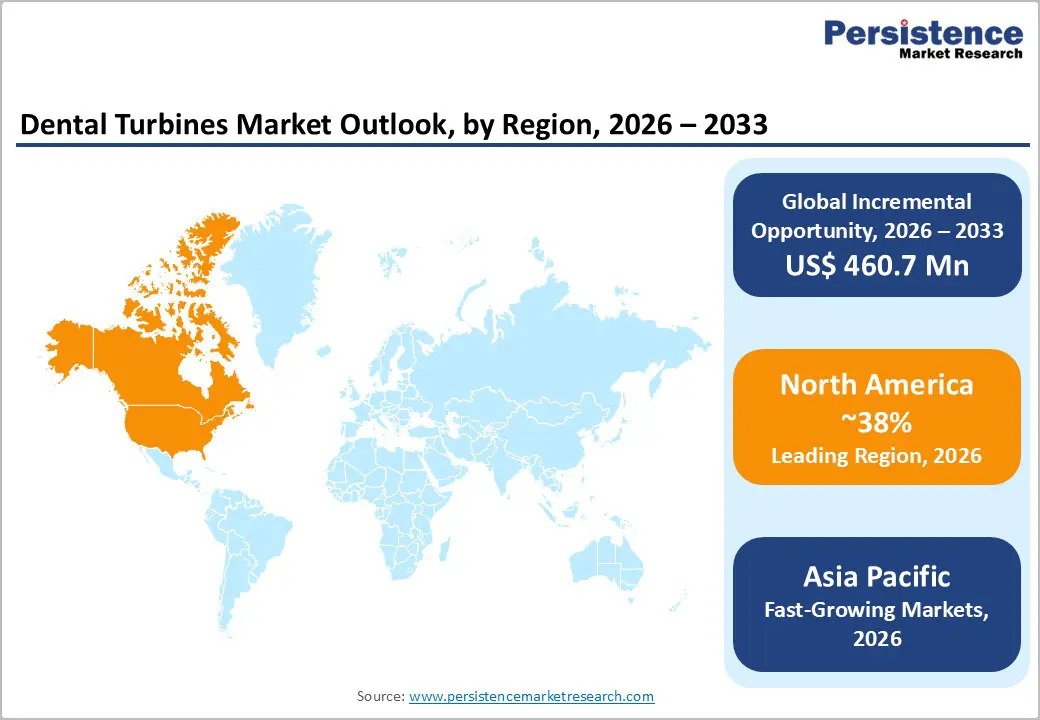
North America is likely to lead the dental turbines market with ~38% global market share in 2026, driven by a highly developed dental care infrastructure, strong demand for premium electric handpieces from DSO networks, and active FDA 510(k) regulatory pathways ensuring high-quality product availability. Canada's Canada Dental Care Plan (CDCP) is expanding access and stimulating incremental clinic investment.
U.S. Dental Turbines Market Size
The U.S. accounts for ~85% of North American dental turbine revenue, supported by 200,000+ dental practices, the highest global per-capita dental expenditure, and DSO-driven equipment standardization programs. Dentsply Sirona and Danaher Corporation's KaVo® brands dominate U.S. market share in both premium electric and standard air-driven segments.
Europe Dental Turbines Market Trends and Insights
Europe represents the second-largest regional market, characterized by high penetration of premium electric turbines particularly in Germany and Austria and rigorous EU MDR 2017/745 compliance requirements ensuring product quality. The region is home to leading turbine manufacturers W&H Group, Bien-Air Dental SA, and Nakanishi Inc.'s European operations, reinforcing its dual role as a major demand and manufacturing hub.
Germany Dental Turbines Market Size
Germany leads European dental turbine adoption, home to ~71,000 dental practices per KZBV (National Association of Statutory Health Insurance Dentists) data. GKV insurance coverage for dental restorative procedures, combined with Germany's engineering culture favoring premium precision instruments, drives high electric turbine penetration and W&H Group market leadership.
UK Dental Turbines Market Size
UK dental turbines market benefits from NHS dental restorative services across 11,600+ community practices and a growing private dental sector. The NHS Dental Recovery Plan 2024 is restoring elective procedure volumes, driving turbine procurement. A-dec, Inc. and W&H Group maintain strong UK distribution presences through established dental dealer networks.
France Dental Turbines Market Size
France supports ~42,000 dental practitioners per Conseil National de l'Ordre des Chirurgiens-Dentistes data, generating sustained turbine demand. Sécurité Sociale reimbursement for restorative procedures sustains procedure volumes. France's premium dental equipment market, favoring Bien-Air and W&H electric handpieces, is growing as private clinic investment in high-specification equipment accelerates.
Asia Pacific Dental Turbines Market Trends and Insights
Asia-Pacific is the fast-growing regional dental turbines market, driven by China's Healthy China 2030 dental expansion, adding thousands of clinics annually, and a growing domestic dental handpiece manufacturing sector led by Guilin Woodpecker Medical Instrument Co., Ltd., which serves both premium domestic demand and cost-sensitive global export markets. China's NMPA device approvals for international brands are progressively improving, broadening premium product access.
India Dental Turbines Market Size
India is a high-growth dental turbines market, driven by 315+ dental colleges per DCI producing 26,000+ annual dental graduates, each initiating turbine equipment procurement upon establishing practice. Rising disposable incomes, growing dental tourism in Chennai, Mumbai, and Delhi, and the Ayushman Bharat health scheme expansion are accelerating dental care access and handpiece demand.
Japan Dental Turbines Market Size
Japan represents a premium dental turbine market with ~67,000 dental practices per the Japan Dental Association (JDA) data. Japanese dentists demonstrate a strong preference for high-precision electric turbines from domestic manufacturers Nakanishi Inc. (NSK®) and The Yoshida Dental Mfg. Co., Ltd., reinforcing premium segment market leadership and driving consistent high-value handpiece procurement.
Competitive Landscape
The global dental turbines market is moderately consolidated, with Dentsply Sirona, Inc., Danaher Corporation (KaVo®), Nakanishi Inc. (NSK®), and W&H Group commanding significant market positions through global distribution networks and premium product portfolios. Key differentiators include brushless electric motor technology, integrated LED illumination, autoclave-compatible head designs, and compatibility with open-architecture dental unit platforms. Guilin Woodpecker and B.A. International companies compete aggressively on price in emerging markets.
Emerging business model trends include turbine subscription/rental models for DSO networks, IoT-enabled maintenance tracking, and digital catalog integration with chairside dental unit management systems.
Key Developments
- In July 2025, J. MORITA USA introduced its most advanced air-driven handpiece, the TwinPower Turbine G-Series, engineered to deliver enhanced cutting efficiency and improved performance for dental professionals.
- In October 2023, NSK America, a Japan-based dental equipment manufacturer, announced the launch of its upgraded Ti-Max Z2 Series of air turbine dental handpieces, featuring enhanced performance and advanced design improvements.
Companies Covered in Dental Turbines Market
- Dentsply Sirona, Inc.
- Nakanishi Inc.
- W&H Group
- B.A. International
- Bien-Air Dental SA
- The Yoshida Dental Mfg. Co., Ltd.
- A-dec, Inc.
- Guilin Woodpecker Medical Instrument Co., Ltd.
- Danaher Corporation
- DentalEZ
- Others
Frequently Asked Questions
The global dental turbines market is expected to be valued at US$ 290.4 million in 2026.
Major drivers include rising oral disease prevalence, expanding dental clinics, increasing demand for handpieces, advancements in electric turbines, and growth in dental infrastructure in emerging markets.
North America is poised to lead with ~38% of global market share in 2026.
Key opportunities include the fast-growing electric turbine market, expanding Asia-Pacific dental infrastructure, dental tourism growth, and increasing adoption of advanced turbine technologies.
Leading companies include Dentsply Sirona, NSK, W&H Group, KaVo, Bien-Air, A-dec, Woodpecker, and Yoshida Dental, driving global market competition.


