




- Pharmaceuticals
- Crystal-Induced Arthritides Treatment Market
Crystal-Induced Arthritides Treatment Market Size, Share, and Growth Forecast, 2026 -2033
Crystal-Induced Arthritides Treatment Market by Drug Class (NSAIDs, Urate-Lowering Agents / Xanthine Oxidase Inhibitors, Others), Disease Condition (Chronic Gout, Acute Gout Flares, Others), Route of Administration, Distribution Channel, and Regional Analysis for 2026 - 2033

Crystal-Induced Arthritides Treatment Market Size and Trends Analysis
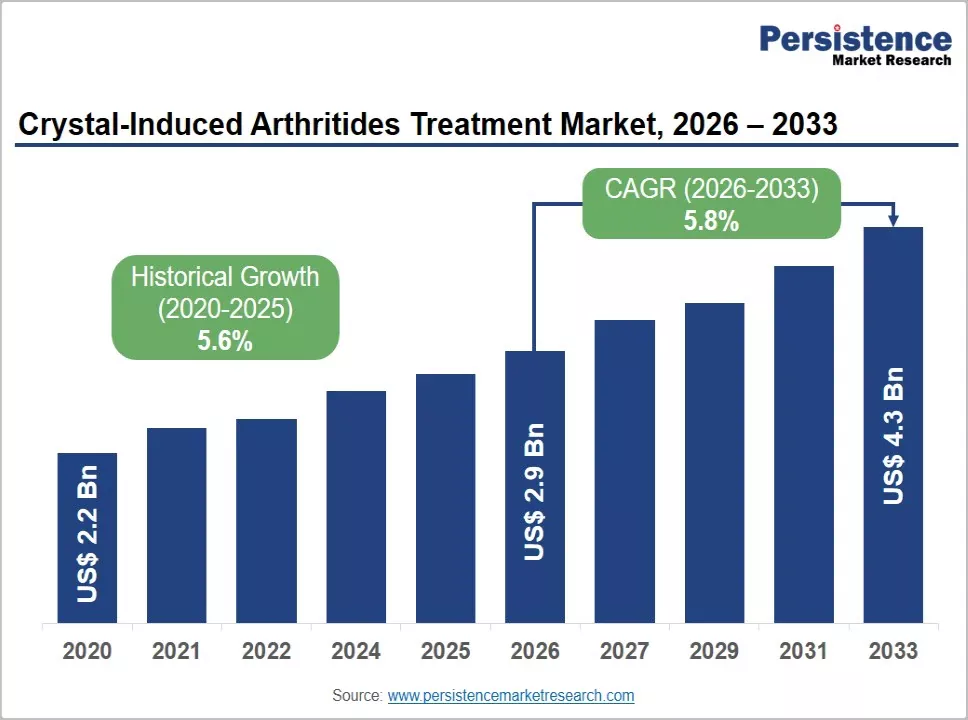
The global crystal-induced arthritides treatment market size is likely to be valued at US$2.9 billion in 2026 and is expected to reach US$4.3 billion by 2033, growing at a CAGR of 5.8% between 2026 and 2033, driven by the persistent global burden of gout, increasing diagnosis of crystal-associated joint disorders, population aging, and wider adoption of long-term urate-lowering treatment.
Treatment patterns are also evolving toward sustained urate control, targeted therapy for refractory disease, biologic intervention, and exploration of inflammatory pathways involved in crystal deposition.
Key Industry Highlights:
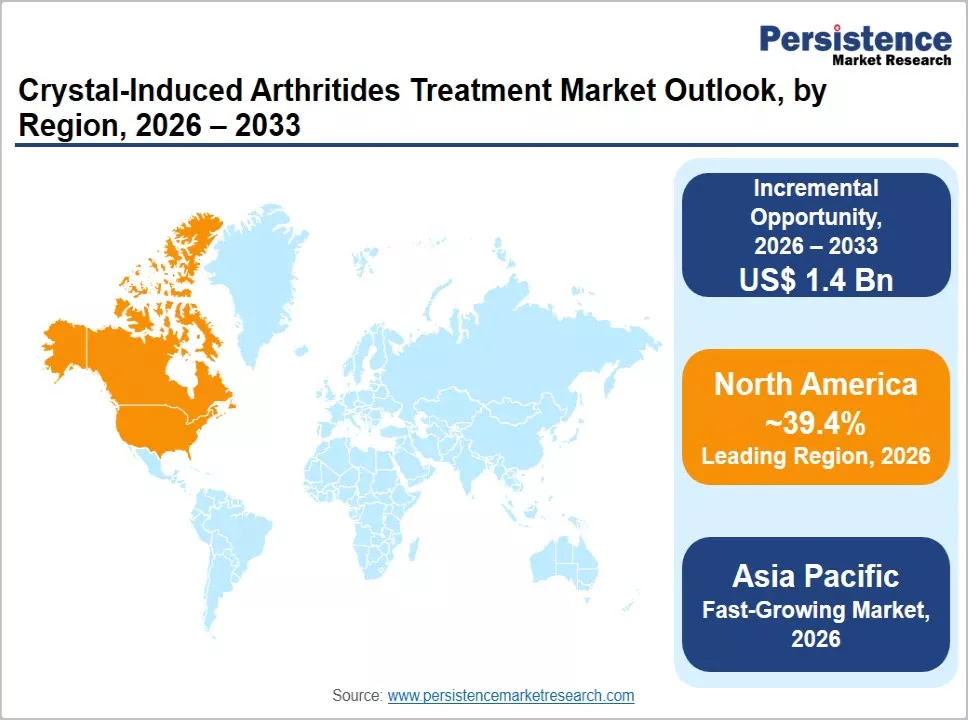
- Leading Region: North America is projected to account for 39.4% of market revenue in 2026, supported by a large treated patient population, established rheumatology infrastructure, high pharmaceutical spending, and strong therapeutic innovation.
- Fastest-growing Region: Asia Pacific, driven by rising gout and hyperuricemia prevalence, population aging, improving healthcare access, expanding pharmaceutical manufacturing, and increasing adoption of long-term urate-lowering therapies.
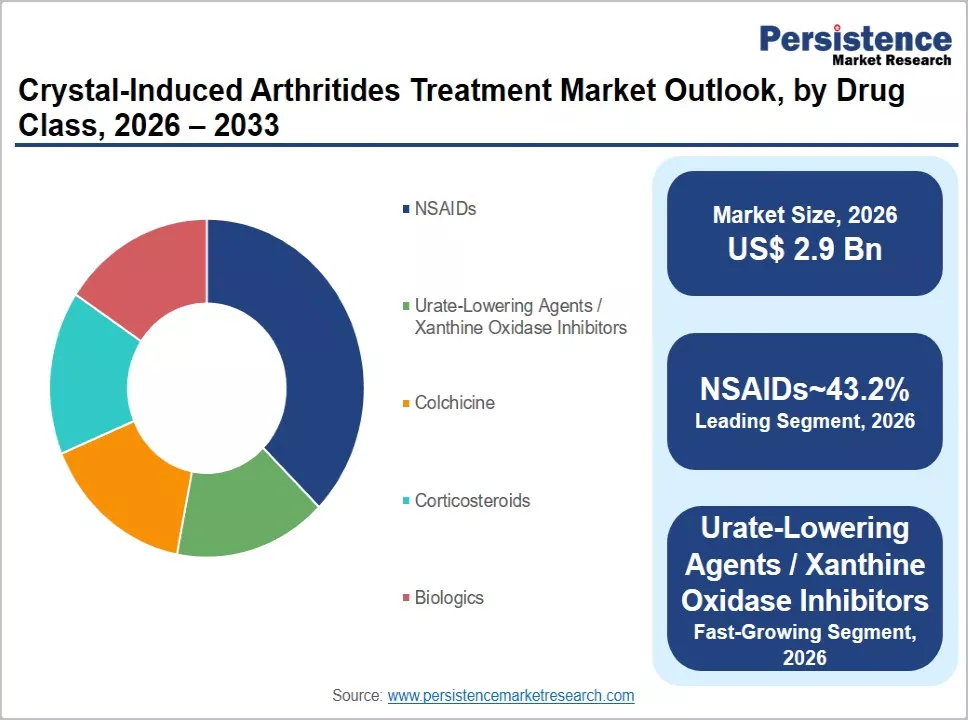
- Dominant Drug Class: NSAIDs, anticipated to account for approximately 43.2% of market revenue in 2026, supported by their established role in acute gout-flare management, broad availability, affordability, and rapid anti-inflammatory effects.
- Leading Disease Condition: Chronic gout, anticipated to represent 61.6% of market revenue in 2026, driven by recurring demand for urate-lowering therapy, monitoring, prophylaxis, and treatment escalation.
DRO Analysis
Drivers - Rising Disease Prevalence and Population Aging Are Expanding the Treatment Pool
The growing burden of gout provides a strong foundation for expansion of the Crystal-Induced Arthritides Treatment Market. The World Health Organization estimates approximately 54 million prevalent gout cases globally, while U.S. National Health and Nutrition Examination Survey data estimated that approximately 12.1 million Americans had gout during 2017–2018, equivalent to a crude prevalence of about 5.1%. Prevalence increases substantially with age, making demographic aging an important structural demand driver. At the same time, calcium pyrophosphate deposition disease becomes more clinically relevant among older populations. Greater awareness, improved imaging, synovial-fluid analysis, and increased access to rheumatology services can therefore expand diagnosis beyond traditional gout populations. For pharmaceutical companies, the resulting opportunity spans acute anti-inflammatory products, chronic urate-lowering therapies, corticosteroids, biologics, and specialty-care treatments.
Treatment Is Moving From Flare Management toward Long-Term Disease Control
Clinical practice is increasingly focused on reducing urate burden and preventing recurrent crystal formation rather than treating individual attacks in isolation. The American College of Rheumatology recommends allopurinol as the preferred first-line urate-lowering therapy and supports a treat-to-target approach based on serial serum urate testing, generally targeting a serum urate concentration of less than 6 mg/dL. The guideline also recommends anti-inflammatory prophylaxis for at least 3–6 months when urate-lowering treatment is initiated. This approach creates recurring treatment demand through maintenance therapy, dose titration, monitoring, prophylaxis, and flare management. At the higher-acuity end of the market, therapies such as pegloticase address chronic gout that is refractory to conventional treatment. The resulting market structure combines high-volume conventional medicines with higher-value specialty therapies.
Restraint - Safety Risks, Comorbidities, and Treatment Costs Limit Broader Adoption of Advanced Therapies
Treatment decisions are often complicated by chronic kidney disease, cardiovascular risk, drug interactions, age-related comorbidities, and intolerance to conventional medicines. These considerations can restrict treatment selection and make long-term management more complex. Advanced therapies also carry additional safety and administration requirements. FDA labeling for pegloticase includes important warnings regarding anaphylaxis and infusion reactions, while screening for G6PD deficiency is required because of the potential risk of hemolysis and methemoglobinemia. Such requirements increase the need for appropriate healthcare infrastructure and specialist supervision. Cost is another barrier, particularly for biologics and targeted therapies. Conventional medicines face strong generic price competition, whereas premium therapies must demonstrate meaningful clinical differentiation and justify their additional acquisition and administration costs.
Opportunities - Refractory Gout Creates a High-Value Opportunity for Next-Generation Therapies
A substantial opportunity exists in patients who remain inadequately controlled, intolerant, or poorly responsive to established therapies. Refractory gout requires a more intensive treatment approach and can involve persistent tophi, frequent flares, impaired mobility, and increased healthcare utilization. Pegloticase provides an established specialty-treatment pathway for adults with chronic gout refractory to conventional therapy. At the same time, pharmaceutical and biotechnology companies are developing oral agents and differentiated formulations intended to improve urate reduction, treatment convenience, and tolerability. XORTX Therapeutics is advancing XRx-026, an investigational oxypurinol formulation, while Atom Therapeutics is developing lingdolinurad, an oral URAT1 inhibitor. These programs indicate continuing investment in alternatives to established xanthine oxidase inhibitors and create opportunities for products capable of addressing treatment gaps in chronic and difficult-to-manage disease.
Inflammatory Pathway Innovation Could Expand Treatment beyond Conventional Gout
Research into the biology of crystal-induced inflammation is opening opportunities for therapies that target specific inflammatory pathways. NLRP3 and IL-1 signaling are central to inflammatory responses triggered by urate and other crystals, while newer research is evaluating the potential relevance of IL-6, JAK, and related pathways. The opportunity is particularly important for CPPD, where there is currently no approved treatment that removes or dissolves calcium pyrophosphate crystals. Management therefore remains focused largely on reducing inflammation and controlling recurrent symptoms. Development of oral and targeted therapies that suppress crystal-induced inflammation could broaden the addressable market beyond conventional gout treatment. Monte Rosa Therapeutics' development of an investigational NEK7-targeted molecular glue degrader illustrates the industry's increasing interest in upstream mechanisms involved in inflammasome activation and recurrent inflammatory episodes.
Category-wise Analysis
Drug Class Insights
NSAIDs are anticipated to account for 43.2% of market revenue in 2026. Their position reflects broad availability, established clinical familiarity, affordability, and rapid anti-inflammatory action. Examples include naproxen, indomethacin, and ibuprofen, which are widely used for acute gout flares. Colchicine and corticosteroids, including oral or injectable prednisone, provide alternatives when NSAIDs are unsuitable because of renal, gastrointestinal, or cardiovascular considerations. Biologics such as pegloticase occupy a smaller, higher-value niche for difficult-to-treat gout.
Urate-lowering agents and xanthine oxidase inhibitors are anticipated to be the fastest-growing drug-class opportunity. Growth is supported by the shift toward long-term disease control and prevention of crystal accumulation. Allopurinol remains the preferred first-line urate-lowering therapy, while febuxostat is used as an alternative for selected patients. Increasing adoption of treat-to-target management, recurring flares, and persistent tophi is supporting demand for sustained urate control. Emerging oral URAT1 inhibitors are also being developed for patients with inadequate response or intolerance to conventional therapies, strengthening the segment's long-term growth potential.
Disease Condition Insights
Chronic gout is anticipated to account for 61.6% of market revenue in 2026. Chronic disease generates recurring demand for urate-lowering medicines, monitoring, prophylaxis, and treatment escalation. Allopurinol and febuxostat are central to long-term management, while patients with severe or refractory disease may require advanced therapies such as pegloticase. The growing emphasis on maintaining target serum urate levels also makes chronic gout a continuing treatment category rather than an episodic intervention.
Acute gout flares are anticipated to be the fastest-growing segment in absolute treatment episodes, driven by recurrent attacks and demand for rapid symptom control across primary care, urgent care, emergency departments, and rheumatology practices. Naproxen, indomethacin, colchicine, and corticosteroids remain common treatment options, while injectable corticosteroids may be used when oral therapy is unsuitable. The opportunity also extends to acute CPP crystal arthritis, where joint aspiration and intra-articular corticosteroids are frequently used. Greater recognition and faster treatment of recurrent flares can increase utilization across multiple healthcare settings.
Regional Insights
North America Crystal-Induced Arthritides Treatment Market Trends
North America is expected to be the leading regional market, accounting for approximately 39.4% of global revenue in 2026, supported by a large diagnosed patient population, high pharmaceutical spending, specialist infrastructure, and strong innovation. The U.S. remains the principal market, while Canada provides additional demand through its established healthcare system.
U.S. Crystal-Induced Arthritides Treatment Market Trends
The U.S. NHANES data estimated approximately 12.1 million people had gout in 2017–2018, with prevalence concentrated among older adults and people with obesity, chronic kidney disease, hypertension, and diabetes. The treatment landscape combines low-cost generics such as NSAIDs, colchicine, and allopurinol with specialty products for refractory disease. In May 2025, ANI Pharmaceuticals initiated a Phase 4 study of Purified Cortrophin Gel for acute gout flares at Massachusetts General Hospital, comparing 40- and 80-USP-unit doses. The development strengthens the role of injectable ACTH therapy for patients inadequately treated with NSAIDs or colchicine.
Innovation is also extending into differentiated urate-lowering therapy. In April 2025, XORTX Therapeutics received FDA feedback on XRx-026, its proprietary oxypurinol formulation, clarifying requirements for a potential NDA through the 505(b)(2) pathway. This supports continued investment in oral therapies for patients who cannot adequately tolerate existing allopurinol treatment.
Canada Crystal-Induced Arthritides Treatment Market Trends
Canada contributes demand through universal healthcare coverage, established rheumatology services, and increasing recognition of gout as a chronic condition requiring sustained management. The regional opportunity is strongest in therapies that reduce recurrence and support adherence, although generic substitution, reimbursement pressure, and regulatory requirements constrain premium pricing.
Europe Crystal-Induced Arthritides Treatment Market Trends
Europe represents a mature market characterized by an aging population, widespread generic use, established rheumatology networks, and strong regulatory oversight. Germany, the United Kingdom, France, and Spain are important national markets, with differences in prevalence and treatment utilization reflecting healthcare access and diagnostic practices.
Germany Crystal-Induced Arthritides Treatment Market Trends
Germany has reported gout prevalence of approximately 1–2% in earlier population research. Its strong pharmaceutical infrastructure and specialist healthcare network support adoption of established and advanced treatments. The European market also benefits from products such as Adenuric (febuxostat), which is authorized for chronic hyperuricemia with urate deposition, including gouty arthritis and tophi. Generic alternatives such as Febuxostat Viatris and Febuxostat Krka reinforce the region's cost-conscious treatment structure and expand access to xanthine oxidase inhibition.
U.K. Crystal-Induced Arthritides Treatment Market Trends
Earlier U.K. research estimated gout prevalence at approximately 2.49%, highlighting a substantial treatment population. The country's centralized evidence and reimbursement environment places greater emphasis on clinical effectiveness and healthcare-resource utilization. This favors therapies capable of reducing recurrent flares and long-term complications. Europe also remains an important innovation market, with AstraZeneca's Zurampic (lesinurad) demonstrating earlier regional interest in URAT1 inhibition as an adjunct to xanthine oxidase inhibitors, although its historical development illustrates the regulatory and commercial challenges facing differentiated gout therapies.
Asia Pacific Crystal-Induced Arthritides Treatment Market Trends
Asia Pacific is expected to be the fastest-growing region, driven by population scale, urbanization, changing diets, healthcare expansion, pharmaceutical manufacturing, and aging demographics. China and Japan represent major established markets, while India and Southeast Asia provide significant longer-term expansion potential.
China Crystal-Induced Arthritides Treatment Market Trends
A national survey of 78,130 adults across 31 provinces estimated gout prevalence at approximately 3.2% and hyperuricemia prevalence at 17.7%. China's gout prevalence also increased from about 640.7 per 100,000 people in 1990 to 810.4 per 100,000 in 2021. The country's large patient pool is supporting demand for affordable urate-lowering medicines while creating opportunities for differentiated therapies. Teijin's development of febuxostat with Astellas Pharma China historically helped establish xanthine oxidase inhibition as an important treatment category in the Chinese market.
Japan Crystal-Induced Arthritides Treatment Market Trends
Japan has a mature hyperuricemia treatment environment. A national claims analysis identified diagnosed gout in approximately 1.1% of the study population, with around 80.7% receiving urate-lowering therapy. Teijin Pharma's Feburic (febuxostat) remains a notable domestic example, having been approved for gout and hyperuricemia and helping establish long-term xanthine oxidase inhibition in routine care.
India adds substantial future potential, with approximately 156.7 million people aged 60 years or older in 2024, while Sun Pharma's portfolio includes multiple febuxostat brands such as Feboxa, Febuget, and Febutaz, illustrating the availability of locally manufactured oral urate-lowering options. The region is also becoming relevant to next-generation innovation: in October 2026, Monte Rosa Therapeutics reported positive Phase 1 results for MRT-8102, a NEK7-directed therapy targeting the NLRP3 pathway, with a Phase 2 gout study planned for late 2026 or early 2027.
Competitive Landscape
The global crystal-induced arthritides treatment market has a mixed competitive structure, with intense fragmentation in conventional oral therapies and greater concentration in specialty and biologic treatments. Allopurinol, colchicine, NSAIDs, corticosteroids, and related medicines face substantial generic competition, placing pressure on pricing and differentiation. Specialty products for refractory gout face higher regulatory, manufacturing, and clinical barriers, which limits the number of direct competitors. Competition is therefore determined not only by sales volume but also by product differentiation, clinical evidence, physician adoption, regulatory approvals, treatment convenience, geographic reach, and pipeline strength.
Market leaders are combining cost-efficient conventional medicines with differentiated specialty therapies. Key strategies include improving long-term urate control, developing targeted mechanisms, expanding into emerging markets, reducing administration burdens, strengthening specialty distribution, and using clinical evidence to support premium positioning. Digital pharmacy and patient-support models are also becoming increasingly important.
Key Industry Developments:
- In February 2026, Sobi completed its acquisition of Arthrosi Therapeutics, adding the investigational once-daily oral URAT1 inhibitor pozdeutinurad (AR882) to its portfolio. The drug was being evaluated in two global Phase 3 studies for progressive and tophaceous gout, strengthening Sobi’s position in next-generation gout treatment.
- In May 2026, Sobi announced positive topline Phase 3 results for pozdeutinurad, with both tested doses meeting the primary endpoint for serum uric acid reduction at six months.
Companies Covered in Crystal-Induced Arthritides Treatment Market
- Amgen Inc.
- Takeda Pharmaceutical Company Limited
- AstraZeneca plc
- Novartis AG
- Teijin Pharma Limited
- ANI Pharmaceuticals, Inc.
- Swedish Orphan Biovitrum AB
- Arthrosi Therapeutics, Inc.
- Atom Therapeutics Co., Ltd.
- XORTX Therapeutics Inc.
- Monte Rosa Therapeutics, Inc.
- Zydus Lifesciences Limited
- Sun Pharmaceutical Industries Limited
- Teva Pharmaceutical Industries Ltd.
- Viatris Inc.
- Hikma Pharmaceuticals PLC
Frequently Asked Questions
The global crystal-induced arthritides treatment market is expected to reach US$2.9 billion in 2026.
The crystal-induced arthritides treatment market is projected to reach US$4.3 billion by 2033.
Key trends include greater adoption of treat-to-target urate management, increasing use of long-term urate-lowering therapy, development of oral URAT1 inhibitors, growing demand for therapies for refractory gout, and research targeting inflammatory pathways such as NLRP3 and NEK7.
NSAIDs are the leading drug-class segment, anticipated to account for approximately 43.2% of market revenue. By disease condition, chronic gout leads with approximately 61.6% share in 2026.
The crystal-induced arthritides treatment market is projected to grow at a CAGR of 5.8% from 2026 to 2033.
Major players include Amgen, AstraZeneca, Takeda Pharmaceutical, Novartis, and ANI Pharmaceuticals.


