




- Technology
- Crypto Asset Management Market
Crypto Asset Management Market Size, Share, and Growth Forecast, 2026 - 2033
Crypto Asset Management Market by Offering (Solutions / Platforms, Services), Asset Type (Bitcoin (BTC), Ethereum (ETH), Stablecoins, Others), Investor Type (Institutional Investors, High-Net-Worth Individuals (HNWI) / Family Offices, Retail Investors, Corporate Treasuries, Others), and Regional Analysis for 2026 - 2033

Crypto Asset Management Market Size and Trends
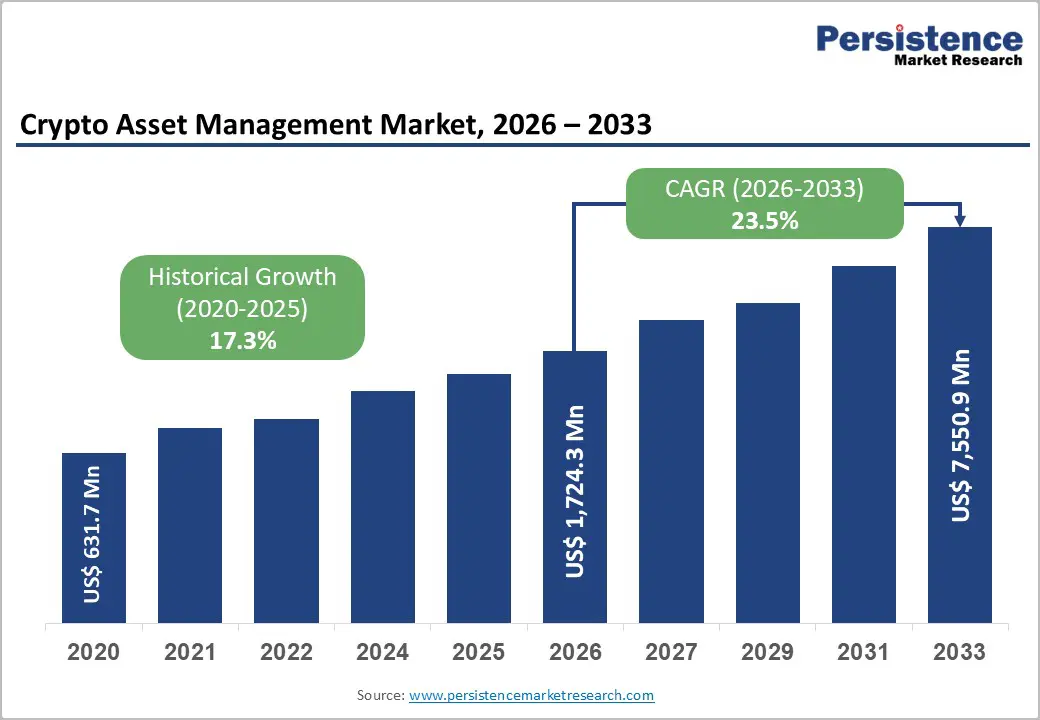
The global Crypto Asset Management Market size is projected to rise from US$ 1,724.3 Mn in 2026 to US$ 7,550.9 Mn by 2033. It is anticipated to witness a CAGR of 23.5% during the forecast period from 2026 to 2033, driven by the accelerating adoption of digital assets among institutional investors, the mainstreaming of regulated investment vehicles, and evolving global regulatory clarity.
The landmark approval of spot Bitcoin exchange-traded funds (ETFs) by the U.S. Securities and Exchange Commission (SEC), combined with the enforcement of the Markets in Crypto-Assets (MiCA) regulation across the European Union, has significantly bolstered investor confidence. The integration of advanced technologies such as artificial intelligence, machine learning, and blockchain analytics into asset management platforms is enhancing portfolio optimization, risk management, and transparency, creating compelling demand.
Key Industry Highlights:
- Leading Offering: Solutions / Platforms dominate the market with over 70% share in 2026, valued at more than US$ 1,207 Mn, driven by the growing need for secure, automated infrastructure that integrates custody, trading, compliance monitoring, and portfolio analytics. Services represent the fastest-growing supported by rising demand for portfolio advisory, tax consulting, compliance support, and DeFi integration as investors require specialized expertise to navigate complex crypto investment strategies.
- Leading Asset Type: Bitcoin (BTC) leads the market with more than 43% share in 2026, valued at over US$ 741.5 Mn, owing to its strong reputation as the most established digital asset and its role as a digital store of value among institutional investors. Ethereum (ETH) is the fastest-growing asset type, supported by its foundational role in decentralized finance (DeFi), smart contracts, and tokenized asset ecosystems, which enable staking, decentralized trading, and programmable financial services within managed portfolios.
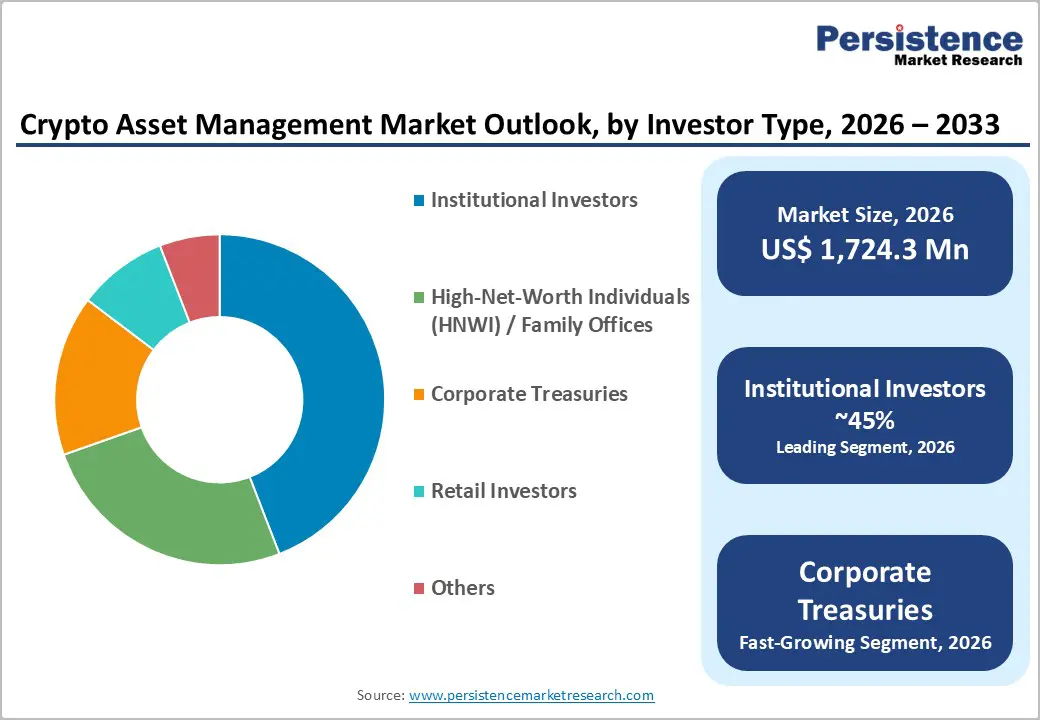
- Leading Investor Type: Institutional Investors account for the largest share at more than 45% in 2026, valued at over US$ 776 Mn, as hedge funds, pension funds, and asset managers increasingly integrate digital assets into diversified portfolios. Corporate Treasuries represent the fastest-growing segment, as businesses explore cryptocurrencies for treasury diversification, inflation hedging, and blockchain-based operational use cases, creating demand for secure custody and specialized treasury management solutions.
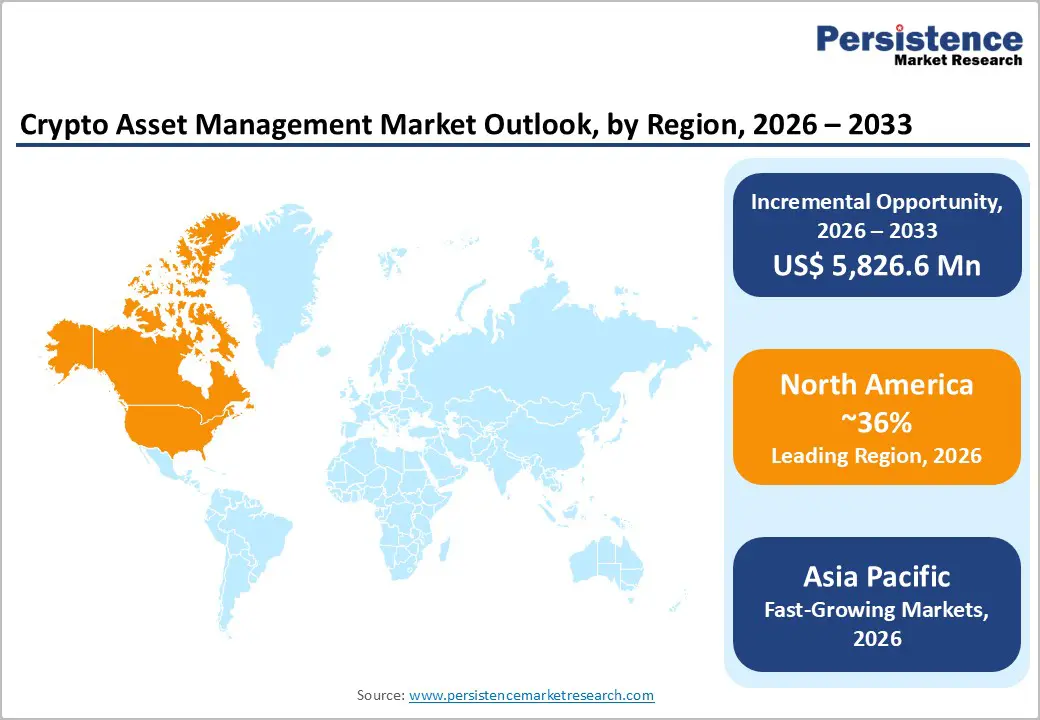
- Leading Region: North America leads the market with more than 36% share in 2026, reaching approximately US$ 620.8 Mn, supported by strong institutional participation, regulatory developments, and the approval of spot Bitcoin ETFs in the United States. Asia Pacific is the fastest-growing region with a CAGR of 28.1%, driven by rapid fintech innovation, expanding blockchain infrastructure, and supportive regulatory frameworks in markets such as Japan, Singapore, and South Korea.
| Key Insights | Details |
|---|---|
|
Crypto Asset Management Market Size (2026E) |
US$ 1,724.3 Mn |
|
Market Value Forecast (2033F) |
US$ 7,550.9 Mn |
|
Projected Growth (CAGR 2026 to 2033) |
23.5% |
|
Historical Market Growth (CAGR 2020 to 2025) |
17.3% |
Market Dynamics
Driver - Rising Institutional Adoption and Expansion of Regulated Crypto Investment Vehicles
The approval of spot Bitcoin ETFs by the U.S. Securities and Exchange Commission in January 2024 enabled traditional financial institutions to gain regulated exposure to cryptocurrencies. Major asset managers such as BlackRock, Fidelity Investments, and ARK Invest launched Bitcoin ETF products that attracted strong capital inflows from institutional investors. By late 2025, spot Bitcoin ETFs collectively accumulated over US$ 90 billion in assets under management, demonstrating growing demand for professionally managed digital asset portfolios. The rapid growth of BlackRock’s iShares Bitcoin Trust (IBIT) highlights the increasing acceptance of crypto as an institutional asset class. Research conducted by Coinbase and EY-Parthenon indicates that a rising share of institutional investors intends to allocate more than 5% of portfolio assets to digital assets, strengthening the role of crypto asset managers.
Increasing Regulatory Clarity and the Development of Structured Crypto Market Frameworks
The emergence of clearer regulatory frameworks across major economies is significantly improving trust and transparency in the crypto ecosystem. The implementation of the Markets in Crypto-Assets Regulation (MiCA) by the European Union introduced a comprehensive legal framework governing crypto-asset service providers, token issuers, and stablecoin operators. Regulatory oversight from institutions such as the European Securities and Markets Authority is strengthening compliance requirements and standardizing licensing procedures across EU member states. This regulatory clarity is encouraging financial institutions to participate in digital asset markets and seek professional portfolio management solutions. In the United States, agencies including the Office of the Comptroller of the Currency have supported the development of digital asset custody and banking infrastructure. As regulatory certainty improves globally, both institutional and high-net-worth investors are increasingly turning to specialized crypto asset management firms to manage risk, ensure compliance, and optimize portfolio performance.
Restraint - Persistent Market Volatility and Cybersecurity Vulnerabilities
Leading digital assets such as Bitcoin and Ethereum still demonstrate significantly higher price fluctuations compared with traditional benchmarks like the S&P 500, complicating portfolio risk management for institutional investors. Cybersecurity threats remain a major concern across the digital asset ecosystem. Industry security reports indicate that more than US$2–3 billion worth of crypto assets were lost globally to hacks, scams, and protocol exploits in 2025, highlighting vulnerabilities in blockchain infrastructure and custodial platforms. These incidents weaken investor confidence and increase insurance, compliance, and cybersecurity expenditures for asset managers. Smaller firms with limited security infrastructure face greater operational risks and barriers to scaling custody and portfolio management services.
Regulatory Fragmentation and Compliance Burden Across Jurisdictions
Regulatory fragmentation across global markets continues to create significant operational challenges for crypto asset management firms. While frameworks such as the European Union’s Markets in Crypto-Assets (MiCA) regulation provide greater regulatory clarity within Europe, the absence of a unified global standard increases cross-border compliance complexity. According to a study, MiCA compliance and licensing preparation costs range between €50,000 and €100,000, depending on the operational scope and regulatory requirements. A substantial number of existing Virtual Asset Service Providers (VASPs) struggle to meet the new licensing and reporting standards introduced under the regulation. Divergent policies across North America, Europe, Asia-Pacific, and the Middle East require firms to establish jurisdiction-specific legal and compliance frameworks. This fragmented regulatory environment raises operational costs and slows the expansion of mid-size crypto asset management companies globally.
Opportunity - Tokenization of Real-World Assets and DeFi Yield Strategies
The tokenization of traditional financial assets such as equities, bonds, real estate, and commodities is emerging as a transformative opportunity. By converting real-world assets into blockchain-based tokens, asset managers enable faster settlement, improved liquidity, and fractional ownership, making investments more accessible to a broader investor base. Financial institutions are increasingly exploring tokenized funds and digital securities to enhance transparency and operational efficiency. Decentralized finance (DeFi) protocols are introducing new yield-generating strategies such as staking, lending, and liquidity provisioning. These innovations allow asset managers to design diversified portfolios that combine traditional assets with blockchain-based income streams. Firms that integrate tokenized products with DeFi yield strategies are expected to attract institutional investors seeking innovative portfolio diversification and enhanced returns.
Expansion of Corporate Treasury Allocations and HNWI Crypto Adoption
Many corporations are exploring cryptocurrencies as an alternative store of value and a potential hedge against inflation, leading to increasing demand for professional digital asset management services. High-net-worth individuals (HNWIs) and family offices are rapidly expanding their exposure to cryptocurrencies as part of diversified investment strategies. As regulatory frameworks and custody solutions continue to mature, investors are gaining greater confidence in allocating larger portions of their portfolios to digital assets. Asset management firms that provide secure custody, portfolio advisory, and compliant investment structures tailored for corporate and HNWI clients are well-positioned to capture this expanding segment. The growing need for sophisticated portfolio management tools is expected to further strengthen institutional participation in the market.
Category-wise Analysis
Offering Insights
Solutions / Platforms dominate the market, capturing more than 70% market share in 2026 with a value exceeding US$ 1,207 Mn, due to the rising need for secure and automated infrastructure to manage digital assets across multiple blockchains and exchanges. It enable portfolio tracking, automated rebalancing, compliance monitoring, and risk analytics, which are essential for both institutional and high-net-worth investors. As the digital asset ecosystem expands, investors require unified dashboards that integrate custody, trading, and reporting functions. These platforms also help reduce operational complexity and security risks associated with manual wallet management.
Services are expected to grow rapidly due to the increasing complexity of digital asset investment strategies and the need for specialized expertise in areas such as portfolio advisory, compliance consulting, and managed trading. Many investors entering the crypto market lack in-house blockchain expertise and therefore rely on external providers for portfolio structuring, tax advisory, and custody integration. Service providers also assist institutions in navigating evolving regulatory frameworks and risk management practices. As decentralized finance (DeFi) and tokenized assets expand, advisory and integration services become critical for implementing advanced investment strategies.
Asset Type Insights
Bitcoin (BTC) holds over 43% market share in 2026, with a value exceeding US$ 741.5 Mn, due to its strong reputation as the most established and widely recognized digital asset. Many institutional investors treat Bitcoin as a digital store of value and a hedge against currency volatility, similar to digital gold. Its high liquidity, deep market infrastructure, and widespread exchange support make it the primary entry point for crypto investments. Asset managers often allocate a large portion of portfolios to Bitcoin to maintain stability relative to more volatile altcoins.
Ethereum (ETH) is expected to grow significantly due to its central role in decentralized finance, smart contracts, and blockchain-based applications. Ethereum supports programmable financial services, enabling asset managers to access staking rewards, decentralized exchanges, and tokenized asset ecosystems. The transition toward scalable network upgrades and improved energy efficiency has increased institutional confidence in Ethereum’s long-term viability. As decentralized applications, NFTs, and tokenized assets continue expanding, Ethereum’s utility-driven demand is expected to drive strong growth in managed portfolios.
Investor Type Insights
Institutional Investors command the largest market share at over 45% in 2026, with a value exceeding US$ 776 Mn, due to the growing acceptance of digital assets as an alternative investment class within diversified portfolios. Hedge funds, pension funds, asset managers, and family offices are increasingly allocating capital to crypto assets to enhance returns and diversify risk. Institutional participation requires secure custody, compliance tools, and advanced portfolio management capabilities, which crypto asset management platforms provide. Regulatory developments and the emergence of institutional-grade infrastructure have further strengthened investor confidence.
Corporate Treasuries are expected to grow significantly due to the rising interest among companies in holding digital assets as part of their treasury diversification strategies. Businesses are exploring cryptocurrencies to hedge against currency inflation and to enhance balance sheet resilience. The platforms enable corporations to securely store, manage, and monitor digital holdings while ensuring compliance with financial reporting standards. Companies involved in blockchain ecosystems often maintain digital assets for operational purposes such as payments or token-based services. This increasing strategic use of digital assets within corporate financial management is driving demand for specialized treasury-focused crypto asset management solutions.
Regional Insights
North America Crypto Asset Management Market Trends
North America holds over 36% share in 2026, reaching US$ 620.8 Mn value, due to its mature financial ecosystem and strong institutional participation. The United States remains the core market, supported by the approval of spot Bitcoin ETFs in 2024 by the U.S. Securities and Exchange Commission, which accelerated institutional inflows into digital asset investment products. Major industry players are headquartered in the region, strengthening the institutional crypto custody and asset management ecosystem. Regulatory oversight from agencies such as the Office of the Comptroller of the Currency and the U.S. Securities and Exchange Commission has gradually integrated digital asset custody, trading, and investment products into mainstream financial markets. The region’s strong venture capital funding, advanced financial infrastructure, and growing adoption of regulated crypto investment vehicles continue to reinforce its leadership in the global market.
Asia Pacific Crypto Asset Management Market Trends
Asia Pacific is expected to grow at a significant rate with a CAGR of 28.1%, supported by rapid fintech development and high digital asset adoption among retail and institutional investors. Key markets such as Japan, Singapore, and South Korea have established relatively clear regulatory frameworks that support licensed crypto exchanges, custodians, and investment platforms. The Monetary Authority of Singapore has introduced progressive digital asset policies and stablecoin regulations, positioning Singapore as a leading institutional crypto hub in the region. Hong Kong has developed a comprehensive licensing framework under the supervision of the Hong Kong Monetary Authority, attracting global digital asset firms seeking regulated access to Asian markets. The region’s large tech-savvy investor base, expanding blockchain infrastructure, and increasing institutional participation are expected to sustain strong growth.
Europe Crypto Asset Management Market Trends
Europe is expected to hold more than 23% share by 2026, driven primarily by the implementation of the Markets in Crypto-Assets Regulation (MiCA), which became fully applicable across the European Union in December 2024. The framework provides a unified regulatory structure for crypto asset service providers, allowing firms to operate across multiple EU member states through a single authorization. Countries such as Germany, France, and Netherlands have emerged as key markets for regulated digital asset funds, custody services, and institutional investment platforms. The presence of established crypto finance firms including Crypto Finance AG and the strong regulatory oversight of financial authorities have enhanced investor confidence in the region. This harmonized regulatory environment is expected to encourage greater institutional adoption and cross-border crypto asset management services across Europe.
Competitive Landscape
The Crypto Asset Management Market exhibits moderate consolidation, with the top custodians managing over 40% of institutional assets under custody globally. Established players dominate the market through scale, brand credibility, and strong regulatory compliance. Key differentiation strategies include institutional-grade custody services, multi-asset platform capabilities, regulatory licensing, and AI-powered portfolio analytics. Emerging business models include the integration of DeFi yield products into managed offerings, tokenized real-world asset funds, and full-service platforms that unify custody, trading, compliance, and analytics within a single ecosystem.
Key Developments:
- In October 2025, Galaxy Digital Inc. launched GalaxyOne, a fintech platform enabling U.S. investors to access high-yield cash accounts, crypto trading, and equities trading in one integrated digital platform. The service offers up to 8% APY for accredited investors through Galaxy Premium Yield and 4% APY on cash deposits, while also allowing trading of major cryptocurrencies like Bitcoin, Ethereum, and Solana, along with commission-free U.S. stock and ETF trading.
- In August 2025, Coinbase completed the acquisition of Deribit, the world’s leading crypto options exchange, strengthening its position in the global crypto derivatives market. The acquisition enables Coinbase to offer a full suite of trading products, including spot, futures, perpetuals, and options on a single global platform.
Companies Covered in Crypto Asset Management Market
- Coinbase
- Gemini Trust Company
- Fidelity Digital Assets
- Bakkt
- Crypto Finance AG
- Ripple
- Paxos Trust Company
- Ledger SAS
- Grayscale Investments
- Galaxy Digital
- Pantera Capital
- Bitwise Asset Management
- CoinShares
- Others
Frequently Asked Questions
The global market is projected to be valued at US$ 1,724.3 Mn in 2026.
The growing need for secure, regulated, and professionally managed crypto investment solutions are key drivers of the market.
The crypto asset management market is expected to witness a CAGR of 23.5% from 2026 to 2033.
Tokenization of real-world assets (RWAs) and the integration of DeFi-based yield strategies, which expand investment options and improve liquidity for digital asset portfolios is creating strong growth opportunities.
Coinbase, Gemini Trust Company, Fidelity Digital Assets, Bakkt, Crypto Finance AG, Ripple, Paxos Trust Company, Ledger SAS are among the leading key players.


