




- Home Care & Utilities
- Counter Top Dishwashers Market
Counter Top Dishwashers Market Size, Share, and Growth Forecast 2026 - 2033
Counter Top Dishwashers Market by Product Type (Compact Countertop Dishwashers, Single Drawer Countertop Dishwashers, Double Drawer Countertop Dishwashers, Portable Countertop Dishwashers, Built-in Countertop Dishwashers), Capacity (Up to 4 Place Settings, 4-6 Place Settings, 6-8 Place Settings, Above 8 Place Settings), Installation Type, End-user, and Regional Analysis, 2026 - 2033

Counter Top Dishwashers Market Size and Trend Analysis
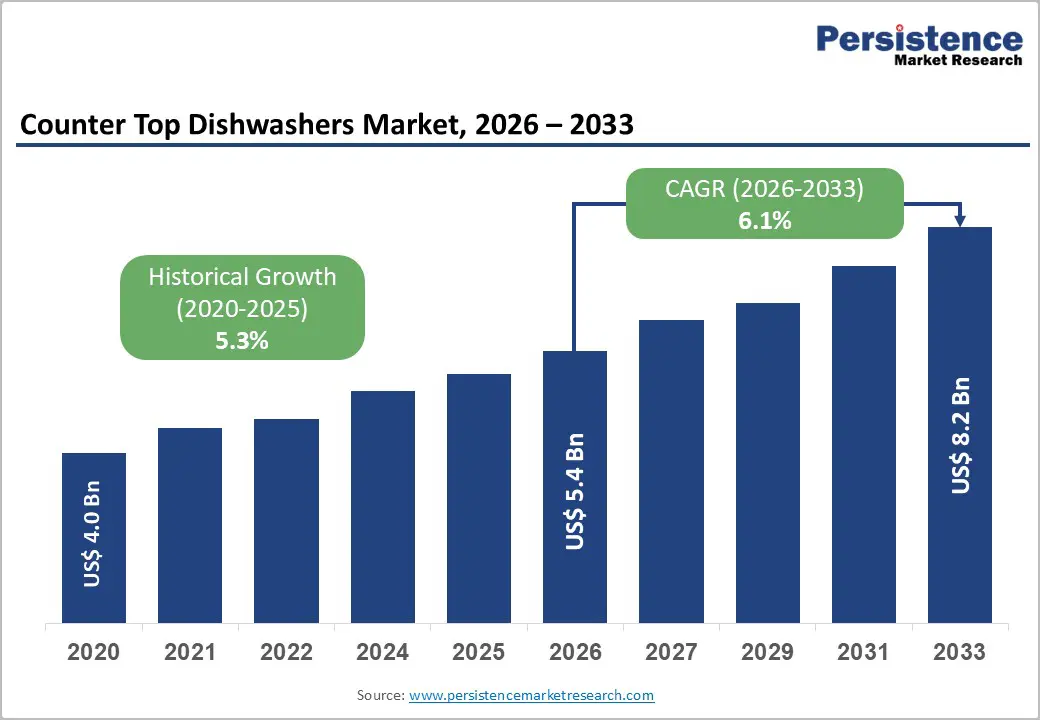
The global counter top dishwashers market size is likely to be valued at US$ 5.4 billion in 2026 and is expected to reach US$ 8.2 billion by 2033, growing at a CAGR of 6.1% during the forecast period from 2026 to 2033.
The countertop dishwasher market is experiencing sustained growth driven by rapid urbanization, shrinking household sizes, and heightened consumer interest in water-efficient kitchen appliances.
Key Industry Highlights:
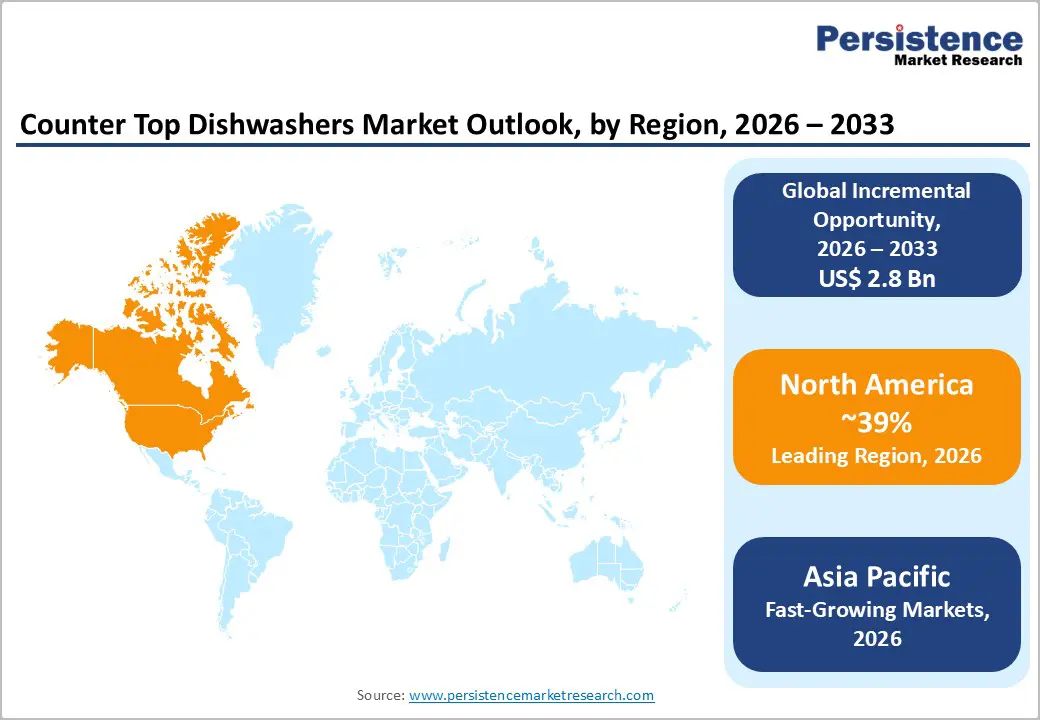
- Leading Region: North America leads the countertop dishwasher market holding 39% share, supported by U.S. EPA ENERGY STAR and WaterSense programs, high e-commerce appliance adoption, and growing single-person and renter households driving sustained demand for compact, plug-and-play dishwashing solutions.
- Fastest Growing Region: Asia Pacific is the fastest growing region with a CAGR of 7.8%, led by China's rapidly rising urban dishwasher penetration, Japan's mature compact appliance culture, and India's accelerating urbanization, driving first-time appliance purchasing across the expanding middle class through 2033.
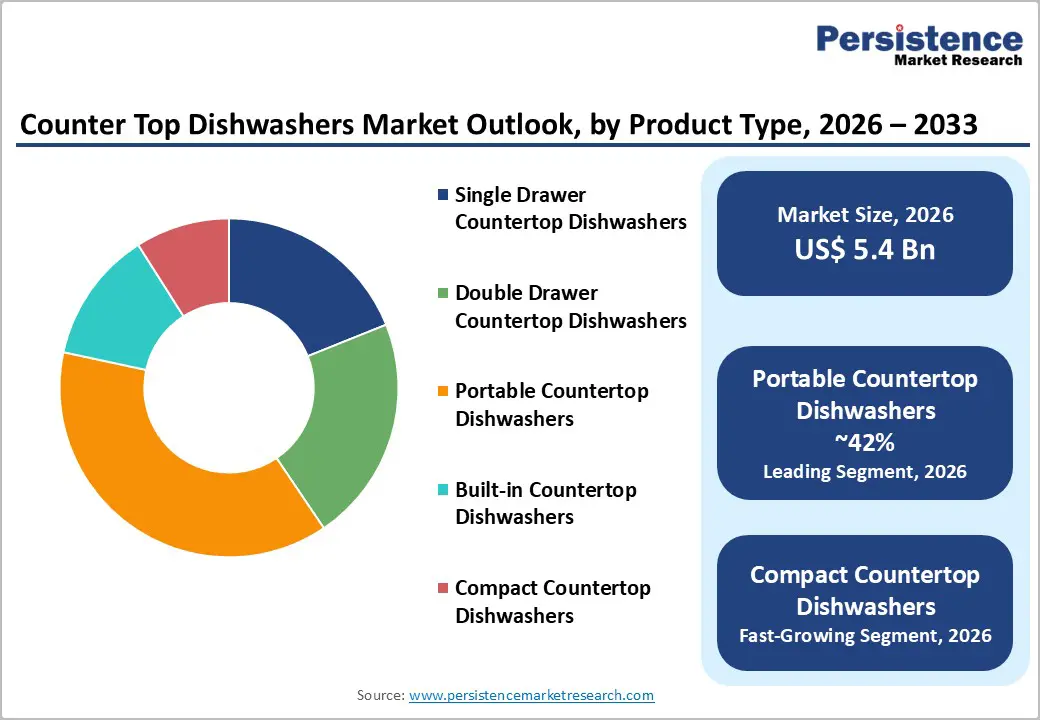
- Dominant Segment: Portable countertop dishwashers lead with approximately 42% share, driven by faucet-connectivity convenience, no permanent installation requirements, broad rental housing suitability, and accessible price points across leading retail and e-commerce channels.
- Fastest Growing Segment: Integrated Water Tank Models within By Installation Type is the fastest growing segment, uniquely serving renters and studio apartment consumers requiring fully plumbing-free operation, smart home connectivity, and flexible portable usage across multiple living environments.
- Key Opportunity: Smart appliance integration, including IoT connectivity, voice assistant compatibility, and app-controlled cycles, combined with explosive global e-commerce growth, offers manufacturers compelling premium pricing potential and global market reach expansion opportunity through 2033.
| Key Insights | Details |
|---|---|
| Counter Top Dishwashers Market Size (2026E) | US$ 5.4 Billion |
| Market Value Forecast (2033F) | US$ 8.2 Billion |
| Projected Growth CAGR (2026 - 2033) | 6.1% |
| Historical Market Growth (2020 - 2025) | 5.3% |
Market Dynamics
Drivers - Rising Urbanization and Declining Household Sizes
Rapid urbanization worldwide is significantly increasing demand for compact and space-saving home appliances. According to the United Nations Department of Economic and Social Affairs (UN DESA), over 68% of the global population is expected to live in urban areas by 2050. As a result, more people are residing in apartments and studio units where installing full-size dishwashers is often impractical.
Countertop dishwashers provide a highly convenient solution with their plug-and-play functionality and easy connection to standard kitchen faucets. Additionally, the trend toward smaller households and limited living spaces is especially strong in densely populated cities across China, Japan, South Korea, and Western Europe. These factors are making countertop dishwashers an increasingly essential appliance for urban consumers who prioritize convenience, efficiency, and optimal use of limited kitchen space.
Water Conservation Regulations and Sustainability Mandates
Stricter water conservation policies and sustainability initiatives are encouraging the adoption of dishwashers over traditional hand-washing methods. Research from the American Water Works Association (AWWA) shows that modern dishwashers use as little as 3-5 gallons of water per cycle, compared to 20-27 gallons required for manual washing. Governments and regulatory bodies are implementing efficiency standards to reduce water and energy consumption. The European Union’s Ecodesign Regulation (EU) 2021/666 establishes minimum efficiency requirements for household dishwashers. Such regulations are motivating consumers to switch to more efficient appliances. Compact countertop dishwashers are increasingly meeting these standards and often qualify for ENERGY STAR and other eco-certifications. As environmental awareness continues to grow, consumers are actively choosing sustainable appliances, further accelerating demand for efficient countertop dishwasher models worldwide.
Restraints - Limited Capacity and Functional Constraints
Despite their growing popularity, countertop dishwashers have inherent limitations that restrict their adoption among larger households. Most models are designed to handle only 4-6 place settings, making them less suitable for families with three or more members who generate higher volumes of dishes daily. In addition, many consumers report challenges in accommodating larger cookware items such as pots, pans, and bulky utensils.
These limitations often position countertop dishwashers as secondary or supplementary appliances rather than primary kitchen solutions. As a result, their appeal remains stronger among single users and small households. This capacity constraint reduces their penetration into family-oriented segments, which represent a substantial portion of the global home appliance market. Consequently, the limited functionality and size restrictions continue to act as a key barrier to broader market expansion.
Consumer Awareness Gaps and Habitual Hand-Washing in Developing Markets
In many developing regions, including South Asia, Southeast Asia, Latin America, and Africa, hand-washing dishes remains the dominant practice due to cultural habits and economic factors. Dishwasher penetration rates are still below 5% in countries such as India and Indonesia, highlighting the limited adoption of automated dishwashing solutions. The low level consumer awareness regarding the water-saving, hygiene, and convenience benefits offered by dishwashers is one of the major challenges.
Additionally, price sensitivity in these markets makes consumers hesitant to invest in such appliances. Overcoming deeply rooted habits requires consistent education and targeted marketing efforts, which many manufacturers have yet to fully implement. Without strong awareness campaigns and clear value propositions, demand growth remains constrained. This lack of consumer understanding and affordability concerns continues to moderate the overall growth potential of the global countertop dishwasher market.
Opportunities - Plug-and-Play and Integrated Water Tank Models for Rental and Compact Housing
Integrated water tank countertop dishwashers present a strong growth opportunity, especially in rental and compact living environments. These models eliminate the need for direct faucet connections, allowing them to operate independently with built-in water storage systems. This makes them ideal for renters, students in dormitories, studio apartment residents, and small office kitchens. According to the National Multifamily Housing Council (NMHC), renters account for more than 36% of households in the United States, highlighting a large target market. Manufacturers are increasingly focusing on premium designs, incorporating features such as Wi-Fi connectivity, sleek aesthetics, and user-friendly controls. These features appeal strongly to urban millennials and Gen Z consumers who value convenience and smart home integration. As the global rental housing market continues to expand, demand for flexible and portable appliance solutions like integrated water tank dishwashers is expected to grow steadily over the long term.
Smart Appliance Integration and E-Commerce Channel Expansion
The integration of smart technologies is transforming countertop dishwashers into connected home appliances. Features such as compatibility with voice assistants like Amazon Alexa and Google Home, along with IoT-enabled remote monitoring and customizable wash cycles, are enhancing user convenience and control. According to Statista, the global smart home appliance market is projected to exceed US$150 billion in the near future, creating significant growth opportunities for smart countertop dishwasher models.
At the same time, the rapid expansion of e-commerce platforms is reshaping the distribution landscape. Online sales of home appliances are growing at strong double-digit rates, enabling brands to reach customers beyond traditional retail channels. This shift allows even smaller or niche manufacturers to access global markets and directly engage with consumers. Together, smart technology adoption and e-commerce expansion are significantly increasing the market’s accessibility and growth potential.
Category-wise Analysis
By Product Type Insights
Portable countertop dishwashers dominate the product segment, accounting for approximately 42% of the total market share. Their popularity is driven by ease of installation, flexibility, and suitability for small living spaces such as apartments, recreational vehicles (RVs), and office kitchens. These models do not require permanent modifications such as drilling or plumbing, making them highly attractive for renters and shared housing residents. Leading brands such as Farberware, BLACK+DECKER, and Comfee have established a strong presence by offering affordable, compact, and user-friendly designs. Portable dishwashers are particularly appealing to first-time buyers looking for a simple upgrade from manual dishwashing without a major investment. Additionally, the growth of e-commerce platforms has further accelerated demand by enabling direct-to-consumer sales and providing access to product reviews, comparisons, and competitive pricing, thereby strengthening the segment’s market position.
By Capacity Insights
The 4-6 place settings segment leads the market, contributing approximately 48% of total demand within the capacity category. This segment offers an ideal balance between compact size and practical usability, making it well-suited for individuals and small households. A dishwasher within this capacity range can efficiently handle daily dishwashing needs, including plates, glasses, cutlery, and small bowls, in a single cycle.
The price range, typically between US$150 and US$400, makes these models accessible to a broad consumer base. Manufacturers continue to enhance product differentiation in this segment by introducing advanced features such as steam cleaning, automatic door opening, and UV sanitization. These innovations not only improve performance but also increase perceived value. As a result, the 4-6 place settings category remains the most commercially attractive segment, offering a strong balance between demand volume and profitability for manufacturers.
By Installation Type Insights
Faucet-connected countertop dishwashers lead the installation type segment, accounting for approximately 51% of the market share. These models connect directly to standard kitchen faucets using simple adapters, requiring no specialized tools or plumbing expertise. This ease of installation makes them highly accessible for first-time users transitioning from manual dishwashing. Additionally, faucet-connected models provide a consistent water supply, enabling effective cleaning performance and hot water sanitization, which may not always be achievable with tank-based units.
Many of these models also meet NSF International certification standards, ensuring high sanitation performance. This is particularly appealing to health-conscious consumers and small food service operators. The combination of convenience, reliable performance, and hygiene assurance makes faucet-connected dishwashers a preferred choice, especially for users seeking a dependable and efficient entry-level solution in the countertop dishwasher market.
By End-user Insights
The residential segment dominates the end-use category, representing approximately 78% of total market demand. This strong share reflects the product’s primary purpose of addressing dishwashing needs in small urban households. The increasing number of single-person and couple-only households across North America, Europe, and East Asia is a major factor driving demand in this segment. According to the U.S. Energy Information Administration (EIA), dishwasher ownership in the United States has steadily increased, with countertop models gaining popularity among new buyers. Additionally, rising disposable incomes in emerging markets are encouraging consumers to invest in modern home appliances as part of lifestyle upgrades. Countertop dishwashers are increasingly seen as convenient and efficient solutions for daily household tasks. This growing consumer preference for smart and compact appliances continues to strengthen the residential segment’s leading position in the global market.
Regional Insights
North America Counter Top Dishwashers Market Trends
North America leads the global countertop dishwasher market, driven primarily by strong demand in the United States. High consumer spending on home appliances, combined with a well-established e-commerce ecosystem, supports widespread product availability and accessibility. Additionally, strong awareness of water conservation benefits encourages adoption of efficient dishwashing solutions. Programs such as the U.S. Environmental Protection Agency’s WaterSense and ENERGY STAR initiatives promote the use of water- and energy-efficient appliances.
Major retailers including Amazon, Walmart, Best Buy, and Target have significantly expanded their countertop dishwasher offerings to meet growing demand. Canada also contributes to regional growth, supported by increasing urbanization and government incentives promoting energy-efficient appliances. The rise of condominium living in cities such as Toronto, Vancouver, and Montreal further boosts demand. Countertop dishwashers are increasingly positioned as eco-friendly lifestyle products, enhancing their appeal among environmentally conscious consumers.
Europe Counter Top Dishwashers Market Trends
Europe represents the second-largest market for countertop dishwashers, driven by smaller living spaces, strong environmental awareness, and stringent regulatory standards. Germany leads the regional market due to its robust appliance manufacturing industry and consumer preference for high-quality, engineered products. Major brands such as Siemens, Bosch, and Miele continue to innovate in the compact dishwasher category, targeting urban consumers.
The European Union’s Ecodesign Directive and mandatory energy labeling regulations ensure that efficiency remains a key purchasing factor. Other significant markets include the United Kingdom, France, and Spain, where adoption is increasing, particularly in urban rental housing. In the UK, a high proportion of rental households creates strong demand for plug-and-play appliances. Additionally, regulatory harmonization across the EU simplifies compliance for manufacturers, enabling efficient product distribution and encouraging innovation aligned with regional sustainability standards.
Asia Pacific Counter Top Dishwashers Market Trends
Asia Pacific is the fastest-growing region in the countertop dishwasher market, driven by rapid urbanization, rising disposable incomes, and changing consumer lifestyles. China leads the region, supported by a rapidly expanding middle class and increasing adoption of modern home appliances. E-commerce platforms such as JD.com and Tmall play a crucial role in promoting countertop dishwashers through targeted marketing and consumer education.
Japan represents a mature market, characterized by small kitchen spaces and a strong preference for compact, feature-rich appliances. Domestic brands like Panasonic and Toshiba dominate this segment. India offers significant long-term growth potential due to increasing urbanization, rising nuclear families, and improving housing infrastructure under initiatives such as the Smart Cities Mission. Additionally, emerging ASEAN markets, including Vietnam, Indonesia, and Thailand, are contributing to regional growth as consumers increasingly adopt modern kitchen appliances.
Competitive Landscape
The global countertop dishwasher market is moderately fragmented, with both established multinational companies and emerging direct-to-consumer brands competing for market share. Leading players such as Bosch, Siemens, Panasonic, and BLACK+DECKER leverage strong brand recognition, extensive distribution networks, and advanced research and development capabilities. Key competitive factors include energy and water efficiency, smart connectivity, noise reduction, and product design.
At the same time, challenger brands are gaining traction through e-commerce-focused strategies, social media marketing, and rapid product innovation. These companies often offer competitively priced models that appeal to cost-conscious consumers. Additionally, private-label and white-label manufacturers from China are expanding their global presence with affordable products, intensifying competition. As a result, established brands are under pressure to continuously innovate, enhance product features, and strengthen certification standards to maintain their market position.
Key Market Developments
- February 2025: Bosch Home Appliances launched a new countertop dishwasher series for the European market featuring water consumption under 3 liters per cycle and Wi-Fi app integration, targeting eco-conscious urban apartment dwellers with premium efficiency credentials.
- August 2024: Midea Group expanded its compact dishwasher lineup globally with a model featuring integrated UV sterilization, ultrasonic cleaning technology, and compatibility with Amazon Alexa and Google Home smart home ecosystems.
- May 2023: Comfee (Midea's international brand) introduced a countertop dishwasher with a built-in water storage tank requiring no faucet connection, targeting the North American rental housing market with a strong e-commerce-first launch strategy.
Companies Covered in Counter Top Dishwashers Market
- lpool Corporation
- Bosch
- Haier Group
- Electrolux AB
- LG Electronics
- Samsung Electronics
- Panasonic Corporation
- Midea Group
- Danby
- GE Appliances
- Siemens
- Black+Decker
- Farberware
- Magic Chef
- Fisher & Paykel
Frequently Asked Questions
The global Counter Top Dishwashers Market is projected to reach US$ 8.2 Billion by 2033, growing from an estimated US$ 5.4 Billion in 2026 at a CAGR of 6.1% during the 2026 - 2033 forecast period. The market was valued at approximately US$ 4.0 Billion in 2020.
Key growth drivers include rapid global urbanization and the rise of single- and two-person households favoring compact appliances, combined with regulatory pressure on water conservation, including EU Ecodesign Regulation and U.S. EPA ENERGY STAR programs, that incentivize consumers to replace manual hand-washing with efficient, certified countertop dishwasher models.
Portable Countertop Dishwashers dominate the By Product Type segment with approximately 42% market share. Their leadership is driven by faucet-connectivity convenience, zero permanent installation requirements, suitability for renters and apartment residents, and broad accessibility across both online and brick-and-mortar retail channels globally.
North America leads the global Counter Top Dishwashers Market, with the United States as the primary driver. High consumer appliance spending, ENERGY STAR and WaterSense certification programs, strong e-commerce infrastructure, and a growing proportion of single-person and renter households collectively sustain the region's dominant market position.
Key opportunities include developing integrated water tank models targeting the large and growing global renter household market, and integrating smart home technologies, IoT connectivity, voice assistant compatibility, and app-controlled wash cycles, enabling premium product positioning and access to rapidly growing connected home appliance consumer segments worldwide.
Leading companies in the Counter Top Dishwashers Market include Bosch Home Appliances, Siemens Home Appliances, Panasonic Corporation, Midea Group (Comfee), BLACK+DECKER, Farberware, Toshiba, Whirlpool Corporation, Electrolux Group, Danby Products Limited, hOmeLabs, AIRMSEN Appliances, Novete, and GreenLife Cookware, along with packaging industry participants detailed in the full report scope.


