




- Industrial Machinery
- Control Valves Market
Control Valves Market Size, Share, and Growth Forecast, 2026 - 2033
Control Valves Market by Valve Type (Rotary Valves, Linear Valves), Actuation (Pneumatic, Electric, Hydraulic), Application (Flow Control, Pressure Control), End-Use Industry, and Regional Analysis for 2026 - 2033

Control Valves Market Size and Trends Analysis
The global control valves market size is likely to be valued at US$ 9.7 billion in 2026 and is expected to reach US$ 15.5 billion by 2033, growing at a CAGR of 6.9% between 2026 and 2033, driven by rising process automation, continued investment in energy and water infrastructure, and growing adoption of smart valve diagnostics.
Control valves regulate the flow, pressure, temperature, and level of liquids, gases, and steam in industrial processes, which makes them essential equipment in oil and gas, power, water treatment, chemical, and pharmaceutical facilities.
Key Industry Highlights
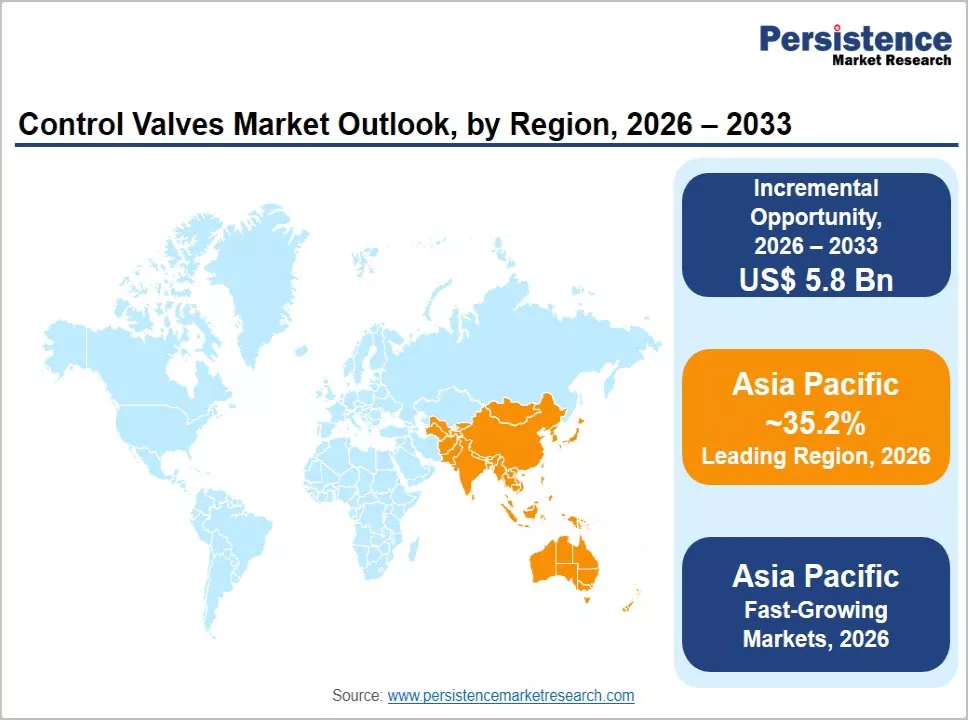
- Leading Region: Asia Pacific, anticipated to account for 35.2% of the market share, supported by petrochemical expansion in China, refinery capacity additions in India, and power generation investment across the region.
- Fastest-growing Region: Asia Pacific, driven by industrialization, infrastructure development, and rising adoption of industrial automation across manufacturing and process industries.
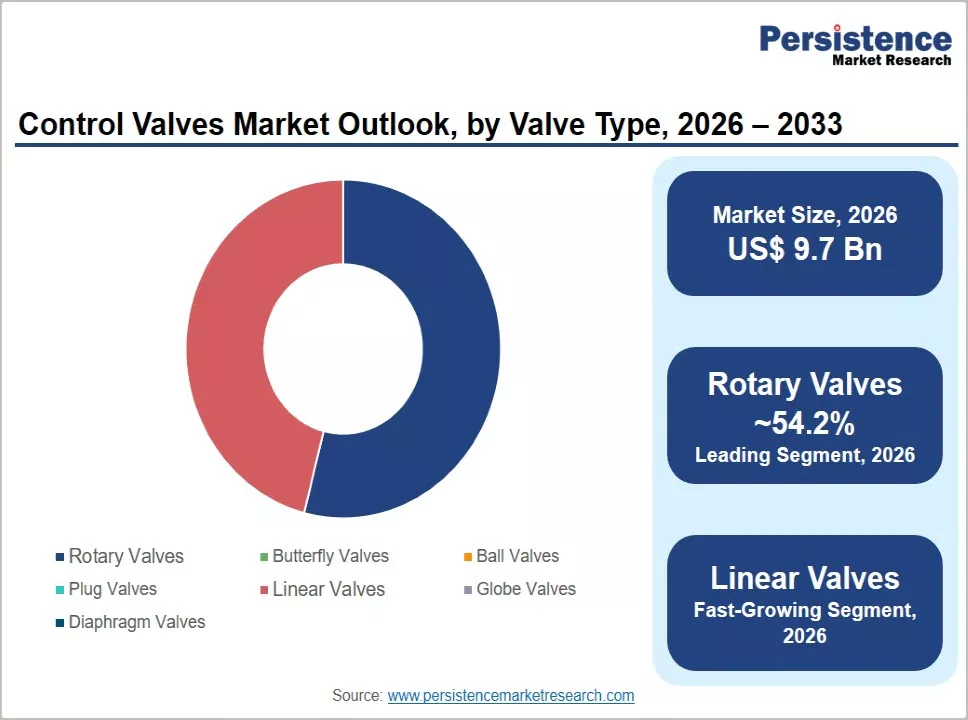
- Dominant Valve Type: Rotary valves, with butterfly valves alone accounting for approximately 54.2% of revenue, supported by compact designs, lower weight, and suitability for large-diameter pipelines.
- Leading Actuation: Pneumatic control valves, anticipated to hold approximately 41.9% of the market share, driven by reliability, fast response, and suitability for hazardous process environments.
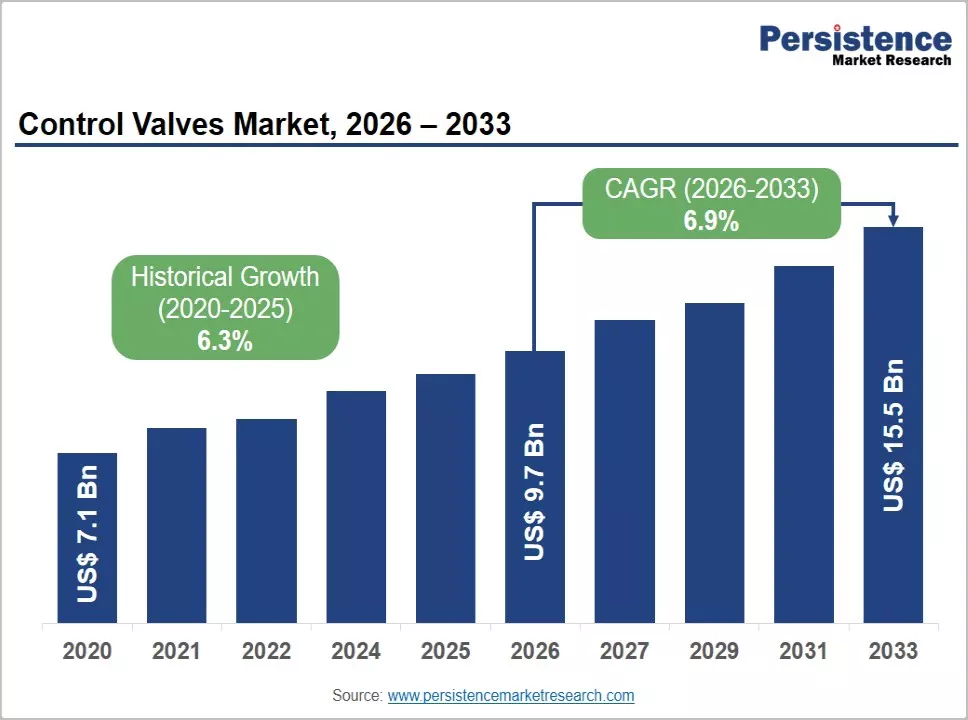
DRO Analysis
Drivers - Process Automation and Energy Infrastructure Investment Are Lifting Valve Demand
Process plants are adding automated flow, pressure, and temperature control to improve output consistency and reduce unplanned downtime. Refining and power projects are the largest sources of new demand. India's Ministry of Petroleum and Natural Gas reports refining capacity of 258.1 million metric tons per annum, projected to reach 309.5 million metric tons per annum by 2030.
In April 2025, China's State Council approved 10 new nuclear reactors representing investment above CNY 200 billion (about US$ 27.4 billion). Each new refinery unit, combined-cycle plant, or reactor requires large numbers of control valves, actuators, and positioners, which converts capital spending directly into equipment orders.
Drivers - Water Infrastructure Programs and Regulatory Standards Are Expanding Demand
Governments are funding large water and wastewater upgrades that rely on valves for pressure management, dosing, and flow regulation. In the U.S., the Bipartisan Infrastructure Law provides more than US$50 billion through the Environmental Protection Agency for drinking water, wastewater, and stormwater infrastructure, described by the agency as the largest federal water investment in the country's history.
Stricter drinking water and discharge standards raise requirements for precise process control, which supports installation of automated control valves in treatment plants, pumping stations, and distribution networks. Water and wastewater treatment already accounts for approximately 24.8% of the market share, and funding programs of this scale are expected to keep the segment ahead of other end-use industries in growth.
Restraint - High Installation, Calibration, and Maintenance Costs Limit Adoption Among Smaller Operators
Control valves operating under high pressure, high temperature, or corrosive conditions require special alloys, advanced trim designs, and frequent calibration, which raises installation and lifecycle costs. Smaller operators and municipal utilities often postpone upgrades because these costs weigh on limited capital budgets.
Integration of digital positioners with legacy control systems also adds engineering effort and extends commissioning timelines. Price-sensitive projects frequently favor lower-specification valves over advanced diagnostic models, which slows the shift toward premium products. Reliance on specialty alloys and precision-machined trim also exposes manufacturers to raw material cost swings and longer delivery schedules on severe-service orders.
Opportunities - Smart Valves and Predictive Maintenance Create New Service Revenue
Operators are moving from time-based maintenance toward condition-based maintenance. Digital positioners and valve diagnostics identify wear, deposits, sluggish movement, and actuator faults before they develop into failures. In September 2025, Siemens updated its SIPART PS2 positioner with diagnostic functions of this type, and Yokogawa has highlighted industrial IoT-based asset health monitoring in 2026.
Manufacturers able to bundle valves, diagnostics, and asset-management software are positioned to add recurring service revenue, particularly in refining, power, and chemicals, where unplanned shutdowns carry high costs. Predictive maintenance also reduces inspection costs and extends valve service life, which strengthens the case for upgrading installed valves with digital positioners.
Electric Actuation Offers Strong Growth Potential through Automation Integration
Electric control valves are the fastest-growing actuation category, at approximately 8.1% CAGR over 2026 to 2034, as plants move toward digital process control and reduce reliance on compressed air systems. In June 2025, Rotork joined Rockwell Automation's technology partnership program to integrate its IQ3 Pro electric actuator platform with Rockwell's automation ecosystem.
In November 2025, AUMA introduced the TIGRON SIL electric actuator certified to SIL 3, expanding options for safety-critical valve installations in oil and gas, power, and chemical plants. Electric units also remove the need for air supply lines, and two-way digital communication supports remote configuration and condition monitoring at distributed assets such as pumping stations and pipelines.
Category-wise Analysis
Valve Type Insights
Rotary valves are anticipated to lead the market, with approximately 54.2% of revenue. The segment includes butterfly, ball, and plug valves, which operate through quarter-turn motion and offer compact designs, lower weight, and high flow capacity with low pressure drop, which reduces energy losses in large piping systems. For example, butterfly valves are widely installed in water treatment plants, power station cooling circuits, and large-diameter pipelines, while ball valves serve oil and gas, refining, and chemical processes that require tight shutoff. Growing automation of quarter-turn valves with electric and pneumatic actuators is further supporting segment demand.
Linear valves are anticipated to be the fastest-growing valve type, driven by demand for precise throttling and tight control in complex processes. Globe valves are a key high-growth category within the segment because of their stable throttling performance and strong shutoff capability. For example, refineries, chemical plants, and power stations use globe control valves for steam, feedwater, and pressure letdown service, while diaphragm valves serve pharmaceutical and food processing lines that require hygienic, leak-free operation. Precise positioning at low flow rates keeps linear designs preferred for critical control loops, and rising investment in process optimization is expected to support adoption.
Actuation Insights
Pneumatic control valves are anticipated to account for approximately 41.9% of the market share. Compressed-air actuators offer fast response, simple construction, and fail-safe operation through spring-return designs, which suits hazardous areas in oil and gas, refining, and chemical plants where electrical equipment presents ignition risks. For example, refinery process units commonly pair pneumatic diaphragm and piston actuators with digital positioners to regulate flow and pressure on critical loops. Established air-supply infrastructure and low replacement costs keep pneumatic units the default choice in many existing facilities, and replacement demand sustains segment volumes.
Electric control valves are anticipated to be the fastest-growing actuation category, at approximately 8.1% CAGR over 2026 to 2034, supported by digital process control, remote configuration, and the absence of compressed-air systems. For example, water utilities and power plants increasingly specify electric actuators for remote pump stations and distribution networks where air supply is limited, with two-way communication supporting condition monitoring. Hydraulic, self-operated, and solenoid control valves serve specialized duties, including high-force heavy-industry applications, self-regulating pressure and temperature service, and on/off sequencing, which keeps these actuation types relevant in niche installations.
Application Insights
Flow control is anticipated to account for 44.8% of the market share, making it the leading application. Flow regulation underpins almost every continuous process, from feedstock dosing in chemical reactors to throughput management in oil and gas transmission. For example, a refinery regulates crude feed and product transfer rates through networks of flow control valves linked to distributed control systems, which maintains product quality and protects downstream equipment. Rising automation of batch and continuous processes, together with tighter product quality specifications, is supporting steady demand.
Flow control is also expected to remain among the fastest-growing applications, supported by tighter process specifications and the spread of digital positioners that improve flow accuracy. Pressure control follows as a major application, driven by steam systems, gas distribution, and boiler feedwater. Temperature control and level control grow alongside capacity additions in power generation, food processing, and pharmaceutical manufacturing. For example, steam conditioning valves in combined-cycle plants, such as the Emerson Fisher SVX introduced in April 2026, combine pressure and temperature control in a single unit, reducing installation complexity.
Regional Insights
North America Control Valves Market Trends
North America is anticipated to be the second-largest regional market, supported by energy infrastructure investment, process plant modernization, and water system upgrades. Oil and gas operators, power producers, chemical manufacturers, and municipal utilities are increasingly specifying digital positioners and diagnostic-enabled valves to improve plant availability. The region also hosts several leading valve and automation suppliers, which supports a strong innovation ecosystem.
U.S. Control Valves Market Trends
The U.S. remains the largest market in North America due to its extensive oil and gas, power, chemical, and water infrastructure base. Federal water funding and ongoing replacement of aging process equipment support steady demand for control valves across treatment, refining, and power facilities.
In October 2025, Emerson expanded its Fisher control valve portfolio with Whisper Trim technology, designed to reduce noise and improve flow performance in oil and gas and industrial applications. In April 2026, Emerson introduced the Fisher SVX steam conditioning valve for combined-cycle power plants. In July 2026, Flowserve completed its US$490 million acquisition of Trillium Flow Technologies' Valves Division, adding nuclear and power valve capabilities.
Europe Control Valves Market Trends
Europe is a mature market characterized by process industry modernization, energy efficiency requirements, and growing investment in water and power infrastructure. Environmental regulation, safety standards, and emissions controls are increasing demand for precise, leak-tight, and low-emission valve solutions. The region is also home to many global valve and actuator manufacturers, including Samson, IMI, Spirax Group, Valmet, and Rotork.
Germany Control Valves Market Trends
Germany is a major European market because of its strong chemical, automotive, machinery, and power engineering base. In March 2025, the Bundestag approved a special fund of €500 billion for infrastructure and climate neutrality investment over twelve years, including €100 billion for the Climate and Transformation Fund, which finances energy transition programs. The program is expected to increase demand for process equipment in energy, water, and industrial facilities. German manufacturers such as Samson, headquartered in Frankfurt, also support domestic demand through advanced valve and positioner technologies.
U.K. Control Valves Market Trends
The U.K. is an important market supported by a large water sector investment program, energy infrastructure projects, and a strong base of flow-control companies. Ofwat's 2024 price review approved £104 billion of water company expenditure for 2025 to 2030, which is expected to drive installation of pressure management and flow control equipment across treatment works and networks. In July 2026, ABB agreed to acquire Bath-based Rotork in an all-cash transaction valued at approximately US$ 5.5 billion, highlighting the strategic value of flow-control and actuation assets located in the U.K.
Asia Pacific Control Valves Market Trends
Asia Pacific is the leading regional market, accounting for 35.2% of global control valve revenue, and is also the fastest-growing region. Demand is supported by industrial expansion, large-scale energy and chemical investment, and wider adoption of process automation in manufacturing.
China Control Valves Market Trends
China is the largest country market in the region, supported by its large chemical, petrochemical, power, and water infrastructure base and continued industrial upgrading. In April 2025, the State Council approved 10 new nuclear reactors at five projects with combined investment above CNY 200 billion (about US$27.4 billion), which is expected to support demand for high-specification control valves and actuators. Modernization of production facilities is also raising demand for advanced control valve systems with digital diagnostics across chemical and power plants.
India Control Valves Market Trends
India is a high-growth market supported by refining, petrochemical, power, and water infrastructure investment. The Ministry of Petroleum and Natural Gas reports refining capacity of 258.1 million metric tons per annum, projected to reach 309.5 million metric tons per annum by 2030. India's petrochemical capacity is also projected to rise from about 29.6 million tons to 46 million tons by 2030, which broadens demand for process valves across new refinery and petrochemical units.
Competitive Landscape
The global control valves market is moderately consolidated, with competition among diversified automation companies, specialized flow-control manufacturers, and regional valve producers. Leading companies compete on product breadth, severe-service engineering, digital diagnostics, global service networks, and integration with plant control systems. Emerson, Flowserve, Baker Hughes, Honeywell, Schneider Electric, and Valmet hold prominent positions through broad portfolios that combine valves, actuators, positioners, and asset-management software, while companies such as Samson, IMI, Spirax Group, KITZ, and Azbil maintain strong positions in specific process industries and regions.
Leading companies are focusing on product innovation in noise reduction and steam conditioning, smart diagnostics, acquisitions in nuclear, severe-service, and actuation technologies, and capacity expansion in Asia. Service-led models built on installed base, aftermarket support, and condition monitoring are gaining importance.
Key Industry Developments
- In July 2026, Valmet completed its acquisition of Severn Group, which includes Severn Glocon, ValvTechnologies, and LB Bentley, expanding its severe-service valve and automation capabilities across energy, refining, chemicals, and metals and mining.
- In April 2026, Emerson introduced the Fisher SVX steam conditioning valve for precise pressure and temperature control in combined-cycle power plants and other critical process environments.
- In November 2025, AUMA launched the TIGRON SIL electric actuator, certified to SIL 3, to support safety-critical valve installations in oil and gas, power generation, and chemical industries.
Companies Covered in Control Valves Market
- Emerson Electric Co.
- Flowserve Corporation
- Baker Hughes Company
- Honeywell International Inc.
- Schneider Electric SE
- Valmet Oyj
- IMI plc
- Spirax Group plc
- SAMSON AG
- Rotork plc
- Azbil Corporation
- KITZ Corporation
- Crane Company
- Velan Inc.
Frequently Asked Questions
The global control valves market is projected to be valued at US$ 9.7 billion in 2026.
The market is expected to reach US$ 15.5 billion by 2033.
Key trends include the growing adoption of smart valves and digital positioners, predictive maintenance, electric actuation, automation of quarter-turn valves, severe-service and steam conditioning designs, and sustained investment in water and energy infrastructure.
Rotary valves lead by valve type, pneumatic control valves hold approximately 41.9% of the market share by actuation.
The market is projected to expand at a CAGR of 6.9% between 2026 and 2033.
Major companies include Emerson, Flowserve, Baker Hughes, Honeywell, Schneider Electric, and Valmet.


