




- Industrial Machinery
- Textile Winding Machine Market
Textile Winding Machine Market Size, Share, and Growth Forecast 2026–2033
Textile Winding Machine Market by Winder Type (Precision Winder, Non-Precision/Drum Winder), Yarn Type (Cotton/Cellulosic, Polyester/Nylon), Automation & Speed (High-Speed Automation, Semi-Automation), End Use (Spinning Mills), and Regional Analysis, 2026–2033

Textile Winding Machine Market Size and Trend Analysis
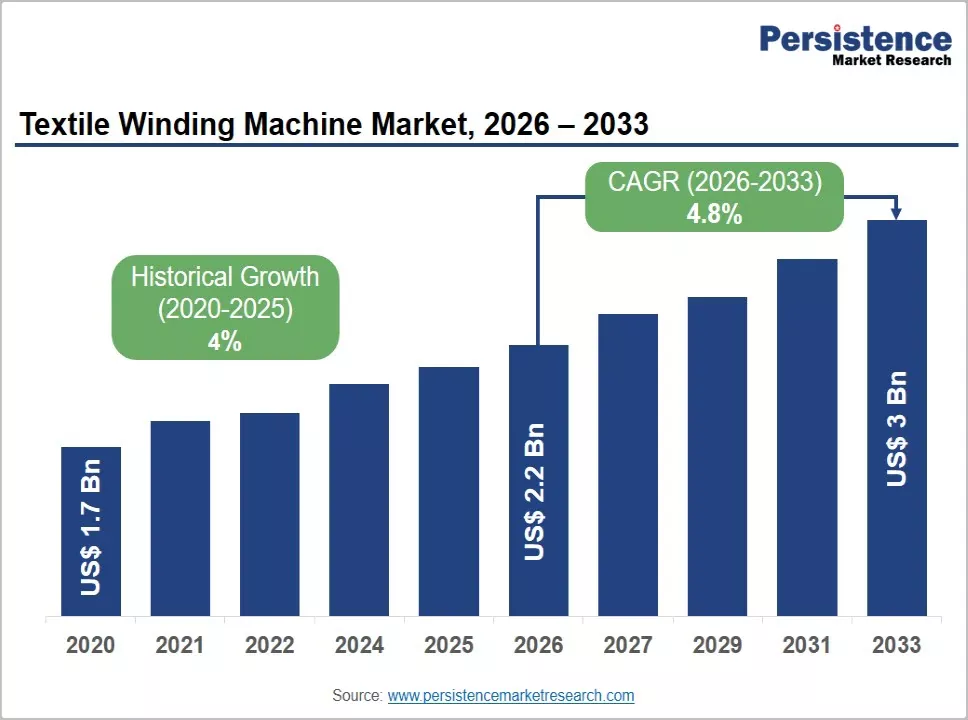
The global textile winding machine market size is likely to be valued at US$ 2.20 billion in 2026 and is projected to reach US$ 3.00 billion by 2033, growing at a CAGR of 4.8% during the forecast period between 2026 and 2033.
Spinning mills are under pressure to raise yarn quality, cut labor dependence, and lower energy use per kilogram, which is reshaping investment priorities across the textile winding machine industry and compelling producers to replace ageing manual and semi-automatic winders with connected, high-speed systems.
This trajectory reflects sustained modernization demand from cotton and man-made fiber mills across South and East Asia, alongside rising consumption of technical textiles that require precise package build and tension control. Industry 4.0 integration, including remote monitoring, AI-assisted yarn fault classification, and automated package handling, is creating a structural upgrade cycle that rewards machinery makers with proven digital platforms and a strong installed base.
Key Industry Highlights
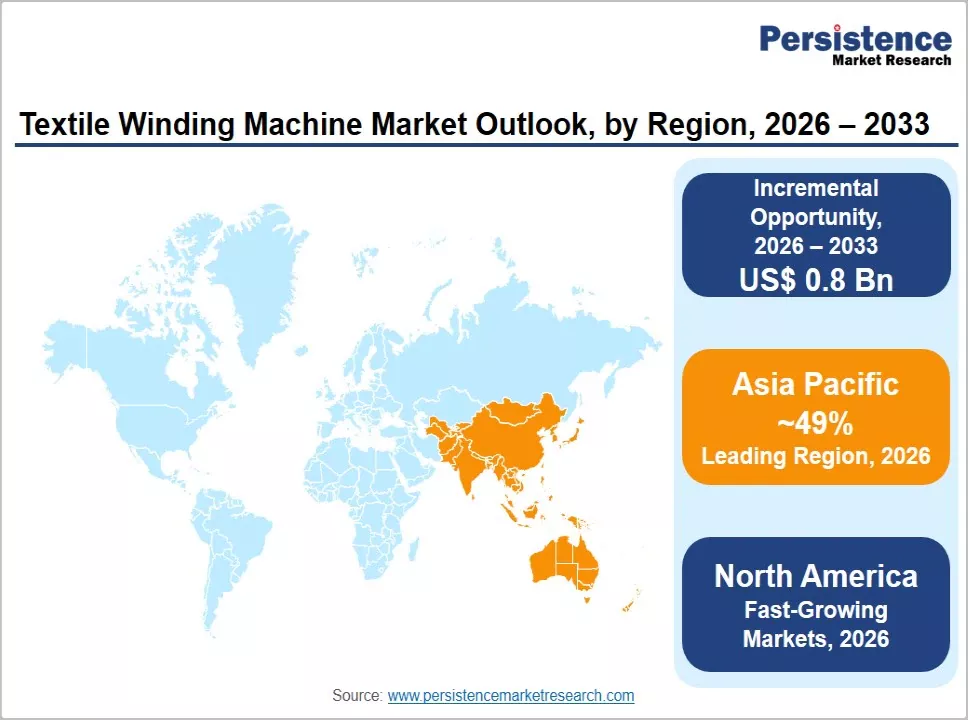
- Dominant Region: Asia pacific is forecast to dominate the regional market, holding about 49% market share in 2026. China’s vast spinning and weaving capacity, its position as the world’s largest textile and apparel exporter, and a rising domestic machinery supply base are collectively sustaining replacement and automation demand, a position the region will retain through 2033.
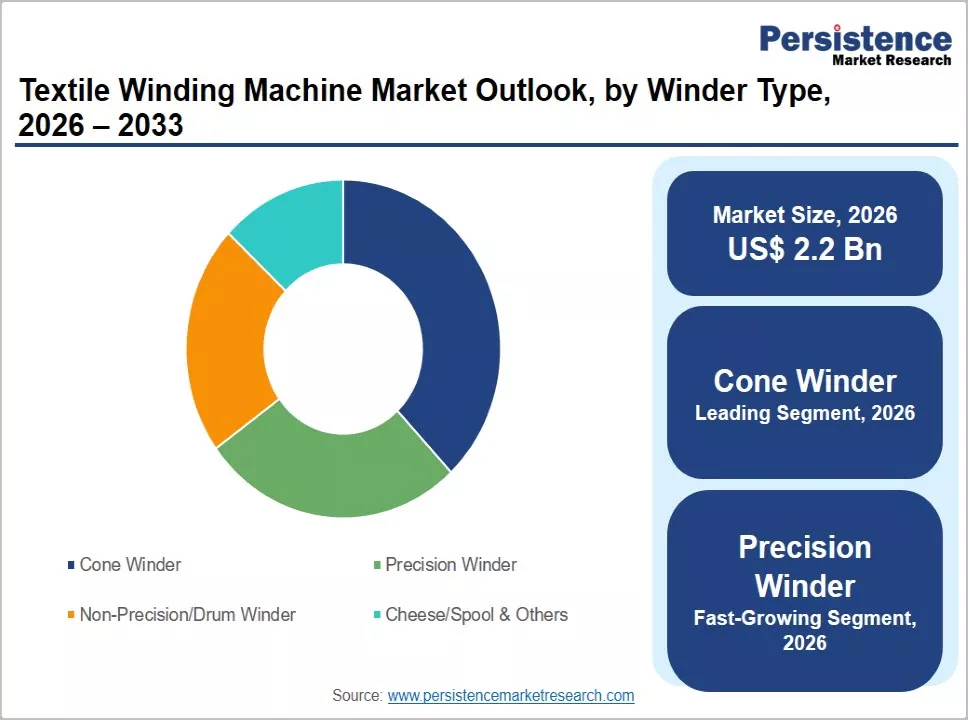
- Dominant Winder Type: Cone winders hold 38% of market share in 2026, fueled by their role as the standard finishing stage in spinning mills, where yarn is cleared, spliced, and wound onto cones for weaving and knitting. Their dominance is structurally stable, as no alternative winder type matches their combination of speed, yarn clearing capability, and package uniformity.
- Fastest-growing Winder Type: Precision winders are gaining share rapidly as technical textile, specialty yarn, and filament producers demand tightly controlled package density and traverse geometry. Barmag’s semi-automatic WINGS POY 2.0 winder with automatic string-up, unveiled alongside its new parent Rieter at ITM 2026, signals growing investment in precision filament winding.
- Leading Automation Tier: Semi-automation accounts for around 46% of market share in 2026, while high-speed automation is expected to expand fastest as mills in India, Bangladesh, Türkiye, and Vietnam move toward lights-out winding rooms linked directly to spinning frames.
DRO Analysis
Driver- Mill Modernization and Automation to Offset Labor Constraints and Quality Demands
Winding is where yarn faults are removed and package quality is fixed, so winding room performance directly affects weaving efficiency and fabric grading. Rising wages, labor scarcity, and buyer demands for contamination-free yarn are pushing spinning mills to automate winding and link it with ring spinning frames through automatic transport and doffing systems.
Savio Macchine Tessili, presenting at ITM 2026 in Istanbul in June, highlighted its Proxima Smartconer, available in fully automatic, manual-feeding, cone-to-cone, Duo Lot, and large-bobbin configurations, supported by the Savio Insight web platform for remote setup and real-time performance analysis. Rieter has similarly positioned its Vision 2027 strategy around automation, AI, and compact spinning, signaling that mill-wide automation is becoming the default specification for new investments.
Restraint- High Capital Cost and Cyclical Mill Profitability
Automatic winders represent a significant capital outlay, and mills operating with thin margins often defer replacement or choose second-hand machines. Textile machinery demand is closely tied to the investment cycle of spinners, which is exposed to cotton price swings, yarn overcapacity, trade policy shifts, and currency volatility in key markets. Competition from lower-priced machinery from China and India also compresses margins for premium European and Japanese suppliers, limiting how quickly they can recover research investments in digital features.
Opportunity- Connected Winding, Retrofit Programs, and Technical Textile Applications
Digital connectivity is turning winding machines from stand-alone equipment into data nodes in the spinning mill. Murata Machinery announced that it will showcase its PROCESS CONER AIcone automatic winder and VORTEX 870 EX spinning machine at ITMA Asia + CITME 2026, scheduled for 20–24 November in Shanghai, while Savio’s relaunched Phoenix Assembly Winder, which handles yarns from Ne 1 to Ne 140 at speeds up to 1,000 meters per minute, addresses assembly winding for technical and specialty yarns. Retrofit kits that add sensors and analytics to installed machines, and growth in technical textiles such as geotextiles, filtration, and automotive fabrics, give suppliers recurring revenue beyond new machine sales.
Category-wise Analysis
Winder Type Insights
Why Does the Cone Winder Dominate the Textile Winding Machine Market?
Cone winders are projected to hold nearly 38% of market share in 2026. Their leading position is primarily attributed to the widespread use of cone-shaped yarn packages in downstream textile manufacturing, particularly weaving and knitting operations. Spinning mills use cone winding machines to transfer ring-spun and rotor-spun yarn from smaller packages into larger, uniformly wound cones that are suitable for storage, transportation, and subsequent fabric production.
Precision winders are likely to be the fastest-growing type, supported by increasing demand for accurately controlled yarn packages across filament, specialty yarn, and technical textile manufacturing. These machines are designed to maintain precise winding patterns, package density, yarn tension, and traverse ratios, ensuring consistent package formation and improved unwinding performance.
Yarn Type Insights
Cotton/cellulosic is expected to lead the yarn type segment, holding around 44% of market share in 2026. Its leading position is supported by the extensive global production and consumption of cotton-based yarns across apparel, home textiles, furnishings, and other fabric applications. Major cotton-spinning countries, including India, China, Pakistan, and Türkiye, maintain substantial spinning capacities, creating consistent demand for winding machinery.
Blends and specialty yarns are likely to be the fastest-growing segment, driven by increasing demand for performance-oriented, sustainable, and application-specific textile materials. Textile manufacturers are increasingly using combinations of natural and synthetic fibers, recycled polyester, recycled cotton, and other specialty materials to develop yarns with improved durability, flexibility, moisture management, and functional properties. These yarns are increasingly utilized in sportswear, automotive interiors, protective clothing, medical textiles, and industrial fabrics.
Automation & Speed Insights
Semi-automation is estimated to lead the automation segment, capturing nearly 46% of market share in 2026. Its leading position is primarily supported by widespread adoption among textile manufacturers in emerging economies, where spinning mills continue to balance production efficiency with equipment investment costs. Semi-automatic winding machines offer a practical combination of mechanical operations and operator-assisted functions, allowing manufacturers to improve yarn handling, package formation, and production consistency without investing heavily in fully automated systems.
High-speed automation is likely to be the fastest-growing tier, driven by increasing investments in advanced textile manufacturing technologies and the need to improve production throughput. Textile manufacturers are increasingly adopting fully automatic winding machines equipped with direct connections to spinning frames, automated bobbin feeding, automatic yarn piecing, and integrated package conveying systems. These technologies minimize manual intervention, reduce operator dependency, and enable continuous production with limited interruptions.
End Use Insights
Spinning mills are estimated to lead the end-use segment, accounting for about 57% of market share in 2026. This dominance is primarily attributed to the extensive use of winding machines in yarn manufacturing, where winding represents an essential finishing stage before yarn is supplied for downstream textile processing. Spinning mills rely on these machines to transfer yarn from spinning bobbins onto larger packages, ensuring uniform yarn tension, consistent package density, and reduced yarn breakage.
Technical textiles are likely to be the fastest-growing end use, driven by increasing demand for specialized textile materials across medical, industrial, automotive, construction, and protective applications. Unlike conventional textiles, technical textiles require specific yarn characteristics, including controlled tension, uniformity, strength, and precision during processing. Winding machines play an important role in preparing specialized yarn packages for subsequent weaving, knitting, coating, and other manufacturing operations.
Regional Insights
Asia Pacific Textile Winding Machine Market Trends and Insights
Asia Pacific is forecast to dominate the regional market, capturing nearly 49% of market share in 2026, propelled by the scale of China’s spinning, weaving, and knitting industries and the presence of major domestic machinery producers such as Jingwei Textile Machinery and Saurer’s Chinese operations. Rising labor costs and environmental compliance are pushing Chinese mills toward automation and energy-efficient winding, while Japanese suppliers anchor the premium segment. Through 2033, growth will be driven by replacement of ageing equipment and AI-based quality control. ITMA Asia + CITME 2026 in Shanghai is expected to showcase the latest winding and spinning automation.
China Textile Winding Machine Market Size
China is projected to hold about 86% of the Asia Pacific regional market in 2026. As the world’s largest textile and apparel exporter, the country sustains large-volume demand for cone winders and filament winders. Domestic manufacturers are narrowing the technology gap, intensifying price competition while foreign suppliers defend share through digital features and reliability.
Japan Textile Winding Machine Market Size
Japan is likely to command about 14% of the Asia Pacific regional market in 2026. Although domestic spinning capacity is modest, Japan is a technology hub, with Murata Machinery exporting its PROCESS CONER automatic winders and Vortex spinning systems worldwide. Demand at home centers on specialty and technical yarns.
Europe Textile Winding Machine Market Trends and Insights
Europe is estimated to account for around 13% of market share in 2026, serving as both a technology source and a market for high-value technical and specialty yarns. Rieter, SSM Schärer Schweiter Mettler AG, Savio, Trützschler, and Vandewiele are headquartered across Switzerland, Belgium, Italy, and Germany, and the region’s consumption is concentrated in Türkiye’s integrated yarn-to-garment industry and in Italy’s textile districts. Energy-efficiency regulation and sustainability reporting are encouraging investment in lower-power winding systems.
Türkiye Textile Winding Machine Market Size
Türkiye is projected to account for nearly 33% of the Europe regional market in 2026. The country’s integrated cotton and man-made fiber industry supplies European fashion retailers, creating steady demand for modern winding and spinning equipment. ITM Istanbul, held in June 2026, is the main regional platform where suppliers such as Savio, Rieter, and Barmag launch new systems.
Italy Textile Winding Machine Market Size
Italy is expected to command nearly 18% of the Europe regional market in 2026. The country combines machinery manufacturing strength, with Savio, Fadis, and Itema based there, and consumption by specialty yarn and fabric producers serving fashion and technical textile applications.
North America Textile Winding Machine Market Size
North America is likely to be the fastest-growing region in the textile winding machine market, driven by increasing investments in advanced textile manufacturing, automation, and smart production technologies. Rising demand for high-quality technical textiles across automotive, aerospace, healthcare, and industrial applications is encouraging manufacturers to upgrade winding equipment. The adoption of energy-efficient machines, precision winding systems, and digital monitoring solutions is further supporting market expansion. Government initiatives promoting domestic manufacturing and modernization of textile facilities are also strengthening regional demand.
U.S. Textile Winding Machine Market Size
The U.S. is anticipated to hold nearly 85% of the North American market share in 2026, making it the dominant country in the region. Demand is supported by investments in advanced textile manufacturing, automation, and high-performance yarn production. Growing applications of technical textiles across automotive, aerospace, healthcare, and industrial sectors are encouraging manufacturers to adopt precision winding equipment. Modernization of textile facilities and increasing focus on production efficiency are further supporting market expansion.
Canada Textile Winding Machine Market Size
Canada is estimated to account around 15% of the North American market share in 2026. Demand is driven by investments in specialized textile manufacturing, technical fabrics, and advanced yarn processing. Growing applications across automotive, healthcare, construction, and industrial sectors are encouraging the adoption of automated and energy-efficient winding equipment. Increasing emphasis on sustainable manufacturing, production consistency, and equipment modernization is expected to support market growth.
Competitive Landscape
The global textile winding machine market is moderately consolidated at the top, with a tier of established machinery groups including Murata Machinery, Ltd. (Muratec), Rieter Holding AG, Saurer Intelligent Technology AG, Savio Macchine Tessili S.p.A., Trützschler Group, and Lakshmi Machine Works Ltd (LMW) competing on winding speed, splice quality, energy efficiency, and digital integration.
Below this tier, specialists such as SSM Schärer Schweiter Mettler AG, Vandewiele NV, Fadis S.p.A., Itema Group, Benninger AG, TMT Machinery Pvt. Ltd., Peass Industrial Engineers Pvt. Ltd., Jingwei Textile Machinery, and Meera Industries Ltd. compete on precision winding, application-specific engineering, and cost competitiveness. Competitive differentiation increasingly turns on connectivity, service reach in emerging markets, and the ability to supply complete automated spinning-to-winding lines.
Key Industry Developments
- In November 2026, the Rural Technology Action Group (RuTAG) at the Indian Institute of Technology (IIT) Guwahati developed a four-in-one yarn winding machine to simplify yarn preparation and reduce manual labor in the handloom weaving sector. The machine integrated four operations: hank-to-bobbin winding, bobbin-to-pirn winding, yarn doubling, and cone-to-bobbin winding. The technology addressed the limitations of conventional charkhas, which typically processed only 1–2 kg of yarn per day, while reducing repetitive movements and physical strain among weavers.
Companies Covered in Textile Winding Machine Market
- Murata Machinery, Ltd. (Muratec)
- Rieter Holding AG
- Savio Macchine Tessili S.p.A.
- SSM Schärer Schweiter Mettler AG
- Lakshmi Machine Works Ltd (LMW)
- Saurer Intelligent Technology AG
- Vandewiele NV
- Trützschler Group
- Fadis S.p.A.
- TMT Machinery Pvt. Ltd.
- Benninger AG
- Peass Industrial Engineers Pvt. Ltd.
- Jingwei Textile Machinery
- Itema Group
- Meera Industries Ltd.
Frequently Asked Questions
The global textile winding machine market is valued at US$ 2.20 billion in 2026.
Mill modernization to offset labor scarcity and meet higher yarn quality standards.
Cone winders hold the largest share of the market at 38% in 2026. Their dominance reflects their role as the standard finishing stage in spinning mills, where electronic yarn clearing and splicing deliver the package quality required by weaving and knitting.
Asia Pacific dominate the market with a 49% share in 2026. Two structural factors underpin this leadership: the scale of China’s spinning, weaving, and knitting capacity as the world’s largest textile and apparel exporter, and a growing domestic machinery supply base.
The most significant opportunities lie in connected winding and retrofit programs and high-speed automation in India and Bangladesh.
The market is moderately consolidated at the top, with Murata Machinery, Rieter Holding AG, Saurer Intelligent Technology AG, Savio Macchine Tessili S.p.A., Trützschler Group, and Lakshmi Machine Works Ltd (LMW) as the dominant players.


