




- Metals & Minerals
- Clear Brine Fluids Market
Clear Brine Fluids Market Size, Share, and Growth Forecast 2026 - 2033
Clear Brine Fluids Market by Product Type (Zinc Calcium Bromide, Calcium Chloride, Cesium Formate Brine, Potassium Chloride, Sodium Chloride, Sodium Bromide, Others), Application (Drilling Fluids, Completion Fluids, Enhanced Oil Recovery, Other Oilfield Activities), and Regional Analysis for 2026 - 2033

Clear Brine Fluids Market Size and Trend Analysis
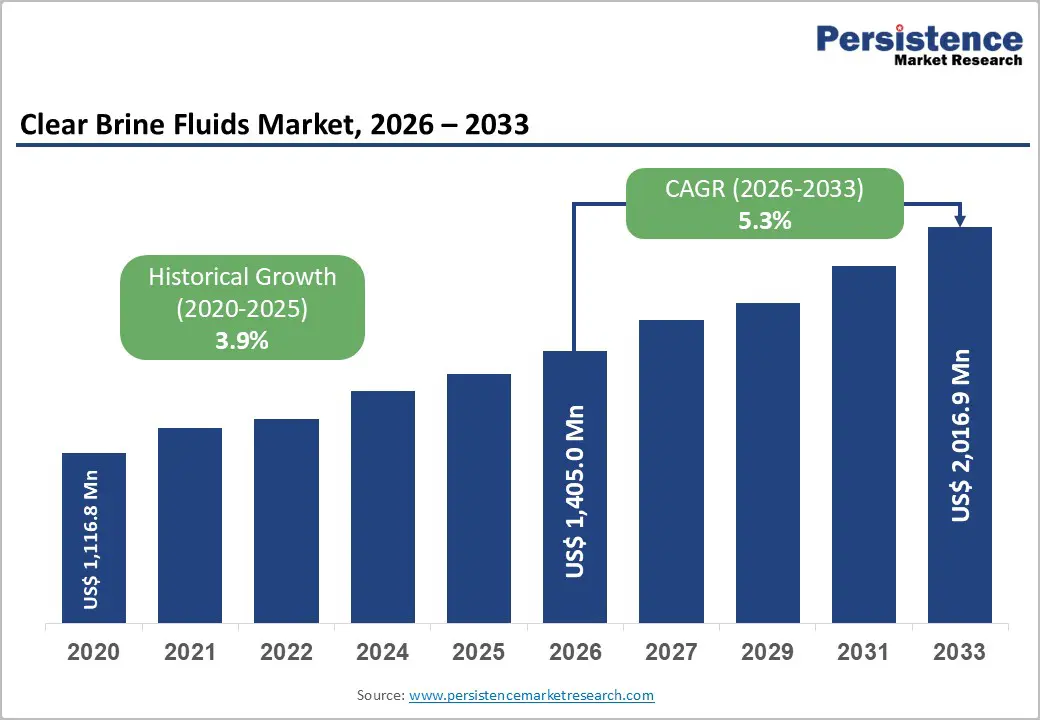
The global clear brine fluids market is estimated at US$ 1,405.0 million in 2026 and is projected to reach US$ 2,016.9 million by 2033, growing at a CAGR of 5.3% between 2026 and 2033.
This robust growth trajectory is primarily driven by a significant surge in deepwater and high-pressure/high-temperature (HPHT) drilling activities worldwide, as upstream operators intensify exploration efforts in complex reservoirs across the Gulf of Mexico, North Sea, and offshore Brazil.
According to the International Energy Agency (IEA), global upstream oil and gas investment is expected to exceed US$ 570 Bn in 2025, fueling strong demand for high-performance completion and drilling fluids. Additionally, escalating environmental regulations are accelerating the shift from conventional solids-laden drilling muds toward eco-friendly clear brine formulations, reinforcing the market's expansion across all major producing regions.
Key Industry Highlights:
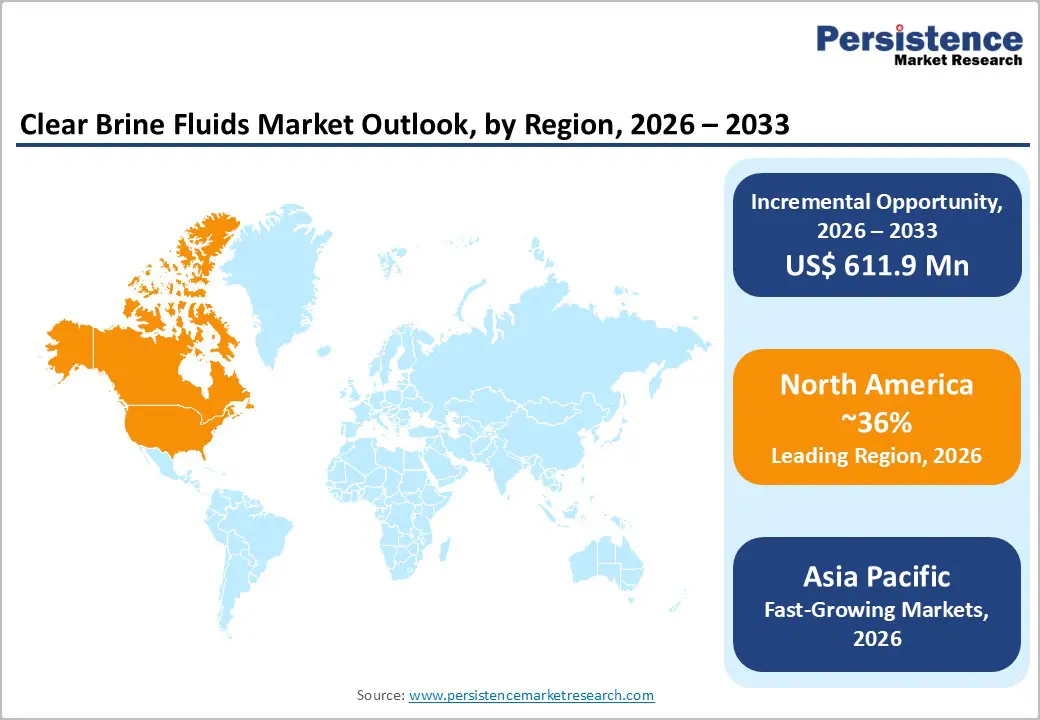
- Leading Region: North America dominates the global clear brine fluids market, with 36% market share, driven by extensive shale drilling activities across the Permian Basin, Bakken, and deepwater Gulf of Mexico projects, with over 40% of regional operators utilizing these fluids for high-pressure wells.
- Fastest Growing Region: Asia Pacific is the fastest-growing regional market, projected at a 6.6% CAGR, propelled by India's deep-water exploration mission, China's shale gas expansion, and offshore developments across ASEAN member nations.
- Dominant Segment: Zinc Calcium Bromide holds approximately 38% product type share owing to its unmatched density range (up to 19.2 lb/gal) for deepwater and HPHT completion operations, making it technically indispensable in high-pressure environments.
- Fastest Growing Segment: Enhanced Oil Recovery (EOR) application segment is the fastest growing within the market, as mature field operators in the Middle East, Latin America, and North America increasingly deploy brine injection and waterflooding techniques to optimize reservoir pressure and extend field life.
- Key Market Opportunity: The transition to potassium formate and cesium formate brine systems, listed as non-hazardous by OSPAR's PLONOR standard, represents the most significant strategic opportunity, driven by tightening environmental regulations across the North Sea, Gulf of Mexico, and offshore Asia Pacific operating environments.
| Key Insights | Details |
|---|---|
| Clear Brine Fluids Market Size (2026E) | US$ 1,405.0 Mn |
| Market Value Forecast (2033F) | US$ 2,016.9 Mn |
| Projected Growth CAGR (2026 - 2033) | 5.3% |
| Historical Market Growth (2020 - 2025) | 3.9% |
DRO Analysis
Drivers - Rising Deepwater and HPHT Drilling Activity
The increasing complexity of global oil and gas exploration, marked by a decisive shift toward deepwater, ultra-deepwater, and HPHT reservoirs, is one of the most powerful demand drivers for clear brine fluids. These environments demand completion fluids with precise density control, thermal stability, and minimal formation damage potential. According to the U.S. Energy Information Administration (EIA), deepwater production is forecast to account for over 30% of global offshore output through 2030.
In the Gulf of Mexico alone, active deepwater rigs routinely exceed 50 units, all requiring high-density brine solutions for pressure management. The Middle East offshore sector is set to receive over US$ 40 Bn in upstream investments by 2025, further expanding the addressable market for zinc calcium bromide and cesium formate-based brine systems. This structural shift in exploration geography is creating a sustained and expanding demand base for premium clear brine formulations.
Unconventional Resource Development and Shale Gas Expansion
The global proliferation of unconventional resource development, particularly shale gas and tight oil extraction, is significantly amplifying demand for clear brine fluids. In horizontal drilling and multi-stage hydraulic fracturing operations, clear brines serve as critical completion fluids, providing wellbore stability and clay/shale inhibition. Potassium chloride and potassium formate brine systems are especially valued for their proven capacity to prevent shale hydration and swelling, which is a pivotal risk in argillaceous formations.
According to the U.S. EIA, the United States produced approximately 103 Bcf/d of dry natural gas in 2023, predominantly from shale plays. Meanwhile, Argentina's national oil company YPF committed US$ 3 Bn out of a US$ 5 Bn investment plan to the Vaca Muerta shale play in 2024. China's shale gas output, drawing on approximately 15% of global shale reserves, is also rising sharply, opening a substantial incremental demand corridor for high-performance brine fluids.
Restraints - High Production Costs and Raw Material Price Volatility
A fundamental restraint on the clear brine fluids market is the high cost structure inherent in manufacturing chemically complex brine systems. Formulations utilizing cesium formate, zinc bromide, and calcium bromide rely on scarce and costly specialty chemicals whose prices are closely correlated with global bromine and formate commodity markets. According to the U.S. Geological Survey (USGS), global bromine production is dominated by just a few geographies, namely Israel, Jordan, and the United States, creating supply concentration risk.
Furthermore, logistical complexities in delivering fluids to remote offshore or deepwater sites substantially inflate total delivered cost, often by 20-35% above onshore equivalents. This cost burden disproportionately affects smaller independent operators, limiting broader adoption beyond integrated majors and large national oil companies.
Stringent Environmental Regulations and Disposal Constraints
Environmental compliance is emerging as a notable restraint across key markets. Effluent disposal regulations, particularly for zinc-containing brine fluids, are becoming increasingly stringent under frameworks such as the U.S. Environmental Protection Agency (EPA) offshore discharge standards and the OSPAR Convention governing North Sea operations. Zinc-based brines face regulatory pushback due to their aquatic toxicity, compelling operators to invest in fluid reclamation or switch to costlier zinc-free alternatives.
In the European Union, the Water Framework Directive and associated offshore waste management protocols impose additional compliance obligations. These regulatory hurdles increase operational costs and can delay project timelines, acting as a moderate but consistent brake on market growth, especially in environmentally sensitive offshore zones.
Opportunities - Eco-Friendly and Biodegradable Brine Formulations
The market's most compelling near-term opportunity lies in the development and commercialization of low-toxicity, biodegradable, clear brine fluid systems. Growing regulatory pressure, particularly in the North Sea, Gulf of Mexico, and offshore Australia, is compelling operators to transition away from zinc-based fluids toward environmentally benign alternatives. Potassium formate and cesium formate brines have emerged as the leading eco-friendly candidates, owing to their inherent biodegradability, low toxicity, and superior thermal stability above 200°C.
According to the OSPAR Commission, formate-based brines are classified as "non-hazardous" under the PLONOR list (Pose Little Or No Risk to the environment), creating a regulatory tailwind. With approximately 32% of companies now actively investing in low-toxicity formulation R&D, this segment offers significant revenue growth potential for first-movers who can scale formate production cost-effectively.
Expansion in the Asia Pacific Offshore Exploration
Asia Pacific represents the fastest-growing regional opportunity for clear brine fluid manufacturers, driven by ambitious state-led offshore exploration programs and rising energy import substitution goals. India launched its National Deep Water Exploration Mission in August 2025, opening over 1 million square kilometers of offshore acreage for exploration, signaling a large incremental demand corridor. According to the India Brand Equity Foundation (IBEF), India's petroleum product consumption reached approximately 4.44 million barrels per day (BPD) in FY2023, necessitating a proportional increase in upstream drilling activity.
China, which holds approximately 15% of global shale gas reserves, is rapidly scaling its HPHT shale gas drilling infrastructure, driving robust demand for high-density brine systems. Meanwhile, Indonesia, Vietnam, and Thailand are accelerating offshore field development, collectively adding substantial new demand volume for completion and drilling fluids across the forecast period.
Category-wise Analysis
Product Type Insights
Zinc calcium bromide accounts for approximately 38% of the global clear brine fluids market by product type, reflecting its critical role in high-density drilling and completion applications. Its ability to achieve fluid densities ranging from 15.1 to 19.2 lb/gal (1.81-2.30 sg) makes it indispensable for deepwater and high-pressure/high-temperature (HPHT) completion operations, where precise hydrostatic pressure control is essential for well integrity.
Market adoption is further reinforced by the strategic collaboration between Halliburton’s Baroid division and TETRA Technologies, particularly through the TETRA CS Neptune product line engineered for pressure-intensive offshore wells in the Gulf of Mexico and the North Sea. In addition, peer-reviewed research published in Scientific Reports in 2024 highlights the suitability of zinc-based brines for high-density applications. Despite increasing environmental scrutiny related to zinc toxicity, the segment’s superior technical performance is expected to sustain its market leadership over the forecast period.
Application Insights
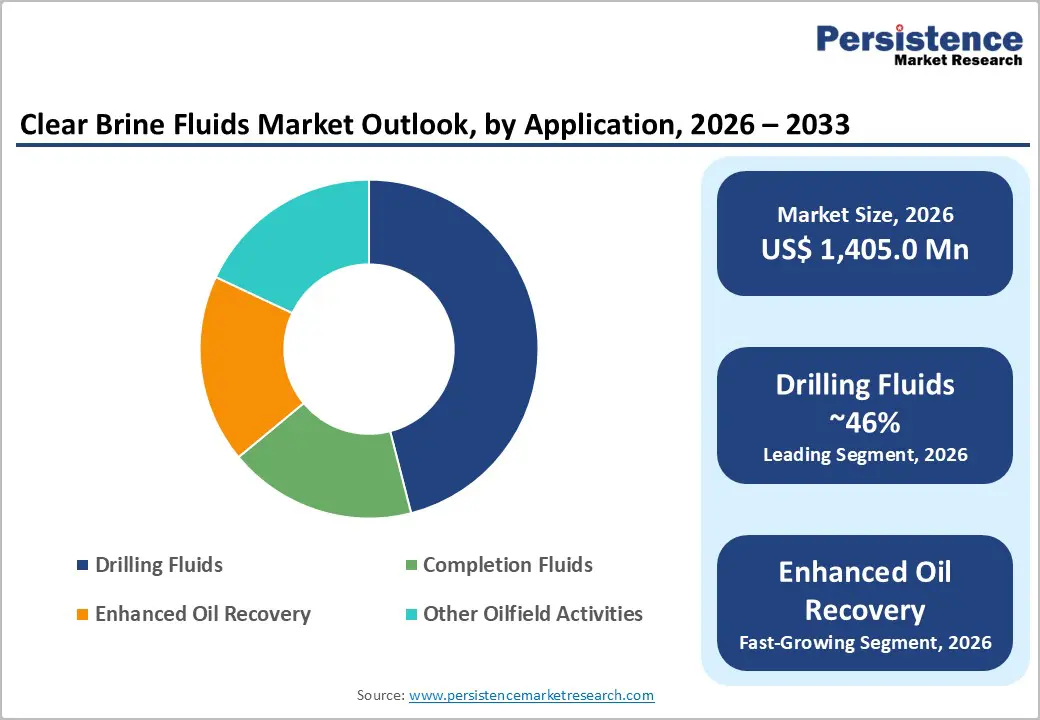
Drilling fluids are likely to value for the largest share of the global clear brine fluids market by application, accounting for approximately 46% of total demand. This leadership position is attributable to the essential and non-substitutable role of clear brines in maintaining wellbore pressure equilibrium, minimizing formation damage, and facilitating efficient cuttings transport during primary drilling operations. The increasing adoption of horizontal drilling and extended-reach wells, particularly across U.S. shale basins and multilaterals in the Middle East, has structurally elevated demand for solids-free, high-performance brine-based drilling fluids.
Sustained international rig activity, with average counts exceeding 950 rigs in 2024, further supports baseline consumption of drilling-grade brines. The Completion Fluids segment follows closely, driven by deepwater project expansion, while Enhanced Oil Recovery (EOR) represents the fastest-growing application as operators deploy brine injection to sustain reservoir pressure and improve recovery efficiency.
Regional Insights
North America Clear Brine Fluids Trends
North America represents the leading regional market for clear brine fluids, supported by the scale, maturity, and technical sophistication of its upstream oil and gas sector. The United States, which hosts highly productive shale basins such as the Permian Basin, Eagle Ford, and Bakken, records the highest per-basin consumption of completion-grade brines globally. Sustained rig activity, with more than 600 active rigs through 2024, provides a stable foundation for demand.
The implementation of the United States-Mexico-Canada Agreement has further strengthened cross-border energy investment and upstream development in Mexico. Additionally, increasing adoption of clear brine fluids for high-pressure wells reflects a structural shift in fluid selection. Regulatory emphasis on sustainable drilling and lower-toxicity formulations continues to drive innovation, while deepwater projects in the Gulf of Mexico maintain strong demand for ultra-high-density zinc-calcium bromide systems.
Europe Clear Brine Fluids Market Trends
Europe’s clear brine fluids market is primarily centered on the North Sea basin, encompassing the United Kingdom, Norway, the Netherlands, and Denmark, regions characterized by mature yet technologically advanced hydrocarbon production. Continued licensing activity by the UK North Sea Transition Authority for brownfield developments and satellite tie-backs is sustaining consistent demand for completion fluids. Leading operators, including Equinor, are increasingly favoring premium, environmentally compliant solutions, as demonstrated by its supply agreement with Sinomine Specialty for cesium-based drilling and completion fluids on the Norwegian Continental Shelf.
Stringent regulatory frameworks, particularly the OSPAR Convention and the EU Water Framework Directive, are accelerating the transition toward PLONOR-listed formate brines over zinc-based alternatives. Concurrently, specialty chemical manufacturers such as LANXESS AG and BASF SE support regional supply resilience, while compliance with the EU Corporate Sustainability Reporting Directive is expected to further drive adoption of formate-based systems throughout the forecast period.
Asia Pacific Clear Brine Fluids Market Trends
Asia Pacific represents the fastest-growing regional market for clear brine fluids, driven by large-scale government-backed energy investments, rising domestic energy consumption, and the accelerated expansion of offshore exploration programs. China, which holds approximately 15% of global shale gas reserves, is rapidly scaling high-pressure/high-temperature (HPHT) shale gas drilling infrastructure under its national energy security strategy, generating substantial incremental demand for high-density brine systems.
India’s petroleum product consumption reached approximately 4.44 million barrels per day in FY2023, and the launch of the National Deep Water Exploration Mission in August 2025, covering more than one million square kilometers of offshore acreage, is expected to create a sustained structural uplift in clear brine fluid demand. Additionally, ASEAN countries, particularly Indonesia, Vietnam, and Thailand, are advancing offshore block developments, while Japan and South Korea contribute through technologically advanced brine chemical manufacturing.
Competitive Landscape
The global clear brine fluids market exhibits a partially consolidated structure, with a handful of integrated oilfield service companies and specialty chemical producers commanding leading positions, while a long tail of regional players serves local demand. The top five players, Halliburton, SLB (Schlumberger), TETRA Technologies, Albemarle Corporation, and LANXESS AG, collectively account for an estimated 55-60% of global revenues. Key competitive differentiators include brine density range, proprietary additive chemistry, field service network depth, and environmental compliance credentials. Companies are simultaneously investing in IoT-enabled fluid monitoring, AI-driven formulation optimization, and sustainable low-toxicity chemistry to differentiate product portfolios and capture premium pricing in environmentally regulated markets.
Key Developments:
- December 2025: Global energy technology company SLB signed a strategic collaboration agreement with Shell to develop digital and AI solutions that drive measurable performance and efficiency gains across upstream operations for the company and the wider industry.
- July 2024: TETRA Technologies, Inc. secured a three-well TETRA CS Neptune fluids contract for a deepwater Gulf of Mexico project, advancing the deployment of its zinc-free, high-density brine technology for pressure-critical completion operations.
- July 2025: SLB announced the acquisition of ChampionX Corporation. This strategic acquisition strengthens SLB's leadership in the production and recovery space. The integration of ChampionX production chemicals and its complementary artificial lift, digital, and emissions technologies enhances the SLB portfolio, helping to drive performance and extend asset life along the production lifecycle.
Top Companies in Clear Brine Fluids
- Halliburton (The Woodlands, U.S.), one of the world's largest oilfield services companies with operations in over 80 countries, is a dominant force in the clear brine fluids market through its Baroid fluids division. The company's partnership with TETRA Technologies for CS Neptune high-density brines and its deep field service network across Gulf of Mexico, Middle East, and North Sea operations reinforces its market-leading position.
- SLB - Schlumberger Ltd. (Paris, France) leverages its broad upstream technology platform to deliver integrated, clear brine fluid solutions, encompassing halide brines, formate systems, and brine filtration services, through its dedicated completion fluids business line. The acquisitions of Zirax Ltd. (2023) and ChampionX (2025) have materially expanded its specialty chemical capabilities and production chemistry reach, positioning it as a comprehensive brine solution provider.
- TETRA Technologies, Inc. (The Woodlands, U.S.) is the most focused pure-play participant in the clear brine fluids market, with its TETRA CS Neptune and TETRA PureFlow+ product lines representing proprietary zinc-free, high-density brine platforms. The company is advancing a bromine production project at its Evergreen Brine Unit in Arkansas to secure long-term raw material supply for both completion fluids and the emerging long-duration energy storage market.
Companies Covered in Clear Brine Fluids Market
- Albemarle Corporation
- LANXESS AG
- Schlumberger Ltd. (SLB)
- Zirax Ltd.
- Solent Chemicals
- Cabot Corporation
- Clements Fluids
- EMEC
- GEO Drilling Fluids, Inc.
- ICL (Israel Chemicals Ltd.)
- Halliburton
- TETRA Technologies, Inc.
- BASF SE
Frequently Asked Questions
The global Clear Brine Fluids market is valued at approximately US$ 1,405.0 Mn in 2026 and is projected to reach US$ 2,016.9 Mn by 2033, growing at a CAGR of 5.3% during the forecast period.
The primary demand driver is the global intensification of deepwater and HPHT drilling operations, which require high-density, solids-free brine fluids for wellbore pressure control and formation protection. Simultaneously, the rapid global expansion of unconventional resource development, including shale gas in the United States, China, and Argentina, is accelerating the consumption of potassium chloride and potassium formate brine systems for shale inhibition during horizontal drilling and completion.
Zinc Calcium Bromide holds the dominant position, approximately 38%, in the global Clear Brine Fluids market by product type. Its supremacy is underpinned by its exceptionally high-density range of up to 19.2 lb/gal (2.30 sg), which is uniquely suited to deepwater and HPHT completion operations where achieving precise hydrostatic pressure gradients is technically mandatory.
North America leads the global Clear Brine Fluids market, with 36% market share, supported by the world's most active shale and deepwater drilling programs. The region benefits from a high concentration of integrated oilfield service companies, proximity to key production basins including the Permian Basin and the Gulf of Mexico, and a well-developed brine chemical supply chain anchored by companies such as Halliburton, TETRA Technologies, and Albemarle Corporation.
The most compelling growth opportunity lies in developing and commercializing eco-friendly, biodegradable brine formulations, particularly potassium formate and cesium formate systems listed as non-hazardous under the OSPAR PLONOR standard. Tightening environmental regulations in the North Sea, Gulf of Mexico, and offshore Asia Pacific are compelling the market's transition away from zinc-based brines, creating first-mover advantage for companies that can scale formate production cost-competitively.
The leading players in the global Clear Brine Fluids market include Halliburton, SLB (Schlumberger), TETRA Technologies, Inc., Albemarle Corporation, LANXESS AG, ICL (Israel Chemicals Ltd.), Cabot Corporation, BASF SE, Zirax Ltd., Clements Fluids, and GEO Drilling Fluids, Inc.. These companies compete based on brine density range, proprietary additive chemistry, environmental compliance profile, and field service network depth.


