




- Industrial Goods & Service
- Circular Knitting Machines Market
Circular Knitting Machines Market Size, Share, and Growth Forecast, 2026 - 2033
Circular Knitting Machines Market by Machine Type (Single Jersey, Double Jersey, Others), Needle Type (Latch Needle, Compound Needle, Others), Application, and Regional Analysis for 2026 - 2033

Circular Knitting Machines Market Size and Trends Analysis
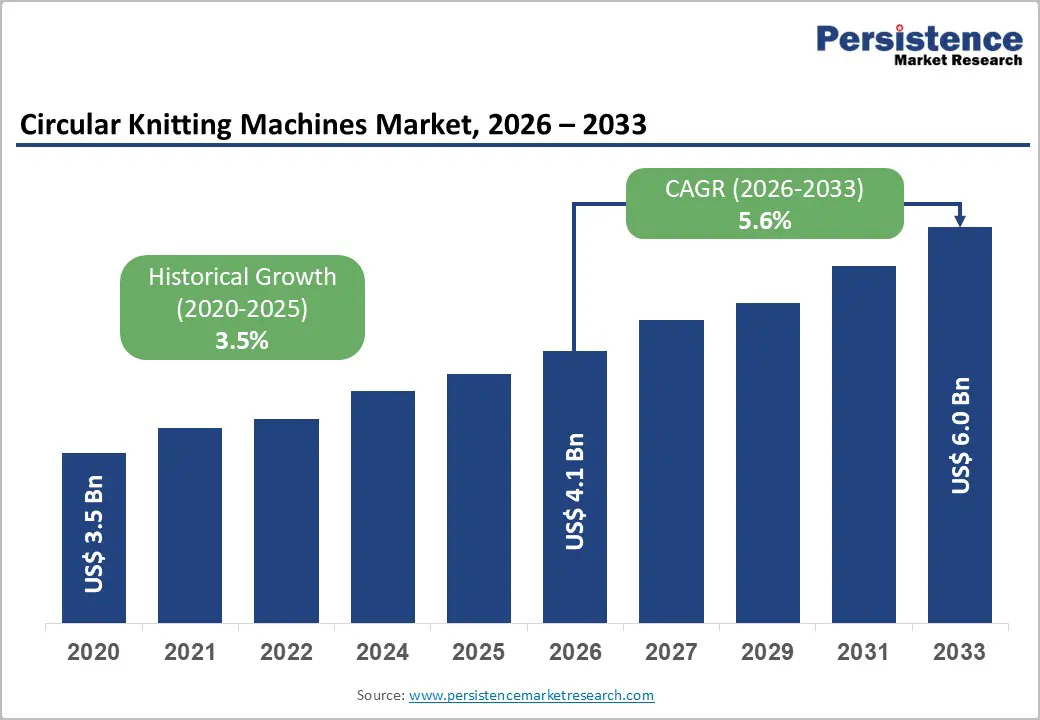
The global circular knitting machines market is likely to be valued at US$ 4.1 billion in 2026 and is expected to reach US$ 6.0 billion by 2033, growing at a CAGR of 5.6% between 2026 and 2033, driven by productivity optimization, digital machine control, and fabric diversification, rather than simple capacity expansion.
Despite a cyclical decline in machine shipments in 2024, long-term demand remains resilient as manufacturers prioritize energy-efficient systems, compatibility with recycled yarns, and rapid changeover capabilities. The expanding global fiber base continues to reinforce downstream demand for knitting machinery.
Key Industry Highlights:
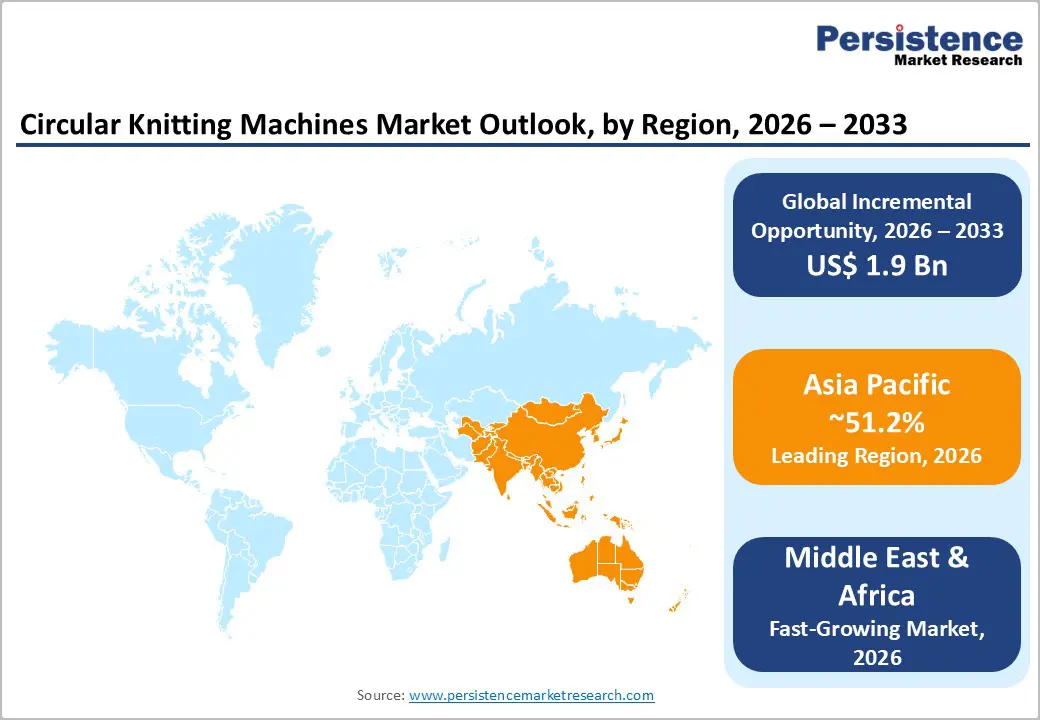
- Leading Region: Asia Pacific is projected to dominate the market with a 51.2% market share, supported by strong textile manufacturing infrastructure, high fiber consumption, and large-scale production capabilities across China, India, and Southeast Asia.
- Fastest-growing Region: The Middle East & Africa is the fastest-growing region, driven by expanding textile hubs, increasing foreign investments, and government-led industrialization initiatives, with growth supported by emerging manufacturing clusters.
- Investment Plans: Significant investments are being directed toward automation, digital machine upgrades, and textile parks development, particularly through initiatives such as India’s PLI schemes and PM MITRA parks, along with greenfield textile projects in Africa.
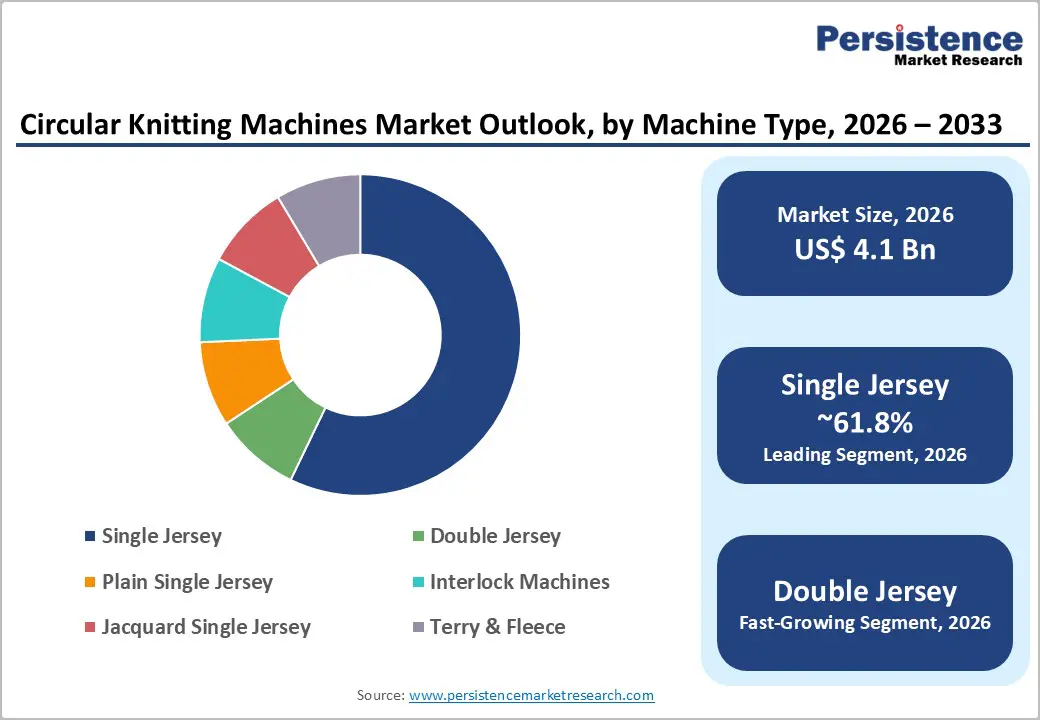
- Dominant Machine Type: Single Jersey machines lead the market with an anticipated 61.8% share, owing to their high productivity and widespread use in mass apparel production such as T-shirts, sportswear, and innerwear.
- Leading Needle Type: Latch needles hold the largest share at an anticipated 54.5%, driven by their versatility, durability, and strong suitability for high-volume textile manufacturing applications.
| Key Insights | Details |
|---|---|
| Circular Knitting Machines Market Size (2026E) | US$4.1 Bn |
| Market Value Forecast (2033F) | US$6.0 Bn |
| Projected Growth (CAGR 2026 to 2033) | 5.6% |
| Historical Market Growth (CAGR 2020 to 2025) | 3.5% |
DRO Analysis
Driver Analysis - Automation and Digital Integration Enhancing Operational Efficiency
Automation and digitally connected machines are transforming procurement strategies in the circular knitting machines market. Modern systems now incorporate IoT-enabled controls, predictive maintenance, and real-time monitoring, allowing manufacturers to optimize machine uptime and reduce operational disruptions. These advancements enable mills to improve production consistency while lowering labor dependency. As labor costs rise and skilled workforce availability declines, automated systems offer a compelling value proposition. The integration of digital platforms also allows remote diagnostics and performance optimization, supporting long-term cost efficiency. This shift is accelerating replacement demand, particularly among large-scale manufacturers aiming to modernize legacy equipment.
Rising Apparel Production and Fiber Consumption Supporting Base Demand
The sustained growth in global apparel production continues to underpin demand for circular knitting machines. Increasing consumption of synthetic and blended fibers has intensified the need for high-speed, high-volume fabric production systems. Polyester remains the dominant fiber category, driving demand for efficient knitting technologies capable of handling large production volumes. Emerging economies, particularly in Asia, are witnessing strong textile exports and domestic consumption, further strengthening the installed base of knitting machinery. The scale of global fiber production highlights the critical role of circular knitting machines in supporting apparel manufacturing and maintaining supply chain efficiency.
Regulatory Push toward Sustainable and Technical Textiles
Sustainability regulations and policy frameworks are reshaping the textile manufacturing landscape. Governments and regulatory bodies are promoting circular economy practices, encouraging the use of recycled fibers and environmentally responsible production methods. This transition is driving demand for advanced knitting machines capable of processing recycled yarns and producing durable, high-performance fabrics. Simultaneously, national initiatives focused on technical textiles are expanding application areas beyond traditional apparel. These programs support innovation, research, and adoption of specialized fabrics, increasing the need for technologically advanced circular knitting equipment.
Restraint Analysis - High Capital Investment and Extended Replacement Cycles
Circular knitting machines represent a significant capital investment, which can limit adoption, particularly among small and medium-sized manufacturers. The high upfront cost of advanced machines, combined with additional expenses for automation, software integration, and workforce training, often extends return-on-investment timelines. During periods of economic uncertainty or fluctuating demand, manufacturers tend to delay equipment upgrades, leading to slower replacement cycles. This dynamic creates short-term volatility in equipment demand despite strong long-term fundamentals.
Skilled Labor Shortages and Supply Chain Constraints
The operation and maintenance of advanced circular knitting machines require skilled technicians and specialized knowledge. A declining interest in technical training and manufacturing careers has resulted in a shortage of qualified personnel, which can hinder the adoption of sophisticated machinery. At the same time, the reliance on precision components, electronics, and control systems exposes manufacturers to supply chain disruptions. Delays in sourcing critical parts can impact production timelines and increase operational risks, particularly in regions dependent on imports.
Opportunity Analysis - Expansion of Technical Textiles Driving High-Value Demand
Technical textiles represent a major growth opportunity within the circular knitting machines market. Applications such as medical textiles, hygiene products, geotextiles, and protective fabrics require specialized knitting capabilities and high precision. These segments often offer higher margins compared to conventional apparel, encouraging manufacturers to invest in advanced machinery. Government initiatives supporting technical textile development are further accelerating adoption. As demand for functional and performance-oriented fabrics increases, manufacturers are expected to prioritize machines capable of handling complex yarn structures and delivering consistent quality.
Growth of Retrofit and Digital Service Models
The increasing adoption of retrofit solutions is creating new revenue streams for machinery manufacturers. Instead of replacing entire systems, textile producers are upgrading existing machines with advanced control systems, sensors, and connectivity features. This approach reduces capital expenditure while enhancing machine performance and extending asset life. For suppliers, retrofit solutions provide recurring revenue opportunities through software upgrades, maintenance services, and digital support. This trend is particularly relevant in fragmented markets where cost sensitivity remains high.
Emerging Manufacturing Hubs Creating Greenfield Opportunities
The development of new textile manufacturing hubs in emerging regions is generating fresh demand for circular knitting machines. Countries in the Middle East and Africa are investing in textile parks, export-oriented manufacturing zones, and industrial clusters. These greenfield projects typically require modern, high-efficiency machinery, creating opportunities for equipment suppliers. As these regions strengthen their position in global textile supply chains, demand for advanced knitting machines is expected to rise, supported by favorable government policies and increasing foreign investment.
Category-wise Analysis
Machine Type Insights
Single jersey machines are expected to dominate the market, accounting for an anticipated 61.8% share in 2026. Their widespread adoption is driven by their ability to produce lightweight fabrics used in T-shirts, sportswear fabric, innerwear, and casual apparel. These machines offer high productivity, lower operational complexity, and cost-efficiency, making them ideal for large-scale manufacturing environments. Variants such as plain single jersey machines are extensively used in mass-produced garments, while jacquard single jersey machines enable intricate patterns for fashion-oriented applications. Terry and fleece machines further extend functionality into segments like towels, loungewear, and winter apparel. For instance, leading textile hubs in countries such as China and India rely heavily on single jersey machines for high-volume knitwear exports. The dominance of this segment reflects the continued strength and scalability requirements of the global apparel industry.
Double jersey machines are likely to be the fastest-growing segment, with growth exceeding 6% CAGR, supported by increasing demand for high-quality and performance-oriented fabrics. These machines produce thicker, more stable, and elastic fabrics, making them suitable for premium apparel, sportswear, and technical textile applications. Interlock machines, a key subtype, are gaining traction due to their superior softness, dimensional stability, and durability, particularly in activewear and athleisure categories. For example, global sportswear brands increasingly use interlock fabrics for leggings, base layers, and compression garments. In addition, double jersey machines are being adopted in applications such as mattress covers, automotive textiles, and medical fabrics. Their ability to support diverse and higher-value applications beyond traditional apparel positions them as a critical growth segment in the evolving circular knitting machines market.
Needle Type Insights
Latch needles are expected to hold the largest share, accounting for an anticipated 54.5% of the market in 2026. Their dominance is attributed to their versatility, durability, and compatibility with a wide range of yarn types, including cotton, polyester, and blended fibers. These needles are widely used in high-volume apparel production due to their reliability, ease of maintenance, and cost-effectiveness. Manufacturers prefer latch needle systems for standard fabric constructions such as single jersey and rib fabrics, where operational efficiency is critical. For example, large-scale garment manufacturers producing basic T-shirts and innerwear depend on latch needle-based machines for consistent output and minimal downtime. This widespread applicability across mainstream textile production ensures their continued leadership in the market.
Compound needles are expected to be the fastest-growing segment, driven by their ability to handle fine, delicate, and specialized yarns with greater precision. These needles enable superior stitch formation and reduced yarn stress, making them highly suitable for technical textiles and high-performance fabrics. Their adoption is increasing in applications such as medical textiles (e.g., compression garments and bandages), sportswear, and seamless knitwear, where fabric quality and consistency are critical. For instance, premium activewear manufacturers are increasingly using compound needle machines to produce lightweight, breathable, and stretchable fabrics. While bearded needles remain relevant in niche or legacy applications, their usage is declining as manufacturers shift toward more advanced needle technologies. The growing emphasis on precision and functionality in textile production is expected to further accelerate the adoption of compound needles.
Regional Market Insights
North America Circular Knitting Machines Market Trends - Automation-Driven Reshoring & Technical Textile Expansion
North America represents a mature yet strategically important market, led by the United States. The region’s demand is driven by reshoring initiatives, regulatory compliance requirements, and a strong focus on technical textiles. Manufacturers increasingly prioritize automation and advanced machine capabilities to offset high labor costs and maintain competitiveness. The regulatory environment emphasizes traceability, quality standards, and sustainability, which directly influences machinery procurement decisions. For example, companies such as Parkdale Mills and Unifi Inc. have expanded domestic production capabilities, reinforcing the need for efficient and digitally enabled knitting systems to support localized supply chains.
Investment in technical textiles, including medical and hygiene products, continues to drive regional growth. The U.S. has seen increased production of PPE fabrics and medical knit materials following supply chain disruptions, prompting manufacturers to upgrade machinery for precision and compliance. Brands such as Hanesbrands have also invested in nearshoring and automation to improve responsiveness and reduce lead times. The adoption of digital knitting technologies is also enabling small-batch and on-demand production, aligning with customization trends in apparel. Despite these advancements, high operational and labor costs remain a structural challenge, requiring continuous investments in productivity-enhancing technologies.
Middle East & Africa Circular Knitting Machines Market Trends - Industrialization-Led Growth & Emerging Textile Hubs
The Middle East & Africa is expected to be the fastest-growing region, supported by government-led industrialization efforts, expansion of textile manufacturing hubs, and rising foreign direct investment. Countries such as Ethiopia have developed dedicated textile parks like Hawassa Industrial Park, which has attracted global apparel manufacturers and created demand for modern knitting machinery. International brands such as PVH Corp. and H&M have sourced from these regions, encouraging infrastructure development and technology upgrades in local manufacturing facilities.
Emerging economies across the region are focusing on building integrated textile value chains to reduce import dependence and strengthen export competitiveness. Countries such as Egypt and Morocco are actively modernizing their textile sectors through industrial policies and trade agreements with Europe. In the Middle East, nations such as the UAE are investing in advanced manufacturing zones and logistics infrastructure, supporting textile machinery imports. While the availability of cost-competitive labor enhances the region’s appeal, challenges related to infrastructure gaps and policy consistency persist. Even so, ongoing investments and export-oriented strategies are expected to drive sustained demand for advanced circular knitting machines.
Asia Pacific Circular Knitting Machines Market Trends - Large-Scale Manufacturing Dominance & Policy-Backed Expansion
Asia Pacific is projected to dominate the market, accounting for 51.2% of the market share in 2026, driven by its strong textile manufacturing base, high fiber consumption, and large-scale production capabilities. Countries such as China, India, Japan, and key Southeast Asian economies play a central role in global textile supply chains. China remains the largest market, supported by its extensive industrial ecosystem and continuous investments in automation and smart manufacturing. Leading Chinese manufacturers such as Shenzhou International Group have expanded vertically integrated production, increasing demand for high-speed and digitally controlled knitting machines.
India is experiencing strong growth due to policy support such as Production Linked Incentive (PLI) schemes and PM MITRA parks, which aim to enhance textile manufacturing infrastructure. Companies such as Arvind Limited are investing in advanced knitting and processing technologies to cater to both domestic and export markets. Japan contributes through high-precision engineering and innovation in textile machinery, while ASEAN countries such as Vietnam and Bangladesh are benefiting from supply chain diversification, attracting global apparel brands and increasing machinery demand. The region’s competitive advantages, low production costs, skilled labor availability, and strong policy backing continue to reinforce its leadership in the circular knitting machines market.
Competitive Landscape
The global circular knitting machines market is fragmented, with a concentration of leading players in the premium segment. Established manufacturers dominate high-end equipment with advanced features, while regional players compete on cost and accessibility. The market structure reflects a balance between innovation-driven competition and price-based differentiation. Key players are focusing on automation, digitalization, and application diversification. Companies are integrating software, services, and consumables into their offerings to create comprehensive solutions. Expansion into technical textiles and emerging markets remains a critical growth strategy.
Key Industry Developments
- In February 2026, Huixing Machine Co. Ltd. acquired the circular knitting machine business of Mayer & Cie., following insolvency proceedings, aiming to restart production operations and strengthen its global market presence through access to established technology and European manufacturing capabilities.
- In August 2025, Mayer & Cie. announced the launch of its OVJA 2.4 EC II jacquard circular knitting machine at ITMA Asia, focusing on energy efficiency, reduced component usage, and applications in sportswear and home textiles, strengthening its innovation-driven product portfolio.
Companies Covered in Circular Knitting Machines Market
- Mayer & Cie.
- Terrot GmbH
- Santoni S.p.A.
- Fukuhara Industrial & Trading Co. Ltd.
- Wellknit Machinery Co. Ltd.
- ORIZIO S.r.l.
- Quanzhou Baiyuan Machinery Science & Technology Co., Ltd.
- Fujian Taihong Machinery Co., Ltd.
- Hangzhou Yexiao Knitting Machinery Co., Ltd.
- Jiunn Long Machine Co., Ltd.
- Senher Precision Machinery Co., Ltd.
- Tayu Machine Co. Ltd.
- Welltex Machinery Co. Ltd.
- Pailung Machinery Mill Co., Ltd.
- Jingwei Textile Machinery Co., Ltd.
Frequently Asked Questions
The circular knitting machines market is estimated to be valued at US$4.1 billion in 2026.
The circular knitting machines market is projected to reach US$6.0 billion by 2033.
Key trends include increasing adoption of automation and IoT-enabled machines, rising demand for technical textiles, growing use of recycled yarns, and expansion of digital retrofit solutions for existing machinery.
The single jersey machine segment is the leading category, accounting for an anticipated 61.8% market share, driven by high demand in mass apparel production.
The circular knitting machines market is expected to grow at a CAGR of 5.6% from 2026 to 2033.
Some of the major players include Mayer & Cie., Terrot GmbH, Santoni S.p.A., Fukuhara Industrial & Trading Co. Ltd., and Wellknit Machinery Co. Ltd.


