




- Nutraceuticals & Functional Foods
- Cardamom Essential Oil Market
Cardamom Essential Oil Market Size, Share, and Growth Forecast, 2026 - 2033
Cardamom Essential Oil Market by Product Type (Organic, Conventional), Application (Food & Beverages, Pharmaceutical, Personal Care & Cosmetics, Aromatherapy), Distribution Channel, and Regional Analysis for 2026-2033

Cardamom Essential Oil Market Share and Trends Analysis
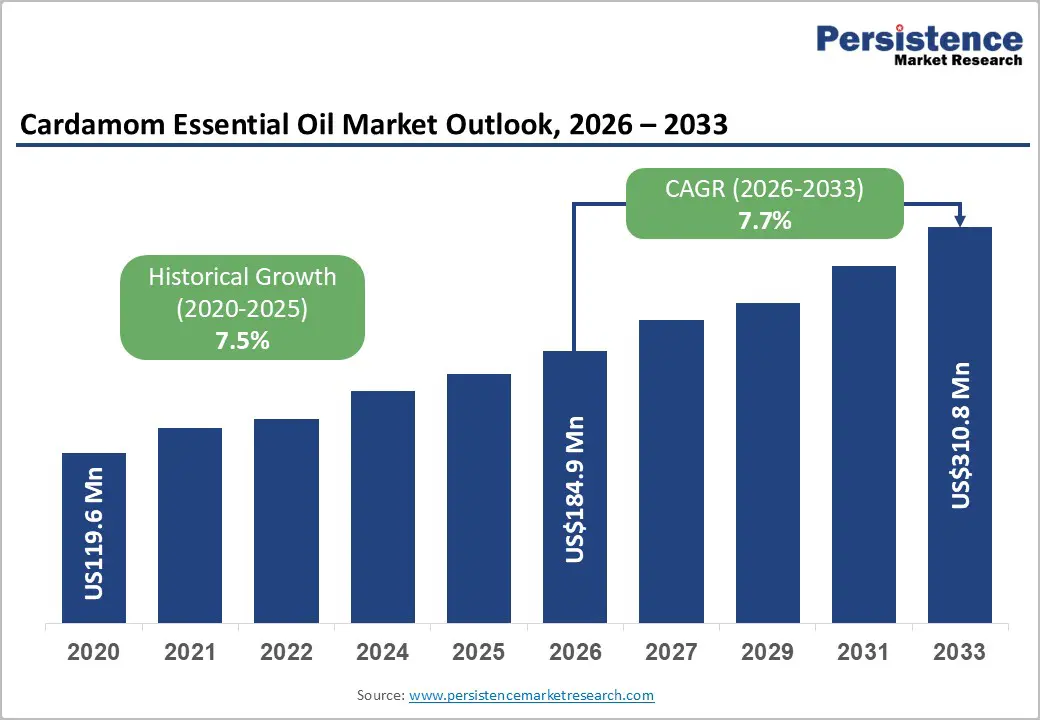
The global cardamom essential oil market size is likely to be valued at US$184.9 million in 2026 and is expected to reach US$310.8 million by 2033, growing at a CAGR of 7.7% during the forecast period from 2026 to 2033, driven by long-term structural shifts toward plant-based ingredients, rising consumer demand for clean-label formulations, and expanding institutional acceptance of essential oils across regulated end-use sectors. Advancements in extraction technologies and stronger quality assurance standards have improved product consistency and reliability. Additionally, the expansion of organized retail networks and digital distribution channels has enhanced global accessibility. Collectively, these factors contribute to sustainable long-term development with a balanced risk profile.
Key Industry Highlights:
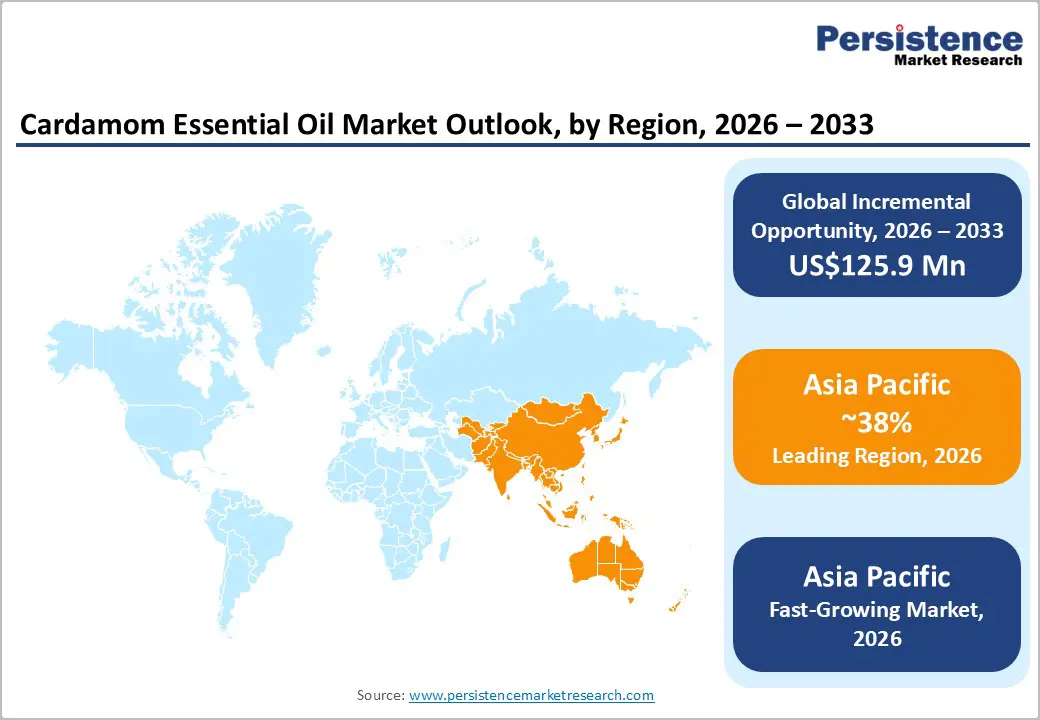
- Leading Region: The Asia Pacific region leads the market, accounting for approximately 38% in 2026, supported by traditional use, production strength, and widespread consumption in the culinary and wellness sectors.
- Fastest-growing Region: Asia Pacific is likely to be the fastest-growing region, driven by rising domestic demand, expanding e-retail channels, and increasing adoption in health, personal care, and natural product applications.
- Leading Product Type: The conventional cardamom essential oil type is expected to lead, holding approximately 65% in 2026, due to established production and usage patterns, though organic variants are gaining interest.
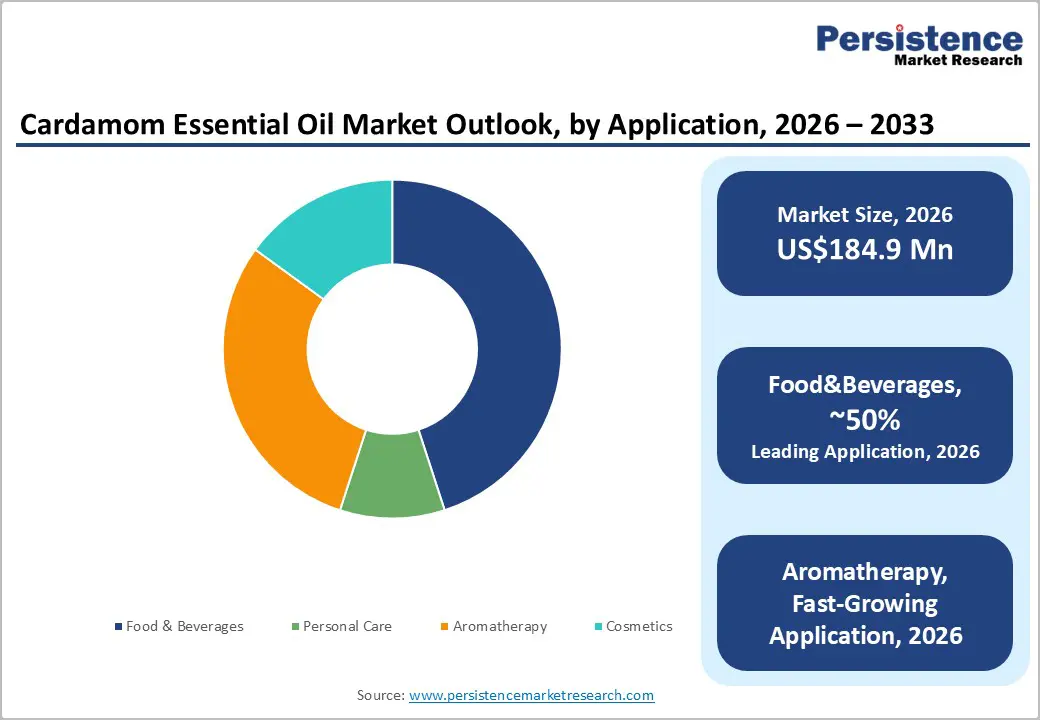
- Leading Application Type: The food & beverages segment is expected to account for approximately 50% in 2026, supported by the widespread use of cardamom as a natural flavoring in tea, bakery, dairy, and functional beverages, along with the rising demand for clean-label and plant-based ingredients.
| Report Attribute | Details |
|---|---|
|
Cardamom Essential Oil Market Size (2026E) |
US$184.9 Mn |
|
Market Value Forecast (2033F) |
US$310.8 Mn |
|
Projected Growth (CAGR 2026 to 2033) |
7.7% |
|
Historical Market Growth (CAGR 2020 to 2025) |
7.5% |
Market Factors- Growth, Barriers, and Opportunity Analysis
Growth Analysis - Rising Adoption of Natural and Clean-Label Ingredients
The rising adoption of natural and clean label ingredients is a major driving force for the market, supported by long-term shifts in consumer preferences and regulatory expectations. Globally, consumers are becoming more health-conscious and increasingly skeptical of synthetic additives, preservatives, and artificial flavors. This shift has encouraged food, beverage, and personal care manufacturers to reformulate products using plant-based, minimally processed ingredients that are easily recognizable and perceived as safer. Regulatory authorities in markets such as the U.S. and the European Union are emphasizing transparency, traceability, and accurate labeling standards, which further support the use of essential oils derived from familiar culinary spices such as cardamom.
Premium tea and functional beverage brands are incorporating cardamom essential oil to replace artificial flavor enhancers while maintaining authentic taste profiles. Similarly, natural skincare companies are using cardamom oil as a botanical fragrance alternative to synthetic perfumes, aligning with “free-from” product positioning. In aromatherapy, brands such as doTERRA International LLC promote spice-based oils for digestive comfort and relaxation blends, reinforcing wellness-oriented consumption. These examples highlight how clean label reformulation is driving structural and sustained market growth rather than short-term demand spikes.
Health-Driven Consumer Shift Accelerating Demand for Cardamom Essential Oil
Consumer preferences are increasingly shifting toward natural and plant-derived ingredients, which is significantly supporting growth in the market. In major markets such as the U.S. and Germany, health-conscious consumers are showing a strong preference for recognizable botanical ingredients over synthetic additives and artificial flavoring agents. This trend is encouraging manufacturers to reformulate products across categories, including teas, functional beverages, skincare, and aromatherapy.
Cardamom essential oil, valued for its digestive, antimicrobial, and warming characteristics, aligns well with clean-label trends and “free-from” product positioning. Growing regulatory focus on ingredient transparency has further strengthened consumer confidence, prompting manufacturers to incorporate spice-derived essential oils into both mainstream and premium product lines. Companies such as doTERRA International LLC actively promote cardamom oil in formulations aimed at digestive support and relaxation, targeting wellness-oriented consumers.
Within the beverage sector, botanical beverage startups in the U.S. are introducing herbal tonics containing cardamom extracts that emphasize respiratory comfort and oral freshness. Likewise, natural skincare brands are integrating cardamom oil into serums and massage blends to enhance their therapeutic appeal. The expansion of these applications reflects broader lifestyle shifts toward wellness and natural ingredients, supporting steady long-term market growth rather than short-term demand fluctuations.
Barrier Analysis - Agricultural Supply Concentration and Environmental Sensitivity
Agricultural supply concentration and environmental sensitivity act as significant restraints for the market. Cardamom cultivation depends heavily on specific agro-climatic conditions, including consistent rainfall, shaded terrain, fertile soil, and moderate temperatures. Major production is concentrated in regions of India and Guatemala, where even minor climatic disruptions such as irregular monsoons, prolonged droughts, or fungal infestations can sharply reduce crop yields. As essential oil extraction relies on high-quality pods, fluctuations in agricultural output directly impact oil availability, pricing stability, and processing efficiency, making supply planning complex for manufacturers.
Erratic rainfall patterns in southern India’s cardamom-growing belts have previously led to reduced harvest volumes and increased raw material prices, affecting exporters and distillers. Similarly, localized plant diseases in Guatemala have constrained supply chains, forcing buyers to compete for limited premium-grade produce. Since cultivation is geographically concentrated, manufacturers have limited alternative sourcing options, increasing vulnerability to regional risks. Seasonal harvest cycles and dependence on smallholder farmers further amplify procurement uncertainty. This structural reliance on climate-sensitive agriculture restricts scalability, creates cost volatility, and challenges long term contract stability for essential oil producers.
Supply Chain Volatility and Geographic Concentration Constraints
The geographic concentration of cardamom cultivation poses significant supply chain risks for the market, as production is largely dependent on a few key regions, notably Guatemala and India. Adverse weather, plant diseases, or export disruptions can sharply reduce crop yields, leaving global buyers with limited alternative sourcing options. Such supply fluctuations increase distillation costs, compress margins for essential oil processors, and heighten competition for high-quality raw materials.
Trade disruptions further amplify market volatility. Tariff changes and regulatory hurdles can raise import costs and delay contracts, while poor harvests force producers to either absorb higher expenses or pass them to end users. Smaller aromatherapy brands may delay new product launches in response to rising raw material prices. These challenges complicate long-term sourcing strategies, slow innovation in premium formulations, and limit the scalability of value-added essential oil production.
Opportunity Analysis - Policy Support for Sustainable Agriculture and Processing
Policy support for sustainable agriculture and agri-processing creates a meaningful opportunity for the market by strengthening raw material security and long-term productivity. Governments in producing countries such as India and Guatemala are promoting climate-resilient farming, soil conservation, and responsible pesticide management to improve crop quality and yield stability. In India, initiatives led by the Spices Board India support farmer training, quality certification, and post-harvest infrastructure, which enhance traceability and export competitiveness. Such structured programs reduce supply volatility and improve consistency in cardamom suitable for essential oil extraction.
Additionally, policy incentives encouraging local agri-processing and value addition help shift the focus from raw spice exports to higher margin essential oil production. Investments in distillation units, quality testing laboratories, and farmer processor integration improve extraction efficiency and quality assurance standards. Government-backed processing clusters in southern India have enabled exporters to supply certified, traceable oil directly to global wellness and food brands. As multinational buyers increasingly prioritize sustainability-linked procurement, these policy-supported frameworks position cardamom essential oil as a dependable and ethically sourced ingredient, creating durable, long-term growth opportunities.
Government-Led Sustainability Initiatives Strengthening Market Opportunities
Policy-driven initiatives in India are creating strong growth opportunities for the cardamom essential oil market by improving farm productivity and supply reliability. The Spices Board India promotes climate-resilient cultivation practices, organic certification, and efficient irrigation systems such as drip irrigation, helping farmers mitigate monsoon-related crop losses and enhance raw material consistency. Government-backed schemes encouraging pest-resistant seeds and better agronomic training support long-term sustainability, which is critical for essential oil extraction quality.
Investments in processing infrastructure, particularly in Kerala’s Idukki district, have strengthened value addition at the source. Modern distillation plants have reduced extraction losses and improved oil purity, enabling direct export of traceable essential oils to European wellness brands. These integrated agricultural and processing improvements position India as a competitive and sustainable supplier in the global market.
Category-wise Analysis
Product Type Insights
The conventional segment is expected to lead, accounting for approximately 65% in 2026, due to strong economies of scale, cost-efficiency, and supply stability. The conventional segment remains dominant due to its cost efficiency, large-scale production capacity, and stable supply. Higher yields enable it to meet bulk demand from confectionery, beverage, and household product industries while maintaining a price advantage over organic variants with similar aromatic performance. Its greater resilience to pests and climate variability ensures consistent availability. Trends such as zero-residue processing, upcycling of lower-grade pods, and blended formulations further strengthen its industrial relevance. Stricter quality standards from regulatory bodies and continued demand from the Middle Eastern coffee markets, along with the adoption of advanced CO? extraction methods, reinforce its competitive and resilient market position.
The organic segment is likely to be the fastest growing, experiencing strong growth, supported by premiumization in personal care and rising pharmaceutical-grade purity requirements. Brands such as Aesop and Dr. Hauschka are adopting organic cardamom oil to replace synthetic fragrances, while retailers such as Whole Foods Market and Sprouts Farmers Market are expanding shelf space for certified products. Trends including CO? extraction, wild-harvested sourcing, and sustainable packaging further enhance its premium positioning. Regulatory frameworks from the European Union and the United States Department of Agriculture have strengthened certification standards, boosting consumer trust and supporting continued segment expansion.
Application Insights
The food & beverages segment is projected to hold the largest share of the market, accounting for approximately 50% in 2026. Its dominance is attributed to the ability of essential oils to provide consistent flavor profiles, uniform batch quality, and improved microbial stability compared to raw spices. Growing global interest in Middle Eastern and Asian cuisines, combined with the ongoing shift toward clean-label formulations, is further increasing their adoption in a variety of food products. Applications are expanding across craft beverages, premium confectionery, and plant-based dairy alternatives, where oil-based extracts enhance aroma while maintaining product texture. Strengthened quality and safety standards from the Spices Board India and the Food Safety and Standards Authority of India are also encouraging broader industrial usage. Large flavor and ingredient companies such as Givaudan and McCormick & Company, Inc., are also contributing to market expansion through large-scale integration of natural flavoring solutions.
The aromatherapy segment is expected to be the fastest-growing application area for cardamom essential oil, supported by increasing awareness of mental wellness and the rising use of home fragrance and diffuser products. Known for its warming, grounding, and respiratory-support characteristics, cardamom oil is commonly included in blended essential oil formulations and gender-neutral wellness products. Emerging trends such as HVAC-based scent diffusion and water-dispersible essential oil formulations are further expanding its use across residential and commercial environments. At the same time, stricter safety guidelines from the International Fragrance Association and regulatory oversight by the U.S. Food and Drug Administration have improved transparency and quality standards within the sector. Prominent wellness brands, including doTERRA International LLC and Young Living Essential Oils, continue to support the premium aromatherapy segment through specialized blends and consumer education initiatives.
Regional Insights
North America Cardamom Essential Oil Market Trends
North America’s cardamom essential oil market is a stable market, driven by the functional beverage boom, growing pharmaceutical applications, and expanding premium pet wellness demand. The rise of non-alcoholic “So-Ber” culture and botanical sodas has increased the use of cardamom oil as a complex natural flavoring, while U.S. pharmaceutical manufacturers utilize it to mask bitterness in pediatric syrups and supplements. A unique regional driver is the premium pet care sector, where diluted cardamom oil is incorporated into calming sprays and digestive aids. Emerging trends such as “terroir-based” origin marketing, DTC subscription wellness kits, and scent-branding in retail and hospitality are further expanding commercial applications.
Regulatory tightening under the U.S. Food and Drug Administration's FSMA traceability rules and California’s Prop 65 standards has raised purity and documentation requirements, favoring large, compliant suppliers while reducing informal trade. Updated environmental marketing guidance from the Federal Trade Commission has also curtailed greenwashing, increasing demand for certified and lab-tested oils. Market leadership is reinforced by major players such as NOW Health Group, Inc., Young Living Essential Oils, doTERRA International LLC, Frontier Co-op, and International Flavors & Fragrances, which dominate retail and B2B supply chains across the region.
Europe Cardamom Essential Oil Market Trends
Market growth in Europe is shaped by its strong apothecary culture, where oils are treated as quasi-pharmaceuticals, creating consistent demand in digestive, respiratory, and dermo-cosmetic applications. Consumer preference for mild, “green/fresh” cardamom (Elettaria) and trends such as alcohol-free botanical spirits and gentle baby care products drive product selection toward high-quality Guatemalan and Indian crops. Industrial trends such as biodynamic certification, olfactory wellness in offices, and upcycled perfumery are elevating the segment, emphasizing premium, ethically sourced, and innovative formulations.
Regulatory frameworks strongly influence the market, with the European Green Deal, Chemical Strategy for Sustainability, IFRA 51st Amendment, and REACH standards enforcing safety, traceability, and environmental compliance. These measures favor professional, well-documented suppliers while raising barriers for smaller producers. Leading European and global brands such as Givaudan, Firmenich, Biolandes, Oshadhi, and Robertet Group dominate the market, setting standards for therapeutic-grade, ethically sourced, and premium cardamom oils.
Asia Pacific Cardamom Essential Oil Market Trends
The Asia Pacific region is expected to lead the market, accounting for approximately 38% of the global share in 2026. The region benefits from the deep cultural integration of cardamom in traditional systems such as Ayurveda and Traditional Chinese Medicine, which supports consistent and long-term demand. Rapid urbanization across countries, including India, Indonesia, and Vietnam, is increasing the consumption of flavored packaged foods and beverages, while the premiumization of street food and the expanding beauty and personal care industries in countries such as South Korea and China are driving demand for high-quality, standardized essential oils. Certification requirements such as Halal and Kosher also influence regional market dynamics, particularly in Southeast Asia, where certified products are often necessary for wider commercial acceptance. Additionally, industry trends, including the modernization of Ayurvedic formulations, the development of capsule-based supplements, the adoption of hybrid extraction techniques such as sonication-assisted extraction, and the environmentally responsible reuse of distillation by-products, are improving production efficiency and sustainability.
Regulatory advancements across the region are further strengthening product quality and market scalability. Measures such as anti-adulteration regulations implemented by the Food Safety and Standards Authority of India have encouraged the professionalization of distillers and improved product authenticity. Meanwhile, the ASEAN Cosmetic Directive has facilitated cross-border ingredient standardization, and China’s Cosmetic Supervision and Administration Regulation recognizes cardamom as a historically safe botanical ingredient. Key regional companies, including Synthite Industries Ltd., S H Kelkar & Co. (Keva), Plant Lipids, and Forest Essentials, play a major role in the market, contributing to both conventional and organic cardamom oil production while promoting trends toward certified, premium-quality, and export-oriented formulations.
Competitive Landscape
The global cardamom essential oil market is moderately fragmented, with leadership concentrated among global suppliers such as Synthite Industries Ltd., Givaudan, Young Living Essential Oils, doTERRA International LLC, and McCormick & Company, Inc. These leaders exert significant influence over market standards through integrated production, advanced extraction technologies, and robust distribution networks, shaping both conventional and organic segments. Their functional footprint extends from high-volume industrial supply for food, beverage, and aromatherapy applications to premium, traceable formulations for wellness and cosmetic sectors.
Competitive positioning in the market is defined by a mix of horizontal and vertical integration, with players differentiating through scale, quality assurance, sustainable sourcing, and niche product offerings such as biodynamic, zero-residue, or certified organic oils. Industry dynamics are further shaped by regional consolidation in key producing markets, regulatory harmonization, and evolving consumer expectations for clean-label, ethically sourced, and technologically verified products. This combination of structural influence, specialized capabilities, and regulatory alignment enables leading suppliers to maintain stable supply chains, set pricing benchmarks, and guide innovation across applications globally.
Key Industry Developments:
- In July 2025, Multi Commodity Exchange of India (MCX) introduced Cardamom Futures Contracts to improve price discovery and offer effective hedging tools for small farmers and traders.
- In April 2025, global commodity trader Armajaro acquired a 40% stake in Malabar Spices, a major Indian cardamom supplier, strengthening its position in the global spice trading market.
Companies Covered in Cardamom Essential Oil Market
- doTERRA International LLC
- Young Living Essential Oils
- Plant Therapy Essential Oils
- Edens Garden
- Floracopeia Inc.
- Greenleaf Extractions Pvt. Ltd.
- Aromaaz International
- Mountain Rose Herbs
Frequently Asked Questions
The global cardamom essential oil market size in 2026 is estimated to be US$184.9 million.
Growth is driven by rising adoption of natural and clean-label ingredients, expanding wellness consumption, and increasing use in food, aromatherapy, and personal care applications.
The cardamom essential oil market is growing at a moderate CAGR of around 7.7% during the mid-term forecast period.
Opportunities arise from organic product expansion, sustainable sourcing policies, value-added formulations, and growth in aromatherapy and premium wellness products.
Key players include doTERRA International, Young Living Essential Oils, Plant Therapy, Edens Garden, Floracopeia, Aromaaz International, Greenleaf Extractions, and Mountain Rose Herbs.


