




- Transportation & Logistics
- Buses and Coaches Market
Buses and Coaches Market Size, Share, and Growth Forecast 2026–2033
Buses and Coaches Market by Bus Type (Standard, Single Deck, Double Deck, Coaches, Articulated), Propulsion (Diesel, Natural Gas, Hybrid, Electric, Hydrogen), Application (School, Intercity, Intracity), and Regional Analysis, 2026–2033

Buses and Coaches Market Size and Trend Analysis
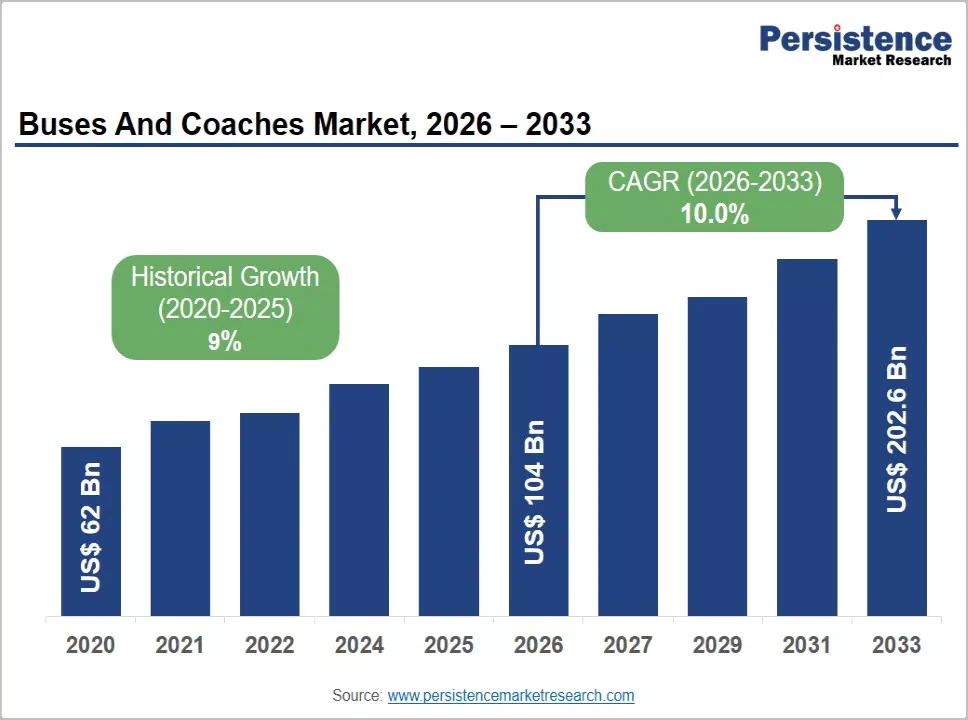
The global buses and coaches market size is likely to be valued at US$ 104 billion in 2026 and is projected to reach US$ 202.6 billion by 2033, growing at a CAGR of 10% during the forecast period between 2026 and 2033. Buses and coaches are no longer a diesel-led, tender-driven business. Transport authorities, school districts, and intercity operators are replacing ageing fleets with zero-emission vehicles as clean-air rules, low-emission zones, and falling battery costs move procurement away from diesel.
The forecast period is defined by large state-backed tenders, fast electric bus adoption in Europe, India, and Latin America, and the entry of Chinese manufacturers into new export markets, alongside growing interest in long-range electric coaches, hydrogen fuel cell buses, and connected fleet management. Manufacturers, operators, transport authorities, and battery suppliers should read this as a market in which total cost of ownership, charging infrastructure, and financing models decide who wins contracts.
Key Industry Highlights
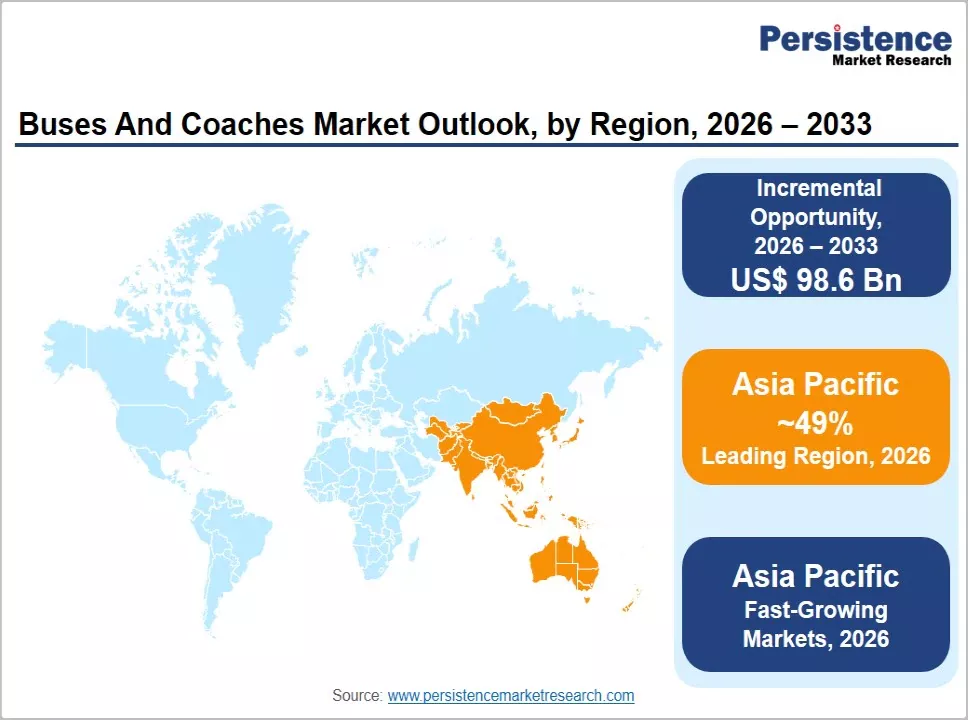
- Dominant and Fastest-growing Region: Asia Pacific hold 49% of the market revenue in 2026 and is projected to grow at an estimated 11.4% CAGR through 2033, driven by China, India, and Southeast Asia. Large state transport tenders, urban electrification programs, and the production scale of Yutong, BYD, TATA Motors, and Ashok Leyland keep volume growth above the global average.
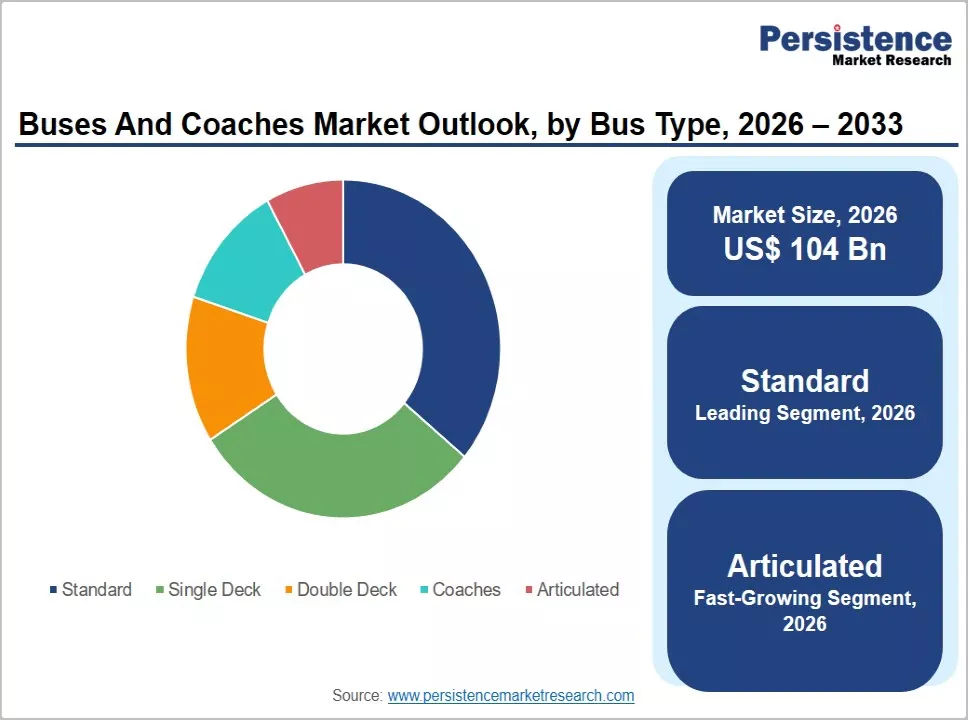
- Leading Bus Type and Propulsion: Standard buses account for about 36% of 2026 revenue and diesel for around 58%, reflecting the depth of existing fleets, lower upfront prices, and wide fuel and service networks in emerging markets. Intracity transit is the largest application at about 52% of revenue.
- Fastest-growing Bus Type and Propulsion: Articulated buses and electric propulsion are the fastest-growing segments. European electric bus registrations rose 49% to 8,141 units in the first half of 2026, led by Yutong, BYD, MAN, Mercedes-Benz, and Wrightbus, while zero-emission buses reached about 24% of EU bus registrations in the first quarter of 2026.
- Fastest-growing Application and Emerging Opportunity: Intercity services are the fastest-growing application as operators trial long-range electric coaches. BYD premiered its C12 DUO battery-electric coach for the UK in November 2026 with a quoted range of up to 547 km, Scania presented a battery-electric Touring coach, and Wrightbus said a hydrogen fuel cell coach could arrive in 2027 or 2028.
DRO Analysis
Driver- Fleet Electrification Mandates, Urban Air-Quality Policy, and Public Transport Investment
Governments are paying for cleaner bus fleets, and operators are responding. In India, TATA Motors announced orders for more than 5,000 buses and bus chassis from state transport undertakings in March 2026, and electric bus registrations grew 40% to 2,944 units in the first half of 2026, led by Switch Mobility.
In Europe, battery-electric buses have become the default choice for new city fleets, with first-half 2026 registrations up 49%. Falling lithium iron phosphate battery costs, fixed-fee service contracts such as Alexander Dennis' AD24 program, and transport-as-a-service models such as Zenob?'s November 2026 expansion into Germany are lowering the barriers for operators that cannot buy vehicles and chargers outright.
Restraint- High Upfront Costs, Charging Infrastructure Gaps, and Uneven Demand in Mature Markets
Electric buses cost considerably more than diesel models, and depots need grid upgrades, chargers, and energy management before vehicles can enter service, which delays deployments in cities with constrained grids or budgets. Demand is also uneven: UK bus and coach registrations fell 32.1% to 5,162 units in the first nine months of 2026, and zero-emission registrations dropped 16.3% to 1,606 units, even as their share of the market rose to 31.1%. Competitive pricing and the export push of Chinese manufacturers add pressure on domestic suppliers, while driver shortages and concerns over battery warranties and residual values make operators cautious about large orders.
Opportunity- Electric Coaches, Hydrogen Fuel Cell Buses, and Fleet Digitalization
Intercity electric coaches, hydrogen buses for long routes, and software-led fleet services represent the largest white space. The BYD C12 DUO offers up to 547 km of range with a 429 or 495 kWh battery, while Daimler Buses' fourth-generation NMC4 batteries lift eCitaro pack capacity from 98 to 111 kWh, taking the solo model to as much as 600 km. Solaris is preparing an intercity bus in battery-electric and hydrogen versions, and Wrightbus is considering new UK manufacturing capacity and international expansion. Repowering is another opening, as First Bus ordered 43 more StreetDeck double-deckers to be converted from diesel to battery-electric, extending fleet life at lower cost than new vehicles.
Category-wise Analysis
Why Do Standard Buses Command the Largest Share of the Global Buses and Coaches Market?
Standard buses are projected to lead the segment, holding nearly 36% of market share in 2026. The 10 to 12 meter format suits most urban and suburban routes, and state transport undertakings in India, Latin America, and Southeast Asia buy it in volume through competitive tenders. TATA Motors, Ashok Leyland, Yutong, and Marcopolo S.A. supply standard buses across diesel, natural gas, and electric versions, and single deck models remain the base for most city and regional services. Operators value the balance of capacity, maneuverability, and parts availability.
Articulated buses are likely to be the fastest-growing bus type, driven by bus rapid transit corridors and high-capacity routes in Latin America, India, and Europe. The Mercedes-Benz eCitaro G can reach up to 777 kWh of battery capacity with NMC4 batteries, showing how electric artics are scaling up. Double deck buses are anchored by London, where more than 950 zero-emission double-deckers operate, while coaches such as the BYD C12 DUO and Scania Touring are moving into electric intercity service.
Propulsion Insights
What Is Keeping Diesel Ahead of Alternative Propulsion in Global Bus Fleets?
Diesel is projected to lead the propulsion segment, accounting for around 58% of market share in 2026. Lower purchase prices, long range, quick refueling, and established service networks keep it dominant in emerging markets, school fleets, and coach operations. MAN, Volvo, Scania, and Ashok Leyland continue to upgrade diesel platforms, and new launches such as the Higer Azure 9 diesel midibus at Euro Bus Expo 2026 show that manufacturers still serve segments where electrification is not yet economic.
Electric is likely to be the fastest-growing propulsion type, as Yutong, BYD, Solaris, and MAN deliver record volumes to European cities and Indian state operators. Hybrid buses bridge the transition in cities with limited charging, natural gas buses serve markets with cheap gas such as India and parts of Europe, and hydrogen remains early-stage, with Wrightbus pointing to a 2027 or 2028 launch for its fuel cell coach.
Application Insights
Why Does Intracity Transit Lead Global Bus and Coach Demand?
Intracity is expected to lead the application segment, holding about 52% of market share in 2026. City bus fleets are bought by public agencies on predictable replacement cycles and funded by government programs, which makes this the most visible driver of electrification. TATA Motors reports more than 3,800 electric buses running in Indian cities with over 550 million kilometers of cumulative operation, and Volvo, New Flyer, and Daimler AG compete for transit contracts across Europe and North America.
Intercity is likely to be the fastest-growing application, supported by liberalized long-distance coach markets, rising tourism, and the arrival of long-range electric coaches. Higer's V12 has entered trials with FlixBus, while BYD, Scania, and Volvo are launching electric coaches designed for 50,000 miles or more of annual use. School buses form a stable base, particularly in North America, where yellow bus fleets are renewed gradually and electric models are entering through grant-backed pilots.
Regional Insights
North America Buses and Coaches Market Trends and Insights
North America is forecast to account for around 14% of the buses and coaches market in 2026. Transit agencies, school districts, and motorcoach operators buy through public funding and tenders, with New Flyer among the leading transit bus suppliers. Fleet renewal, domestic-content rules, and zero-emission funding programs shape procurement, while higher vehicle prices and grid readiness slow the pace of electric adoption.
U.S. Buses and Coaches Market Size
The U.S. is estimated to hold around 85% of the North America regional market in 2026. Large urban transit agencies, school districts, and intercity coach operators drive volume, and the shift to electric and hybrid fleets depends on federal and state incentives and on the availability of depot charging.
Canada Buses and Coaches Market Size
Canada is expected to account for around 15% of the North America regional market in 2026. Transit agencies are expanding battery-electric fleets, and a new national transit planning project is examining the operational performance of battery-electric buses across the country.
Europe Buses and Coaches Market Trends and Insights
Europe is anticipated to command around 22% of market share in 2026. The region has the world's most active zero-emission bus market, with zero-emission vehicles reaching about 24% of EU bus registrations in the first quarter of 2026. Yutong, Solaris, MAN, Iveco Bus, Mercedes-Benz, and Wrightbus lead registrations, supported by city clean-air targets and public funding.
Germany Buses and Coaches Market Size
Germany is projected to account for around 21% of the Europe regional market in 2026. Daimler Buses, MAN, and the Neoplan and Setra brands anchor a deep domestic supply base, and Daimler's NMC4 battery generation for the eCitaro range reflects the focus on higher energy density and longer service life.
U.K. Buses and Coaches Market Size
The U.K. is estimated to account for nearly 14% of the Europe regional market in 2026. Registrations fell 32.1% in the first nine months of 2026, but zero-emission buses reached a 31.1% share, with Wrightbus leading at 17.9%, followed by Alexander Dennis, and BYD and Yutong gaining ground in electric double-deckers and coaches.
Which Region Will Drive the Fastest Buses and Coaches Growth Through 2033?
Asia Pacific is forecast to dominate and be the fastest-growing region, capturing around 49% of market share in 2026 and expanding at an estimated 11.4% CAGR through 2033. Large state tenders, urban air-quality policy, and the manufacturing scale of Chinese and Indian producers are driving growth, while Yutong and BYD expand exports of new-energy buses to Europe, Latin America, and Central Asia.
China Buses and Coaches Market Size
China is projected to hold 55% of the Asia Pacific regional market in 2026. Yutong, BYD, Zhongtong, King Long, and Higer dominate production, and new-energy bus exports are surging as manufacturers use domestic scale and integrated battery supply chains to compete overseas.
India Buses and Coaches Market Size
India is expected to account for around 15% of the Asia Pacific regional market in 2026. State transport undertakings are renewing fleets through TATA Motors and Ashok Leyland orders, and the PM e-Bus Sewa and PM E-DRIVE schemes support electric bus deployment, with registrations up 40% in the first half of 2026.
Competitive Landscape
The global buses and coaches market is moderately consolidated at the global level but fragmented within each region, with a small group of large manufacturers leading the major markets. Yutong, BYD, TATA Motors, Volvo, and Daimler AG lead on production scale, product range, and geographic reach, while Ashok Leyland, Scania, MAN, New Flyer, and Marcopolo S.A. compete through regional strength, brand reputation, and specialized models.
Competitive intensity is rising as Chinese manufacturers expand exports, European makers refresh electric platforms, and new entrants target the UK and Indian markets. Winning requires competitive battery and charging solutions, local assembly and service networks, tender-ready financing packages, and a credible roadmap from diesel to electric and hydrogen vehicles.
Key Industry Developments
- In March 2026, TATA Motors announced that it had secured cumulative orders for more than 5,000 buses and bus chassis from multiple State Transport Undertakings across India, awarded through competitive e-bidding. The orders cover fully built buses and chassis for urban and intercity services and are supported by the company's Sampoorna Seva 2 lifecycle management program, which provides maintenance support, genuine parts, and breakdown assistance.
- In November 2026, BYD gave the C12 DUO battery-electric coach its world premiere at Euro Bus Expo in Birmingham. The two-axle, 12-meter coach seats up to 57 passengers, uses LFP Blade batteries of 429 or 495 kWh, and has a quoted range of up to 547 km. BYD UK has said it targets a total cost of ownership below that of a comparable diesel coach within three years at annual mileage of 50,000 to 55,000 miles.
Companies Covered in Buses and Coaches Market
- Ashok Leyland
- BYD
- Daimler AG
- MAN
- Marcopolo S.A.
- New Flyer
- Scania
- TATA Motors
- Volvo
- Yutong
Frequently Asked Questions
The global buses and coaches market is valued at US$ 104 billion in 2026.
Fleet electrification mandates, urban air-quality policy, large state tenders, falling battery costs, and new financing and service models, partly offset by high upfront costs, charging infrastructure gaps, and uneven demand in mature markets.
Standard buses hold around 36% of the market. Their mid-length format suits most urban and suburban routes, and state transport undertakings buy them in volume through competitive tenders.
Asia Pacific leads with a 49% share in 2026, driven by China and India, where state tenders, urban electrification programs, and large domestic manufacturers sustain volume.
The largest opportunities are long-range electric coaches, hydrogen fuel cell buses, diesel-to-electric repowering, transport-as-a-service financing, and connected fleet management.


