




- Transportation & Logistics
- Fine Arts Logistics Market
Fine Arts Logistics Market Size, Share, and Growth Forecast 2026 - 2033
Fine Arts Logistics Market by Logistics Function (Transportation (Road, Air, Sea, and Rail), Warehousing & Distribution, and Value-Added Services), End User (Art Dealers and Galleries, Auction Houses, Museums, Art Fairs, Private Collectors), and Regional Analysis, 2026 - 2033

Fine Arts Logistics Market Size and Trend Analysis
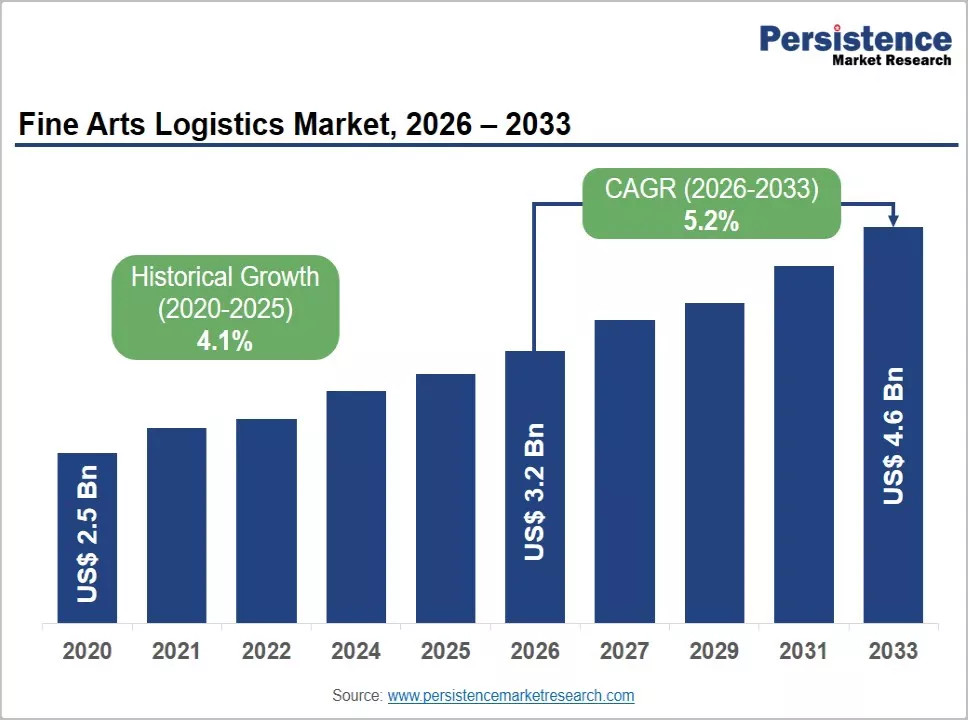
The global fine arts logistics market size is likely to be valued at US$ 3.2 billion in 2026, and is estimated to reach US$ 4.6 billion by 2033, growing at a CAGR of 5.2% during the forecast period 2026 - 2033.
Growth is underpinned by the rising value of art collections, the increasingly international nature of the art trade, and growing demand for secure, climate-controlled handling and storage.
The market has been experiencing steady growth, reflecting the resilience of high-value collecting despite periods of cautious transaction activity. However, the forecast period anticipates stronger expansion as online art sales, a busier global fair and exhibition calendar, and the entry of private equity-backed consolidators raise demand for specialized, technology-enabled services.
Key Industry Highlights
- Dominant Logistics Function: Transportation is set to command around 52% of the revenue share in 2026, while value-added services are likely to grow the fastest at 6.6% CAGR through 2033, as crating, installation, and condition reporting become integral to client expectations.
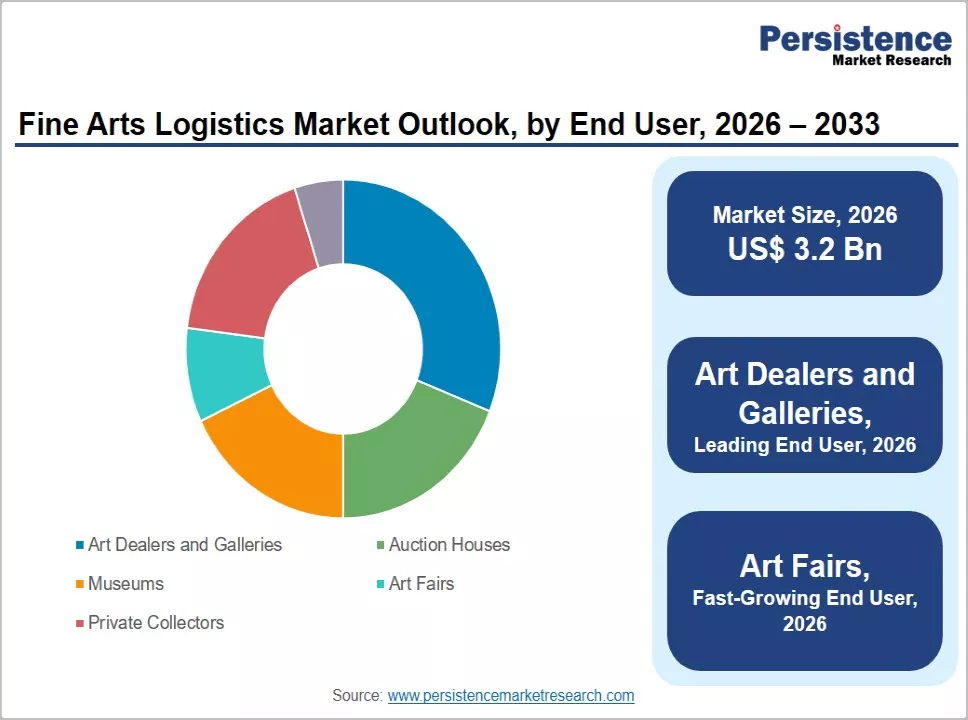
- Leading End Users: Art dealers and galleries are expected to lead with 31% in 2026, while private collectors are likely to be the fastest-growing at about 6.3% CAGR during 2026 - 2033, reflecting the growth of private collections and private museums.
- Dominant Transportation Mode: Road is anticipated to lead with an estimated 47% share in 2026, while air freight is slated to represent the fastest-growing mode at 5.9% CAGR from 2026 to 2033.
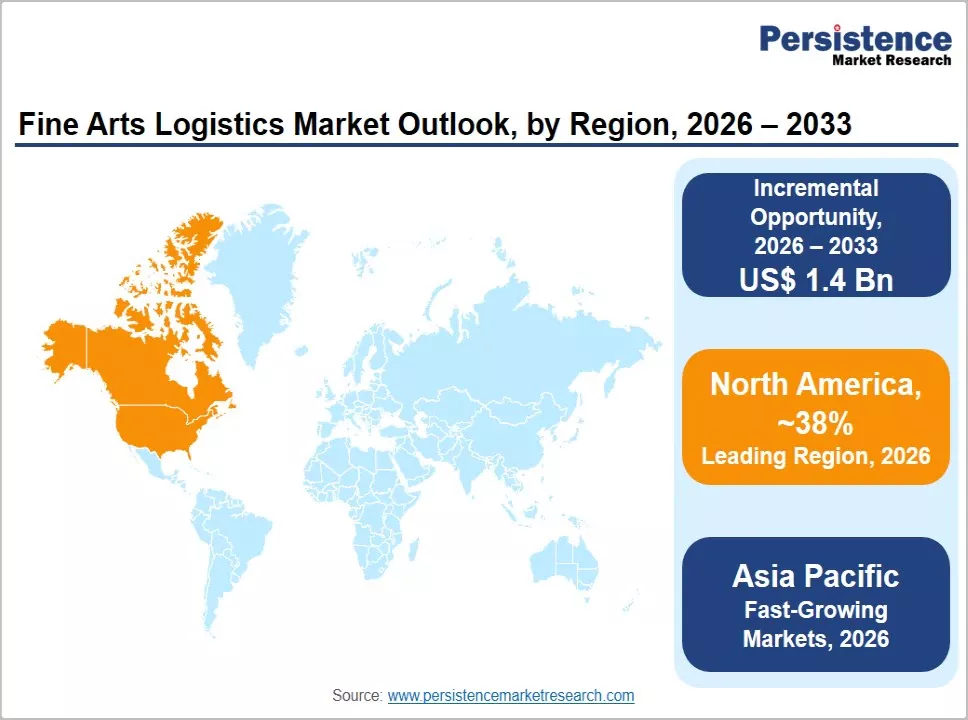
- Regional Leadership: North America is poised to dominate with an estimated 38% share in 2026, while Asia Pacific is projected to register the fastest growth at 6.9% CAGR through 2033, led by China, Singapore, and expanding Asian art hubs.
- Competitive Environment: Competitive dynamics include acquisitions by specialist providers, private equity-backed platform building, and expansion into emerging hubs such as the Middle East and the U.S. Sun Belt.
DRO Analysis
Drivers: Growing Art Trade Globalization and Collector Demand for Specialized Handling
The globalization of the art trade is the leading force driving the fine arts logistics market growth, as dealers, auction houses, and collectors move works across borders to reach buyers, exhibitions, and fairs. Art is treated as a long-term store of value and as part of wealth portfolios, which raises expectations for museum-grade packing, climate-controlled transit, secure storage, and documented chain of custody.
The expansion of online sales channels further increases shipment frequency, as buyers purchase works remotely and expect safe, trackable delivery. Customs brokerage, export licensing, and cultural property compliance add complexity, pushing owners toward specialist providers with technical and regulatory expertise rather than general freight forwarders.
Exhibition Calendars and Private Museum Growth
A busy calendar of biennials, art fairs, and traveling exhibitions generates recurring, time-sensitive shipments with demanding handling needs. Meanwhile, the growth of private museums and foundations in Asia, the Middle East, and North America is creating additional demand for installation support, storage, and collection management services.
Restraints: High Service Costs, Insurance Complexity, and Regulatory Friction
Fine arts logistics is a premium service, and costs for custom crating, climate-controlled storage, couriers, and insurance can be significant relative to shipment value for emerging artists and smaller galleries. Fluctuating air freight capacity and rising fuel and labor costs add further pressure. Cross-border movement is also complicated by customs procedures, import duties, and evolving trade policies, including tariffs, which can delay shipments and increase administrative burden for dealers and collectors who operate on tight exhibition schedules.
Fragmentation and Risk Exposure
The industry remains fragmented, with many small regional operators varying widely in standards, equipment, and security protocols. Damage, loss, and theft risks require specialized insurance and rigorous handling, and any incident can affect reputation and client trust. Skilled art handlers are also in limited supply, constraining capacity expansion during peak seasons.
Opportunities: Technology Adoption, Sustainable Crating, and Emerging Hub Expansion
Digitalization offers considerable room for differentiation. Real-time tracking, shock and humidity sensors, digital condition reporting, and registrar software are improving transparency and reducing claims. Providers are also developing reusable crates and lower-emission transport options in response to museum and gallery sustainability commitments. Expansion into growth hubs, such as Dubai, which has been attracting new storage and logistics facilities, and underserved U.S. cities such as Atlanta and Austin, creates opportunities to capture rising local demand for storage and handling services.
Consolidation and Service Integration
Acquisitions are enabling providers to build vertically integrated platforms that combine transportation, customs brokerage, crating, installation, and storage. This consolidation allows operators to offer end-to-end solutions across multiple countries, increases utilization of specialized facilities, and strengthens relationships with institutional clients, supporting sustained growth through 2033.
Category-wise Insights
Logistics Function Analysis
Why Does Transportation Lead the Fine Arts Logistics Market?
Transportation is the leading logistics function segment, expected to hold about 52% of the fine arts logistics market revenue share in 2026. It encompasses road, air, sea, and rail movement of artworks, supported by specialized vehicles, climate control, shock-absorbing crates, and trained couriers. Recurring demand from gallery shipments, auction consignments, loans, and fair participation keeps volumes steady, while the high value of each shipment supports premium pricing. Integration of customs brokerage and documentation services further strengthens the function’s revenue contribution.
Value-added services are likely to grow the fastest through 2033. These include crating, packing, installation, condition reporting, appraisal support, and collection management. Clients increasingly prefer single-provider solutions that reduce handoffs and risks, and providers are bundling services and registrar technology to deepen relationships. Museums and private collectors with large holdings are especially drawn to integrated services that connect storage, inventory, and exhibition logistics.
End User Analysis
Which End User Dominates Fine Arts Logistics?
Art dealers and galleries dominate the end user segment, projected to capture about 31% of the revenue share in 2026. Galleries ship works to fairs, clients, and exhibitions throughout the year, and rely on trusted providers for consistent handling and storage. Their purchasing is recurring and relationship-driven, providing stable demand. Growth in online viewing rooms and cross-border sales further increases shipment volumes, although smaller galleries remain sensitive to costs and tend to consolidate shipments.
Private collectors represent the fastest-growing end user segment, anticipated to achieve about 6.3% CAGR during the 2026 - 2033 period. Wealth creation, interest in art as an alternative asset, and the establishment of private museums are boosting demand for storage, relocation, and installation. Collectors increasingly use freeports and secure storage facilities, and seek services that combine handling, documentation, and insurance coordination, supporting higher spending per client.
Transportation Mode Analysis
Why Does Road Transportation Lead Fine Arts Movement?
Road transportation is poised to lead with an estimated 47% share in 2026, favored for its flexibility, door-to-door delivery, and suitability for climate-controlled, air-ride vehicles. Dense gallery and museum clusters across Europe and North America depend on trucking for domestic and regional shipments, including art fair circuits. Providers continue to invest in specialized fleets with tracking, security, and temperature control, though capacity and driver availability can limit growth.
Air freight is the fastest-growing mode in fine arts logistics, expected to register an approximate 5.9% CAGR through 2033. Speed is essential for time-sensitive consignments, international loans, and fair shipments, and air carriers offer dedicated handling for high-value cargo. Rising intercontinental trade between New York, London, Hong Kong, and Dubai supports demand, while sea and rail serve oversized works and cost-sensitive consignments at a smaller scale.
Regional Insights
North America Fine Arts Logistics Market Trends and Insights
North America is anticipated to account for an estimated 38% of the global fine arts logistics market in 2026. The region’s market is likely to benefit from a deep concentration of galleries, auction houses, museums, and high-net-worth collectors. New York remains the largest hub for art storage and logistics, and providers are expanding into secondary cultural centers. Consolidation is accelerating, with acquisitions strengthening regional networks and service depth. Competition among large integrated operators and specialist regional firms is expected to intensify through 2033.
U.S. Fine Arts Logistics Market Size
The U.S. is estimated to account for approximately 88% of the North America fine arts logistics market in 2026. Market growth is likely to be supported by active auction and gallery activity, private museum development, and rising demand for climate-controlled storage. Recent acquisitions by UOVO in Texas, Delaware, and the Eastern states, and by DIETL across key art markets, illustrate efforts to build national coverage. Customs brokerage expertise and compliance with import and export regulations are also anticipated to remain important differentiators.
Canada Fine Arts Logistics Market Size
Canada is projected to represent approximately 9% of the North America fine arts logistics market in 2026. Market expansion is expected to be driven by museum exhibitions, gallery activity in Toronto, Montreal, and Vancouver, and cross-border shipments with the U.S.. Growing private collections and public institution programs are likely to sustain demand for specialized transport and storage. Providers with integrated customs services and cross-border networks are anticipated to benefit from steady exhibition traffic through 2033.
Europe Fine Arts Logistics Market Trends and Insights
Europe is estimated to account for approximately 13% of the global fine arts logistics market in 2026. The region’s market is expected to benefit from a dense network of museums, fairs, and auction centers across London, Paris, Basel, and Brussels, alongside a strong tradition of specialist art handlers. Cross-border movement within Europe and between Europe and the U.S. sustains recurring demand. Providers are expanding warehouse capacity, as seen in new art storage facilities in Brussels and acquisitions in Antwerp. Regulatory complexity after Brexit continues to encourage use of specialists with customs expertise.
U.K. Fine Arts Logistics Market Size
The U.K. is anticipated to account for approximately 30% of the Europe fine arts logistics market in 2026. Demand is expected to be supported by London’s position as one of the world’s leading art trading centers, active auction calendars, and established storage and handling providers. Consolidation among providers, including acquisitions that expand storage and installation capacity, is likely to strengthen service offerings. Customs documentation for movements to and from the European Union and rising demand for climate-controlled storage are projected to support market expansion through 2033.
Why Is Asia Pacific Expected to Be the Fastest-Growing Region in the Fine Arts Logistics Market?
Asia Pacific is projected to account for approximately 21% of the global fine arts logistics market in 2026, with the region anticipated to register the fastest growth at an estimated CAGR of 6.9% through 2033. Market expansion is likely to be driven by wealth creation, the growth of private museums, and the emergence of Hong Kong, Singapore, and Shanghai as art trading and storage centers. Art fairs and international exhibitions in the region are increasing cross-border shipments, while demand for secure freeport storage is rising.
China Fine Arts Logistics Market Size
China is estimated to represent approximately 36% of the Asia Pacific fine arts logistics market in 2026. The country’s market is expected to benefit from a growing base of collectors, new private and public museums, and active auction markets in Hong Kong, Beijing, and Shanghai. Rising imports of Western and contemporary works and increasing outbound exhibition loans are likely to raise demand for customs brokerage, secure transport, and installation services. Investment in climate-controlled storage near major cities is projected to support China’s regional leadership through 2033.
Singapore Fine Arts Logistics Market Size
Singapore is projected to account for approximately 14% of the Asia Pacific fine arts logistics market in 2026. The market is expected to witness steady expansion, supported by its status as a regional trading and storage hub, free trade zone advantages, and a growing calendar of art fairs and exhibitions. Government support for cultural development and the concentration of wealth management activity are likely to encourage demand for secure storage, transport, and collection management services serving collectors across Southeast Asia.
Competitive Landscape
The global fine arts logistics market structure is fragmented but consolidating, with leading providers, including UOVO, DIETL, Crozier, and Cadogan Tate, holding a significant share of the high-value, institutional segment. These established players leverage specialized facilities, global networks, and trusted relationships with museums, galleries, and auction houses. They are also known to invest in climate-controlled storage, tracking technologies, and registrar software to maintain service leadership.
Regional and niche competitors such as Hasenkamp Group, Masterpiece International, Gander & White, and Momart are focusing on specialized services and geographic strongholds. Barriers such as handling expertise, customs licensing, and facility investment limit new entrants, while private equity backing is accelerating acquisitions. Market consolidation is expected to increase gradually as larger providers acquire local specialists to broaden geographic reach and build vertically integrated platforms.
Key Market Developments
- In November 2026, UOVO acquired Bonsai Fine Arts, a fine art crating, transportation, installation, and storage provider, strengthening its Eastern U.S. network and establishing a presence in Atlanta.
- In June 2026, Maxwell Street Capital Partners invested in Masterpiece International, which partnered with Boxart to form Masterpiece Group, a vertically integrated fine art logistics platform combining transportation and local services.
- In January 2026, DIETL, a division of The Rock-It Company, acquired Delaware Freeport, Delaware National Art Company, Techno Export, and Registrar Technologies to expand its storage, customs brokerage, and technology-enabled services.
Companies Covered in Fine Arts Logistics Market
- UOVO
- DIETL (The Rock-It Company)
- Crozier Fine Arts (Iron Mountain Incorporated)
- Cadogan Tate
- Hasenkamp Group
- Masterpiece International
- Boxart
- Gander & White Shipping
- Momart
- Convelio
Frequently Asked Questions
The global fine arts logistics market is valued at US$ 3.2 billion in 2026 and is projected to reach US$ 4.6 billion by 2033, expanding at a CAGR of 5.2% during 2026 - 2033.
The rising value of art collections, the globalization of the art trade, and growing demand for secure, climate-controlled handling and storage are driving the market.
Transportation leads logistics functions with about 52% share, art dealers and galleries lead end users with about 31%, and road leads transportation modes with an estimated 47% in 2026.
North America dominates with an estimated 38% share in 2026, supported by a deep concentration of galleries, auction houses, and collectors, while Asia Pacific is projected to grow fastest at 6.9% CAGR through 2033.
Technology adoption, sustainable crating, expansion into emerging hubs, and service integration through acquisitions are key market opportunities.
The market is fragmented but consolidating, with UOVO, DIETL, Crozier, and Cadogan Tate holding a significant share of the high-value institutional segment.


