




- Transportation & Logistics
- Recreational Vehicle Rental Market
Recreational Vehicle Rental Market Size, Share, and Growth Forecast 2026–2033
Recreational Vehicle Rental Market by Supplier Type (Private and Individual Owners, Fleet Operators), Booking Type (Offline, Online Booking), Product Type (Motorized RVs and Towable RVs), Rental Duration (Short-Term, Mid-Term, Long-Term), and Regional Analysis, 2026–2033

Recreational Vehicle Rental Market Size and Trend Analysis
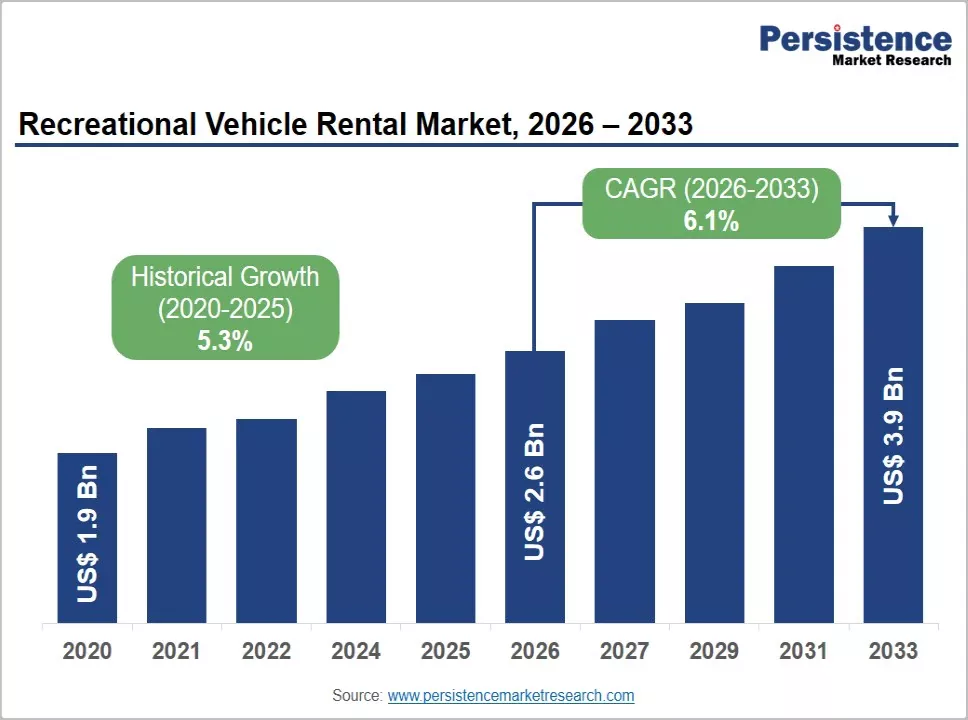
The global recreational vehicle rental market size is likely to be valued at US$ 2.6 billion in 2026, and is estimated to reach US$ 3.9 billion by 2033, growing at a CAGR of 6.1% during the forecast period 2026–2033. Growth is underpinned by the rising preference for flexible, nature-based travel, the expansion of peer-to-peer rental platforms, and increasing interest in extended trips enabled by remote work.
The market has been experiencing moderate growth, reflecting seasonal demand patterns and the high cost of vehicle ownership and insurance. However, the forecast period anticipates steady acceleration as online marketplaces broaden inventory, operators introduce one-way and packaged trips, and travelers seek affordable alternatives to hotels in popular destinations.
Key Industry Highlights
- Dominant Supplier Type: Fleet operators are set to command around 57% of the revenue share in 2026, while private and individual owners are likely to grow the fastest at 7.2% CAGR through 2033, as peer-to-peer platforms widen vehicle availability.
- Leading Booking Type: Online booking is expected to lead with 69% in 2026 and is likely to remain the fastest-growing channel at about 6.8% CAGR during 2026–2033, reflecting mobile-first reservations and transparent pricing.
- Dominant Product Type: Motorized RVs are anticipated to lead with an estimated 61% share in 2026, while towable RVs are slated to represent the fastest-growing product type at 6.7% CAGR from 2026 to 2033.
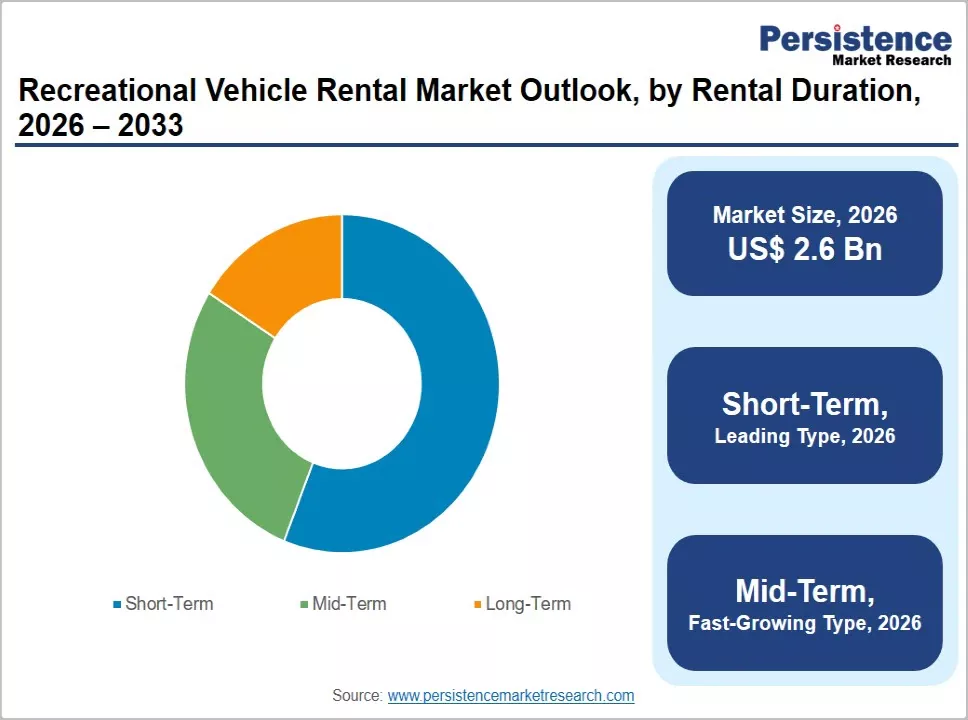
- Top Rental Duration: Short-term rentals are poised to hold around 64% share in 2026, whereas mid-term rentals are likely to register the fastest growth at 7.4% CAGR through 2033, supported by remote work and extended vacations.
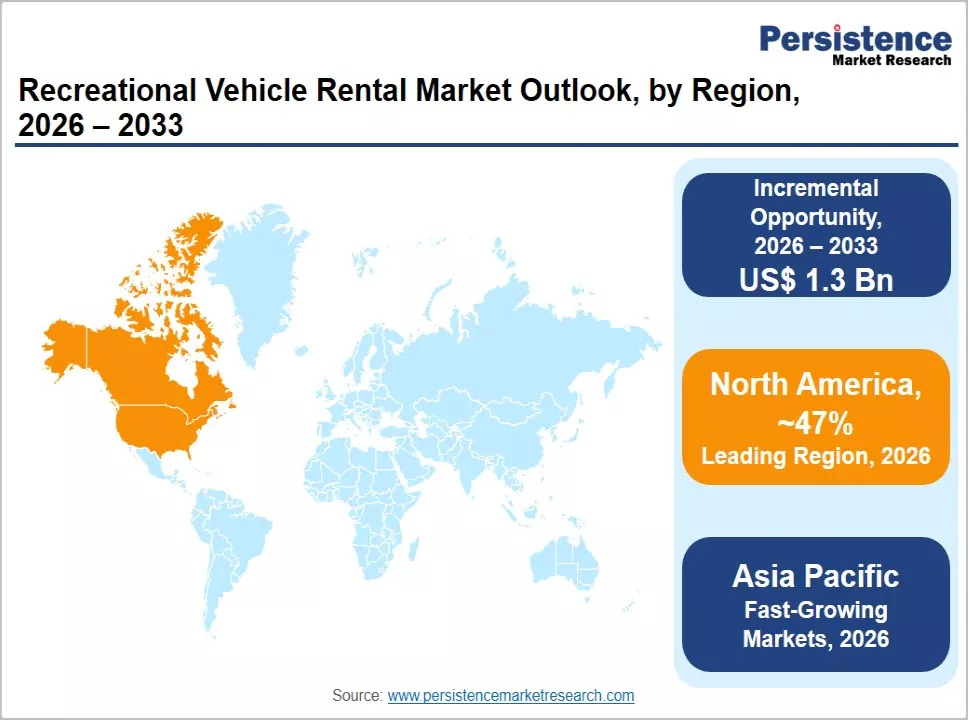
- Regional Leadership: North America is poised to dominate with an estimated 47% share in 2026, while Asia Pacific is expected to register the fastest growth at 7.6% CAGR through 2033, led by Australia and Japan.
- Competitive Environment: Competitive dynamics include one-way rental launches, packaged national park trips, strategic partnerships with campgrounds, and platform expansion into owned campgrounds and glamping.
DRO Analysis
Drivers: Experiential Travel Demand and Peer-to-Peer Platform Growth as Primary Growth Catalyst
Growing demand for flexible, experience-led travel is the leading force driving the recreational vehicle rental market growth, as travelers seek greater control over itineraries, accommodation, and costs. RV travel offers a combination of transport and lodging, which can be significantly cheaper than hotel stays for families and groups, and allows access to national parks, coastlines, and remote areas.
Online marketplaces connect owners with renters, expanding inventory beyond traditional fleets and improving price transparency, insurance coverage, and delivery options. Domestic tourism strength, record visitation to national parks, and major events in 2026 are boosting reservations, with leading platforms reporting double-digit increases in summer bookings.
Remote Work, One-Way Trips, and Packaged Experiences
Remote and hybrid work has extended the average trip length, supporting mid-term rentals for workcations and seasonal stays. Operators are responding with one-way rentals, national park packages, and personal rental advisors to simplify planning for first-time travelers.
This convergence of lifestyle change, digital convenience, and product innovation ensures sustained growth in the recreational vehicle rental market in the coming years. Platforms are also adding mobile apps, digital check-in, and roadside assistance to improve the first-time renter experience.
Restraints: High Operating Costs and Seasonality and Damage Management
High operating costs remain a major challenge for the recreational vehicle rental market. Fuel prices, insurance premiums, maintenance, cleaning, storage, and depreciation raise the cost base for fleet operators and individual owners, and these costs are often passed on to renters.
Demand is also strongly seasonal, with peak periods in summer and holidays and low utilization in winter, which makes fleet planning and profitability difficult. Operators must manage idle capacity while maintaining vehicles and staff throughout the year.
Campground Capacity, Complexity of Use, and Regulatory Barriers
Limited availability of campsites in popular destinations, parking restrictions, and rising camping fees can reduce the attractiveness of RV trips. First-time renters may also be concerned about driving large vehicles, handling hookups, and breakdown risk, which restrains conversion among new customers. Regional differences in licensing rules, vehicle size limits, and insurance requirements add compliance complexity for cross-border operators and peer-to-peer platforms.
Opportunities: Electrification, Mid-Term Rentals, and Campground Partnerships
Electric and hybrid campervans, lightweight towable trailers, and smart connected RVs are opening new opportunities as travelers look for lower-emission options and easier driving. Fleet operators and platforms can also expand into mid-term and long-term rentals for remote workers, snowbirds, and people between homes, increasing utilization during off-peak seasons. Integration of campground booking, insurance, and delivery and setup services into a single app creates additional revenue streams beyond rental fees.
International Tourism Recovery and Emerging Destinations
The recovery of international tourism in Europe, Australia, New Zealand, and Japan is expanding demand from visitors who prefer self-drive holidays. Emerging markets in Asia Pacific, the Middle East, and Latin America are developing camping infrastructure, creating greenfield opportunities for operators and platforms. Partnerships with campgrounds, tourism boards, and outdoor brands, along with giveaway and loyalty campaigns, are improving customer acquisition and brand visibility.
Category-wise Insights
Supplier Type Analysis
Why Do Fleet Operators Lead the Recreational Vehicle Rental Market?
Fleet operators are the leading supplier type segment, expected to hold about 57% of the recreational vehicle rental market revenue share in 2026. Companies that own and maintain their vehicles offer consistent quality, standardized insurance, roadside assistance, and multiple pick-up locations, which appeal to international tourists and first-time renters. Large operators benefit from bulk purchasing, in-house maintenance, and negotiated insurance rates, enabling competitive pricing and high service reliability. Their presence at airports and tourist hubs, along with corporate and tourism partnerships, secures a stable base of bookings.
Private and individual owners are likely to grow the fastest through 2033 at about 7.2% CAGR. Peer-to-peer platforms allow owners to rent out vehicles when not in use, offsetting ownership costs and giving renters access to a wide range of motorhomes, campervans, and trailers, often at lower prices than fleet rentals. Platform-provided insurance, host support, and delivery services are reducing risk and improving trust. Growing interest in RV ownership as an income source, along with data and management tools offered to hosts, is strengthening supply.
Booking Type Analysis
Why Does Online Booking Lead Recreational Vehicle Rental Channels?
Online booking is the leading booking type segment, projected to capture about 69% of the revenue share in 2026. Travelers use websites and mobile apps to compare vehicle types, read reviews, check availability, and complete reservations in minutes. Peer-to-peer marketplaces operate entirely online, and fleet operators increasingly route most reservations through direct digital channels and travel aggregators. Dynamic pricing, instant booking, digital check-in, and integrated insurance purchase improve conversion and operational efficiency, supporting steady growth at about 6.8% CAGR through 2033.
Offline booking, which includes phone reservations, travel agents, dealership counters, and walk-in rentals, continues to play a role for older customers, group tours, and complex multi-week itineraries that require personal guidance. Some platforms are adding advisor teams to bridge digital and personal service, helping new renters choose vehicle types and delivery options. Although the offline share is gradually declining, hybrid models that combine online booking with human support are expected to remain important for customer confidence.
Product Type Analysis
Which Product Type Dominates Recreational Vehicle Rental?
Motorized RVs dominate the product type segment, projected to account for about 61% of the revenue share in 2026. This category includes Class A, Class B, and Class C motorhomes and campervans that combine driving and living space in a single vehicle, which is attractive for renters without a suitable tow vehicle. Motorized RVs allow quick setup, easy movement between destinations, and, in the case of campervans, urban access and simple parking. Premium pricing and strong tourist demand in North America, Europe, and Australia support higher revenue per rental.
Towable RVs, including travel trailers and fifth wheels, represent the fastest-growing product type, anticipated to achieve 6.7% CAGR during the 2026–2033 period. Lower daily rates, larger living space for families, and the ability to leave the trailer at a campsite while exploring with the tow vehicle make them appealing for budget-conscious travelers. Delivery and setup services, in which owners or operators tow and position the trailer at a destination campground, remove the need for towing experience and are expanding the addressable customer base.
Rental Duration Analysis
Why Do Short-Term Rentals Lead Rental Duration?
Short-term rentals are the leading rental duration segment, expected to hold about 64% of the market in 2026. Weekend getaways, week-long family vacations, festivals, and sporting events drive the majority of bookings, supported by flexible cancellation, packaged itineraries, and national park access. Seasonal demand peaks in summer and school holidays, and major events such as global sporting tournaments and anniversaries are expected to raise utilization in selected markets, with operators reporting year-over-year growth in reservations.
Mid-term rentals are the fastest-growing segment, expected to register about 7.4% CAGR through 2033. Rentals of several weeks to a few months serve remote workers, retirees, and travelers who combine tourism with extended stays, and they improve fleet utilization during shoulder seasons. Long-term rentals, covering stays of several months or more, remain a niche but growing option for people who are between homes, relocating, or testing RV living before purchase, and they offer operators predictable revenue with lower turnover and cleaning costs.
Regional Insights
Why Is North America Expected to Lead the Recreational Vehicle Rental Market?
North America is projected to account for approximately 47% of the global recreational vehicle rental market in 2026, making it the largest regional market. The region's RV rental industry is likely to benefit from a deep-rooted road trip culture, an extensive network of national parks and campgrounds, and the presence of the world's largest peer-to-peer RV marketplaces. National parks drew more than 325 million visits in 2025, and 2026 events such as the FIFA World Cup, the U.S.' 250th anniversary, and the Route 66 centennial are expected to lift demand. Competition among fleet operators and online platforms is also expected to intensify through 2033.
U.S. Recreational Vehicle Rental Market Size
The U.S. is estimated to account for approximately 83% of the North America recreational vehicle rental market in 2026. Market growth is likely to be supported by strong domestic travel, wide availability of RVs among private owners, and the expansion of online marketplaces. One platform reported a 15% year-over-year increase in reservations for summer 2026, driven by major national events, while another has introduced one-way rentals and national park packages to simplify planning. Rising hotel costs and interest in outdoor travel are anticipated to support demand through 2033.
Canada Recreational Vehicle Rental Market Size
Canada is projected to represent approximately 17% of the North America recreational vehicle rental market in 2026. Market expansion is expected to be driven by domestic travel to provincial and national parks, strong summer tourism, and the growth of Canadian peer-to-peer platforms that connect private owners with renters. Cross-border travel from the U.S. and international visitors to the Rockies, British Columbia, and the Maritimes are also likely to support fleet operators. Mid-term rentals for retirees and seasonal travelers are anticipated to gain traction through 2033. Rising interest in glamping and campground packages is also expected to complement vehicle rentals.
Europe Recreational Vehicle Rental Market Trends and Insights
Europe is estimated to account for approximately 10% of the global recreational vehicle rental market in 2026. The region's market is expected to benefit from a strong campervan culture, well-developed campsite networks, and the rise of European-born digital rental platforms that cater to millennial and family travelers. Cross-border road trips, one-way rentals between countries, and growing interest in compact campervans suitable for narrow roads are likely to support demand. Sustainability preferences are also encouraging operators to introduce hybrid and electric camper models. Digital nomad travel and festival tourism are also supported by relaxed attitudes toward vehicle-based accommodation.
Germany Recreational Vehicle Rental Market Size
Germany is anticipated to account for approximately 27% of the Europe recreational vehicle rental market in 2026. Demand is expected to be supported by one of Europe's largest caravan and motorhome ownership bases, a strong domestic camping culture, and home-grown rental brands headquartered in the country. German operators are expanding digital booking, station networks, and cross-border services, while campsite infrastructure and growing interest in vanlife are projected to support market growth through 2033. Rental stations located near airports and major cities are likely to remain central to international visitor demand.
Why Is Asia Pacific Expected to Register the Fastest Growth in the Recreational Vehicle Rental Market?
Asia Pacific is projected to account for approximately 13% of the global recreational vehicle rental market in 2026, and is anticipated to register the fastest growth, expanding at an estimated CAGR of 7.6% through 2033. Market expansion is likely to be driven by rising disposable incomes, the development of camping infrastructure, and growing interest in self-drive and outdoor travel. Australia and Japan are expected to remain the primary demand centres, while New Zealand, South Korea, and China are building awareness of campervan and glamping travel.
Australia Recreational Vehicle Rental Market Size
Australia is estimated to represent approximately 43% of the Asia Pacific recreational vehicle rental market in 2026. The country's market is expected to benefit from long-distance touring routes, a strong grey nomad and backpacker culture, and the return of international visitors. Established operators with multiple brands compete alongside peer-to-peer platforms, offering vehicles ranging from budget campervans to premium motorhomes. Government tourism campaigns and demand for outback and coastal road trips are projected to sustain Australia's regional leadership through 2033. Seasonal demand during the southern summer typically leads operators to expand fleets and relocation offers.
Japan Recreational Vehicle Rental Market Size
Japan is projected to account for approximately 21% of the Asia Pacific recreational vehicle rental market in 2026. The market is expected to witness steady expansion, supported by growing interest in domestic travel, camping, and remote-work stays in rural regions. Compact camper vehicles suited to narrow roads are popular among domestic and visiting travelers, and rental operators are adding online reservation systems and partnerships with campsites. Rising inbound tourism is also likely to encourage rental offerings aimed at international visitors through 2033.
Competitive Landscape
The global recreational vehicle rental market structure is moderately fragmented, with peer-to-peer platforms such as Outdoorsy, RVshare, and RVezy and fleet operators including Cruise America, El Monte RV, and Tourism Holdings controlling around 35% of the revenue share. These established players have been leveraging extensive vehicle inventory, brand recognition, insurance partnerships, and large digital audiences. They are also known to invest in technology to improve booking experience, dynamic pricing, and host support. Insurance providers and campground networks are also becoming strategic partners in shaping customer trust and platform loyalty.
Regional and niche competitors such as Roadsurfer, Indie Campers, McRent, Jucy, and Escape Campervans are focusing on campervan segments, European and Australasian touring routes, and younger travelers. Barriers such as fleet capital requirements, insurance, and location networks limit new entrants, while peer-to-peer models lower asset requirements for platforms. Market consolidation is expected to increase gradually as larger players acquire regional operators and platforms expand into campgrounds, insurance, and fleet management services.
Key Market Developments
- In July 2026, Streamside RV Resorts & Campgrounds partnered with Outdoorsy and Charbroil on a nationwide travel giveaway offering premium RV rental credits covering four-night stays.
- In summer 2026, Outdoorsy reported a 15% year-over-year increase in reservations, driven by the FIFA World Cup, the U.S.' 250th anniversary, and the Route 66 centennial.
- In 2026, RVshare introduced one-way rentals, national park getaway packages, and a dedicated RV Rental Advisor team to provide flexible and turnkey RV travel options.
Companies Covered in Recreational Vehicle Rental Market
- Outdoorsy, Inc.
- RVshare, LLC
- RVezy
- Cruise America, Inc.
- El Monte RV
- Tourism Holdings Limited (thl)
- Roadsurfer GmbH
- Indie Campers
- McRent Europe GmbH
- Jucy Group
- Escape Campervans
Frequently Asked Questions
The global recreational vehicle rental market is valued at US$ 2.6 billion in 2026 and is projected to reach US$ 3.9 billion by 2033, expanding at a CAGR of 6.1% during 2026–2033.
The rising preference for flexible, nature-based travel, the expansion of peer-to-peer rental platforms, and increasing interest in extended trips enabled by remote work are driving the market.
Fleet operators lead supplier types with about 57% share, online booking leads booking types with about 69%, motorized RVs lead product types with about 61%, and short-term rentals lead durations with about 64% in 2026.
North America dominates the market with an estimated 47% share in 2026, supported by road trip culture and extensive park networks, while Asia Pacific is projected to grow fastest at 7.6% CAGR through 2033.
Electric and hybrid campervans, mid-term rentals for remote workers, integrated campground and insurance services, and emerging camping destinations are key market opportunities.


