




- Transportation & Logistics
- Fourth Party Logistics Market
Fourth Party Logistics Market Size, Share, and Growth Forecast 2026–2033
Fourth Party Logistics Market by Type (Synergy Plus Operating Model, Solution Integrator Model), End User (Aerospace & Defense, Automotive, Consumer Electronics, Food and Beverages, Industrial, Retail, Healthcare), and Regional Analysis, 2026–2033

fourth party logistics market Size and Trend Analysis
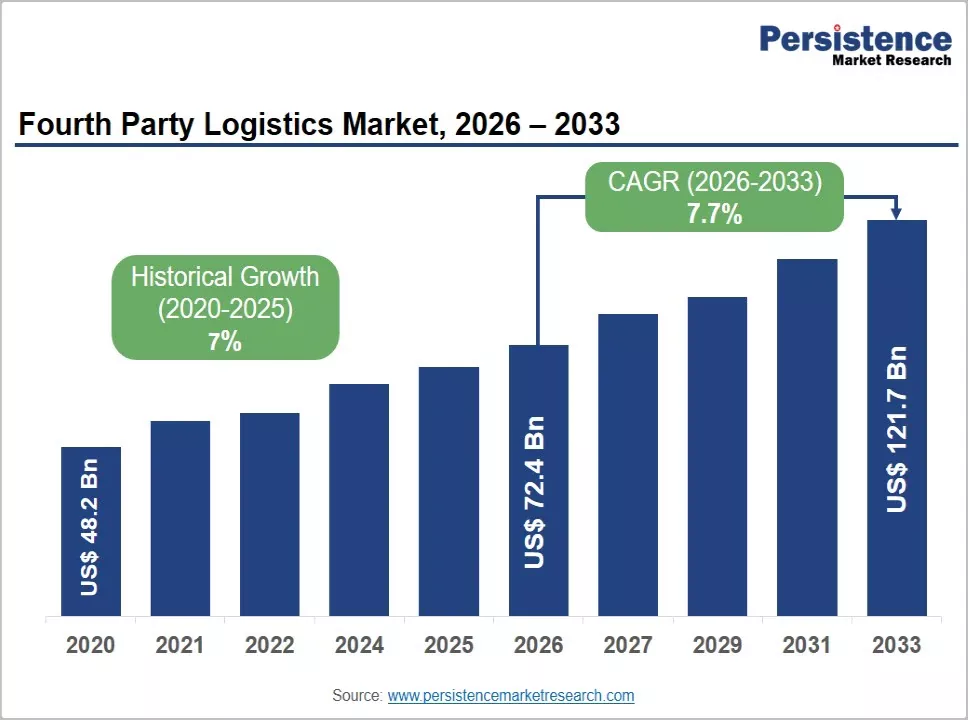
The global fourth party logistics (4PL) market size is likely to be valued at US$ 72.40 billion in 2026 and is projected to reach US$ 121.70 billion by 2033, growing at a CAGR of 7.7% during the forecast period between 2026 and 2033. Shippers are consolidating fragmented logistics networks under a single orchestrating partner as tariff realignments, Red Sea diversions around the Cape of Good Hope, and volatile freight rates expose the limits of transactional, carrier-by-carrier procurement.
This trajectory reflects a structural shift from asset-heavy execution toward data-led supply chain governance, in which 4PL providers own the control tower, the carrier panel, and the performance analytics on behalf of the client. Demand is further reinforced by regulatory reporting obligations on supply chain emissions, which reward providers able to consolidate shipment data across modes and geographies, a dynamic that favors technology-led integrators with proven multi-region delivery capability.
Key Industry Highlights
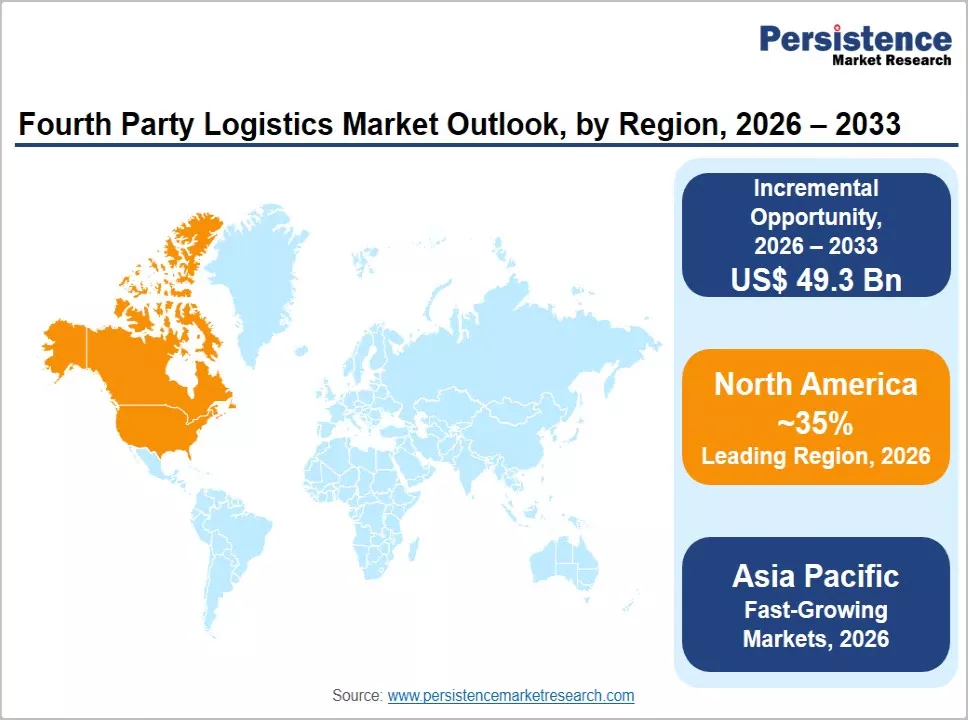
- Dominant Region: North America is forecast to dominate the regional market, hold about 35% market share in 2026. A deep base of multinational shippers, advanced transportation management system adoption, and tariff-driven network redesign are collectively sustaining demand for managed, outsourced supply chain orchestration, a position the region is expected to retain through 2033.
- Fastest-growing Region: Growing at a CAGR of 9.3%, Asia Pacific is outpacing every other region in the fourth party logistics industry. India’s National Logistics Policy, China’s cross-border e-commerce expansion, and the regional relocation of manufacturing capacity are jointly lifting demand for integrated supply chain management across Southeast and South Asia.
- Dominant Type: Solution integrator model hold 46% of market share in 2026, as it allows providers to assemble carriers, warehousing partners, and technology platforms into a single accountable service. Its leadership is structurally stable because it delivers outsourcing benefits without requiring the client to transfer ownership of its in-house logistics assets.
- Fastest-growing Type: Industry innovator model is gaining share rapidly as healthcare, automotive, and consumer electronics clients seek sector-specific expertise and shared networks that lower cost-to-serve through collaboration among competing shippers.
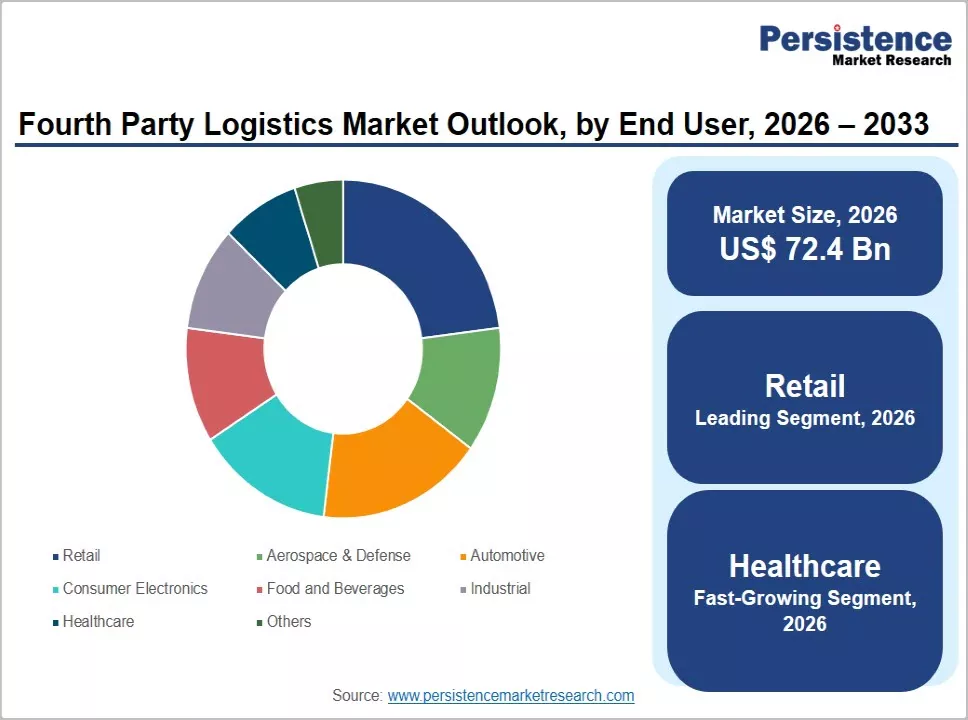
- Top End User: Retail account for around 23% of the end-user segment in 2026, while healthcare is expected to expand fastest as temperature-controlled and compliance-intensive flows migrate to orchestrated models.
DRO Analysis
Driver- Escalating Supply Chain Complexity and Trade Policy Volatility
Multinational shippers now manage a web of carriers, forwarders, customs brokers, and warehouse operators across dozens of lanes, while trade policy shifts, including the tariff changes introduced by the U.S. in 2025, force repeated network redesign. Uber Freight reported in September 2026 that its North American customers want fewer logistics partners across their global operations, and that the company doubled the number of new 4PL deals won in Europe during 2025.
Maersk’s acquisitions of LF Logistics and Pilot Freight Services in 2022 signaled the same logic from the carrier side, building end-to-end integrated offerings that can be bundled with orchestration services. The resulting demand for a single accountable partner, able to rebalance sourcing and routing within days rather than quarters, is the most durable growth driver in the sector.
Restraint- Control, Data Ownership, and Integration Concerns
Handing over procurement and planning authority remains a significant adoption barrier. Many shippers worry about a loss of visibility into carrier rates, dependence on a single provider, and conflicts of interest when the 4PL belongs to a group that also operates 3PL or freight forwarding businesses.
Integration with legacy enterprise resource planning and transportation management systems is costly and slow, and multi-year contracts with demanding service-level penalties make exit expensive. These frictions disproportionately affect mid-sized shippers, which lack the internal governance capacity to supervise an orchestrator and often default to simpler 3PL arrangements.
Opportunity- AI-Enabled Control Towers and Healthcare Supply Chain Orchestration
Artificial intelligence is turning 4PL from a coordination service into a decision engine, with predictive ETAs, automated carrier allocation, and exception management at scale. Redwood Logistics’ inaugural AI in Logistics Report, released in May 2026, found that only 13 percent of shippers deploying AI were generating quantifiable results, which underscores the size of the gap that integrators with mature data platforms can close. In parallel, pharmaceutical and medical device shippers facing EU Good Distribution Practice requirements and serialization mandates are seeking orchestrators capable of end-to-end cold chain compliance, creating a premium-margin niche for providers with validated healthcare networks.
Category-wise Analysis
Type Insights
Why Does the Solution Integrator Model Dominate the Fourth Party Logistics Market?
Solution Integrator Model is projected to account for nearly 46% of market share in 2026, as it combines the 4PL’s own consulting and technology capabilities with those of third-party carriers and 3PLs to design, build, and run the client’s supply chain as a single contracted solution. Clients value the single point of accountability: one contract, one performance dashboard, and one party responsible for cross-docking, last-mile, and customs outcomes. Global integrators such as Deutsche Post DHL, Kuehne + Nagel, and CEVA Logistics leverage their owned contract logistics and forwarding relationships to staff these programs, which reinforces buyer confidence in delivery continuity.
Industry Innovator Model is likely to be the fastest-growing type, driven by sector-specific consortia in which a 4PL pools volumes from several shippers in the same industry to unlock shared warehousing, pooled transport, and benchmark data. The model is gaining traction in automotive, consumer electronics, and healthcare, where shippers face identical inbound and regulatory challenges and see more value in collaboration than in competing on logistics cost.
End User Insights
What Is Driving 4PL Adoption Across Retail and Healthcare?
Retail is estimated to lead the end-user segment, capturing nearly 23% of market share in 2026, driven by omnichannel fulfilment complexity, seasonal volume peaks, and a growing share of returns handled through reverse logistics networks. Retailers sourcing across Asia, Europe, and North America use 4PL partners to orchestrate inbound container flows, regional distribution, and store replenishment under a unified control tower, with the provider absorbing the labor of carrier tendering and exception handling. Automotive and industrial clients follow closely, favoring 4PL contracts that coordinate just-in-time parts flows across multi-tier supplier networks.
Healthcare is likely to be the fastest-growing end user, propelled by temperature-controlled biologics, clinical trial supply, and medical device distribution, all of which demand audit-ready visibility and regulatory compliance across borders. Providers with validated cold chain networks and pharmaceutical expertise are capturing disproportionate share as drug manufacturers outsource planning rather than merely transport.
Regional Insights
North America Fourth Party Logistics Market Trends and Insights
North America is forecast to dominate the regional market, capturing nearly 35% of market share in 2026, propelled by the concentration of large multinational shippers, mature transportation management software adoption, and an active managed-transportation ecosystem. Tariff volatility and the continued relocation of sourcing toward Mexico under USMCA are prompting shippers to rebuild cross-border networks, creating sustained demand for orchestrators that can redesign lanes and carrier panels quickly. Through 2033, AI-enabled control towers and consolidation of carrier relationships will remain the primary growth levers.
U.S. Fourth Party Logistics Market Size
The U.S. is projected to hold about 87% of the North America regional market in 2026. Providers such as Uber Freight, which built its managed-transportation franchise through the acquisition of Transplace, and Redwood Logistics are expanding technology-led 4PL offerings for mid-market and enterprise shippers. Persistent freight-rate volatility and the push to digitize procurement will sustain this momentum through 2033.
Canada Fourth Party Logistics Market Size
Canada is likely to command about 13% of the North America regional market in 2026. Demand is anchored by cross-border trade with the U.S., resource-sector supply chains, and port-to-inland corridors through Vancouver, Prince Rupert, and Montréal. Trade tensions with the U.S. and the push to diversify export destinations are encouraging Canadian manufacturers to adopt orchestrators capable of managing multi-market distribution.
Europe Fourth Party Logistics Market Trends and Insights
Europe is estimated to account for around 18% of market share in 2026, with a dense industrial base, multi-country distribution complexity, and tightening sustainability regulation reinforcing the case for orchestration. The Corporate Sustainability Reporting Directive and the definitive phase of the Carbon Border Adjustment Mechanism, which began in January 2026, are compelling shippers to track emissions and embedded carbon across supply chains, favoring 4PL providers with consolidated multimodal data. Uber Freight’s September 2026 decision to expand its European 4PL operations, with a second hub in Kraków, Poland, illustrates how global entrants are targeting the region.
Germany Fourth Party Logistics Market Size
Germany is projected to account for nearly 22% of the Europe regional market in 2026. As the continent’s largest logistics market and a manufacturing powerhouse in automotive, machinery, and chemicals, Germany generates complex inbound and outbound flows suited to orchestrated models. The completion of DSV’s acquisition of DB Schenker in April 2025 is reshaping the competitive landscape and creating opportunities for shippers to re-tender integrated logistics programs.
U.K. Fourth Party Logistics Market Size
The U.K. is expected to command nearly 18% of the Europe regional market in 2026. Post-Brexit customs formalities and the phased Border Target Operating Model have added documentation and inspection complexity to EU trade, raising the value of orchestrators with in-house brokerage and compliance expertise. A mature e-commerce sector further supports demand for integrated fulfilment and returns management.
Which Region Will Drive the Fastest Fourth Party Logistics Growth Through 2033?
Asia Pacific is likely to be the fastest-growing region during the forecast period between 2026 and 2033, expanding at a CAGR of 9.3% in 2026. Manufacturing diversification into Vietnam, India, and Indonesia, together with rising intra-Asia trade and cross-border e-commerce, is multiplying the number of lanes that shippers must coordinate. Governments are also investing in logistics infrastructure and digital trade platforms, lowering barriers for integrators that can connect fragmented local providers.
China Fourth Party Logistics Market Size
China is anticipated to hold around 38% of the Asia Pacific regional market in 2026. The country’s position as the world’s largest exporter and a leading e-commerce market creates dense multimodal flows that benefit from orchestration, particularly for consumer electronics and automotive supply chains relocating part of their capacity to Southeast Asia. Domestic logistics platforms and global integrators are competing to provide cross-border visibility and customs coordination.
India Fourth Party Logistics Market Size
India is forecast to account for nearly 14% of the Asia Pacific regional market in 2026 and is the region’s fastest-growing national market. The National Logistics Policy of 2022, the PM Gati Shakti master plan, and the Unified Logistics Interface Platform are digitizing freight movement and encouraging manufacturers and retailers to outsource planning to technology-led providers, supporting robust double-digit growth through 2033.
Competitive Landscape
The global fourth party logistics market is moderately consolidated at the top, with a tier of global logistics groups including Deutsche Post DHL, Kuehne + Nagel, DB Schenker, CEVA Logistics, and Maersk competing on network breadth, contract logistics capability, and the maturity of their control tower platforms. Below this tier, specialist and technology-led providers such as 4PL Group (Pty) Ltd, Allyn International Services, Inc., and Global 4PL Supply Chain Services compete on vendor neutrality, industry-specific expertise, and flexible commercial models, while XPO Logistics and GEFCO Group participate through freight and automotive logistics strengths. Competitive differentiation increasingly turns on three variables: the quality of data and AI-driven analytics, the depth of independent carrier networks, and the credibility of the provider’s neutrality in carrier and 3PL selection.
Key Industry Developments
- In November 2026, Global Trade Magazine highlighted the growing adoption of artificial intelligence (AI) and digital technologies in fourth-party logistics (4PL) operations as companies sought to improve supply chain coordination and visibility. The article emphasized how 4PL providers increasingly integrated transportation, warehousing, inventory management, procurement, and distribution through centralized digital platforms. AI-powered predictive analytics and digital control towers helped logistics operators monitor shipments, identify potential disruptions, evaluate alternative transportation routes, and optimize inventory allocation.
- In May 2026, 4flow launched optaire, an AI-native platform designed to optimize end-to-end supply chain and logistics operations. The company unveiled the platform at the Gartner Supply Chain Symposium/Xpo 2026 in Orlando, Florida. The platform integrated artificial intelligence across logistics, supply chain network planning, and risk and disruption management to help businesses identify potential disruptions, develop alternative plans, and execute decisions in real time. Its modular architecture enabled organizations to address specific operational challenges and develop customized solutions.
Companies Covered in Fourth Party Logistics Market
- 4PL Group (Pty) Ltd
- Allyn International Services, Inc.
- CEVA Logistics
- Global 4PL Supply Chain Services
- Deutsche Post DHL
- Kuehne + Nagel
- DB Schenker
- Maersk
- XPO Logistics
- GEFCO Group
Frequently Asked Questions
The global fourth party logistics (4PL) market is valued at US$ 72.40 billion in 2026.
The growing complexity of multi-carrier, multi-region supply chains, amplified by tariff changes and maritime route disruptions, and the shift of shippers toward a single accountable orchestration partner.
Solution integrator model holds the largest share of the market at 46% in 2026. Its dominance reflects the single-contract accountability it offers.
North America dominates the market with a 35% share in 2026. Two structural factors underpin this leadership: a deep base of multinational shippers with advanced transportation management system adoption, and tariff-driven network redesign that is accelerating outsourced supply chain orchestration.
The most significant opportunities lie in AI-enabled control towers, where Redwood Logistics’ 2026 research shows that only 13% of shippers deploying AI generate quantifiable results.
The market is moderately consolidated at the top, with Deutsche Post DHL, Kuehne + Nagel, DB Schenker, CEVA Logistics, and Maersk as the dominant players.


